Home Blog Page 8

Primeminister Complains to God Over Middle East Policy

Last week, the Bishop of Leeds sent a letter to David Cameron, complaining about some of his policies toward the Middle East. That made me think about who the British Primeminister should lobby, when he is dissatisfied with the strategy pursued in the Middle East…

Dear Lord,

You art in Heaven, and hallowed is thy name, but when it comes to the Middle East, enough is enough! You have to give a chance to us decent Christian chaps who muddle through life down here, trying to do your will as you somewhat vaguely command it. It seems you told the Bishop of Leeds to give me a right worshipful ticking off over my government’s policy to Iraq and Syria. That seems jolly unfair, especially as you could have told me your thoughts privately, thus sparing me yet another ‘bishop slams government’ headline. I pray to you every day, just like Tony and Maggie did, and unlike the atheistic Miliband. Hence, I cannot fathom why you have engaged the Church of England to campaign against me like this, when its support for Tony and Maggie was so indomitable. More importantly, I really feel it is about time you stood up like the one true omnipotent God you are, and took your share of responsibility for the mess in the Middle East.

To begin with, might you not be a little more ‘hands on’ with directing the quest for peace? I see you have everything under control in Switzerland, Canada and New Zealand, so could you not pay more attention to events in the Holy Land? There is far too much confusion over which groups have been conferred special status by you, and why. This inevitably leads to disputes about land rights, access to water, whether devil worshippers should be raped and murdered, and that sort of thing.

In general, there is a lot of argument concerning your will, and who is correctly following it. Do you want women veiled or not? Should gays be allowed to marry, or stoned to death? Is it better to rehabilitate criminals, or to mutilate them? Some Muslims even believe it is acceptable to discriminate against Christians through higher taxes! If I were you, I would give serious consideration to appointing a senior advisor to work full-time on your communications policy with respect to the Middle East. Perhaps Archangel Gabriel might be an appropriate choice. At the very least, you should listen to Tony’s guidance, as I know he gives it to you every night. He knows all about the Middle East, having done a lot of business with Arabs, Jews, and all sorts. Tony was also a whizz at summarising complicated policies through attractive soundbites. He can help you to get tough on sectarian conflict, tough on the causes of sectarian conflict.

At this juncture, I feel compelled to remind you of the strategic blunder you made, by informing Mohammed that he was the last prophet. That decision leaves you unable to issue subsequent corrections and amendments, like you famously did when sending your son to die on the cross. Though you may lose a little face, I recommend a u-turn, like when I formed a coalition with the Lib Dems, after mocking them only days before. Please designate a new prophet to look after your wayward sheep. I know Tony would be up for the job, though his popularity ratings have dropped a little in recent years. If there is a question of diversity, than perhaps Oprah Winfrey might be best placed to act as your representative on Earth. She is independently wealthy so will not be subject to the usual corruptive influences, she ticks all the right boxes, and she even owns her own TV network, which would help with spreading the word.

Now let me now turn to the specific points raised by your instrument, the attack dog collar also known as the Bishop of Leeds. He chastised me about HM Government’s policy in Iraq and Syria. However, a moment’s reflection reveals they also paint you in an unflattering light. The bishop wrote that: “the UK is responding to events in a reactive way, and it is difficult to discern the strategic intentions behind this approach.” Can you think of a more fitting way to describe your own stance? If you are allowed to move in mysterious ways, why expect the rest of us to be straightforward? Please clarify if your goal is the peaceful co-existance of people of all faiths, or whether the Muslims are right to try to convert us all. It would be easier for my government to develop a more proactive policy, if we knew it was consistent with the instructions you give to worshippers who inhabit the Middle East.

Having said his letter was about Iraq and Syria, the bishop also questions my government’s position on Islamist extremism around the globe. I think our position is very plain: we are against it! All of us in HM Government would appreciate it if you would articulate your position as clearly as we have articulated ours. Next time a violent jihadi gets down on his hands and knees to pray to you, might you not have a quiet word in his ear, telling him to sow the seeds of peace, instead of spraying bullets from his AK-47?

The bishop highlights the good work done by my government in providing humanitarian aid to the Yazidis, but then challenges me about what has been done to protect and aid displaced Christians in the region. Let me turn this back to you. After all, when it comes to religion, does the buck not stop with you? How can you reconcile making indirect demands that Britain accommodate hundreds of Christian refugees, with your lack of intervention to protect Christians in Iraq and Syria? When we wanted to bomb Syria, the British Parliament stopped us. However, no authority on Heaven or Earth can stop you from taking a more active role. In ancient history, you sent plagues to punish the Egyptians, but only after the Jews suffered terribly. Should you not learn the lesson of that episode, by sending plagues to reverse the tide of violence unleashed by ISIS, before they establish a new Islamic Caliphate?

Finally, the bishop concludes by noting that:

Underlying these concerns is the need for reassurance that a commitment to religious freedom will remain a priority for the government, given the departure of ministers who championed this… Is this not the time to appoint an ambassador at large for international religious freedom “” which would demonstrate the government’s serious commitment to developing an overarching strategy (backed by expertise) against Islamist extremism and violence?

Lord, it seems to me that the same questions might just as easily be asked of you. You have a woeful track record when it comes to the conflicting spokespersons you have put at the head of each and every church. None of your teachings shows any sign of an overarching strategy to discourage Islamist extremism and violence. From some perspectives, it appears you want the extremists to win! Please give thought to appointing a new shepherd for your Middle Eastern flock, perhaps by resurrecting a charismatic former world leader. I know that I would be very happy to see Maggie restored to her full glory here on Earth, waving her handbag and telling everyone to behave. However, I recognize that her funeral did cause a brouhaha with a vocal minority. We could really do with a similarly popular and widely-recognized world leader, but who also possessed a very nice smile. With that in mind, I strongly recommend you bring back Nelson Mandela, and grant him a mandate to promote peace and reconciliation in this troubled region.

I do hope you give serious consideration to my proposals. In future, please contact me directly if you would like help with resolving hostilities in the Middle East.

Yours sincerely,

David Cameron

Suicide: A Genuine Epidemic of Violence

The sad truth is that some people want to exaggerate violence. Fear is a source of power. If you can frighten, anger, outrage and disturb people, you can manipulate them. The threat of violence is potent, whether real or imagined. Recently I blogged how one campaigner used a debunked statistic about violence to bolster her arguments for a change in British law… and perhaps also to draw attention to herself. It depresses me to see that over 200 people tweeted links to the offending article, because many of them dedicated their 140 characters to the misinformation it presented, in the mistaken belief they were raising awareness instead of spreading lies. Violence is an evil, and dishonesty is an evil. We get used to these evils; we find it hard to imagine a world free of them. I often write about information and misinformation, important numbers and public ignorance of them. Today I want to discuss numbers in the context of a major source of violence. I feel compelled to write about something I have long put off: an analysis of the chances you will kill yourself. These particular statistics about violence are never exaggerated, are often neglected. They tell us a story about our society, its priorities, and how they are wrong. I hope that once you know the facts, you will remember them, and that your priorities will change accordingly. If enough people know the facts, maybe our society’s priorities will change, and we might start to address the waste of human life caused by our indifference to self-inflicted violence.

Apologies for readers elsewhere, but I will begin with statistics drawn from the United Kingdom; I will briefly discuss statistics for other countries later on. Whilst suicide rates vary between countries, my chief conclusion holds true across borders.

For the purposes of crime statistics, homicide is murder, manslaughter or infanticide. The reporting periods differ slightly, but for the reporting year 2012-13, there were 551 homicides in England and Wales, 62 homicides in Scotland, 17 murders and 3 manslaughters in Northern Ireland. This gives a total of 633 homicides in the UK per annum, ignoring the differences in the reporting periods.

During the 2012 calendar year, the UK registered the suicide of 5981 people aged 15 and over.

633 homicides versus 5981 suicides. Do the math. Statistically speaking, a Brit is over 9 times more likely to kill themselves, than to suffer homicide.

In the run up to the next general election, politicians will frequently talk about murder, both specific ones and the statistics overall, in order to sway voters. They will insist that they are doing everything possible to tackle violence, or they will promise they will do even more than the other lot has already done. But they will not mention suicide nine times more frequently than they mention murder. They will not promise to dedicate nine times the level of resources to suicide. One of the reasons they will not talk about preventing suicide is because not enough voters ask them about it. Please keep this in mind, next time you hear a politician or activist, saying what needs to be done to reduce violence, or relaying a lurid story about how someone was murdered.

Why do we care so little about suicide? I have a theory relating to that, and it may be unpopular. But let me retreat to the data before I share it.

When the British public was asked their opinions for a wide-ranging survey about important numbers and social policy, the British public believed that 33% of crime involves violence or the threat of violence. The true figure is 24%. 51% believed that violent crime is rising, even though it has fallen significantly and repeatedly. Many people choose to believe society is more violent than it really is.

When you look at the data tables for that survey, there is an interesting split of attitudes according to gender. Women are more likely to overestimate violence than men. 8% of women felt that violent crime falls into the 41-50% band, compared to 5% of men. 7% of women, compared to 4% of men, felt it was in the 51-60% band, and so on. On average, women estimated that 36.4% of crime is violent; men estimated that 30.1% of crime is violent. Asked if it was true that violent crime is rising, 53% of women believed it to be true, compared to 48% of men.

This gender skew in perception cannot be explained by who suffers violence. The most recent relevant statistical analysis covers the year 2011/12. It stated that 62% of all violence is against men. That means that 3.8% of men are victims of some form of violent crime during the year, compared to 2.1% of women. 68% of homicide victims are men.

Another common perception is that young adults are most likely to suffer violence. Whilst young adults do suffer much more violence than older groups, children under 1 year of age are the most likely victims of homicide, at 21 homicides per million, compared to 15 homicides per million suffered by those aged 16 to 29.

There are some types of violence that women suffer more than men, especially sexual violence. 7.3% of women experience domestic abuse, and 51% of female homicide victims are killed by a partner or ex-partner. This contrasts with 5% of men suffering domestic abuse. When men are killed, it is most likely to be at the hands of a friend or acquaintance (39%). Rates of domestic violence are thankfully falling. By 2011/12, domestic violence was 74% lower than the peak value in 1993. However, it should be noted that there are many reasons to believe sexual violence continues to be underreported.

The conclusion I draw from this is that women are most likely to fear violence, but that men are most likely to suffer violence. This disparity may be exacerbated by biased media coverage. Feminist campaigner Caroline Criado-Perez recently asserted the following.

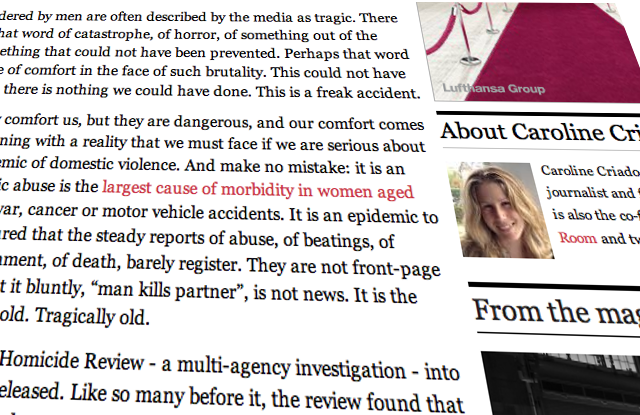
Women murdered by men are often described by the media as tragic. There is a sense in that word of catastrophe, of horror, of something out of the ordinary. Something that could not have been prevented. Perhaps that word gives us a sense of comfort in the face of such brutality. This could not have been predicted, there is nothing we could have done. This is a freak accident.

Such words may comfort us, but they are dangerous, and our comfort comes at a cost of reckoning with a reality that we must face if we are serious about tackling the epidemic of domestic violence. And make no mistake: it is an epidemic… It is an epidemic to which we are so inured that the steady reports of abuse, of beatings, of assaults, of imprisonment, of death, barely register. They are not front-page news. After all, to put it bluntly, “man kills partner”, is not news. It is the opposite of new. It is old. Tragically old.

I think the data tells us a very different picture. If there is an epidemic of violence against women, there is an even greater epidemic of violence against men. And if there is an epidemic of violence where people are killed by other people, there is a much greater epidemic of violence where people kill themselves. That is not to suggest that any violence is tolerable. But it does help to put emotive words like ‘epidemic’ into some kind of context. I am sure our society can do more to reduce the frequency of domestic violence, and the number of women murdered by men. Having said that, how do we now feel about society’s efforts to tackle the epidemic of suicide?

I will continue my unpopular theory on why we care little about suicide. Again, let me present some data first. The Samaritans reviewed and augmented the data on the 5981 suicides that occurred in 2012. Of the victims, 4507 were men. Men commit suicide at least three times more frequently than women. More men commit suicide than women in every age group, and in every part of the UK. Young men are most likely to kill themselves in Northern Ireland, thirtysomething men are most at risk in Wales, whilst middle-aged men represent the largest share of suicides in Scotland and England. Suicide rates have declined only slightly across the UK, except in Northern Ireland, which saw a sharp rise between 2004 and 2006, and has fluctuated since.

Keep the following in mind. If the rates remain steady – 51% of women are killed by male partners or ex-partners, women are the victim of 32% of homicides, and there are 633 homicides per year – then we can expect 103 women will die each year at the hands of male partners and ex-partners. That means British women are over 13 times more likely to kill themselves, than to be killed by a current or former partner. It also means that a typical British man is 44 times more likely to kill himself, than to kill a female partner. What does this say about our perception of ‘epidemics of violence’, and the moral panic surrounding them?

Just as violence against women may be underreported, there is also a problem of the underreporting of suicide. As the Samaritans put it:

It is commonly acknowledged by professionals in the field of suicide research that official statistics underestimate the ‘true’ number and rate of suicide. This is not only the case in the UK and ROI but in most (if not all) countries.

Please read the full Samaritans report for a complete understanding of why suicides are underreported. The report also highlights the problems of comparing suicide statistics between nations. That said, they compare suicide rates for the UK with those for the Republic of Ireland, and the numbers are not that different. The difference between the genders is similarly pronounced; Irish men are almost 5 times more likely to kill themselves than Irish women. However difficult it is to compare stats between countries, male suicides exceed female suicides in almost every country in the world. In the USA, the ratio of male suicides to female suicides is 3.5:1. In Lithuania, 5.1:1. In Sri Lanka, 3.8:1. In Germany, 3.3:1. In Turkmenistan, 3.9:1. In Zimbabwe, 2:1. In Venezuela, 4.4:1. And so on, and on, men are dying at their own hands, all round the world, in disproportionate numbers. If the situation was reversed, feminists and other well-intentioned people would be crying out for a remedy. But where is the current outcry, where is our anger?

And be in no doubt that this is a real epidemic. The World Health Organization says that over 800,000 people die of suicide each year. That is one death every 40 seconds. As a killer, suicide is comparable to the 1.24mn who die each year from road accidents, the 627,000 who die from malaria, and the 521,000 who die from breast cancer. Do we feel as strongly about strategies to prevent suicide as we do about seat belts and air bags in motor vehicles, mosquito nets for African children, or research into cancer treatment? If not, then why not? Is it because the victims of suicide somehow deserve their fate, because they made the choice to die? Is it because most of them are men, and we are far more interested in ‘fixing’ men when they hurt other people, than when they hurt themselves?

The pain of suicide is all around us. We see the victims again and again. Even the famous and successful are brought low by depression. Gary Speed. Kurt Cobain. Alexander McQueen. Tony Scott. Robin Williams. We mourn them, then move on, as if nothing needs to change. When a famous suicide hits the newspapers, the world endures another 2000 suicides that day, without further comment. And for every person who does commit suicide, there will be many more contemplating the act. Why are we blind to this pain around us? Why do we do so little about it? Is it that we do not care, or is the problem that nobody can turn this into a popular ‘campaign’ of the type that monopolizes headlines? It is easy to get people to sign a petition saying a woman’s face should be on a banknote, but much harder to reduce suicide prevention to a glib one-line demand for change. Or is the problem that we only care about violence when there is somebody to blame? Are we indifferent to suffering, if we choose not to imagine ourselves as a possible victim?

Our media presents suicide like each is an individual tragedy. I rather believe our society can do more to prevent suicide, and that there would be less suicide if we changed the priorities of our society. This would benefit both women and men, though statistically men would benefit more, because they currently suffer more. We should be doing plenty more. As the World Health Organization explains:

There is compelling evidence indicating that adequate prevention and treatment of depression and alcohol and substance abuse can reduce suicide rates, as well as follow-up contact with those who have attempted suicide.

And WHO tells us about the obstacles too…

Worldwide, the prevention of suicide has not been adequately addressed due to basically a lack of awareness of suicide as a major problem and the taboo in many societies to discuss openly about it. In fact, only a few countries have included prevention of suicide among their priorities…

It is clear that suicide prevention requires intervention also from outside the health sector and calls for an innovative, comprehensive multi-sectoral approach, including both health and non-health sectors, e.g. education, labour, police, justice, religion, law, politics, the media.

I admit that I started writing this article in an angry mood, not least because a feminist spread a lie about domestic violence being the largest cause of morbidity for women aged 19-44, even though it definitely is not. She did it to persuade people to support a change to UK law, and I was peeved at the thought that ‘awareness’ is not being raised in the ways it most desperately needs to be raised. But having reached this stage, having re-read all the terrible statistics about suicide, I feel a different kind of emotion. I want to learn from that feminist’s example. Some people are doing sterling work to address the epidemic of suicide. More of us must help them. We must campaign for change. People should be more aware of what can and should be done. For example, the charity CALM is taking an innovative approach to countering suicide in the UK, by finding new ways to reach out to vulnerable men. We need charities like CALM more than ever, because as they succinctly put it:

Suicide is now the single biggest cause of death in men aged 20 “” 49 in England and Wales.

And that is the truth.

Supporting charity is a good thing, but we also need to become political. The next British general election is less than 300 days away. We should use this time to press politicians, of every party, to explain their response to the WHO’s call for ‘an innovative, comprehensive multi-sectoral approach’ to suicide prevention. The old political bullshit is not good enough. Effective strategies to counter suicide demand more than simplistic, standard policies that politicians parrot about the economy, healthcare, and welfare state. For the first time, the government has issued an annual report on the performance of cross-government strategies to prevent suicide in England. Voters must demand no less for Scotland, Wales and Northern Ireland. We should familiarize ourselves with the findings, popularize the work already done, share the lessons learned, and talk about the steps we still need to take. And then we must hound politicians to compete with each other, demanding they detail the solutions they would pursue, if put in power.

Suicide is an epidemic of violence, inflicted on ourselves by our ignorance, our apathy, our silence, and our sadness. If I was a feminist writing about domestic violence, you would automatically grasp the connections to the political sphere. I am a man, writing about self-inflicted violence, and saying this is a political issue. We must stop averting our eyes, stop treating every suicide like a stand-alone tragedy, and start being ferociously political about how society prevents suicide. I am frightened, angry, outraged and disturbed by how our society passively tolerates the ongoing waste of human life, taken from us every day by suicide. I hope that by reading this, I have passed those feelings on to you, and you will pass them on to others.

Criado-Perez Bogus Abuse Claim Deleted by New Statesman

Today can we celebrate a partial victory for truth, but the battle is not over. Two weeks ago, I wrote how feminist campaigner Caroline Criado-Perez cited a made-up statistic about domestic abuse in an article for the New Statesman’s website. She stated that British women are suffering an ‘epidemic’ of violence, and that the systemic nature of this violence has been badly underreported by mainstream British media. Her conclusion was that the scale of violence necessitates a change in British law. But only one statistic was presented amidst her extravagant language. That statistic claimed that domestic violence is the leading cause of morbidity for women aged 19-44, and the wording was hyperlinked to a report by the World Health Organization. There are only two problems with her preferred stat.

1) It is totally false.

2) It is not in the World Health Organization report that Criado-Perez cited.

Anyone who went to the trouble to read the 246-page WHO report would discover that interpersonal violence is only the 43rd-highest cause of morbidity for women. According to their data tables, interpersonal violence accounts for 0.5% of the total morbidity suffered by women. In comparison, HIV/AIDS is the genuine leading cause of worldwide morbidity for women, and is responsible for 6.5% of the total morbidity suffered. Actual rates of interpersonal violence would need to be multiplied 13 times in order to become the top cause of morbidity. Criado-Perez not only tried to use a worldwide statistic to make the case for changing British law, it is not even a real statistic.

Criado-Perez just pretended to use the WHO report as source material. Her ‘fact’ is actually a widely-spread urban legend, which can easily be found in all sorts of places on the internet. A tell-tale sign comes from how Criado-Perez worded her fact: “…more than war, cancer or motor vehicle accidents.” I dare you to google those words, to see how often they are repeated in this context. But crucially, none of those websites give an accurate report of any primary research into violence. They are merely misquoting each other, having all been written by people who wanted a juicy sensational attention-grabbing headline, but were too lazy to locate genuine research. A thorough investigation by the BBC statistics program More or Less clarified where this misinformation originally came from:

…there have been multiple bouts of statistical inflation. The 1993 table [in a report by the World Bank] showed rape and domestic violence as the 6th largest cause of morbidity in women aged 15 to 44, globally. Leaving to one side the difficulties in collecting that statistic… rape was dropped from the category without making any adjustments, and the whole lot was booted up the league table from 6th place, to 1st place.

Criado-Perez and the New Statesman ignored me, when I informed them of their error, just a few hours after the article was published online. However, they could not ignore my subsequent complaint to Britain’s national Press Complaints Commission. And so, the bogus stat has now been deleted from the amended version of the article. It is a shame that they waited two weeks to correct an error that would never have been made if they did simple fact-checking, and should have been corrected within hours of publication.

However, the damage that was done has not been undone. Almost everybody who was going to read the article would have read it before the correction was made. Readers now need to specifically search the New Statesman’s website to find the article. The New Statesman made no effort to verify the facts during the days when Criado-Perez’s piece was one of four featured articles on their homepage. I will be persisting with my complaint to the Press Complaints Commission, with a view to securing an equally prominent correction, as befits such a gross inaccuracy and such a gross failure of editorial standards.

Sadly, the editors of the New Statesman have shown they have little interest in factual accuracy. They continue to mislead the public. Instead of apologizing to readers for misleading them, they merely noted:

Update, 7 August 2014: this article was amended to change the statistic referred to in the UN report.

And is the new statistic as misleading as the old one? In a sense, no. It has the advantage of being derived from the cited WHO report, instead of being dredged from some unknown part of the internet. But in another sense, the New Statesman continues to scrabble for misleading data that preserves Criado-Perez’s argument, which was that violence against women is badly understated. This is a difficulty for them, as they can find no statistical data that supports this assertion. That is why they inserted this amended ‘fact’, in place of Criado-Perez’s bogus stat:

The prevalence of domestic abuse means that 40-70 per cent of female murder victims are killed by a husband or boyfriend, according to the UN.

It is true that WHO is a branch of the UN, and that their 2002 report referenced five studies of domestic violence, as conducted in Australia, Canada, Israel, South Africa and the USA. Those five studies give rise to this example range of 40 to 70 percent. But the authors of this WHO report never generalized from those five studies, and did not pretend this is a global statistic, like the editors at the New Statesman have.

Every single murder is regrettable and shocking. However, if we play the game of cherry-picking global stats, it is far from clear why homicide rates in Australia (10% higher than found in the UK), Canada (60% higher), Israel (80% higher), South Africa (3000% higher) and the USA (380% higher) justify claims that British women are suffering an ‘epidemic’ of violence. There is a simpler, better way to improve the New Statesman’s article. They should simply insert reliable and current statistical data about domestic violence suffered by British women. That will be shocking enough. More importantly, it will be relevant, and not misleading. The article starts by describing the murder of a British woman. It ends by demanding a change to British law. Between the two, it comments on the supposed failures of British media. So why not simply present the pertinent data, instead of shopping around for 12 year old stats from five foreign countries?

I think we know the answer. Both Criado-Perez and the New Statesman confuse their ambition as political campaigners with their responsibilities as journalists. However necessary it is to change the law, the change should be motivated by fact, not fiction. And whatever responsibility they have to inform the public about important issues, they cannot forget their responsibility to present accurate information, and to present corrections of misinformation with an appropriate level of prominence. Sadly, some people really want to believe exaggerated statistics about violence. That is unfortunate for everybody, not least the real victims of violence, whose tragedies should not be trivialized by pretending atypical suffering is commonplace. Democratic law-making serves all in society: the victims, the guilty, innocents, and bystanders. Sensational lies about the prevalence of violence will never deliver sound laws that best serve our society. Criado-Perez and the New Statesman should admit their fault, and rebuild their reputations on the solid foundation of fact. That begins with an apology to readers for misleading them, and an accurate presentation of the data.

Krugman on Cars; an economist knows nought of people

I enjoy reading the New York Times blog of economist Paul Krugman. I imagine the thrill is similar to that enjoyed by a bloodthirsty crowd of Romans, watching gladiators fight in the Colosseum. When reading Krugman, I know there will be violence (of the intellectual variety). I know that blood will be spilled (in the sense of shredded reputations and cutting put-downs). And I know there will be a winner and a loser. Better still, I know the eventual result, and I know I will like it. No matter what he argues, Krugman never fails to be a comical loser, though he thinks himself a heroic winner. Thanks to the X Factorization of public debate, Krugman’s fans also think him a winner, even when he makes the ludicrously pompous argument that he and his supporters are less prone to confirmation bias than the rest of the human race.

As public intellectuals go, Krugman is of the verminous variety. He routinely picks fights, showing his teeth in the hopes of intimidating others. But he quickly runs to the shadows, when an opponent refuses to back down. To complete the gladiatorial spectacle, and see both sides of the fight, we merely need to flick to the words written by the opponents that Krugman picks upon. They invariably rain literary blows on their would-be persecutor, making it clear why the Krugman’s fans prefer to consume just his side of the story.

Krugman’s one-sidedness is confirmed every time he mentions Niall Ferguson (most recently, here). Niall Ferguson’s name features a lot on Krugman’s blog. It recurs so often that Krugman must imagine Ferguson is an avid follower, and so takes every opportunity to irritate his nemesis. Surely no regular reader needs to hear Ferguson’s name mentioned so often. But whilst Krugman maligns Ferguson month after month, supposedly in a bid to promulgate the truth about Ferguson’s falsehoods, Krugman ran from the big prize fight that Ferguson finally offered him. When Ferguson catalogued every major mistake Krugman has made (a long catalogue, but worth reading again), did Krugman defend himself? Did he offer any evidence to the contrary? Did he admit to errors, whilst giving some justification for the positions he adopted? No, no and no. Krugman just ran away, saying he would not speak about Ferguson because he considers the Harvard Professor of History to be nothing more than a ‘troll‘. And how does Krugman continue to respond to this troll? Not by rising above him, and ignoring his presence. Krugman’s prolonged response comes in the form of endless snide comments in his blog. Krugman has the air of a man who was publicly slapped in the face, so ran away in shame. Now desperate for revenge, the pettiest Nobel laureate stalks the man who embarrassed him, taking every sly opportunity to spit on the back of his head, before running off again.

So, after seeing another needless mention of Ferguson’s name, I scrolled down to see what arrogant absurdities Krugman had served up recently. I hoped to find Krugman saying something smug and stupid about a topic so widely understood that Krugman could not possibly adopt his usual defensive posture, which involves hiding behind wonkish economic gibberish and deliberately skewed misrepresentations of the data. My search was not in vain, and was rather short. Lacking the self-awareness of a man who might actually listen to his own words, Krugman pontificated about a topic that many of us understand: cars, and what we think of them. At first it seemed the so-called liberal was going to grasp the thorny subject of how the internet allows people to drive each other’s cars, and give each other lifts, and how this comes into conflict with protecting the economic interests of particular groups like taxi drivers. That would be a reasonable subject for an economist to discuss, and one that might be vexing for a ‘liberal’ of Krugman’s ilk, who somehow equates liberality with protecting vested economic interests. But Krugman did not offer this analysis. Instead, he observed that people do not really need or want cars.

Life Without Cars

I’ve been following some of the discussion about Uber, Lyft, and all that, and I have a few unoriginal thoughts. Well, strictly speaking they are original… [yada yada]…

Anyway: the big benefit from new IT-mediated car services will come if they make it possible for lots of people “” and not just people in Manhattan “” to live without owning their own cars. And if you think about it, you can see how that might work.

The more human amongst you will have already noticed the flaw in Krugman’s argument. You probably noticed it when I wrote that ‘people do not really need or want cars’. The flaw is that lots of people like cars, and want cars, even if they do not need cars. That is pretty typical of people: they like and want all sorts of things they do not need. Sometimes they like things so much, they say they need them, even though they do not really need them. Nobody needs television, or laughter, or cake. We just really like them. The fact that people like cars is vital to understanding why car ownership has historically gone up, rather than down. It is also key to understanding why the number of households with multiple cars has risen. Things can become more popular, and more common, even if nobody needs them. Our desire for many television channels, and for many kinds of cake, and for many cars, greatly exceeds our bare necessity.

Right now, if you live in places without exceptionally good public transportation, it’s very difficult to manage without a car. Yet when you think about it, for most people owning a car is quite wasteful.

Having reached the middle of the third paragraph, Krugman still has not grasped the possibility that some people like cars. Ferraris. Cadillacs. Top Gear. Personalized number plates. Giving your car a name. Reading car magazines. You intuitively and instantly understand what I am saying, because you are a person and I am talking about people, instead of waffling about the abstractions of macroeconomics and public policy. Krugman’s blind spot is plain: he is a Nobel prizewinning economist without the slightest affinity for actual human beings.

It’s an expensive item of equipment that sits idle most of the time; it requires parking (and often a parking structure) both at origin and at destination; it requires maintenance and is a big hassle all around.

Krugman thinks cars are a big hassle all around. Most of us have a devil and an angel on our shoulders, ensuring some internal quality control over the things we say and do. In contrast, Krugman is a machine, bereft of an internal dialogue. He is more of a machine than any motor car. Krugman relentlessly follows his ‘logical’ programming, no matter how imbecilic the conclusion. And what does he calculate in this case? Porsche = big hassle. Aston Martin = big hassle. Off-roading = big hassle. Driving a convertible sports car through a forest on a sunny day = big hassle. Driving your pregnant wife to the hospital instead of begging a lift off your neighbours = big hassle. Not wanting to depend on somebody who might be unreliable to get you to the airport on time = big hassle. Not knowing when you will leave work but knowing you will not have to wait for a taxi = big hassle. Given what an enormous hassle cars are, marketeers have done an amazing job, brainwashing people, manipulating them into buying their own car! Per Krugman’s logic, as none of us genuinely want cars, our need for cars must be truly enormous, and growing all the time.

I am forced to wonder what Krugman thinks of Recreational Vehicles – the houses on wheels that some Americans own. These monster vehicles serve as both vacation transport and vacation home, which must rank as the most inefficient investment of capital in history. And yet, some Americans want them, even though none need them. They could just fly somewhere, and then stay in a hotel. Krugman must be deeply unsettled by the irrationality of the 8.5% of American households that own an RV.

So reliable, quick-response chauffeur services could free many people from the need to tie up all those resources in a consumer durable that they only use now and then. And from a social point of view it would avoid the need to tie up so much capital that sits unused most of the time.

According to Krugman, his is the thought process I should follow, whilst contemplating if I want to drive to a relatively out-of-the-way location, in order to go for a long hike in the countryside. His thought process is correct, even if I want to nip to a unique gift shop in the next town over, to make a last-minute purchase. Never mind convenience. Never mind freedom. Like Krugman, I should be thinking about the wasted capital! I should be thinking how much wealthier, and happier, I would be if that capital was reinvested elsewhere.

Also I should imagine how much better off I would be, if I could just rent an unfamiliar vehicle, with or without an unfamiliar driver, which we assume is conveniently available at literally any time I need it, and at a price which I also assume is better value than the cost of simply owning and maintaining a car in the first place! And yet, somehow, I struggle to think like Krugman.

But then, when you really think about it, you discover that lots of things are a waste of capital. Do you have a guest bedroom in your house, which is rarely used? That is a waste of capital! Perhaps that means Krugman would be a fan of the British government’s so-called ‘bedroom tax’ – a change to welfare payments where people receive less money if they waste the capital of an unused bedroom in their government-provided housing. But I doubt Krugman would describe that particular waste of capital in those unsympathetic terms.

Those influenced by Paul Krugman should take a look at the house he lives in. It is very much larger than where I live. It is larger than where most people live. There are roads, but no evidence of a sidewalk, so presumably everybody drives in that part of the world. Why should ordinary people give up the luxury of their cars, and the capital invested in it, when Krugman invests so much more capital in his excessively large home which is designed to be visited by car? If you think cars are bad for the environment, consider the energy and resources that were used to build Krugman’s house, and the heightened energy bill needed to make full use of such a property. Or maybe he does not make full use of the house, so from a social point of view, Krugman is happy to selfishly tie up capital so long as it suits him personally.

Any house larger than the minimum necessary to sustain life must count as a very good example of wasted capital, but we are literally surrounded by other examples. Every minute you do not watch your television, you waste the capital that was spent on that purchase. If you have a television in the bedroom as well as the living room, you have doubled the waste. Every minute you are not hoovering your carpet with your vacuum cleaner, you waste the capital absorbed by that useful household gadget. Are you even using all your carpet? I bet there are some segments you rarely stand upon. Wasted capital, all of it! Imagine how glorious life would be, without all this wasted capital!

And that is before I mention public parks, during the night time. Or the books in libraries, after closing hours. Or churches, when there is no service (or even when there is a service, according to atheists). Wasted capital, wasted capital, wasted capital. Why should anyone pay to build parks, libraries and churches, and then pay again to maintain them? Instead, we should all live in dense high-rise cities (to avoid the need for cars) but spare ourselves the waste of parks by visiting the countryside, on the better-than-ever train service. We should not invest in books because they waste capital (and paper!) and instead we should read from free websites on our Kindles. We should do away with organized religion, and its obsession with temples, icons and art, and we should all behave like Quakers, preying in each other’s houses. We should coerce people to give up all these unnecessarily wasteful pursuits, in order to preserve the greatest god of all: capital. Life would be so much better, if we could find peace, knowledge and enlightenment without so much wasted capital!

Of course, we would still have roads. They would be needed for ambulances, and fire trucks, and delivery vans, and possibly even for buses. But if there were far fewer cars to drive upon them, they might seem like wasted capital too.

There is, however, an obvious problem: rush hour.

On the contrary, there are a whole slew of problems with the way Krugman thinks. He is blissfully unaware of them, and is likely to remain so. The adoring comments he receives on his blog are mostly written by people with a similarly blinkered view, so they will not broaden his outlook. Even if the yawning gaps in his thinking were pointed out, Krugman would still not be able to comprehend that his thinking is flawed. There is no need to vote Republican, in order to see what is wrong with Krugman’s thinking, but the fault line of Krugman’s worldview is that criticism only comes from partisans.

Peak car use comes twice a day, and that would seem to dictate that we have nearly as many cars as we do now even if they’re supplied by the likes of Uber.

But here’s where surge pricing comes in. If traveling during peak hours is more expensive than off-peak, people will have an incentive to shave off those peaks. People who aren’t commuting to work will avoid travel at peak hours; some people will find other ways to travel; some people (and businesses) will rearrange their schedules to take advantage of cheaper off-peak travel. So you can imagine a society that still relies mainly on cars to get around, but manages to do this with significantly fewer cars than we need at present.

How does Krugman’s brain work? Does it work? Anybody who ever drove in rush hour knows there are already plenty of incentives to ‘shave off those peaks’. Just because the incentive is not measured in dollar bills, does not mean there is no incentive. Or does Krugman really believe the average driver is a money-obsessed retard, indifferent to sitting in traffic jams for hours, but willing to dramatically change behaviour in order to save a few cents?

Cars aren’t the only consumer durable where something like this might work, of course.

Agreed. See above for my comment on houses. And yet, people do seem to like having spare rooms for all sorts of reasons, despite the truly enormous amount of capital that they tie up. To put capital into perspective, consider the numbers for the UK, the kind of small densely-packed country that might actually have a chance of ‘life without cars’. The total value of all British vehicles, including cars, but also including planes and ships, is under GBP200bn (USD340bn). The total value of all British housing is over GBP4,000bn (USD6,800bn). So why is Krugman worried about the relatively tiny proportion of capital tied up in cars, when the quickest and easiest way to save capital (and to save the environment) is that we all volunteer to live in homes the size of shoeboxes?

People in New York don’t need refrigerators (and in particular freezers) that are as big as those in the suburbs, because it’s so easy to pop around the corner for groceries…

People have small refrigerators in New York because real estate is expensive, and hence living spaces are small. The cost of space is the factor that drives down the size of refrigerators, not the ease of accessing of alternatives. Krugman understands economics like a man who can draw a perfectly accurate picture of a stationary horse and a cart, but earnestly believes that the cart leads the horse when in motion.

… online ordering and delivery could produce a similar effect outside the city.

Here is a question that should arise in the mind of any decent economist: well why the fuck don’t they, then?

The restriction on space in New York is in opposition to the natural human desire to have a great big house with a great big fridge… even if they have bugger all inside them. In Manhattan, people do not choose late-night delis and pizza delivery in preference to having a big refrigerator. The former services become economically viable because of density of population and because the scarceness of land leads to a high cost for even a rudimentary kitchen. In contrast, people who live outside the city can travel easily, using the car they already want and own, they can afford larger and well-equipped kitchens, meaning they have less reason to rely on ‘convenience’ stores and online delivery services. In these circumstances, the latter business models will only succeed through winning a genuine competition.

But cars are surely the big prize.

And here Krugman shows his hand, and reveals what really motivates his thinking. He does not care if you like cars. He does not like cars. And therefore the goal is to stop you doing things, having things, using things, that he does not like. What you want is irrelevant to his analysis.

Again, I’m sure this has been worked out by someone somewhere. But I’m having fun thinking about it.

I am sure his last sentence is very sincere. Krugman gets a lot of fun imagining how you should live your life according to his principles, whether you like it or not. Being a genuine liberal, I despise Krugman’s twisted claim to be a liberal. I feel no sense of fun imagining a world run according to Krugman’s dictatorial whims. He is a rat in sheep’s clothing, a small man with delusions of demagoguery, a would-be tyrant pretending to be a democrat. Lovers of liberty should abhor him. Fans of his half-cocked thinking should reconsider. Or if not, they should follow Krugman’s logic to its inevitable, irregular conjugation: I buy what I want; you waste capital; Krugman knows best.

Did Caroline Criado-Perez Deliberately Exaggerate Abuse?

Caroline Criado-Perez describes herself as a journalist and feminist campaigner. Is it possible to be both, without conflict? Because of the nature of their objective, campaigners are political animals. Sophisticated people understand why politicians use exaggeration, biased statistics and misinformation to persuade. But the excusable faults of a politician cannot be tolerated in a journalist. The role of a journalist is to present information, not misinformation. Journalists may be free to comment, but the information itself is sacrosanct. In our present era, the difficult dividing line between politics and journalism has been blurred to the point where nobody knows where it lies. And yet, we need dividing lines, to maintain standards in the presentation of information and the quality of public debate. Today I will be writing about Caroline Criado-Perez, suggesting that she crossed the line by grossly exaggerating the frequency of domestic abuse whilst writing for an established political journal, in order to generate sympathy for her campaigning goals.

But before I go further, it is necessary to be clear about how Caroline Criado-Perez attained a certain level of fame, which gives her the opportunity to write for widely-read publications. I must also comment on how I feel about her goals. Violence is wrong. I will not demean myself, or the victims of violence, by entertaining further argument on that point. Criado-Perez wants to live in a less violent society, and I want to live in a less violent society too. However, violence takes many forms, and is not the only evil in our world. Though violence is literally defined to be a physical act, we understand there can be violence done to people’s minds, as well as to their bodies. Deception and manipulation is a kind of violence to the mind. Sometimes one is necessary to forestall the other. The classic philosopher’s conundrum involves a homicidal maniac who mislaid his axe. You know where the weapon is. The murderer asks. Most philosophers see no struggle with the ethics of this situation: you send the killer in the wrong direction. But it is rare that we have such clean-cut consequences when contemplating lies over truth. Even well-intentioned lies cause harm. Democracy works in a free society because we trust people to generally do the right thing when they know the truth. If people have to be lied to, in order to get them to do the right thing, then that is an usurpation of democracy.

Democracy also relies upon the principle that people may speak without intimidation. Criado-Perez is famous for some relatively trivial social media campaigns, and the hostility they provoked. Getting middle-class Brits to sign a 2013 online petition saying there should be a woman (other than the Queen) pictured on the notes issued by the Bank of England is hardly as brave or as worthy an act as that undertaken by the giants of the historic struggle for civil liberties. Criado-Perez is no Rosa Parks, who refused to vacate her seat on a bus in Alabama in 1955, nor a Harvey Milk, who was openly gay whilst standing for election in the 1970’s. And yet, the banknote campaign provoked a storm of misogynistic abuse, directed at Criado-Perez. Such abuse undermines and coarsens our democracy, by intimidating the individual and levying a high price for the free exercise of their rights. All forms of intimidation, whether physical or verbal, are wrong. And that is why I will now criticize Caroline Criado-Perez for presenting deliberately misleading information, even though I know it is likely to upset her fans.

These are some extracts from Criado-Perez’s July 23 article for New Statesman:

“Isolated incidents”: how the laws around domestic violence are failing its victims

…Women murdered by men are often described by the media as tragic. There is a sense in that word of catastrophe, of horror, of something out of the ordinary. Something that could not have been prevented. Perhaps that word gives us a sense of comfort in the face of such brutality. This could not have been predicted, there is nothing we could have done. This is a freak accident.

Such words may comfort us, but they are dangerous, and our comfort comes at a cost of reckoning with a reality that we must face if we are serious about tackling the epidemic of domestic violence. And make no mistake: it is an epidemic. Domestic abuse is the largest cause of morbidity in women aged 19-44, more than war, cancer or motor vehicle accidents. It is an epidemic to which we are so inured that the steady reports of abuse, of beatings, of assaults, of imprisonment, of death, barely register. They are not front-page news. After all, to put it bluntly, “man kills partner”, is not news. It is the opposite of new. It is old. Tragically old.

She then goes on to argue for a change in the law. Criado-Perez builds her argument upon the frequency of violence. She is not arguing that a single, isolated incident of violence is wrong, and must motivate a change in law. Criado-Perez insists there is an epidemic of domestic violence, which implies the legal system does too little to address the problem.

Only one straightforward fact is presented as substantiation:

Domestic abuse is the largest cause of morbidity in women aged 19-44, more than war, cancer or motor vehicle accidents.

The problem with this fact is that it is wrong. It is very wrong. However much we may abhor violence, it is nowhere near the top causal factors of morbidity – sickness – suffered by women of any age group, whether in this country or elsewhere. That is not to say that this stat has not been published and repeated widely. It has taken on the status of an ‘urban legend’, being believed true because it, and variants of it, are reported all over the place. Google the words “more than war cancer or motor vehicle accidents” and you will see what I mean. The BBC once recited a variant of this pseudostatistic during their 10 o’clock news broadcast. Thankfully, that error prompted some statisticians who work for the BBC to debunk the stat once and for all. In 2009, the makers of the popular More or Less radio show thoroughly investigated this claim, and all its variants. They discovered that the misfact has been circulating since the 1990’s, and suffered increasing exaggeration over time. However, the statistical truth was plain: the claims that domestic violence are the leading cause of women’s morbidity are fundamentally untrue, no matter how the claims are interpreted. You can listen to the show here, and some of their key observations are repeated below.

…this claim mutates as it circulates…

…it is pretty common for a rogue statistic to spread and mutate like this, and the likely explanation is that people keep misquoting each other rather than going to a credible original source…

…there have been multiple bouts of statistical inflation. The 1993 table [in a report by the World Bank] showed rape and domestic violence as the 6th largest cause of morbidity in women aged 15 to 44, globally. Leaving to one side the difficulties in collecting that statistic… the whole lot was booted up the league table from 6th place, to 1st place.

If you want to look for top causes of women’s morbidity, then unsafe sex is the top issue worldwide, because it leads to the top killer, which is HIV/AIDS. And when it comes to non-fatal morbidity, mental disorders do women most harm.

At this point, a generous reader may still disagree with me, or at least challenge my right to reach a conclusion. Criado-Perez is not guilty of deliberately misinforming the public, if she genuinely believes a stat which has been reported widely elsewhere. We cannot look inside her mind, to judge if she believed the stat herself. But there is another sense in which Criado-Perez misled readers, which goes beyond her choice of words. Her article was published online, and Criado-Perez inserted a hyperlink from the words “largest cause of morbidity in women aged 19-44”. The link takes readers to a 2002 World Health Organization report on global violence. It is at this point where I believe we can accuse Criado-Perez of demonstrable dishonesty, because the data included in that report contradicts her assertion.

The WHO report is long, considered and comprehensive, full of data tables, and avoids sensational language. In other words, it is the kind of report that few people bother to read. Crucially, whilst Criado-Perez’s sentence is a near word-for-word copy of sentences that can be found in lots of British reports and websites, it is nothing like any of the language used in the WHO report. For all the data it presents, and despite dedicating a chapter to violence between intimate partners, none of its contents support Criado-Perez’s claim that domestic violence is the leading cause of morbidity for women of a certain age range, whether worldwide or for any region. Nobody could suggest the chapter on domestic violence seeks to play down its seriousness, but there is never a claim that such violence outranks other causes of morbidity. And whilst there are many data tables, none of them are granular enough to map to Criado-Perez’s very specific claim about domestic violence and women aged 19-44.

The closest data that can be found in the WHO report indicates that Criado-Perez’s claim is a very severe exaggeration; table A.6 on page 286 shows that interpersonal violence is the 43rd highest cause of disability-adjusted life years – a measure of morbidity – for women worldwide. Domestic violence is necessarily a subset of interpersonal violence, but all interpersonal violence causes just 0.5% of the morbidity suffered by women worldwide. To put this into context, HIV/AIDs causes 6.5% of morbidity for women, unipolar depressive disorders cause 5.5%, malaria causes 3%, self-inflicted injuries cause 1.1% and war causes 0.4%. The table makes no mention of traffic accidents or cancer, begging the question of where Criado-Perez really sourced her statement. And there can be no refuge in the suggestion that the worldwide numbers do not apply to Criado-Perez’s argument, because she is presenting UK data as relevant to a change of law in the UK. The report contains no UK-specific stats about morbidity. The closest table covers morbidity of women in Europe, where interpersonal violence ranks 34th.

In short, Criado-Perez’s claim is not only false, it is contradicted by the WHO report she cited, as far as that report presents relevant data. So why cite a WHO report, if the data is not in there? Why take the risk that somebody would double-check the contents of the report, when she could have cited many other (unreliable) sources, without fear that they would contradict her? I suspect it is because Criado-Perez knew the other sources may be questioned, and because those other sources repeat the same assertion, but without supplying any raw data. As pointed out by the makers of ‘More or Less’, data is more credible if taken from the original source, rather than being reported second-hand. We all know that when stats are reported second-hand, they are also liable to be misreported and exaggerated. Criado-Perez believed the stat was right – and she wants it to be right – but she could not find an original source which supported the stat, because there is no original source which supports it. So she cut a corner, and cited a long and worthy UN report which tells us that domestic violence is serious, and we should be doing something about it. She hoped that nobody would try to join the dots from their data to her pseudo-data, or that if they tried, they would give up and blame themselves for not trying hard enough.

My first instincts were similar to those that many people might have. I wondered if I had read the UN report closely enough. I assumed that if a mistake was made, it was an honest one. So I left a comment on the New Statesman’s website, asking for the author to pinpoint the source of her claim. That was ignored, so bereft of other quick and convenient ways to contact the parties responsible, I tweeted both Criado-Perez and the New Statesman, succinctly stating that the BBC had debunked the stat and it could not be found in the cited report.

Once again, I was ignored. By this time, the story had passed, and was no longer visible on the front page of the New Statesman’s website. Most people who were going to read it, had already read it. The harm had been done. Perhaps, from Ms Criado-Perez’s point of view, that harm is justified by the good she believes she is doing. Perhaps she ignored my tweet because she dismissed me as a misogynistic hater, or maybe she ignored it because she did not want to explain why she cited a WHO report that does not include the single convenient pseudo-fact that she built her whole argument upon. I scratched my head, and wondered what to do.

And then I complained to the UK’s Press Complaints Commission. Criado-Perez describes herself as a journalist. She should be held to the same standards of accuracy expected from all journalists. The New Statesman is not without fault either, because they clearly did not verify the claim that was made against its supposed source. We shall have to wait and see how the Press Complaints Commission responds.

Do my actions make the world a better place? I am not sure, but I hope so. People trust the information presented to them, and clearly some people are far too trusting. We can agree a problem is serious without losing sight of the fact that other problems are even more serious. Violence is an emotive topic, but we make a mistake if we focus resources in a bid to massage our emotions, instead of using them in ways that alleviate most suffering. For example, mental health is woefully neglected by our society, and we will not adequately boost the care given to victims of mental illness if we choose to skew data in order to misrepresent domestic violence as a greater cause of pain. Furthermore, as I wrote in a comment to the New Statesman, I believe that grossly exaggerating violence has a corrosive effect on all of us. It cheapens the tragedy suffered by real victims, whilst encouraging a more hostile, paranoid and divisive society. To make the world a better place, we must start by seeing things as they really are, and that means we must dismiss the politicking hyperbole of self-appointed campaigners.

The Russians Are Lying; we all must demand truth

A baby’s body lies in a Ukrainian field, fallen from the sky. The world mourns her death, and that of the other 297 people killed when Malaysian Airlines flight MH17 was shot down over East Ukraine. They were killed by pro-Russian separatists, or their allies. We know all this, despite the attempts of Russian chauvinists and apologists to suggest otherwise. Those liars deserve to be damned, along with the murderers. Their crime is gruesome, despicable, outrageous. They spread death and destruction, and then blame others for the consequences of their own actions. Let us ask a few questions we know the answers to, instead of allowing Russian nationalists to throw sand in our eyes.

Did the pro-Russian separatists brag about having the kind of anti-aircraft missile system needed to shoot down a plane like this? Yes.

Did the pro-Russian separatists brag about shooting down an aircraft, just after MH17 was shot down? Yes.

In the area Torrez just downed plane An-26…

Also warned – do not fly in “our sky”…

Bird fell on to a waste heap, the residential sector was not touched. Civilians are not injured.

Of course, this boast contained two errors. The plane was a Boeing 777, not a Ukrainian An-26 military transport plane. The result was the murder of 298 civilians. But it is understandable that the incompetent killers would be confused. The rebels used similar surface-to-air missiles to shoot down an An-26 just a few days before.

Are the pro-Russian separatists in the habit of shooting down aircraft? Yes, yes and yes.

The Russian separatists are fighting a war. Their Ukrainian enemy has aircraft, whilst they have none. This puts them at an enormous disadvantage. Hence, they have to turn that asymmetry in their favour, using surface-to-air missiles, just like the Egyptians in the 1973 war against Israel and the Mujahideen in the 1980’s war against the Soviet Union. Shooting down aircraft is a key component of the separatist’s military strategy.

Is Ukraine’s military in the habit of shooting down aircraft? No. There have been no reports of Ukraine’s military shooting down rebel aircraft. That is because the rebels have no aircraft. Why would the Ukrainians take aim at aircraft, when they are fighting insurgent forces that only exist at ground level?

What are the alternative theories, that do not blame the pro-Russian separatists?

Putin said that as the disaster happened in Ukrainian airspace, then the responsibility for MH17 must lie with the Ukrainians. If that were true, then Ukraine’s authorities should also take the blame for every military plane shot down by the separatists. What an extraordinary conclusion that would be: separatists who want to control the land, sea and air of Eastern Ukraine successfully fire lethal weapons at aircraft flying above the territory they occupy, but supposedly have no responsibility for the consequences!

There are also outlandish theories that claim the Ukrainians shot down MH17. This is despite the fact that they are winning the war against the separatists. These theories, invariably from Russians and other sympathizers, are presented without a shred of evidence – physical, circumstantial, or otherwise. They just feel certain that Ukraine killed 298 innocent people as part of a reckless gamble to gain international sympathy. But if that were true, then why are the Ukrainians demanding the crash site be left untouched so it can be investigated properly, whilst the rebels are deliberately preventing international investigators from inspecting the debris?

The Russians cannot be trusted to tell the truth. That much is clear, and anyone who says otherwise must either be a Russian nationalist, a fool, a liar, or all three. As ever, international hotheads and gobshites have rushed to condemn the British press for, errrrr… being honest. Instead of giving so much attention to what foreign idiots say about the British press, I wish they would report that this British citizen, and many others, are increasingly proud of the vital role played by our free press, amidst this world of dishonesty. Anyone outside of Britain should recognize I say this not out of some childish sentiment for my country and its people, but that everybody, everywhere, should be glad of any free press, of any freedom of speech, and of every person with the guts to speak the truth, whoever and wherever they may be.

The same British press was damned by Uruguayans for writing that a footballer deliberately bit someone, instead of believing that the footballer accidentally ran into his opponent teeth-first. The same British press was damned by FIFA ubercrook Sepp Blatter as ‘racist’ because they noticed how the award of the World Cup to a tiny desert country which is killing hundreds of people in order to build the necessary stadiums seems linked to the proven corruption of the chief football administrator from that tiny desert country. Meanwhile, The Times of Israel reports that “UK media leads world trend to criticize Israel“. This is a sign that criticism is deserved when military force leads to the death of civilians, not a sign that criticism should be ignored because British journalists are voicing it. A free press has many enemies. The British press should be judged by its enemies, and be proud of the conclusion that inevitably follows.

At the same time, the Russian press is telling lies, to the point where its employees are sick of having their journalistic principles compromised by Russian political objectives. There is a reason British journalism delivers the stories it does: it is because they are good at doing their job, and encouraged to do it. All over the world there are boneheads, bigots and bullies who get upset at what the British press are writing. That proves our free press is doing a good job, and must keep on doing it.

The Russians are lying, and lies can have terrible consequences. They start with the pretence that ordinary people have the freedom to learn the truth, although the truth is suppressed and the people are manipulated. Before too long, an aggressive war of invasion can start, under the pretext of ‘defending’ the people from ‘fascism’. A terrible mistake is made during that war, killing hundreds of innocent civilians, but now the lies have run so far that there are no consequences for the killers. Instead, other innocents must be demonized to desperately shift blame from the guilty parties. The Russians are liars, but we must tell the truth, or we also become responsible for the consequences of lies. Telling the truth means being clear about how the Russians deceive others, and deceive themselves.

There is a war taking place in this world, which extends beyond the pettiness of belligerents in Eastern Ukraine. It is a war for the soul of humanity, and it is fought every day between ordinary people who speak the truth and work to make this a better world, and powerful people who create and spread lies to further their selfish interests. The passengers and crew of MH17 were casualties of that escalating war. We must honour them, by demanding truth, and tolerating nothing less.

The Seven Hopes of Preston Dirges, Castaway

We left Preston Dirge’s office saga with Preston forced to drive Valerie home. His intoxicated subordinate demands that Preston joins her for a nightcap. Will a few drinks loosen lips?

Int. Valerie’s Studio Apartment – Night

Valerie flicks the light switch as they enter. The light does not go on.

VALERIE: The bulb, the bulb. Hold on a mo.

Valerie scuttles across the room in darkness. She bangs her foot. She switches on a spot lamp then rubs her toes.

VALERIE: There’s vodka and coke in the fridge. Bring them in, will you? I’m going to recount my toes.

Valerie puts on music, then sits on the floor, with her back to her sofa. Preston returns with vodka, coke, and glasses.

VALERIE: Glasses? Good. Very sophisticated. Now pour, goddamn you.

Preston pours. They clink glasses and drink.

VALERIE: (Sings along with the music) I was looking for a job and then I found a job, and heaven knows I’m miserable now.

PRESTON: You’re too young to know The Smiths.

VALERIE: Blame my last boyfriend.

PRESTON: I don’t judge strangers. Only everyone I meet.

VALERIE: It’s nice that Tina’s dad waits up for her, don’t you think? Saying that, I was glad to move out. Living at home is so suffocating. Do you have family, Preston?

PRESTON: Two daughters.

Preston pulls out his wallet and shows Valerie a photo of his daughters. They are young girls, Japanese in appearance.

VALERIE: Wow. You didn’t say anything. They’re so pretty, Preston.

PRESTON: The photo is a few years old. They live with their mother, in Tokyo.

VALERIE: Why are they in Tokyo, when you’re here?

PRESTON: I used to work there. Boy meets girl, girl gets pregnant, boy loses job, has to leave. The end.

VALERIE: Have another drink.

She refills their glasses.

PRESTON: Don’t – I’ve got to drive home.

VALERIE: No you don’t.

PRESTON: Excuse me?

VALERIE: Stay here. I’m not letting you drive all the way home in this weather. The weatherman said it might freeze tonight. Stay. This sofa pulls out into a sofa. I mean a bed. Stay, and drink.

PRESTON: Drinking’s not a solution. Trust me, I’ve tried to solve problems that way.

VALERIE: Drink, I said, goddamn you.

PRESTON: I don’t think you should work for me. I’m not bossy enough to be your boss.

VALERIE: I shouldn’t work for you. Not that I’ve done any work yet.

PRESTON: Get used to it. I’ve not done any real work in six years. Just pushing paper.

VALERIE: If you don’t want me working for you, how do you plan to get rid of me?

PRESTON: I’ll give you a good review, but not too good. People who do a bad job are punished by not being allowed to change job. People who do a really good job are rewarded by being given a job they’re incompetent at. (Pause) Or I could solve the problem by leaving. Then they’d close down Certification Compliance.

VALERIE: Compliance Certification.

PRESTON: Same thing.

VALERIE: If you left, what would I do then?

PRESTON: Marketing, I suppose.

VALERIE: I don’t want to do marketing. I want to be creative.

PRESTON: You’ll survive. Give it ten years and you might find yourself doing something you mildly enjoy.

VALERIE: You’re a great motivator. So what happened to your wife in Tokyo? Why did she leave you?

PRESTON: We weren’t married. And strictly speaking, I left, though it was because I didn’t have permission to stay any longer.

VALERIE: Why didn’t she follow you?

PRESTON: Family. She wanted to be near them.

VALERIE: But you’re her family.

PRESTON: She decided otherwise.

VALERIE: Is she one of those people who suffer from – what’s that thing you were talking about? – from confirmation bias?

PRESTON: No, I really don’t think she does. She made a bad choice sleeping with me, but didn’t compound it by marrying me.

VALERIE: We are a couple of sad sacks. As The Smiths won’t oblige, you’d better give me a reason to go on living.

PRESTON: A reason to go on? I can give you seven good reasons.

He holds up the photo of his daughters.

Ext. Japanese Garden – Day

Preston’s girls run around, laughing, amidst cherry blossom.

PRESTON (V.O.): 1. Laughter.

Int. Valerie’s Studio Apartment – Night

Valerie puts her hand on Preston’s arm.

Ext. Japanese Garden – Late Afternoon

The girls cast long shadows as they twirl their parasols.

PRESTON (V.O.): 2. Sunlight.

Int. Valerie’s Studio Apartment – Night

Rain spatters the window.

Ext. Japanese Garden – Twilight

An abrupt shower creates ripples in the pool. Their mother dresses the girls in pac-a-macs, and hurries them home. Rainwater trickles down the leaves. The girls splash in puddles, annoying their mother.

PRESTON (V.O.): 3. Growth.

Int. Japanese Car – Evening

The girls sit in the back of a car. One watches raindrops on the window, and buildings going by. The other sleeps.

PRESTON (V.O.): 4. Going home.

Int. Japanese Kitchen – Night

The mother prepares a meal and the daughters try to help. They examine the ingredients, smelling and tasting them.

PRESTON (V.O.): 5. A real kitchen, and the time to enjoy it.

Int. Japanese Bathroom – Night

The girls are wrapped in towels; the mother dries them off.

Int. Japanese Bedroom – Night

The mother reads stories to the girls as they lie in bed.

PRESTON (V.O.): 6. Feeling clean, warm and dry.

Int. Valerie’s Studio Apartment – Night

Close up of Preston’s face, talking to camera.

PRESTON: And finally – 7. The possibility of meeting someone who understands.

Preston turns to Valerie. She is asleep on his shoulder.

PRESTON: Well, you keep on hoping.

Halfthoughts Rewind

Halfthoughts is having a rare holiday, involving a tour of Yorkshire, Porto and the Tour De France (an unlikely route in space and time, and yet an actual one!). Whilst I am away, why not rewind and take a look at some of the writing you may have missed over the 6 years(!) that Halfthoughts has occupied a corner of the internet? For example, you might want to look at perennial favourite Working for Area 53, or the Barker-esque comedy skit about malware that is The Hacker Store. Or if you fancy something short and breezy you might try one of these poems: So You Thought You Knew Me, Consoles, and How You Once Told Me What I Needed to Know. And for something longer, there is the comedy audio play of Cosmic Corridors, where Matt and Eric learn from Master Miyoda about portals to parallel universes, or the more serious psychological drama of a short film called Re:Move.

Ann Coulter Wins the World Cup for Blowhards

Ann Coulter is an American who writes and says stuff. Let us leave her description like that. If you know who Ann Coulter is, then you have no need for me to describe her further. And if you do not know who Ann Coulter is, then I applaud your good fortune, and recommend that you remain ignorant of her. Except, I feel compelled to point out just how very many errors and misconceptions she included in her latest ‘polemic’, which was bizarrely aimed at the world’s most popular sport: football. Next week Coulter will explain why people should dislike pizza and the week after she will be directing her ire at sunlight. But this week football is the target of her venomous pen. So let us enjoy a good laugh at her expense, whilst she explains why people should not enjoy football as much as they do…

AMERICA’S FAVORITE NATIONAL PASTIME: HATING SOCCER

I’ve held off on writing about soccer for a decade — or about the length of the average soccer game — so as not to offend anyone.

Ann Coulter makes a living by writing and saying offensive things. Also, most of these things are untrue. Ann Coulter is now writing about football for these reasons: the World Cup is currently taking place; the World Cup is the kind of global event that even the most insular Americans notice; and Ann Coulter craves attention.

But enough is enough. Any growing interest in soccer can only be a sign of the nation’s moral decay.

Or it could be a sign that Americans like to watch sport on television. Or it could be a sign that desperate hag pseudo-journalists will write anything about anything, if they think people will read it.

(1) Individual achievement is not a big factor in soccer.

In the sense that football is a team sport, this is true. In the sense that millions of people recognize the names of Lionel Messi, Cristiano Ronaldo, Neymar, Didier Drogba and Arjen Robben, then Coulter is full of shit. In fact, these football stars are much more famous, and much richer, than Ann Coulter is. They are also more famous than everybody who currently plays basketball, baseball and American football. I would name some US sports stars to illustrate my point, but I cannot, because I do not know any. Except for Clint Dempsey and Tim Howard, who are representing their country in the current World Cup.

In a real sport, players fumble passes, throw bricks and drop fly balls — all in front of a crowd.

I am not sure what point Coulter is making here. In the real sport of football, they have crowds. Brazil’s Maracanã stadium can accommodate 80,000 people – which suggests they expect some people to turn up in person to watch the World Cup final. Some people will also watch via TV – maybe 1 billion people will see the World Cup final, and about 200 million on average will see each game, if the last World Cup is anything to go by. During the game, some of the players will kick the ball, whilst others will kick each other. I struggle to understand how, when a footballer kicks something, this is not an example of an individual doing something in front of a crowd.

When baseball players strike out, they’re standing alone at the plate. But there’s also individual glory in home runs, touchdowns and slam-dunks.

I can only hope that US goalkeeper Tim Howard saves a penalty at the World Cup, just to see how Coulter explains the lack of individual glory that must inevitably follow. For other counterarguments, see: Messi, Ronaldo, Neymar et al.

In soccer, the blame is dispersed and almost no one scores anyway.

A typical NFL American football team has a roster of 90 players. Some of those guys go on the field for about 30 seconds per game, because their job will be on ‘special teams’. In other words, they have to do something extraordinarily specialized like trying to stop the opposing team from running the ball back on the rare occasions that someone actually kicks the American ‘football’ (which is designed to be carried in the hands, not kicked by the foot). What chance do most American footballers have of scoring? The only players who regularly score in American football are the running backs, wide receivers and kickers, with the occasional score for a quarterback, tight end or maybe a defensive player following a turnover. Contrast the chance that a typical American footballer will score, with the chance that one of Team USA’s players will score in the World Cup. During their 3 group games, USA scored 4 goals by 3 different players out of a total of 18 different players who have been on the pitch. That means 1 in 6 of the players have scored, far better odds than you will find in the NFL.

There are no heroes, no losers, no accountability, and no child’s fragile self-esteem is bruised. There’s a reason perpetually alarmed women are called “soccer moms,” not “football moms.”

At this point, it becomes clear that Coulter’s argument consists solely in repeating herself. Over and over. And over again. No matter how wrong the argument is. Does she get paid by the word?

Do they even have MVPs in soccer?

Do journalists do research? My question is hypothetical; nobody seriously believes that Coulter is a journalist. Football not only esteems its best players, it gives them a title which is far superior to the dreary American neologism of ‘Most Valuable Player’. In football, the honorific is ‘man of the match’. It is ironic that a woman like Coulter, who despises her own gender whilst sycophantically kissing up to men at every opportunity, is unaware that football lauds its best man, whilst Americans usually talk about the most valuable player.

Everyone just runs up and down the field and, every once in a while, a ball accidentally goes in. That’s when we’re supposed to go wild. I’m already asleep.

People only remain awake whilst reading Coulter’s articles so they can count the number of errors. And the number of repetitions. But to be truthful, I lost count already. In that sense, she scores very high. That is the only sense in which she delivers a winning argument.

(2) Liberal moms like soccer because it’s a sport in which athletic talent finds so little expression that girls can play with boys. No serious sport is co-ed, even at the kindergarten level.

Coulter likes to suck up to rich Americans, which makes it odd that she is unaware of horse riding, the gender-neutral sport of the rich. Coulter backed multimillionaire Mitt Romney for President, whose wife’s investment in an Olympic dressage horse was probably meant to be serious, even if many voters considered it evidence that the Romneys are out-of-touch elitists who have nothing in common with ordinary Americans.

(3) No other “sport” ends in as many scoreless ties as soccer. This was an actual marquee sign by the freeway in Long Beach, California, about a World Cup game last week: “2nd period, 11 minutes left, score: 0:0.” Two hours later, another World Cup game was on the same screen: “1st period, 8 minutes left, score: 0:0.”

This argument would be more impressive if Coulter was not quoting the scores of games that were still in progress. Even the craziest game of American football starts 0-0. And baseball games take three hours on average, meaning many of them are still scoreless by the point when a 90-minute football game has ended.

Even in football, by which I mean football…

By which she means American football. You know, a sport that Americans call football even though they use their hands instead of their feet.

there are very few scoreless ties — and it’s a lot harder to score when a half-dozen 300-pound bruisers are trying to crush you.

In American football, you can score 6 points by throwing a ball half the length of the pitch, if it is caught by somebody standing in the big wide area at the end. Or you can score 3 points by kicking the ball half the length of the pitch, if it goes over the posts. By Coulter’s reckoning, real football is too easy because you have to use your feet (not your hands) to put a ball into a small net, even though lots of unskilled, uncompetitive girls/boys/hermaphrodites will try to stop you. And even though it is really really really hard to score if you have half of the pitch between you and the goal. Somebody should pick Coulter for a woman’s football match, so we can all laugh at how easy she finds the game. Her massive ego would surely demand that she racks up a dozen goals during the first ‘period’.

(4) The prospect of either personal humiliation or major injury is required to count as a sport. Most sports are sublimated warfare.

Mitt Romney. Olympic dressage. Coulter’s pick for President. Decide for yourself if Coulter is an idiot or a hypocrite.

As Lady Thatcher reportedly said after Germany had beaten England in some major soccer game: Don’t worry. After all, twice in this century we beat them at their national game.

Nice quote! However, Margaret Thatcher never said that. A real journalist would know by, ummm, checking Wikiquote. The saying was reportedly coined by a journalist, Vincent Mulchrone of the Daily Mail, just before the 1966 World Cup final.

Baseball and basketball present a constant threat of personal disgrace. In hockey, there are three or four fights a game — and it’s not a stroll on beach to be on ice with a puck flying around at 100 miles per hour. After a football game, ambulances carry off the wounded. After a soccer game, every player gets a ribbon and a juice box.

98491271_Butcher_232125cRepetition, repetition, repetition. They say a picture is worth a thousand words, though in Coulter’s case the exchange rate is closer to 3 million words for every single point she makes. The best counterargument to Coulter’s repetition comes in the form of a picture of former England defender Terry Butcher. Other counterarguments include: Bert Trautmann playing with a broken neck; Patrick Battiston’s clattering by Harald Schumacher; and everybody bitten by Luis Suarez.

(5) You can’t use your hands in soccer.

Which is why they call it football. Now Coulter should explain why she insists on lauding ‘football’ (meaning American football) because of how even the most valuable players use their hands.

Coulter should review the history of American football, and where it got its name from, rather than revelling in her ignorance. American football, a sport where players rarely kick the ball, is derived from rugby football, a sport where players can use their hands to play the ball backwards, but must use their feet if they want to move it forwards. Rugby football evolved from the same sporting activities that also gave rise to association football. These sports were known as football because players used their feet more than their hands. The alternative name of ‘soccer’ is derived from the word ‘Association’. If Coulter was as rational as she believes herself to be, than she should stop referring to American football as ‘football’, and should be calling it ‘mericer’ instead. The defining quality of football is that the players use their feet. The defining quality of American football is that the players are American.

What sets man apart from the lesser beasts, besides a soul…

Nothing sets Coulter apart from the beasts. If Coulter was stabled with Romney’s dressage horse, there is a serious risk that Romney would put a bit between Coulter’s teeth and start riding her around.

…is that we have opposable thumbs. Our hands can hold things. Here’s a great idea: Let’s create a game where you’re not allowed to use them!

See also: running. And the opposable quality of thumbs is not a significant factor in boxing.

(6) I resent the force-fed aspect of soccer.

She ignored it for a decade, knows nothing about it, but says it has been ‘force fed’ to her? No wonder she is so upset about the decline of American morality. Perhaps she should take out her gun and kill the people who make her watch football, in order to restore some moral balance. In Coulter’s world, the number of handguns in circulation is correlated to the health and vitality of society, but kicking a ball for pleasure is immoral.

The same people trying to push soccer on Americans are the ones demanding that we love HBO’s “Girls,” light-rail, Beyonce and Hillary Clinton. The number of New York Times articles claiming soccer is “catching on” is exceeded only by the ones pretending women’s basketball is fascinating.

At this point, it became literally impossible to imagine a football game as boring, or as endless, as Coulter’s article. Even in a nil-nil draw, players do not randomly shamble around the pitch, in the way that Coulter aimlessly rambles through each paragraph.

I note that we don’t have to be endlessly told how exciting football is.

By which she means ‘American football’. Somebody should tell the rest of the world that American football is exciting. Then we could change the name from American football to something more appropriate… like chuck-the-ball-forward-o.

(7) It’s foreign. In fact, that’s the precise reason the Times is constantly hectoring Americans to love soccer. One group of sports fans with whom soccer is not “catching on” at all, is African-Americans. They remain distinctly unimpressed by the fact that the French like it.

This point is very funny. Everything in America is foreign, with the exception of the descendants of the few native Indians who were not massacred by rapacious immigrants. As an example of foreign things in the USA, let us take African-Americans. They are so foreign, there is a clue in the name. Because these Americans were imported from Africa (against their will) they lost touch with the culture of real Africans, and adopted the culture of their slavemasters instead. Meanwhile, real Africans love real football. Just like the French. And the Iranians. And the Koreans. And all those people who come from American countries (with one exception).

In short, the world is like football, in that it comes in two halves. One half is the USA, which ‘hates’ football. Apart from the liberal Americans who do not hate it. So really we are talking about a half of a half that hates football. The other half of the world is everybody that Coulter considers ‘foreign’. Some quick mental arithmetic suggests Coulter might be in a minority.

(8) Soccer is like the metric system…

Clearly Coulter has never heard of the six-yard box.

…which liberals also adore because it’s European. Naturally, the metric system emerged from the French Revolution, during the brief intervals when they weren’t committing mass murder by guillotine.

Coulter is so ignorant she cannot even get her liberal insults correct. The new political correctness is to insist that the Chinese invented football, whilst the English only codified the rules, and the French pioneered its corrupt administration, which is now being sold to the Arabs.

Despite being subjected to Chinese-style brainwashing in the public schools to use centimeters and Celsius, ask any American for the temperature, and he’ll say something like “70 degrees.” Ask how far Boston is from New York City, he’ll say it’s about 200 miles.

Coulter is so boring and lacking in direction that she starts ranting about the metric system halfway through a rant about football. That is a bit like needing Beyonce to perform a halftime show because your showcase sporting final takes so frigging long. Without the halftime show, many viewers of many Superbowls would have slipped into a coma. Gratefully.

Liberals get angry and tell us that the metric system is more “rational” than the measurements everyone understands. This is ridiculous. An inch is the width of a man’s thumb, a foot the length of his foot, a yard the length of his belt. That’s easy to visualize. How do you visualize 147.2 centimeters?

What does any of this have to do with football? Is Coulter now so irrational that she can only visualize 100 metres (a distance run by Olympians) by imagining 100 belts lain on the floor end-to-end, and then observing that each belt is not much shorter than a metre?

(9) Soccer is not “catching on.” Headlines this week proclaimed “Record U.S. ratings for World Cup,” and we had to hear — again — about the “growing popularity of soccer in the United States.”

The USA-Portugal game was the blockbuster match, garnering 18.2 million viewers on ESPN. This beat the second-most watched soccer game ever: The 1999 Women’s World Cup final (USA vs. China) on ABC. (In soccer, the women’s games are as thrilling as the men’s.)

Up next from Coulter: why it is boring to watch the Williams sisters play tennis, and why Billie Jean King should never have been allowed to beat a man in the ‘battle of the sexes‘.

Run-of-the-mill, regular-season Sunday Night Football games average more than 20 million viewers; NFL playoff games get 30 to 40 million viewers; and this year’s Super Bowl had 111.5 million viewers.

In other words, the biggest American football game reaches a smaller global audience than every single game of the World Cup.

Remember when the media tried to foist British soccer star David Beckham and his permanently camera-ready wife on us a few years ago?

No, but Coulter clearly does.

Their arrival in America was heralded with 24-7 news coverage. That lasted about two days. Ratings tanked. No one cared.

They cared so little that it gets cited as an example that everybody is expected to remember.

A quick review shows the following:

David Beckham’s net worth = $300 million
Victoria Beckham’s net worth = $49 million
Ann Coulter’s net worth = $8.5 million

Perhaps Coulter should pay more attention to the Beckhams. These figures suggest that Posh ‘n’ Becks have a superior grasp of both celebrity and how the capitalist system works. The Beckhams have amassed a wealth 41 times greater than Coulter by giving very large audiences things that they enjoy, not by insulting their taste.

If more “Americans” are watching soccer today, it’s only because of the demographic switch effected by Teddy Kennedy’s 1965 immigration law. I promise you: No American whose great-grandfather was born here is watching soccer.

And where were their great-grandfathers born? In a country which loves football, most probably. That is the real demographic switch, not that the ahistorical and insular Coulter would care to mention it.

One can only hope that, in addition to learning English, these new Americans will drop their soccer fetish with time.

Although oddly, old Americans still speak English, another foreign fetish they imported.

A quick review of the real world (where football is so popular that every corrupt son of a bitch wants a piece of the action) suggests that Coulter lives in a fantasy world of her own creation. Keep that in mind, when Coulter recommends who should be the next US President.

COPYRIGHT 2014 ANN COULTER

And here is the proof that Coulter lives in a fantasy world. She has no need to worry: nobody is going to copy this without giving her all the credit she is due. However, I was careful not to infringe the copyright of any images of Coulter. I found that the image of a dressage horse is a close enough facsimile. They both have a long face and nice hair, are mindless playthings that serve the rich, do no real work, have no useful purpose, and exist purely for show.

After all, if you want an American conservative to criticize football, everybody knows you should turn to P.J. O’Rourke. O’Rourke can be relied upon to make the same observations as Coulter, except that when he does it, the resulting article is witty, self-aware, skips all the needless name-calling and nationalism, and was delivered four years ago.


Preston Dirges Between Tides

In the last episode, Preston was forced to drive his colleagues home from the pub. But not all of them will reach the end of the road…

Ext. Gordon’s Apartment Block – Night

Preston’s car pulls up. Tina helps Gordon from the car to his apartment. Preston and Valerie stay in the car.

VALERIE: Preston, why don’t you drink?

PRESTON: So I can drive drunk people home at the end of an evening.

VALERIE: No, really, why?

PRESTON: I do drink. I used to drink plenty. Now I avoid drinking when I’m not round people I like…

VALERIE: So you don’t like me?

Preston: …and when I’m driving.

VALERIE: I still want a drink. Do you want a drink?

Tina returns and gets back in the car. It starts to rain.

VALERIE: Tina, do you want to come over to mine and have a drink?

TINA: I’d better go home. Dad will be waiting up for me.

VALERIE: Do you still live with your family?

TINA: With my dad, and with my younger brothers. Three of them. But the eldest is moving out soon.

VALERIE: Come back to mine and we’ll all have a nightcap.

TINA: Thanks Valerie, but I’d better go home.

Ext. Tina’s family house – Night

Preston’s car pulls up. Tina gets out and hurries inside, as the rain is pouring. We follow her inside.

Int. Tina’s family house – Night

TINA’s DAD (O.S.): Tina, is that you?

TINA: Yes dad, who else?

Tina takes her coat off, then goes in to the living room. Tina’s dad and two of her brothers watch television. She sits between her dad and a brother on the sofa. Her dad puts his arm around her, and kisses her on the forehead.

TINA’S DAD: You’re cold.

TINA: It’s cold outside. What are you watching?

TINA’S DAD: Nothing really. I was waiting for you to get back. Did you enjoy yourself?

TINA: It was alright. Plenty of new material for the webcomic.

TINA’S DAD: That’s my girl. Right, I’m going to bed. Don’t stay up late. None of you.

The brother sat to Tina’s side reaches for a comic and starts reading it.

TINA: I’ll be right up…

Tina puts her arm around her brother’s shoulder and reads over his shoulder.

TINA: …after I’ve had my bedtime story.

Ext. Valerie’s apartment block – Night

Preston’s car pulls up. The rain continues to pour.

VALERIE: Come on up. Let’s have a nightcap.

PRESTON: You’re going to invite a strange man into your flat?

VALERIE: You are strange, but harmless. You’re too hung up on your rules to try it on with me.

PRESTON: You’ve got my number, haven’t you?

VALERIE: And you know where I live. Come on. Come in.