
Home Blog Page 9

Scottish Independence: A Worthwhile Experiment

I live in a country of 60 million people, and like most of them, I do not really care if a small sub-group wants to be independent. Whenever the English are polled about Scottish Independence, most of them would prefer to maintain the United Kingdom as it is. But such polls are meaningless. Questions only test an audience when they feel something of importance is at stake. Asking the English whether they want to maintain a 300 year old union with Scotland is a bit like asking them if they would like another jar of peanut butter in their larder. Even if they are not fans of peanut butter, and rarely consume the stuff, most will say yes on the basis that an extra jar might prove to be useful, and is unlikely to do them any harm. Ask the same people if they immediately want to go out and spend £1.79 on a jar of Sun-Pat peanut butter from their local Morrisons, and you will get a more useful answer, which will probably be no. Hence why free markets provide more useful data about people’s needs and desires than aimless, costless questions asking what people fancy. It is only when the respondent is conscious of costs, as well as benefits, that questions ask something meaningful. If nothing had to be sacrificed, we would all choose to have jam today, and jam tomorrow. But if asked to choose between preserving the union and winning the 2014 World Cup, the average Englishman would cheerily wave goodbye to the Scots, as the price for seeing Roy Hodgson’s team ending 48 years of hurt. English women tilt the other way, preferring the union to footballing glory, though it is unclear if this indicates love for their Scottish cousins, or dislike for an all-consuming and predominantly male sporting event.

The Scots, in contrast, are faced by much sharper questions when asked about independence. For them, the associated costs are much more evident. They would lose the pound. The rest of the UK would not help to bail out their banks. They would have to leave the European Union, then renegotiate entry, which might be vetoed by the Spanish.

All of these costs are repeatedly underlined by the overuse of a single word: ‘forever’. Alistair Darling, head of the campaign to keep Scotland in the UK, put it thus:

One of the things to remember is that this is unlike a general election, where you vote in a government and if you don’t like it, you can vote them out and get another lot in.

The decision we make in September will be forever.

There is no going back. Young people will not just be voting for a ‘Scotland’ for the rest of their lives, but for their children, and for generations to come.

The message is clear: if you walk down this road, you had better be sure, because there is no turning back. Which is total tosh, of course. Scottish independence may be a total disaster, but it is not irreversible. Countries merge and split all the time, for all sorts of reasons. Scotland used to be independent of England, as far as any two countries can be independent whilst sharing a border, trading with each other, speaking each other’s languages, and periodically invading each other. What was once independent can be independent again, and then can be unified again.

The assimilability of nations has been demonstrated across human history and geography. Germany used to be 39 separate states, which joined together under the rule of Prussia, was split between East and West after World War 2, then joined together again. America’s United States have progressively increased in number, from 13 states to 50, though the Confederacy went their own way for a while, and some Texans would still like to. Stalin’s Soviet Union attached a lot of nearby countries to Russia, without asking their consent, whilst Khrushchev’s Soviet Union transferred the Crimea from the Russian Soviet to the Ukrainian Soviet. Whilst the Soviet Union has since dissolved, Putin’s Russia has shown itself adept at taking some of its old territories back. Even the poorest student of the Middle East will recognize how often nations have come together, then been split asunder, in that part of the world. And much more peacefully, we find most of Western Europe has signed commitments to ‘ever-closer union’, even if millions of ordinary Europeans are opposed to the idea. The idea of independence as an immutable permanent state is laughable. South Sudan is the newest country after gaining its independence, the Falkland Islanders desperately want to avoid absorption into Argentina, half of Ukraine wants to join the European Union whilst a minority would rather embrace Mother Russia, and the UK Independence Party won 10% of the vote in Scotland. Whatever independence might bring, it will not be maintained forever.

In this debate, as with all others, the governing elite speak one language, whilst the rest of us speak another. They speak the language of the mass media, a one-way language where they are the speakers, and we are expected to listen. Most of us speak a much humbler, but more purposeful language: that of practical concerns, daily routines and personal ambitions. It is inevitable that the elite’s language will be peppered with words like ‘forever’, when the truth is that they are more like us than they care to admit, and none of them know what will happen next week. Whilst the elite like to make grand predictions about the consequences of various decisions, and employ a technocratic army of modern-day soothsayers to lend credibility to their guesswork, they have no idea if Scottish Independence will prove to be a good thing, or a bad thing. Economists, think tanks, academics, journalists, civil servants and other worthy people all share something in common: they are almost as clueless as we are. They are no better at predicting and controlling events than witchdoctors, fortune tellers and alchemists. That is why they rely so heavily on the magic of words, using them as spells to frighten or enchant us.

The discrepancy between the elite’s self-belief, and its real degree of insight, is never more apparent than when JK Rowling bungs a million pounds into a campaign pot. She writes popular children’s books about wizards. To her mind, this qualifies her to evaluate the risks associated with Scotland’s ageing population, saying it could be a “historically bad mistake” to leave the UK. And those who disagree with her may be ‘death eaters’, a kind of racist wizard who wants to oppress all humanity. Phew. Thank heavens that we have Rowling to explain how the world works in language that can be understood by stupid muggles like us. But remember that Rowling also bunged a million pounds to help Gordon Brown keep his job as Primeminister, even after he (wrongly) predicted the end of boom and bust. That million pounds was, thankfully, wasted. Which tells us all we need to know about Rowling’s foresight.

But to be clear, I am not taking sides. The elite is on both sides of this argument, as they always are. Whatever happens, they intend to remain in charge. The ‘yes’ camp is as ignorant and fatuous as the ‘no’ camp. And even those elitists who sit on the fence tend to talk a lot of nonsense, inflated by their own sense of self-importance. Take journalist Deborah Orr as an example, though perhaps she is a bad example; any Scot who chooses to live in London with Will Self, in preference to living in Scotland with almost any other man (or woman, or dog) must already be unhinged. Writing in opposition to JK Rowling, she argued that independence would change Scotland (the much smaller country) less than it would change England (the much larger country). On the face of it, this argument is absurd. When we examine the argument more closely, we find that first impressions are correct. Take this pearl of self-indulgent wisdom:

It’s no surprise that Rowling is a unionist. She is a high-profile Labour supporter, and Labour loves the union. Of course it does. Labour supporters are fond of pointing out that there are more pandas in Scotland than there are Conservative MPs. Without Scottish seats in Westminster, Labour would find it much more difficult to win general elections in the south. That’s the main reason why many people in England dread an independent Scotland, too.

This kind of argument is often repeated – that leftist Scots might make common cause with the oppressed parts of England, against the really evil bits of England that crush both underfoot. But what’s the really evil bit of England? That would be the City of London. Which is in London. The same London that votes staunchly Labour even whilst the rest of the country swings towards UKIP. When it comes to voting, London and Scotland have more in common with each other than with any of part of the UK, except that nobody campaigns for an independent London (yet).

Is there any evidence that the other bits of England, the ones which Orr thinks are more similar to Scotland, are populated by people who like Scotland? No. In fact, the same poll which showed that Englishmen would rather win the World Cup than preserve the union also shows that support for the union weakens as you travel North. So its seems Labour’s loyal voters in Northern English towns are rather less keen on the Scots than Tory voters in the Southern Shires.

Scotland has long provided a bulwark against English Conservatism, which is why it may look as if the Tories are acting out of principle in supporting the union, rather than their usual self-interest. They are not. Westminster-based, two-party politics suits the Conservatives, because even when they are not in power, their opponent, Labour, only gets in when it has convinced the City of London that it has nothing to fear from them.

Orr succeeds in showing that a kid’s author is better able to construct a robust argument than a professional journalist married to Will Self. Which is not that surprising, when you think about it. Kids notice inconsistencies in stories, whilst Guardian readers cannot spot the inconsistency between their own experience and the facts as presented by their favourite newspaper. And even heroin cannot explain why anyone listens to Will Self. Either people do, or do not, choose how to vote. If they choose how to vote, then the City of London has no power that ordinary voters lack. And if ordinary voters are somehow controlled by the City of London, then we are left with the extraordinary conclusion that the City of London is controlling every Labour supporter who will vote against Scottish Independence, when they vote against Scottish independence, but not when they vote Labour. I would say Orr’s argument is irrational, but it is not coherent enough to deserve that much praise.

Rowling argues that in an independent Scotland, the collapse of the Royal Bank of Scotland would have bankrupted the country, because it was bailed out by central government. But she forgets that Scotland never voted for Thatcher’s Big Bang deregulation of the City, let alone the vandalistic deindustralisation of Scotland that came hand-in-hand with it. Also, while Rowling may have been an admirer of New Labour, many Scots would rather have voted for a Labour party that didn’t squander its landslide by continuing to leave financial services as a law unto themselves. Yes, New Labour was dominated by Scots. But it was the English the Labour big beasts had to woo, not their Scottish constituents.

So, to be clear, Orr’s argument is that: Scottish bankers, who employed thousands of Scottish workers, and were praised by Scottish politicians, both those in Holyrood and those in Westminster, would not have been allowed to do what they did, if it was not for a tiny minority of English bankers who live in London. Possibly next door to Orr. Is there any evidence to back this assertion? Of course not. Orr pins the tail on a paper donkey because she knows it cannot kick her in the face. There will never be evidence for the ‘what if’ scenario she implicitly relies upon.

What if Scotland had been independent before the collapse of the Royal Bank of Scotland? Well, maybe Gordon Brown would have have been Primeminister of Scotland, and maybe he would have followed totally different economic policies. Or maybe not. Orr is disingenuous to look for convenient English scapegoats when she has no idea what policies an independent Scotland might, or might not, have followed. The Republic of Ireland has been independent of England for a long while. Iceland and Spain have always been independent. Yet the banks and the governments of Ireland, Iceland and Spain all followed ruinous policies, leading to similarly over-leveraged banks that needed taxpayer bail-outs. What makes Orr so sure that Scotland would have been so abstemious that they would have chosen to forgo the high rates of growth attained by other countries prior to the banking collapse? Are all Scots equipped with a crystal ball, of equal power to her own?

I’m no Scottish nationalist. But I am enthusiastic about responsive and democratic government, transparent and accountable, for all people, everywhere. I’d have preferred for that to be achieved, for Scotland, within the union. But it just isn’t happening. The fact that “devo max” was not offered as an option in this referendum (blocked by Cameron) is proof that Westminster simply doesn’t want to improve UK democracy.

Here lies the flaw in Orr’s arguments. She likes democracy. She needs someone to blame, a pseudo-authoritarian force that withholds power from the people. But Orr’s problem is that ordinary people do not care for democracy as much as she does. Most do not vote in the European elections, nor council elections. They had the chance to vote for police commissioners, and they barely bothered. Many cities have been asked if they want directly-elected mayors, and mostly they vote against the idea. In short, Orr is determined to give power to the people, whether they like it or not. This is where her elitism becomes most visible, and most paradoxical. The North of England is castigated by Orr as ‘sleepy’ because its inhabitants do not demand more devolution of power. Hence, she concludes that the only way to wake them out of their ‘slumbers’ is to give independence to Scotland. Thank Heavens for Orr and the Scots, who in wanting to govern themselves will, as a by-product, save many people who are too stupid to want to govern themselves!

After all that egotistical confusion, it is interesting that Orr chances upon a valid conclusion:

Scotland wants to be responsible for its own financial affairs. Finger-wagging paternalists who say we couldn’t manage fail to see, first, that their attitude is annoying, and, second, that it is not about being rich or poor, successful or unsuccessful. It is about standing or falling because of choices you have made yourself, not because of choices that have been imposed on you. It is a psychologically healthy and mature position… It’s about believing you can arrange matters in a way that will be inspirational to others “” shine a light in a world that is a bit of a mess. Do I believe that, given the tools, Scotland is capable of making such a contribution? Do I believe it should have the courage to try? I do. Yes.

Orr is right. Scotland should try. But not because it will definitely succeed. Or rather, the people should try, even though they may not benefit. They should try, but not because some London journalist tells them to. She, and the rest of the elite, risk nothing either way. Scottish journalists will still enjoy their London lifestyle, Scottish authors will still sell books in America, and Scottish politicians will still beg Arabs for donations to their charitable foundations. Only the ordinary Scot will be taking a risk, but they should take it. Orr is right, and Rowling is right, because Scotland may fail, but there will always be resentment of England unless Scotland tries to succeed on its own terms. If Scotland fails, it will suffer the greatest indignity of all: being forced to admit that its failings were its own, without the cover of blaming anyone else. But at least, with that, will come truth and self-awareness. The Scottish Nationalists are right, in a way. The campaign against independence is based on fear. Anyone who votes against independence will do so out of fear. Maybe they are right to fear. JK Rowling shows a propagandist’s insight when talking about the ‘risk’ of independence. Being independent, being different, is an inherently risky business. But as with all decisions, benefits can only be imagined, unless people are prepared to take real risks.

Perhaps an independent Scotland would have taken more risks with its banking sector, and be sunk far lower as a consequence. Or maybe it would have taken a different kind of risk: austerely sticking with low rates of growth whilst watching its neighbours profit from the banking boom of the early noughties. All we know now is that Scotland can blame the English for making every bad decision, whilst praising itself for every good decision, but that such blame and praise exist only as words, because Scotland never made the substantial choice to manage its own destiny.

We know that a large minority of Scots want to be independent. They will never be satisfied by devolution of power from a Westminster government. For the health and sanity of the whole community, their risk-averse neighbours should take a chance, and see what happens if Scotland becomes independent. That is the only way to end the divisive, futile speculation about whether an independent Scotland would be better off. Where the Scots succeed, the English will begrudgingly applaud, and learn to follow the Scotish example. Where the Scots fail, the costs will be borne by Scotland alone. Every lottery ticket has a price, though not every ticket can win.

However, even if Scotland fails, they can then merge with the rest of the UK again, just like they opted to be bailed out following the Darien venture, a risky and doomed attempt to found a Scottish colony in Panama. That misadventure led to the 1707 Acts of Union. When negotiating to join a larger state, a heavy price may be paid, as was clear to Britain when joining the EEC, as continues to plague its relationship with the EU, and as frightens Scots when faced with the possibility of rejoining the EU as an independent state. Not all costs may be evident at first glance. Some only become apparent later. This can be attested to by the Greeks, Irish and Portuguese, some of whom harbour resentment for the Germans who kept the Euro afloat. But whilst there are costs to joining a greater union, they are not infinite. If Scotland wants to leave the United Kingdom, it will be able to rejoin it later. The terms of that negotiation cannot be known, but we can be confident that Scotland will always be able to rejoin under some terms. Is it worth Scotland taking the risk of being independent? I think so. Independence will pacify those who currently live in a permanent state of rebellion. It will be an experiment; everyone will learn by observing it. Whatever mistakes Scotland makes, they can be reversed. Of all the possible outcomes, only one might last forever: the eternal regret of never daring to be independent.

Preston Dirges and the Low Blow

In the previous episode of Preston Dirges’ office saga, we left Valerie and Preston during the final round of a marathon pub session. Preston could not be counted out, having dodged the drink and disparaged his dodgy colleagues. But not everyone is still standing…

Int. Pub – Night

Preston looks back to where Tina and Gordon were. Their seats are empty.

PRESTON: Where’s Tina and Gordon?

VALERIE: Why, are you going to save them, like you saved me? Preston, you’re my superhero. Now that you’re a superhero, does this mean you’re going to be corrupted by your absolute power?

PRESTON: No, I’m the one man who can’t be corrupted, even if I should be.

VALERIE: That’s what I thought. Come on, let’s find those two.

PRESTON: Maybe they want some privacy.

VALERIE: Nonsense. This is boring. You can give us all a lift home. You’re sober, and taxis are expensive.

Ext. Pub Car Park – Night

Gordon is bent over, having vomited. Tina rubs his back.

VALERIE: Tina! Gordon! There you both are!

TINA: Gordon’s been a bit sicky-poo.

GORDON: It must have been something I ate.

TINA: He hasn’t eaten anything.

PRESTON: That explains a lot.

VALERIE: (to Preston) We need to take Gordon home.

PRESTON: I thought you were kidding about giving everyone a lift.

VALERIE: Come on.

PRESTON: But he’s been sick.

VALERIE: He’s finished now.

Gordon vomits again.

VALERIE: He’ll be finished soon.

Int. Pub – Night

The words ‘Round 7″² flash on the screen. Kirsty walks up to Doug, who is about to leave.

KIRSTY: Doug, sorry to talk shop but I’ve been working on something I want to share with you.

DOUG: I’m just going. Can this wait until tomorrow?

KIRSTY: Here’s the headlines – 10% on the bottom line, and all that’s required is to adjust the length of our leads. It’s all on here.

She pulls out Gordon’s memory stick, and hands it to Doug.

DOUG: A 10% increase in profit?

KIRSTY: Higher revenues, at zero cost.

DOUG: And who came up with this?

KIRSTY: I did, with a little help from Gordon in BI – he ran the data queries for me.

DOUG: Gordon, the saffer? Lee doesn’t rate him. Let me take a look through this. Good work, Kirsty.

Doug leaves. Kirsty smiles. A boxing bell rings and the words ‘Technical Knock Out’ flash on the screen.

The Long Song

I sing to myself,
When nobody’s listening.
I sing of my hopes and my fears and of dreams and escapes and of planets unknown and of people I’m missing.
You’re a lyric in the song,
A whistle in the harmony,
A jig in my step,
A place that I want to be.

I only sing to myself,
When no-one is near.
I sing of my secrets and tears and of chances foregone and of what never comes and of people held dear.
Though you’re in the song,
It’s just for my ears,
But I wouldn’t mind,
If you overhear.

The song is my life,
Carries on just as long.
I sing of present and past and how I once was a boy and now I’m a man and when I’ll be old and when I am gone.
My song can’t be sung,
Without your key,
You’re more than yourself,
You’ve become part of me.

Everybody Is Racist Nowadays

I blame Pierre-Joseph Proudhon. Ever since this 19th Century French anarchist proclaimed ‘property is theft’, progressives have had a penchant for changing the meaning of words. Radical assertions are easily constructed by taking two different words, and asserting they mean the same thing. The trick has been played many times. A perfectly respectable X is equated to a heinous Y. By bonding them, a powerful new slogan is born. The formula of X=Y admonishes everyone who dares to defend X. They are backed into corner, turned into apologists for Y. And some genuine apologists for Y will seek to legitimize themselves by embracing the equation, thus cementing its credibility.

These semantic substitutions leave us with a poorer language. People are confused, and less able to communicate with each another. The damage is real. Some people genuinely believe that sex = rape, that a welfare cut = a tax, and that a welfare payment = a tax credit. Regarding the first of these equations, we should be fair to Andrea Dworkin by noting she actually wrote that “violation is a synonym for intercourse”, and later argued that not all sex is rape. From this sequence, I conclude Dworkin simply did not mean what she wrote. Dworkin failed to appreciate that the word ‘synonym’ is commutative, and so “violation is a synonym for intercourse” must mean the same thing as “intercourse is a synonym for violation”, which is essentially the same as saying “sex is rape”. However, we should be less tolerant of the propagandists who devised the other examples of linguistic legerdemain. Whatever our political opinions, reducing a payment is not the same as levying a tax, and reducing a tax is not the same as increasing a payment. Messing up these distinctions just makes it harder for democracies to debate and decide who pays what taxes to government, and who receives what government payments. Sadly, the British left are now so enthralled by terminological tactics that some of them went a step too far during the campaign for the European elections. They took one party on the political right, the UK Independence Party, and repeatedly proclaimed that UKIP = racist. Here are just some of very many examples:

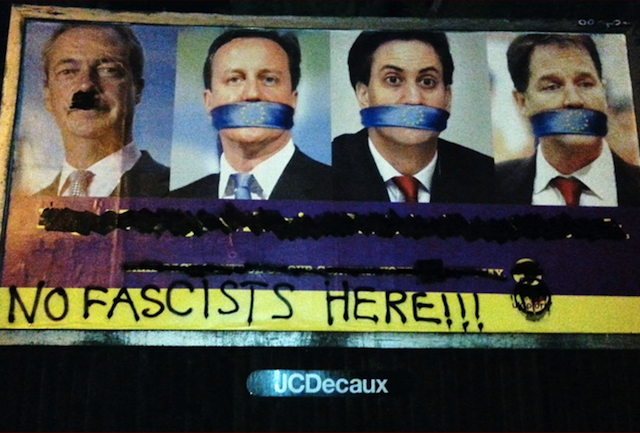
The semi-comical takeover of the #WhyImVotingUkip hashtag could be blamed on the blipvert tendencies of social media. In place of reasoned argument, we get 140 characters, designed to appeal to the lowest common denominator, with the hope of going viral. But what happened on Twitter was just an echo of a more extensive effort to discredit UKIP supporters as racists. This ranged from defacing UKIP posters by giving leader Nigel Farage a Hitler-style moustache, through considered articles about racism written by politicians from mainstream parties, to Green Party campaigners seeking to ‘peacefully’ provoke UKIP opponents by calling them bigots. In summary, a section of the British public are obsessed with labelling UKIP as racist, even though UKIP steadfastly insists it is not.

The desire to prove UKIP’s racism has grown as UKIP has become more popular. This is no coincidence. As Gandhi pointed out: “first they ignore you, then they laugh at you, then they fight you, then you win.” UKIP was ignored for a long time. When they finished third in the 2004 European elections, they were much harder to ignore. When UKIP finished second in the 2009 European elections, they became impossible to ignore. During the 2014 campaign, UKIP’s opponents appeared to be in transition. They were no longer sure whether to laugh at UKIP’s supporters, or to fight them. But if they fight too dirty – by trying to shame voters with false accusations of racism – they might find their tactics are counterproductive. Crying wolf is a tactic that only works well once.

It is the least popular left-wing groups who fight most viciously: the supporters of the Greens, the People’s Assembly, the Trade Union and Socialist Coalition, and all the other fringe neo-communist movements. A simple vote count shows that their enmity is driven by envy. When film director Ken Loach established yet another alternative party, the ironically-titled Left Unity, he showed his admiration for UKIP’s success: “what UKIP has done for the Right, we need for the Left!” But the major problem with any popular movement that represents the will of the people is that it will not get very far by repeatedly insulting the beliefs of lots of people. And for all the furore about UKIP’s supposed racism, they are not advocating the kinds of policies traditionally associated with racism or fascism. This is why it is odd that UKIP voters are being characterized as prejudiced against blacks, keen on the deportation of certain racial groups, and so on.

To the extent that UKIP’s policies might be defined as racist, this all hinges on the fact that exit from the European Union would allow the UK government to exert more control over immigration. It may come as a shock to some people, but when it comes to exerting control over immigration, European Union countries are very unusual. Other countries have policies that limit and define who is allowed to immigrate. Only EU countries adopt a policy which says that literally half a billion foreigners could move to their country, whenever they like, without anything to stop them. Most countries apply selective criteria, allowing some people in (usually the ones who can do certain jobs) whilst barring other people. So if UKIP is deemed racist because it wants a selective immigration policy, then most of the world is racist.

The most truthful way to criticize UKIP is to point out how few policies they have. This should be fertile territory for the left. Many leftist factions have an overabundance of policies, which sit like ageing hand grenades, likely to cause devastation if the public ever handled them. UKIP, however, has no serious policy for the economy, or defence, or the health service. It should be easy to rubbish UKIP. Polls show that even UKIP’s voters tend to be ignorant of any party policy except for exiting the EU. In that respect, UKIP is little more than a never-ending referendum for people who want Britain out of Europe. Accusing UKIP supporters of racism changes the relationship between those people and the rest of society. It is impossible to attribute a quality to a party, without attributing the same quality to its supporters. And it is foolish to dismiss millions of people as racists, based solely on the scantiest evidence. In that respect, those who condemn UKIP as a racist party may be doing more harm to themselves, and to society, than they appreciate.

The contorted, divisive thinking of the British left has been exemplified by how they have responded to two seemingly unrelated events: the crisis in Ukraine, and UKIP’s campaigns. In one case, Russian propaganda has been endorsed and repeated with barely any analysis. Leftist journalist John Pilger is only slightly more extreme than Britain’s mainstream media, when he proclaims that the forces behind the interim Ukraine government are ‘fascists’ and ‘neo-Nazis’, who ‘oversee savage attacks’ on ethnic Russophones who are ‘fighting for survival’. Britain’s mainstream media did not go quite as far Pilger, but broadcasters like C4 were quick to assert that fascists and racists were behind the new Ukrainian government. However, the most important driver of the Maidan movement, whose demonstrations toppled the Ukrainian government, was the desire for Ukraine to join the European Union. In contrast, the only widely-recognized policy of UKIP is that it wants Britain to leave the European Union. So the British left has managed to whip itself into a lather about racist fascist neo-Nazis who want to join the EU, whilst simultaneously rushing to the streets to protest at the rise of racist fascist neo-Nazis who want to leave the EU. There appears to be some contradictory thinking here. And I doubt the contradiction is between the so-called racists, fascists and neo-Nazis, whether in the UK or Ukraine.

Though UKIP repeatedly denies it is racist, others insist it is racist. The reason why UKIP denies its racism so often is because it is asked the question so often. It seems that racism, like beauty, is solely in the eye of the beholder. I dare say that some people will now think I am a racist, though I see no evidence of racist thinking in anything I have written. If so, let them think what they like. I find it peculiar that we live in a world where a person’s beliefs are not determined by asking them what they believe. In such a world, asking somebody if they are racist, and receiving the answer that they are not racist, would count as pretty good evidence for an absence of racism. Nowadays, it appears that some prefer to ignore this kind of evidence. They feel our fellow citizens cannot be trusted; we should peer mysteriously into their souls, rather than believing their words. The individual can no longer be trusted to accurately report their own beliefs.

Instead of believing each person’s words, we are told we should only trust special people, who are gifted with a special powers. It is not clear why these people are special, except that they say they are special, and are convinced of their own powers. These special people can detect an odd word here and there, an occasional glance or gesture, some small behavioural signals which always reveal the crypto-racist. They are like witchfinders – they claim to see the facts clearly, whilst most of us are blind. This witch-hunting power is monopolized by members of a certain political persuasion, and a certain societal class. This is the power which is being exercised, when a Green Party activist ‘peacefully’ tells a UKIP candidate that they are racist; the resulting one-finger comeback only validates their conclusion. Will Self exercised this same power when reviewing a book by Rod Liddle – though Liddle ‘tries to say the right things about race’, Self is still able to detect the racism that lurks underneath Liddle’s words. And if we incessantly ask Nigel Farage about the difference between hypothetical Romanians who live next door, and his German wife, then eventually (and thankfully!) his mask will slip and the sinister truth of his racism might be revealed. Ignore all the other interviews, because Farage, like the demon he is, must have been lying, obfuscating, and misleading us. It is only when Farage says something that might be considered the trivial gaffe of a tired man, and which is quoted out of context, that we should pay attention, and rush to judgement. The witchfinders’ finely-attuned racism sensors have been proven right, yet again…

The following is taken from the recent interview given by Farage to LBC’s James O’Brien.

Farage: Let’s talk about immigration, let’s talk about Europe, let’s talk about the European elections. I am making one very simple point. We cannot have any form of managed migration into Britain and remain a member of the European Union because we have an open door to nearly half a billion people. And the argument, James, I’m putting, is this: we’d be far better to have an immigration policy, that didn’t, as it currently does, discriminate against engineers from India, or doctors from New Zealand, in favour of anybody, regardless of skill levels or backgrounds, coming from Southern and Eastern Europe. And that is the great debate. And when Nick Clegg, you know, took me on, and I tried to have that debate with him, and he was very reluctant on that particular point to engage, Cameron and Miliband run a country mile away from that debate, and that I think is at the heart of our relationship with Europe.

O’Brien: Indeed, and if that was the debate you’d offered to have on this program we’d have it now, but what the caller asked you was why so many people think you’re racist.

Farage: Well, I think, yes, we’ve had our idiots…

O’Brien: (interrupts) … And part of the answer would be that you talk about children who can’t speak English as a first language without mentioning it includes your own children.

Farage: What is racism? Is racism between races? I was talking about, I was talking about…

O’Brien: (speaks over) … Don’t you know? How can you say you’re not something if you don’t know what it is?

Farage: Is race about colour? Is, is, is race about race or is it about nationality? I made a comment there that wasn’t intended to say any more than I felt uncomfortable about the rate and pace of change, and numbers of people…

O’Brien: (speaks over) … No, you felt uncomfortable about people speaking foreign languages, despite the fact that presumably your own wife does when she phones home to Germany.

Farage: I don’t suppose she speaks it on the train.

O’Brien: Why not? Is she not allowed to? Can’t she speak German wherever she wants?

Farage: (speaks over) Of course people are allowed to.

O’Brien: And what about the line about not wanting to live next to Romanians? It’s perfectly acceptable people not to want to…

Farage: (speaks over) I was asked if a group of Romanian men moved in next door to me, would you be concerned.

O’Brien: What about if it was a group of German children did? What’s the difference?

Farage: Oh, the difference. You know what the difference is.

O’Brien: No, I honestly don’t. This is, I think this is where the disconnect is between your position and mine. What is the difference?

Farage: We want an immigration policy based on controlling not just quantity, but quality as well…

And there it lies. This is the best argument yet that Farage is a racist, of the type some rush to compare to Hitler. Farage knows ‘the difference’ between a group of Romanian men, and a group of German children. That is what he said. He knows the difference between men from one country, and children from another country. His interviewer, who posed the question, innocently claims that he does not know the difference. At this point, I must admit that I can discern a difference: one is a group of adult men, the other is a group of children. If a group of men moved next door to me, I might be concerned. By definition, my neighbours would rank amongst the most horrible of all types of people: they are men, not women. And because there is more than one man, these men would defeat me if I tried to physically fight them. If given a choice, I would definitely prefer to live next to children. This is not because I am naive. Children can also cause lots of trouble. In some ways, I would be more concerned if children moved next door to me. As a responsible person, I would call Social Services, and tell them about the lack of adults to take care of the children. But I would be less worried about kids beating me up.

Though Farage was asked to compare children to adult men, this exchange has been misreported everywhere. For reasons best known to people who work in professional media, they have determined this dialogue was only about the differences between Germans and Romanians. Perhaps that is what the interviewer, O’Brien, intended. But if he intended that, why did he talk about German children, instead of a group of German men?

If this exchange is supposed to be the smoking gun that proves Farage is ‘a bit’ racist – presumably nobody thinks Farage is planning to murder millions of people, despite the endless comparisons to Hitler and the Nazis – then only two types of people will be convinced by it. The first type are the people who already thought Farage was racist, and just wanted more evidence to confirm their existing beliefs. Clearly I am not writing in the hopes of influencing them. The second type are the people who did not hear what was actually said. Probably they are beyond help too; they feel no shame at making damning judgements based on the flimsy second-hand reports of others.

I cannot say that Farage is not racist. But then, I cannot say that of many people. I cannot say that Nick Clegg, or the Pope, or Barack Obama is not racist. I must suspend judgement except for those people I know well, and for those people whose racism is so overt as to be beyond doubt. In our society, racism is a serious charge. If the best evidence of Farage’s racism is that he thinks there is a ‘difference’ between German children and Romanian men, then any reasonable and open-minded person would postpone reaching a conclusion. And because Farage is the leader of UKIP, we must also dismiss the lazy generalization that his party is racist. In fact, a reasonable and open-minded person might conclude that the personal beliefs of a man with a German wife and German-speaking children is likely to be more nuanced than would suit some of his political opponents. We should be wary of the motives of UKIP’s opponents, who accuse Farage and his party of racism on the eve of an important election which UKIP are set to win.

But arguments like these will never shake the confidence of those witchfinders who do believe they have a special gift for identifying the racism that lurks in others. So I have only one thing to say to those people: enjoy your gifts, without limit. Trust in your talent, and use it everywhere. I abhor racism. If racists are going to be mercilessly outed, then out them everywhere, from every place they lurk.

But then, the anti-racists might not want to do that. Somewhere along the way, they might lose the courage of their convictions. They usually seem to. Saying UKIP is racist is easier, and more convenient, than saying a member of the Green Party is racist. But there must be a racist in the Green Party. After all, a man might campaign against the threat of global warming, whilst also disliking darkies. Is the Green Party doing enough to find this man, and eject him from the party? Could it do more? Perhaps it should search through the old tweets and Facebook postings of its members, or interview them incessantly. In short, maybe they should examine their own supporters, as much as they scrutinize their rivals.

An abundance of anti-UKIP tweets linked racism with the idea that its supporters are homophobic white privileged men. But do these enthusiastic denouncers of racism really believe that only homophobic white privileged men are capable of racism? There are women who are racists. And Pakistanis who are racists. And gays who are racists. And if we find an anti-racist who indefatigably insists that only white people can be racists, how else should we describe this anti-racist, except to call him another variety of racist?

Denouncing UKIP as racist only works if we avert our eyes from every other political party. Look at the polls which identify where UKIP’s support has come from. UKIP’s voters have come from Labour, and the Lib Dems, and the Tories, and the Greens. When there is a general election next year, many of UKIP’s voters will return to those other parties. The ranks of UKIPs activists and members is augmented by many defectors from other parties. Others chose to join UKIP because they want an alternative to the other parties. So given its lineage, if UKIP is racist then there must be racists in the Labour Party, and racists in the Liberal Democrats, and even the Green Party must harbour racist supporters. There are racists all over. Why not put more time and effort into denouncing those racists? What makes them hard to spot, other than the fact that nobody was looking for them? Perhaps the answer is that anti-racists also know ‘the difference’. Many outspoken anti-racists have also picked sides in many other kinds of fights, relating to EU membership, and climate change, and economics, and feminism. Whilst they say they fight against racism, it would be inconvenient if they sometimes found racists were on ‘their’ side. And it is inconvenient when some of their beliefs are opposed by people from certain ethnic backgrounds. Are they so keen to hunt racism amongst their own ranks? Do they chide themselves for racism, when they consider who engages in female genital mutilation, or the selective abortion of girls? It is more likely they find a convenient ‘difference’ between these awkward scenarios, and the positions adopted by Nigel Farage and his supporters.

“Everybody is racist.” Do you like my new leftist slogan? It fits the X=Y model. I am an adult man; by some definitions, I was a thief and a rapist already. We might as well add racism to my list of crimes, based solely on the evidence that I am human, and therefore prone to many failings. I will happily plead guilty, if all the UKIP-despising anti-racists are willing to sit in the dock alongside me, and have the minutiae of their beliefs examined, to determine who they are prejudiced against. Or maybe everybody should drop the X=Y sloganeering, and only judge people as individuals, based on what they have really said and done. And that includes fair treatment for supporters of UKIP.

Preston Dirges in the Round

In the last instalment of Preston Dirges’ office saga, our hero found himself trapped in the pub, forced to socialize with his colleagues. Will he survive the experience? Will they?

A large group arrives in the pub for Belinda’s leaving drinks. Belinda, Doug, Rubnick, Kirsty, Lee and Nitya are amongst them. The group takes the seats all around. Preston is hemmed in, along with Valerie, Gordon and Tina.

VALERIE: (whispered, to Preston) I thought you said you were going.

PRESTON: (whispering) I can’t go now. It’ll look rude, and they’ll think I’m weird. Why didn’t you mention the leaving drinks to me?

VALERIE: (whispering) I didn’t know this was the pub. It was you that brought me here.

DOUG: Preston, I didn’t expect to see you.

PRESTON: I’m sorry to see Belinda go. I’m sure we all are.

BELINDA: Why, thank you, Preston.

A work colleague carries a tray of drinks up to the table.

COLLEAGUE: The first round is on Doug!

Preston looks to the camera.

PRESTON: Seconds out.

A boxing bell rings. Music plays: “Eye of the Tiger” by Survivor. The words ‘Round 1’ flash up.

COLLEAGUE: Pint of lager for you, Preston.

PRESTON: I don’t drink.

The colleague puts the pint glass in front of Preston.

COLLEAGUE: It’s still yours if you want it.

Gordon cosies up to Valerie.

GORDON: Valerie, did you know that, in Bhutan, they measure Gross National Happiness instead of Gross National Product? It means they care more about the things that promote health and well-being, rather than monetary wealth.

VALERIE: I did know that. Bhutan’s so lovely. I wish I could have stayed a lot longer. When did you visit?

GORDON: Err… I’ve not been.

VALERIE: You should go. It’s wonderful.

GORDON: I intend to. I just could do with a pay rise first, so I can afford the fare.

Preston slumps into his seat, avoiding the drinking game that takes place around him. Tina doodles on a napkin.

TINA: Take a look, Preston.

Tina shows Preston her drawing. It is a caricature of him as a super hero – “Pedanticman”.

PRESTON: You know, that’s very good. Thanks. But I’m not pedantic. It would be more accurate to say I’m pernickty.

TINA: You’re funny, Preston. Why did you choose to work somewhere so boring?

PRESTON: I thought it was only temporary.

TINA: Everything’s only temporary, when you think about it.

PRESTON: Tina, you’re wasted here.

TINA: I know. You too.

PRESTON: I know.

Doug takes the seat next to Belinda.

DOUG: I bet you won’t miss having me as a boss.

BELINDA: I wouldn’t say that. You were always first to the bar.

DOUG: Was that the only good part about working for me?

BELINDA: No, but the alcohol certainly helped.

A boxing bell rings; ‘Round 2’ flashes.

GORDON: Do you have much planned for this weekend?

VALERIE: You mean for Valentine’s Day? I’ve been invited over to a friend’s house – girl’s night in. Make some food, watch a movie, drink some wine, gossip about friends with boyfriends – that kind of stuff.

GORDON: You don’t have a boyfriend then?

VALERIE: No, I’m a lesbian.

GORDON: Oh, that must be very… (pause) refreshing.

VALERIE: I’m kidding, Gordon. No, I don’t have a boyfriend and I’m not looking for one. The last one was a total jackass.

GORDON: I’m sorry. What did he do?

VALERIE: I don’t know what I saw in him. He was goofy, and clumsy and a horrendous dancer. I met him when he barged into me at a nightclub. He was a loser, he was always coming round without warning, then disappearing for days, he forgot my birthday and tried to make up by sending me an e-card the next day. Who sends e-cards to a girlfriend?

GORDON: They’re good for the environment.

VALERIE: Not if you’re in my environment.

Valerie knocks back her drink.

VALERIE: I’m going to go powder my nose.

Kirsty and Nitya are both standing, eyeing who to schmooze next.

KIRSTY: I love your shoes. They look so comfortable. I’m not brave enough to wear shoes without heels. I’d be worried that everyone is looking down on me.

NITYA: I don’t worry about that because mostly I work sitting down. They pay us for our brains, not our legs – allegedly. And we’re all the same height sitting down.

KIRSTY: You know what they also say? We’re all the same height lying down.

NITYA: I’ve heard it said, but I’ll defer to someone with more experience.

‘Round 3’. A third full of pint of lager is put in front of Preston. It joins two other pints he has not touched.

PRESTON: People don’t take the hint, do they?

TINA: I think that’s what they’re saying about you.

Gordon approaches Kirsty.

KIRSTY: How’s it going, Gordon?

GORDON: It’s going great! How’s it going for you?

KIRSTY: Couldn’t be better Gordo, couldn’t be better. (Beat) Couldn’t be better.

GORDON: That’s good. (Pause) Did you know that in Bhutan, they measure national happiness in preference to national wealth?

KIRSTY: You know why that is, don’t you? It’s because they’re poor. If they were rich, they’d measure their happiness by measuring their wealth.

Valerie pushes her way to the bar. She rubs elbows with the man she danced with in the nightclub.

NIGHTCLUB MAN: Hello Valerie. How are you? I didn’t expect to see you here.

VALERIE: Oh hello, it’s you.

Valerie catches one of cupid’s arrows in mid-flight, before it can strike her. She snaps it in one hand.

VALERIE: I’m with some work friends. Work’s just down the road. I started there just this week.

NIGHTCLUB MAN: You’re with that bunch? They’re here all the time. Very rowdy, very loud, very drunken.

VALERIE: Yeah, I fit right in.

NIGHTCLUB MAN: Let me buy you a drink.

VALERIE: No, I’m getting a round in.

NIGHTCLUB MAN: You know you left some stuff at my place.

VALERIE: Stuff? Yeah, that sounds like the kind of thing I leave lying around.

NIGHTCLUB MAN: You know, stuff. Stuff people don’t talk about in public. Stuff that runs on batteries. Stuff you secretly carry in your handbag but must have left on the bedroom floor.

VALERIE: Oh, stuff. Now I know what you mean. Yeah, I’ve been missing my stuff, now that I’m single again.

NIGHTCLUB MAN: Do you want me to bring it over?

VALERIE: I don’t think that’s a good idea.

NIGHTCLUB MAN: You could come collect it.

VALERIE: I don’t think that’s a good idea, either. Post it to me.

NIGHTCLUB MAN: Now that’s not a good idea. If it starts vibrating, it might be mistaken for a parcel bomb.

VALERIE: Don’t make excuses to see me again. Just ask.

NIGHTCLUB MAN: Do you want go out for a drink sometime?

VALERIE: No.

NIGHTCLUB MAN: Please, I’m sorry. I didn’t even know it was your birthday.

VALERIE: You should’ve known. There are ways to find these things out.

NIGHTCLUB MAN: How was I supposed to know? You didn’t tell me.

VALERIE: I shouldn’t have to tell you. You should just know. Look it up on Facebook, like everyone else does.

NIGHTCLUB MAN: You know I don’t use Facebook.

VALERIE: Exactly. You’ve got no idea how to interact with people.

‘Round 4’. Despite Gordon’s attentions, Kirsty looks around for someone else to talk to.

KIRSTY: So I hear Tina’s got a new boyfriend.

GORDON: Where did you hear that? She didn’t want everyone to know.

KIRSTY: Then you should have kept it secret. I heard if from Belinda, who heard it from Dan C, who heard it from Dan G, who heard it from Liz who heard it from new girl Valerie who heard it from you.

GORDON: Well don’t tell anyone else.

KIRSTY: Too late, Gordo. There’s only six degrees of separation between any two people.

GORDON: Then I suppose even Kevin Bacon knows by now.

KIRSTY: Yes he does, and he’s right jealous. Aren’t you?

GORDON: Me? Why would I be jealous?

KIRSTY: Because you two are as thick as thieves. I always thought Tina had a bit of a crush on you. But she seems to have grown out of it.

GORDON: You’re kidding?

KIRSTY: Gordo, you’ve got so much to learn about women.

Valerie returns to her seat, which Preston saved for her. Rubnick takes the seat left vacant by Gordon.

RUBNICK: Val, I need you to settle an argument I’ve been having with Doug. He says young women like men to hold the door open for them, and I say they don’t expect that any more. Which one of us is right?

VALERIE: Both of you. I think anybody likes to have the door held for them, but nobody expects it any more.

RUBNICK: So you think men and women are now exact equals, in every regard?

VALERIE: Not in every regard. Women are still superior at everything that matters.

‘Round 5’. Gordon is drunk, and stands closer to Kirsty, who leans away from him.

GORDON: You’re right. There is a lot to learn about women. I just need someone to teach me.

KIRSTY: Ten out of ten, Gordo. Now that’s the spirit. But you’re not ready to study at my school. I have very exacting entrance requirements.

GORDON: You should let me take the test. I’ll pass any examination.

KIRSTY: I’m seeing a whole new side to you that I’ve never seen before.

GORDON: And there’s still more to reveal.

KIRSTY: ‘A’ for effort, Gordo, but it’s not going to happen. You’re not in my class.

GORDON: I’m a quick study, and I like being the teacher’s pet.

KIRSTY: No, Gordon. School’s out. I’ve moved on from the boys, on to the real men.

GORDON: Maybe school is out, but that doesn’t mean you have to act like a professional.

Valerie is still trapped by Rubnick.

RUBNICK: So the speedo said I was doing well over a ton, so when I saw the flashing lights in the rear view mirror, I thought they had me bang to rights. A few seconds later and the cops blew right past me! Of course, that’s how it is, driving on the German autobahns.

Valerie suppresses a yawn.

VALERIE: That’s interesting. You drive a fast car?

RUBNICK: Porsche 911 Carrera 4 GTS. That car’s a classic. I call her my liebchen – that’s German for sweetheart, you know. You should let me take you for a ride.

VALERIE: I bet you say that to lots of girls.

RUBNICK: I hope you’re not implying anything improper.

VALERIE: You probably say that a lot, too.

‘Round 6’. Neither Preston nor Tina have moved seats.

PRESTON: How’s it going with your new boyfriend?

TINA: How did you hear about him?

PRESTON: I’m not sure. I think everyone at work knows. I know this even though I don’t talk to anyone at work.

TINA: Don’t tell anyone, Preston, but I don’t have a boyfriend. I made him up so I didn’t have to make an excuse for what I’m doing this Valentine’s Day.

PRESTON: So what are you doing?

Tina shakes her head, refusing to answer.

PRESTON: Now you have to tell me.

TINA: I’d lie if I was any good at lying. But you mustn’t tell anyone. I could get into trouble.

PRESTON: Like I said, I don’t talk to anyone at work. It’s a miracle I’m talking to you now.

TINA: I’m launching my new webcomic. The characters are based on people in the office. Let me show you.

Tina uses her smartphone to visit her website.

PRESTON: That’s great, and unexpected. What character am I?

Tina holds up the cartoon of Pedanticman.

PRESTON: Well, I should be happy that I’m worthy of inclusion. But won’t everyone find out?

TINA: I’m not going to use my real name.

PRESTON: Still, don’t you need to tell people in general if they’re going to visit it?

TINA: It’s not the first one I’ve done. I’ve already told all my followers on Facebook.

PRESTON: You’ve got followers? Are you a cult? How many followers?

TINA: You’re being silly. A few thousand.

PRESTON: Wow. Good for you.

Preston leans forward and drinks one of the pints of lager in front of him.

TINA: Preston, what are you doing?

PRESTON: I suddenly felt like a drink. I’m twice your age and I’ve got zero followers.

TINA: It’s not a competition, Preston.

PRESTON: Yes it is. That’s exactly what life is – a great big competition. And I’m losing.

TINA: Then get out.

PRESTON: Get out of life?

TINA: Get out of here. Get away from all this. Go do something you’re good at, something you might really enjoy.

PRESTON: You should get out.

TINA: That’s what I’m gonna do. Marvin, my eldest brother, started work and is moving out. Now that Marvin can help dad with the bills, I can quit this place and focus on the webcomic. It’s worth a try. Now what’s stopping you?

PRESTON: The only thing stopping me from leaving is not knowing where I’d go.

Gordon sits next to Tina, the far side from Preston.

GORDON: Tina, do you like me?

TINA: Of course I like you, Gordon.

GORDON: No, that’s not what I mean. I mean, do you like me?

PRESTON: You should stop drinking, Gordon. You must have had 16 units of alcohol by now. That’s 4 times the recommend daily limit.

GORDON: Who’s counting?

PRESTON: Me. Just then.

GORDON: Well don’t. And this is a private conversation.

TINA: Gordon!?

PRESTON: No problem, I’ll bother Valerie and Rubberdick instead.

Preston turns from Tina, to Valerie, who sits on his other side. Rubnick is uncomfortably close to Valerie, leaning over her, with an arm stretched on the couch behind her.

PRESTON: (aside) And not a moment too soon.

RUBNICK: So we were on the World Trade Centre, which was still standing back then, and I said: ‘this is so high up, it’s amazing that planes don’t hit it’. Can you believe I said that?

PRESTON: I can’t.

RUBNICK: Preston, I was talking to Val. Why don’t you mingle?

PRESTON: Because I’m going to try it on with Valerie. I’ve been waiting my turn but I’m not waiting any longer. Valerie, would you like to come back to my place, for some rumpty-pumpty naughtiness?

VALERIE: You’d have to break your own rule on workplace relationships.

PRESTON: I wasn’t suggesting a relationship. Just hard sex.

VALERIE: Okay. If it’s just a fuck you want, then I’m your girl.

RUBNICK: You’re both very funny.

Preston mirrors Rubnick’s body language, putting his arm around the seat behind Valerie, and sitting close to her.

PRESTON: Who’s being funny?

Rubnick takes the hint, and shuffles back from Valerie.

RUBNICK: I’m going to get a drink. Do you want one?

PRESTON: We’re both good.

Rubnick leaves.

VALERIE: I actually wanted a drink.

PRESTON: But you didn’t want him coming back, did you?

Valerie drunkenly leans against Preston.

VALERIE: No. But I do want a drink.

PRESTON: It’s a school day tomorrow.

VALERIE: Preston, you’re so uptight.

PRESTON: And you’re so drunk.

VALERIE: Yes I am. But I’m also very relaxed as a result. You need to learn to relax. If you won’t drink, perhaps you should masturbate.

PRESTON: You don’t know me at all. If wanking was against the law, I’d be public enemy number one.

VALERIE: That’s funny. That’s much more like it. You take life too seriously.

PRESTON: Life is serious. It’s work that’s the joke.

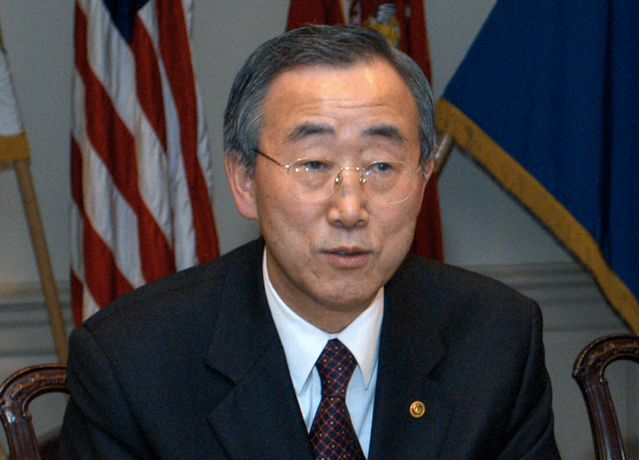
Why Ban Ki-moon Should Kill Himself

I have no grudge against the Secretary-General of the United Nations. Ban Ki-moon has an impossibly difficult job, and appears to do it as competently as anybody might. He seems neither immoral, nor dangerous. But following an article he penned for The Guardian, I am forced to ask myself a question: would the world be better off without Ban Ki-moon? He may not have intended readers to think along those lines, but it does follow the question he posed, which was: what should we do about climate change?

If we think clearly and honestly about climate change, the question of who should live, or die, must naturally arise. The forces of nature kill people already, whether through storms or food shortages. Climate change may lead to more death and destruction. On the other hand, responding to climate change will also influence who lives and who dies, because of the need for tough decisions about the allocation of resources. A billion dollars spent on windmills is a billion dollars not spent on medicines, or crops, or the disposal of landmines, or the making of entertaining movies. So when an individual raises the question of climate change, and insists that people must respond, it is fair to begin by asking what sacrifices that individual is willing to make.

To start with, I should repeat the actual question posed by Ban Ki-moon.

Climate change affects us all. So what’s stopping us joining forces to act on it?

On one hand, this is a straightforward appeal for sensible co-operation to stave potential disaster. On the other hand, it is a monumentally moronic question, that any schoolchild would be able to answer, if not wrongly encouraged to be starry-eyed dreamers in the ilk of John Lennon and a minority of Barack Obama’s waning fans. We might as well ask what stops us from joining forces to make this world a paradise. The answer is: people are selfish.

The UN Secretary-General is undoubtedly aware of human selfishness. His job is to negotiate. There would be no need for negotiation, if people lacked selfish desire. So when he asks a question that so obviously relates to selfishness, we should really contemplate who is being selfish. Is it me? Is it you? Might it be Ban Ki-moon?

I have seen that effective, affordable climate solutions exist. The push-back against sceptics must start in earnest at the UN’s 2014 summit in New York.

Really? That is wonderful news. Unless, perhaps, you are the person who pays the bill for these climate solutions. I might agree to an evening with friends at an affordable restaurant, but that does not mean I want to be stuck with the bill for everyone else’s dinner. When Ban Ki-moon says climate solutions are affordable, he presumably is not offering to pay for them out of his USD240,000 salary. Which is not to suggest he is wrong, or that his salary is excessive. It just means his view on what is affordable may not be the same as someone else’s view on what is affordable. These differences of opinion matter a great deal, when somebody opines on what is affordable for others. Ban Ki-moon’s view on what is an affordable restaurant will likely differ from mine, given that I lack his income. And his view on whether climate change solutions are affordable might change, if the rest of the globe insisted the funding be taken from the existing UN budget, which is over USD2.5bn a year.

Anyhow, I should move on, for fear of sounding petty. What we really need to do is to discuss what the bill will be, and who will pay it.

We really should discuss the bill. And who will pay it.

But we will not. Because Ban Ki-moon does not. In his article, he starts by saying the solutions are affordable. But he fails to state the cost. There is not a single number in his article. When Ban Ki-moon says something is affordable, he means it. And that is final. There is no need to share actual numbers with us, the nobodies who read articles instead of writing them. We may pay taxes, but we should not expect to be consulted on how they are spent. If anyone questions the affordability of these solutions, they must be unscientific, or a sceptic, or some kind of primitive flat earther. After all, the alternative is death and destruction! We should spend any amount to prevent death and destruction! And yet, the human race has always faced death and destruction, and has always had to make hard decisions about how much to spend to curb the risks. Being the kind of sceptic I am, I care less about whether predictions of global warming are accurate, and more about the costs involved, and who will pay them.

I think a lot of arguments from so-called climate sceptics are wide of the mark. They will never win by saying scientists are wrong. Even if scientists are wrong, it would make no difference. Consider religion, in comparison to science. Priests do not follow scientific method, do not gather data, and do not present evidence. And yet, a lot of people still believe the things that priests say. If people can believe priests are right, it is much easier to believe a scientist is right. Scientists admit to fallibility, argue openly, gather data, and follow a method. So when scientists insist that something is true, most people will forget all the times that scientists were wrong in the past, and trust what they say. They do so, because they struggle to identify a better alternative (though some still think their priest knows more than any scientist).

It is futile to dispute the scientist’s ability to predict the future. To win the argument, sceptics need only do something much simpler. They just need to ask for the bill that must be paid in order to address climate change, and then ask who is expected to pay it. Anyone who has ever tried to divide a restaurant bill between a large numnber of people will immediately appreciate why this tactic would be so devastating. The sceptics may get portrayed as selfish, but selfish people will always be in the majority. It makes good political sense to join forces with selfish people. Politics is dominated by selfish people, and it is easy to identify who is selfish. They are the ones who insist that the bill should be paid by someone else.

The debate, as far as debate is allowed, settled, ended or whatever, has dwelled on some kinds of numbers, whilst excluding others. A certain amount of coal releases a certain amount of energy, and gas, when burned. That might lead temperatures to rise by a certain amount at certain points in the globe, and for sea levels to rise by a certain amount, and so on. But nobody is really bothered about the amount the sea level will rise. They are not even bothered if places like Maldives will sink beneath the waves. With apologies to all Maldivians, what really matters is how much it would cost to prevent such an outcome, versus the cost of allowing it to happen but providing people with the same quality of life. The Maldivians may have a sentimental attachment to their islands, but most of them would readily leave their home and their day job, if offered a life of wealth and luxury on another part of the planet. And if not, and they stubbornly refuse to leave, then it is right that they should pay a heavy price, if they want to save land that others value less than they do.

Three decades from now the world is going to be a very different place. How it looks will depend on actions we take today.

Part of the problem with those promoting action on climate change, is that they always talk about taking action, but never say what they think people should do. The vague idea of action is uplifting. The depressing reality is that most action takes the form of burdens, sacrifices, and chores. So what is Ban Ki-moon doing, in response to climate change? We know the answer, from his own article:

To build political momentum and help bring about action, I am convening a climate summit in New York on 23 September…

I have been hosting an international meeting designed as a staging post for the September summit. The Abu Dhabi Ascent has given me considerable hope…

My sights are now set on the September climate summit and the climate negotiations in Lima in December and Paris next year…

New York, Abu Dhabi, Lima and Paris. Ban Ki-moon is very active. He very actively flies around the world, expending energy, encouraging other people to fly around the world, expending energy. These people all consume far more energy than the average human being. And yet, they justify this to themselves, as necessary to save the world from the consequences of consuming too much energy.

I have a suggestion for Ban Ki-moon, if he wants to take action that will save the planet.

Learn to use a fucking phone.

All these meetings are just a bunch of people talking to each other. Is it necessary to get world leaders into the same room, in order to reach agreement? Maybe so. But who says it is necessary? They do. Given how long it takes for world leaders to reach agreement on anything, I think the world would be better off if people like Ban Ki-moon were subjected to a scientific experiment. Ground all world leaders, for a whole year. Deny them jets, and motorcades, and hotel rooms, and conference facilities, and all the energy that is consumed by providing them with these facilities. If they want to have a meeting, let them have a conference call. The NSA may have tapped the Secretary-General’s line, but they can bug hotels too, so they will save energy and effort as well.

If, at the end of the year, no agreement on climate change is reached, and the world leaders moan that it was because they were not allowed to meet face-to-face, then continue to phase two of the experiment. Sack the world leaders, and see if their replacements can discover the magical ability to talk and reach agreement without literally sitting in the same room.

All around the world it is plain that climate change is happening and that human activities are the principal cause…

The world’s top scientists are clear. Climate change is affecting agriculture, water resources, human health, and ecosystems on land and in the oceans. It poses sweeping risks for economic stability and the security of nations.

We can avert these risks if we take bold, decisive action now.

That makes it sound like all human activity is the same. And yet, some people are more ‘active’ than others. Which brings us back to the most important question, which is the size of the bill, and who pays for it. Ban Ki-moon has a huge appetite for carbon, but he does not pay for his own flights. Maybe he should, and if he did, he might find ways to be productive without flying so often. These are the kinds of solutions I am interested in. What prevents the UN from adopting such an approach? Instead of paying for his flights, give Ban Ki-moon a flat allowance. If he spends the allowance on flights, so be it. If not, he pockets the money. And yet, for all the talk about making decisions, world leaders never make bold decisions like this.

An increasing number of government leaders, policymakers, businesses, investors and concerned citizens are beginning to comprehend the costs of climate change.

And yet, they do not use numbers to discuss those costs, nor show signs of making bold decisions in how they live their personal lives, nor how they approach their work.

More crucially, they are also learning that affordable solutions exist or are in the pipeline to reduce greenhouse gas emissions and support resilience. We need to deploy these solutions at a scale commensurate to the challenge. That means investment and it means global co-operation, especially in the areas of finance and technology.

Again, the world ‘affordable’ is used, without any support. It is always easy to talk about investment and co-operation, if the investment and co-operation is done by somebody else. The problem with asking other people to make investments and to co-operate is that it often degenerates into taxing them and punishing them for being uncooperative. There may be some justification for taxes and punishment. But first, we deserve to see the bill, and the arguments for what we will receive if we pay it. Maybe a trillion dollars is worth an inch on the sea levels. Maybe it would take ten trillion dollars to halt their rise permanently. But there is no argument for taxation, confiscation, and punishment, if there is no bill, and no measure of the benefits. And there is no good argument if the people levying the taxes and giving the punishment have exempted themselves from paying their share.

Just as scientists are united on the impacts of climate change, so are economists generally agreed on the costs of combatting it. Working now for a rapid transformation to a low-carbon economy will be significantly less expensive for people and economies than failing to act, especially in developing countries, which are most vulnerable to climate impacts.

We get more talk of costs and even of agreement amongst economists, though I find this last point implausible; economists never agree on anything. The unwillingness to simply state the costs becomes more and more painfully apparent. The dodging of the crucial issue about who should bear the costs becomes more and more ridiculous. And you don’t have to be a climate change sceptic to point out that solutions to climate change will involve an even more complicated prediction than that involved when modelling the global climate. We need to predict where investment would deliver greatest benefit, and where it would be wasted. We want money to be spent well, on efficient solutions that will work well in practice, not poured into the pockets of the corrupt and the foolish. Forgive my scepticism, but most people understand why scepticism about public spending is always warranted. We are all more keen on investing somebody else’s money, than on wasting our own.

Instead of asking if we can afford to act, we should be asking what is stopping us, who is stopping us, and why? Climate change is an issue for all people, all businesses, all governments. Let us join forces to push back against sceptics and entrenched interests.

Stirring language. And yet, nobody is stopping the UN Secretary-General from using a fucking phone instead of flying to meetings. Where do I sign up, to push back on the entrenched interest and wastefulness in the way the UN Secretary-General does his job? I suspect this is not the kind of force he wants me to join.

Change is in the air…

Literally. Would it be so hard to imagine a world so drastically changed, that people stop wasting energy on unnecessary travel? And if that is hard to imagine, just as it is hard to imagine millionaire movie stars agreeing we should slash spending on entertainment in order to better fund energy projects, then we have an answer to Ban Ki-moon’s question. We know full well why we cannot simply join forces and collectively choose to stop man-made climate change.

…I can sense it at all levels of society. Solutions exist. The race is on. My challenge to all political and business leaders, all concerned citizens and voters is simple: be at the head of the race. Don’t get left behind. Don’t be on the losing side of history. Let us work together to make climate change a top priority for all leaders “” at home and in the global arena. Let us take advantage of the opportunities presented by climate action and lay the foundations for a more prosperous and secure future for all.

Maybe Ban Ki-moon can sense change at all levels of society, whilst flying 30,000 feet above it. I cannot. What I perceive is the same old nonsense that the world has always suffered from. Greed. Foolishness. Leaders who talk about change, meaning you need to change, not them.

Ban Ki-moon’s article was quite long, considering how little it said. There were no numbers, and no costs. He did not give an example of any bold decisions that he had taken, in his personal or professional life, to bring about change. He did not even give a single example of any of the ‘solutions’, despite repeatedly telling us how affordable they are. So let me point out a truth that Ban Ki-moon will never admit to, even though it is staring us all in the face.

All around the world it is plain that climate change is happening and that human activities are the principal cause.

Human activities are the principal cause of climate change. Human activity. Humans do things. There lies a possible solution to climate change. Have fewer humans. The global population keeps going up. Energy use keeps going up. And, supposedly, the temperature goes up. Is there any scientist in the world who fails to see the causal relationship between the human population and the problem which Ban Ki-moon wants to solve?

Nobody wants to talk about population growth as a cause of climate change because that would be awkward. And Ban Ki-moon is a diplomat, after all. He says he wants bold, Bold, BOLD action!!! But we are not so bold that we can even mention that population has a link to climate change. Where does that leave us? It means that, however much populations grow in practice, our leaders, in the complete absence of any useful numbers, are telling us we can live the lives we want to lead, have the children we want to have, and save the climate from catastrophe. They pretend the only bold decision we need to contemplate is how we will be more energy efficient, whilst obtaining more energy from sources that are currently much less economically efficient than carbon-based sources. They do not contemplate the other possibilities, if we cannot be as efficient as we hope to be. One of those possibilities is that we consume less. We will eat less, travel less, own less, make less. Population will rise, but GDPs will decline, and so wealth per person will fall. Another possibility is that every person could still consume as much as they currently do, but only because there are fewer people in total.

Ban Ki-moon may ask for bold thinking, but he should be wary of what he asks for, in case he really gets it. Like most leaders, Ban Ki-moon is prone to delusional thinking which insists what is convenient must also be true. There is an irony that Al Gore described global warming as an inconvenient truth. It is no so inconvenient that it stopped him flying to Norway, to collect his Nobel Prize. Presumably another human being should suffer greater inconvenience, to compensate for his indulgence. Or else he is confident that finance and technology must deliver efficiency savings that will compensate for his excessive consumption.

The problem with climate change sceptics is that they let world leaders off the hook, by diverting the debate down a path they cannot win. World leaders like to emphasize the terrible, Terrible, TERRIBLE consequences of climate change, because that justifies making world leaders even more powerful than they already are. It justifies giving them authority to make decisions that many of us will not like. If we go down that path, we should keep in mind what actions might really become necessary, to solve the challenge of climate change. Ban Ki-moon is appealing to the people on an emotional level, and that is exactly what is wrong with how world leaders deal with this problem. Fuzzy words and emotions are no substitute for hard-headed numbers. Real costs cut through, and have serious implications, that change the lives of individuals. The best example is China. The Chinese government reduced the likelihood of famine in their country. The cost was that the Chinese people were allowed fewer children. Was that a cost that a democratic society could have paid?

Maybe the world will not need to follow China’s lead, in order to deal with climate change. But that should be determined scientifically, with robust forecasts that use hard-headed numbers. It is no good applying a lot of effort to forecasting how much the temperature will rise, if we cannot forecast how much a million, billion or trillion dollar investment will reduce that rise. The UN Secretary General says the solutions are affordable. I want to see the evidence for that assertion. Forget debates about oceans and winds. The real debate is about money. I want to understand how big the bill will be, and who pays for it. And having seen the first draft of the bill, I want to know how much that bill will grow, as the population grows.

Ban Ki-moon has three children. Given the way the world is today, the population would stop growing if women had 2.33 babies on average. Improved healthcare should mean that the replacement rate will fall, nearing the idealized rate of 2 babies per woman. Let us not argue whether human activity causes global warming, or even how much by. In his own way, Ban Ki-moon has increased global warming, not just through his personal consumption of energy, but by making people who will also, inevitably, consume energy. Maybe the world can afford Ban Ki-moon’s third child. After all, babies come in round numbers, and nobody is mother to 2.33 kids. But whether the world can afford Ban Ki-moon’s children, and his grandchildren, depends on how much more efficient we can be, when using energy, and how much more efficient we can be, at producing energy without releasing carbon. Those truths will be measured in numbers. Our problem is that leaders only like to discuss numbers when it comes time to tax us. If they want real popular support for change, they need to drop the high-flying language, and start talking about the numbers involved, so we can all give our informed consent. That is the only way we will truly ‘work together’. Otherwise, we will revert to an ages-old paradigm: the powerful will tax, and the rest will pay. And those that pay will be made to do so whether they like it or not, whether they see the benefit or not.

Our societies have not changed the way they should. One example is that we conduct debates in words when they should be conducted in numbers. The global population; the efficiency of using energy to live a typical human life; the efficiency of extracting energy relative to releasing carbon – these are all numbers, of a kind that can be scrutinized and predicted scientifically. They are linked. If the world lives more efficiently, it can sustain a higher population. On the other hand, every additional human life forces everyone to be even more efficient, or to be more stringent in rationing energy, which means limiting choices for how people live their lives. Or maybe we will choose to limit how many lives people bring into this world.

It would be a bold decision for Ban Ki-moon to kill himself. But it would set a great example, showing how much he really cares about climate change. Burying your body in the ground is a great way to reduce your carbon footprint. Apart from all the flights for all the dignitaries who would attend his funeral, the end of Ban Ki-moon’s existence would definitely save energy. He is currently active. By living, he drives global warming. His immediate death would be a small step towards avoiding climate catastrophe. It might save somebody else’s life, or maybe two lives or more. But that is probably a cost that Ban Ki-moon is unwilling to pay. Might he have chosen to pay his share in another way? By having one less child? Or by using the phone a lot more than he does? Those are decisions he has to make for himself. But be under no illusions. Decisions do need to be made. Bills will be paid, one way or another. The problem is that people like Ban Ki-moon do not want to make those decisions. They do not even want to talk about them, though they are paid to do nothing but talk. They will sit at the table, chat amiably, agree the restaurant is affordable, and insist they have already contributed their fair share. And whilst people are still arguing who had soup for starter, and who supped a second bottle of wine, Ban Ki-moon will rise and leave. The UN Secretary-General is too important to deal with problems like that, and he needs to catch a flight…

Paean to the Pixies

The Pixies have released Indie Cindy, which comes 22 years after Trompe Le Monde, and 26 years after Come On Pilgrim. If that news made some joyous sense to you, then you might also understand the following.

There’s a voice in the chaos
Calling us home
There’s a scream in the heartbreak
Making us whole
They say you toured other galaxies
But you’ll never leave us
And though Kim was lost along the way
You gave birth to Rosa, Allison, and Magdalene

Like Spartacus armed with guitars
You set music free
Together we fled through the desert
For many miles
And found a place to stay
At the ranch called fifty-one
That’s where you work the tractors
With many ears to feed

We say we’re human but you know
How we lie
We ceased to resist your big big love
Your education
Broke our bodies open, collapsed our minds
We levitated
And sailed into the shine of the ever
This was our holiday
And when Heaven finally calls my number
They’ll hear me roar
I am un chien andalusia

Preston Dirges’ Sense and Sensibilities

Preston and Valerie have temporarily escaped the office, and the attentions of Kirsty the Reportgirl. After dragging Valerie into his car, Preston now bundles her into a local pub…

Interior: Pub – Day

The pub is almost empty. Preston swings the doors open and marches to the bar. Valerie follows.

PRESTON: What are you having? I’m buying.

Preston pulls out a handful of change from his trouser pocket, and starts sorting through it.

VALERIE: I don’t know. JD and coke.

The landlady appears at the bar.

PRESTON: We’ll have a double Jack Daniels and coke – and I’ll have a coffee, please.

VALERIE: You’re having a coffee?

PRESTON: I don’t drink.

VALERIE: Why didn’t you say that before?

PRESTON: Did I need to? Just because I don’t drink, doesn’t mean you shouldn’t.

VALERIE: But why are you getting me a double, without asking?

PRESTON: I don’t want to seem stingy.

Preston pays with exact change. They sit at a vacant table.

PRESTON: Cheers.

Preston swigs his coffee.

VALERIE: You know, Preston, you’re something else. We should be at work.

PRESTON: It’s nearly home time.

VALERIE: Preston, I’ve been in the office three days with you, but I still don’t know what you do, or what I’m supposed to do.

PRESTON: You want me to explain it again? No problem.

Preston swigs more coffee.

PRESTON: We convince our auditors that the cables we make all comply with the relevant standards and specs. Then we hang their certificates in reception.

VALERIE: Preston, I’ve not even seen a cable yet. All I’ve seen is paperwork.

PRESTON: That’s the point. Paper is easier to manipulate than anything real.

VALERIE: That makes no sense whatsoever.

PRESTON: It makes business sense. Alright. There’s three theories as to how the system works. First, it’s efficient to implement a system of internal quality controls, including many precision tests. The test results are summarized in internal reports, which are then further summarized and scrutinized by us, and then given to the auditor. Second, it’s cheaper to push around lots of paper and talk about testing, than to do real tests on real cables. Third, if you make just the right amount of paper, you always find exactly the right number of problems with your cables. Never so many that the business loses lots of money on fixing them, and always enough to make the auditor feel good about themselves, hence proving that the system works.

VALERIE: You’re fiddling the system?

PRESTON: This really is your first job, isn’t it? Let me give you some advice, people don’t see the wood for the trees, and they don’t want to see the wood for the trees, because scary things lurk in them there woods. So we make everything nice, clean, safe and transparent, by telling a lot of clever lies, where each individual lie isn’t dishonest at all, but the sum total is a total crock. So what we do, is we say what specific tests are needed for our cables, and we choose them just to get the kinds of results we wanted to get. The auditor agrees the actual tests matched our plan, and has no idea of what we really should have tested. So everybody goes home happy.

VALERIE: Perhaps it’s best that you don’t explain work to me, ever again. And anyway, you don’t seem to be very happy.

PRESTON: Don’t I?

Gordon and Tina arrive. Tina sits first, next to Preston. Gordon walks around, to be next to Valerie.

PRESTON: What are you two doing here? Is everybody slacking off today?

TINA: It’s gone five. We came to grab our seats before everyone else arrived.

PRESTON: Everyone else?

TINA: Whoever’s coming to Belinda’s leaving drinks. They’ll be here in a second.

Preston downs his coffee and jumps up from his seat.

PRESTON: I have to get out of here.

Confirmation Bias In Action: The BBC turns 10% into 1%

I was going to let this pass without comment. In my experience, biased as my experience probably is, I find a lot of journalism involves somebody telling us what we should think, as justified by selective, edited, manipulated and misinterpreted data. Never is this worse than when politics is supposedly bolstered by science. And when I use the word, I really mean ‘science’. There is science in this world, but some ‘science’ gets the name despite a scarcity of repeatable experiments and an inability to reach consensus about what would count as evidence for, or against, any theory. I could not let it pass, so let me tell you a story about confirmation bias, politics, journalism and ‘science’.

One reason for my difficulty, despite my desire to let it pass, was that only last week I wrote about confirmation bias and the press, noting how economist and columnist Paul Krugman was buffoonishly unaware of the possibility that he was suffering from a severe case of confirmation bias when he wrote a list of reasons explaining why he does not suffer from confirmation bias. It is a scientific fact that confirmation bias is ubiquitous. Though this really is a scientific fact, it is important to recognize that most people, including journalists, continue to pretend, or believe, that they do not suffer from this bias. Krugman’s example is extreme, but when it comes to politics and journalism, there appears to be no widespread moral prohibition against journalists who present biased arguments, in order to please their biased audiences. On the contrary, that is the essence of the business model for most purveyors of news and comment.

In many respects, we should find it appalling to live in a world of incessant, unrepentant bias, especially when the bias extends to misusing the scientific method and misinterpreting data in order to reach a pre-determined conclusion. However, in a world of many voices, we can let it pass. We can reasonably assume that the many opposing biases will cancel themselves out, like waves that fitfully and energetically clash but leave nothing permanent behind. If readers do not like the New York Times, they might read the New York Post, though if they want to counter bias they should probably read both.

However, not all voices present themselves as one amongst many. Some present themselves as uniquely superior to all. This is why the BBC is really the worst source of news in the whole world. With its mid 20th century understanding of human psychology, the BBC continues to pretend it can be an impartial public service broadcaster. It tells us it never suffers from bias, in anything it produces, and if it does, the bias was only a momentary slip. The BBC believes it has found a way to cure every single one of its 23,000 staff – the largest workforce for any broadcaster in the world – of the pernicious evil of confirmation bias. And when challenged as to how they have accomplished this herculean task, they reel off the reasons, with the kind of blissfully ignorant irony that makes you wonder if they will employ Paul Krugman when readers of the New York Times finally tire of him.

So as I mentioned above, I was going to let this pass, but confirmation bias is important, and underreported. It is hence unlike most stories that feature in the news, which tend to be relatively unimportant, and grossly overreported. Confirmation bias clouds our judgement, leads to bad decisions, makes the world a worse place. Democracies will never have good public policy unless our societies tackle and minimize confirmation bias. But our institutions let the public down, and the BBC is the worst example of that collective failure. And this failure grows more acute when bad science is used to justify poor conclusions. Many people realize the world is grubby and full of narrow-minded and prejudiced people. They look to science as a less polluted source of information. It is therefore reckless to abuse the scientific method, and to undermine future trust in science by misrepresenting its conclusions.

Whilst the story I am about to tell is a small story in many ways, it is an important story about bias, and the failings of the institutions that are supposed to support our democracy. I could let it pass when some bad scientific interpretation caught the eye of a journalist due to his confirmation bias. But I would not let it pass when his biased story caught the eye of many members of the public due to their confirmation bias. And so, because of this chain of events, a scientific ‘truth’ is now known to a large number of people, confirming what they already thought they knew about the world, even though the science does not, in fact, tell them what they want to hear. And for this little tragedy, this small defeat in the war for truth, we should thank the ‘impartial’ BBC. So please indulge me, as I now dissect what is today’s most shared story on the BBC News website, a piece entitled “Study: US is an oligarchy, not a democracy“.

This is how the story begins.

A review of the best commentary on and around the world…

Today’s must-read

The US is dominated by a rich and powerful elite.

So concludes a recent study by Princeton University Prof Martin Gilens and Northwestern University Prof Benjamin I Page.

This is not news, you say.

Perhaps, but the two professors have conducted exhaustive research to try to present data-driven support for this conclusion.

The offending journalist was correct in one regard. This is not news. However, it is not news because the ‘data-driven support for this conclusion’ is flawed in one important respect: the data. A lot of you, by now, will already be suffering the onset of confirmation bias, so I ask you to retain a cool, objective, scientific outlook as I continue.

The academic paper in question presents no data about any ‘rich and powerful elite’. I know this, because I read the paper. If the journalist read the paper, then he deliberately omitted to mention the most important caveat in the paper. Instead of reviewing data about a ‘rich and powerful elite’, it presents data about the top 10% of earners in the United States of America, and shows a correlation between their views and the policies adopted by government. This is very clear throughout the paper, but its importance is stated in this excerpt.

We believe that the preferences of “affluent” Americans at the 90th income percentile can usefully be taken as proxies for the opinions of wealthy or very-high-income Americans, and can be used to test the central predictions of Economic Elite theories. To be sure, people at the 90th income percentile are neither very rich nor very elite; in 2012 dollars, Gilens’ “affluent” respondents received only about $146,000 in annual household income. To the extent that their policy preferences differ from those of average-income citizens, however, we would argue that there are likely to be similar but bigger differences between average-income citizens and the truly wealthy.

There is no need to analyse the rest of the paper, because everything hinges on this assumption. The researchers indisputably show a correlation between the policies implemented by the American government, and the opinions of the top 10% of Americans by income. That is a fact. There does appear to be a relationship between opinions expressed in surveys, the income of the person expressing the opinion, and the likelihood that the US Government will adopt policy that conforms to that opinion. The imbalance is clear – the top 10% get what they want, the rest do not. But the authors have to assume that the goals of an ill-defined ‘rich and powerful elite’ are the same as 10% of the entire population. And they also have to assume that if the government adopts a policy it is only because of the influence of this ‘rich and powerful elite’, and not the influence exercised by 10% of the entire of population.

Is evidence of an imbalance that favours 10% of America’s population equivalent to the writer’s meaning, when he reports that the ‘US is dominated by a rich and powerful elite’? No. Even the academics distinguish between the ‘truly wealthy’ and the top 10%. And here, on this single, simple point about data, the paper’s conclusions must fall. I suspect the weakness of the professors’ arguments was in their mind, when they used weasel words in the conclusion, also repeated by the BBC’s journalist:

Americans do enjoy many features central to democratic governance, such as regular elections, freedom of speech and association and a widespread (if still contested) franchise. But we believe that if policymaking is dominated by powerful business organisations and a small number of affluent Americans, then America’s claims to being a democratic society are seriously threatened.

In other words, Americans do seem to live in a democracy, but if policymaking is influenced in a way not proven by the data shown in the paper, then the claim to be a democracy would be threatened. Notice how we leapfrog from some data about the top 10% of American earners, to a conditional statement about when democracy might be vaguely ‘threatened’, to a BBC headline which says the USA is not a democracy. The BBC’s hack follows this misleading headline with a complacent comment, saying that the USA’s status as an oligarchy is so widely appreciated, it is not even newsworthy. What is the role of the BBC in this case? Is it to open our minds to new information? Seemingly not. Is it to encourage some people to close their minds, by telling them what they want to hear? I suspect so.

You could reasonably argue that this academic paper draws a conclusion based on data. You could reasonably argue that this academic paper states a conclusion about the influence of the truly wealthy. But you cannot reasonably argue that the paper’s conclusion about the influence of the truly wealthy is based on the data it presents. To argue otherwise is evidence of one of two faults: foolishness, or bias. It is perfectly possible to imagine an oligarchy where 10% of the population dominate. That would look a lot like apartheid South Africa. In that country, the whites were richer than blacks, and held power. But we also understand there were significant differences in wealth, and opinion, amongst the whites. That is not the kind of example this journalist has in mind, when asserting the following about the USA.

…the wealthy few move policy, while the average American has little power.

I think we all know the real reasons why words like ‘few’ and ‘average’ are being presented to the reader, when it would have been just as easy to write about ‘ten percent’ and the other ‘ninety percent’. I would not think of ten percent of the population as a ‘few’ people. The research demonstrates an imbalance, but not the kind of imbalance that the professors wanted to show, and thus their own bias is revealed. On the contrary, the top ten percent of the American population will include a lot people like journalists and professors – the kinds of people who might tell us that their power and influence has been exaggerated, and that all power resides with an elite that excludes them.

It is telling that the British Broadcasting Corporation finds it necessary to highlight a minor academic story from the USA at the same time as the British Labour Party employs David Axelrod’s services as a political communicator. Axelrod is famous for helping Barack Obama to win two Presidential elections. News coverage of Axelrod’s appointment has uncritically repeated Axelrod’s message about his appointment. Axelrod says he is not some mercenary for hire. No, no, no. He really shared all the views of all the candidates he worked for, and was paid handsomely by. Yes, yes, yes. He shared all their views, even when he swapped between opposing candidates. Yes, yes, yes. And now he shares all the views of the British Labour Party, and is not working for them because he is cynically motivated by the prospect of a big pay day. Phew. Because nobody in the BBC wants to suggest that Labour’s campaign message of ‘us’ versus ‘them’ is going to be orchestrated by a guy who makes so much money from politics, he definitely counts as one of ‘them’.

Axelrod’s message, uncritically repeated by the BBC, is that Labour will win by saying similar things to Obama. But as ever, the political memory is weak, which may also be a sign of confirmation bias. It is not possible for Labour to simply emulate the message written by Axelrod, and spoken by Obama, during his two successful Presidential campaigns. That is because two different messages were given. Readers of Halfthoughts from its inception may recall that its banner has subtly changed over the years. Before Obama’s first victory, it depicted President George W. Bush, with an empty thought bubble, to represent his empty head. When Obama won in 2008, I thought I would play a trick on his over-adoring fans. I changed the banner to make it appear I was uncritically repeating the central message of his 2008 campaign: change. It was a slow joke, that grew steadily funnier over the years. By 2012, when little had changed, I delivered the utterly predictable punchline, crossing out the word ‘change’. Romney’s defeat has saved me the effort of needing to alter the banner since, and so the joke rolls on.

When it came time for the American public to contemplate change, it was predictably time for Axelrod to change his message. Change and hope were no longer in fashion. It was time for ‘better the devil you know’. But devils are not very popular, just like Obama was not very popular, as measured by his very low approval ratings. So Axelrod needed to present Obama as a combatant against a foe who was even more unpopular. The campaign message became ‘us’ versus ‘them’, where ‘us’ was understood to be very many, and ‘them’ was understood to be very few. This, we now learn, is also the message Axelrod will use with Ed Miliband. And this makes perfect sense, when we consider that the polls say Ed Miliband is even less popular than Barack Obama.

When analysing the ‘us’ and ‘them’, there is always some deliberate vagueness about who is included in each group. This is not properly compensated for by the intensity of the emotion used to confirm that ‘we’ are wonderful honest hard-working victims, whilst ‘they’ are miserable evil selfish persecutors. When Axelrod and Obama were campaigning in 2012, some said the few were as many as 1% of the population. No Democrat dared to suggest that ‘they’ were 10%, although Romney made an imbecilic error by opposing himself to 47% of the population. If ‘they’ were 10%, that would raise awkward questions about who donated to Obama’s campaign. If ‘they’ were 10%, they would include very many journalists, businessmen and celebrities who campaigned vigorously for Obama. The 10% clearly includes people like Paul Krugman, who writes a column subtitled ‘The Conscience of a Liberal’ but who is very definitely near the top end of the 10%, if not in the top 1%. The game of ‘us’ versus ‘them’ only works if we deny the possibility that some of ‘us’ are really ‘them’.

And so, Axelrod’s message for Labour will be the same as the one he used for Obama in 2012, presumably because Labour is unable to tell us much about what they would change. Like Obama’s presidency, it will be important to elect them because of what they represent, and who they oppose, but not because of the policies they espouse, and what they will do. Suggesting you might actually do something will inevitably lead to disappointment, and that difficult shift of message that asserts the time for change has passed, and it is better to stick with the devil you know.

Amidst this fracas, the BBC plays its dutifully ‘impartial’ role, by highlighting some research, out of all the thousands of political science papers published all the time, that just happens to accord with Axelrod’s message that he fought a rich elite, in order to preserve America’s democracy. Do I see confirmation bias here? Yes I do. Perhaps I perceive my own confirmation bias. But like Krugman, I doubt that my own confirmation bias is the fault here. I do not blame myself for confirmation bias, because I can do something done by neither Axelrod, nor the BBC, nor the professors who wrote this paper. I can offer a second, alternative model that equally fits the data, but which definitely does not fit their interests.

Who would be in the 10%, either in the US or UK? Axelrod, definitely. Most senior management at the BBC, definitely. The better-paid BBC journalists, probably. US professors of political science, very likely. Every American senator, representative and governor, whether Republican or Democrat, with absolute certainty. The entire front bench of the Labour Party, beyond doubt. Every Member of Parliament is in the top 5% of UK income, just because of their basic MP’s salary, before counting all the top-ups and perks they may qualify for. So when these researchers observed a correlation between the opinions of the top 10% of the US, and the decisions reached by government, I find it easy to propose a simple model which would explain this correlation, without needing to assume the influence of a super wealthy elite.

Everybody in the American government, of whatever political persuasion, is in the top 10%. They have more in common with other people in the top 10% than they do with anyone else. Most of their friends are in the top 10%. Their parents were probably in the top 10%. And their views are bolstered by professionals, businessmen, academics and journalists who are also in the top 10%. Not surprisingly, they share the views of most people in the top 10%, and they make policy decisions accordingly. That is the character of American politics. That is the character of British politics also, although today’s Labour Party sometimes pretends otherwise.

Journalists and professors are turning a blind eye to a perfectly plausible explanation of this important data. The data shows there is a link between an American’s income, and the decisions made by America’s government. They ignore the most straightforward explanation, because some want to believe a corrupt elite holds sway over all of us, and none in a position of power or influence wants to admit what the data most obviously suggests. All of these people belong to the 10% class, and the data implies their class governs and controls everything. I admit my alternative model is no more proven by the data than the professors’ model of a tiny dominant elite. But at least I am open to thinking it, and stating it as a possibility. What excuse do they have, for failing to admit the possibility that governments inherently favour the interests of the kind of people who actually run governments? What excuse could they have, apart from bias?

Krugman’s April Fool

I should begin by stating I am a sceptic, and I routinely check information and opinion by researching opposing views. No, no, no… I should begin elsewhere. I should begin by explaining why I think economics is more of a pseudoscience than a real science. No, no… that is not right either. I should begin by explaining what happened when Christendom changed from the Julian to the Gregorian calender… nope, that is not right either. The problem with making fun of Paul Krugman, Nobel prizewinning economist, popular writer, and pompous blowhard, is that it is so hard to know where to begin.

You see, I like to think of myself as a liberal. Not any old liberal, but a classic liberal. Saying you are a classic liberal is a bit like saying you drive classic cars, or that you drink classic Coke. You gesture toward the classic car on your driveway, or slightly tilt the bottle of classic Coke in your hand, and raise an eyebrow. Everybody knows what that eyebrow means. It means ‘if this ain’t a car/cola, then nothing else is’. So being a classic kind of liberal, I think I know what the word ‘liberal’ means. I have read books by John Locke and J.S. Mill, and they shaped my outlook. And then I read books by guys like Karl Popper, who also seemed to be a liberal. Popper disliked the arrogant, dogmatic, totalitarian thinking of Marx and Plato, helping me to understand why I disliked them too. Popper also introduced me to the difference between science and pseudoscience. And having read these books, I reached the same conclusions they reached: that the world is full of people who disagree, that many of those people are wrong about many things, that you have to observe the world to determine the facts, that it is good to be sceptical, that many people are not sceptical enough, and that you should never silence opposing views. These ideas are to liberalism what chrome is to a classic car, or what cocaine is to classic Coke. But when I read Paul Krugman’s blog for the New York Times I often get a queasy feeling, nothing like the pleasant sensation of cruising in a classic car with the top down, or the buzz of ingesting fresh coca leaves. Though Krugman often writes about being a liberal, and his column is entitled ‘Conscience of a Liberal’, I find Krugman has no appetite for the indispensable ingredients of liberalism, or at the very least, what used to be indispensable to liberalism.

So, to jump back to current affairs, I flipped to Krugman’s blog this Friday, even though he is not much of a liberal, because I really wanted to know what is wrong with the British economy. Though Krugman is an American writer, who works for an American newspaper, aimed at an American audience, Krugman is always writing about what is wrong with the British economy. It seems that lots of Americans with a keen interest in politics really want to know what is wrong with the British economy, because this helps them to decide which American politicians are best. And Krugman can usually be relied upon to say there is something very wrong with the British economy, just after somebody else says there is not much wrong with the British economy. A sceptic, like me, might observe an empirical pattern to Krugman’s writing about the British economy: Labour lost a general election, the Conservatives formed a government in coalition with the Liberals, that government ‘cut’ expenditure (in the sense of not allowing it to rise as fast as it otherwise would), and since then, Krugman has consistently predicted, then concluded, that there has been/is/will be something terribly wrong with the British economy. So the sceptic in me immediately thought of Krugman, when I found out Britain’s Chancellor, George Osborne, will tell the IMF:

…our economy has grown faster than any other in the G7 over the last year and is now forecast by the IMF to do the same in 2014. This is despite warnings from some that our determined pursuit of our economic plan made that impossible.

In other words, Osborne is going to crow about how successful his economic plans have been, and how doubters like Krugman are full of sh*t. But being the kind of sceptic I am, I want to know the counter-argument. I like to know why having the fastest growing economy in G7 is nothing to boast about, and why the British Chancellor of the Exchequer is talking out of his bum. Krugman behaved exactly as I predicted, stating Osborne is wrong because he is actually doing what Krugman says he should do, whilst pretending to do the opposite.

This leads me to my observation about pseudoscience. Many people act in ways that contradict their professed beliefs. Pseudoscience encourages this hypocrisy. When the world does not conform to expectations, the worshipper of pseudoscience will call upon any excuse to preserve a broken theory. That is what Marxists did, even though Marx’s predictions were all wrong. And the adherents of pseudoscience will remain firm in their stated convictions, even though their actions show they are unwilling to back their theories in practice. This is why Marxist leaders always behaved like capitalists or feudal lords, and never accepted equal treatment with their fellow citizens. Even a Marxist knows there are lots of ways to bet on economies. Interest rates, foreign exchange, stock markets, commodity prices… an imaginative person who can reliably predict the future should be able to make himself fabulously rich by betting on economic outcomes. And yet, like many other economists, Krugman earns his money by lecturing and writing. Krugman spends all his time forecasting what will happen to economies, yet instead of directly profiting from that foresight, he earns a salary by complaining that world leaders do not take his advice. Or by complaining world leaders did what he told them to do, but pretend otherwise. It is at this point that I question if the second-hand car salesman is trying to sell me a beat-up Hyundai disguised as a classic automobile. Warren Buffett follows his own advice, and is fabulously rich. George Soros follows his own advice, and is fabulously rich. Why would Krugman prefer to acquire his net wealth of $2.5mn through the difficult process of writing and lecturing, when he could make so much more, by using his insights for direct gain?

Maybe some world leaders are liberals, of the sort that relies upon empirical evidence when choosing their advisors. In that case, they would have noted the research of historian Niall Ferguson, who wrote four lengthy articles for the Huffington Post, listing very many Krugman predictions that proved to be horribly wrong. Classic liberals will already grasp the point I am making here. I include the link so the sceptics can check for themselves, but they can take my word for it: Ferguson showed that Krugman has been wrong, on many occasions, about many important things. If past experience shows that a man has often made bad predictions, we should doubt his ability to predict the future. That scepticism is demanded by a scientific mind. But Krugman, perhaps because he is the worst sort of pseudoscientist, never shows any sign of doubting himself. As Ferguson points out, Krugman is the kind of man who writes:

I (and those of like mind), have been right about everything.

These words summon my queasy doubts regarding Krugman’s liberal credentials. I find myself suffering the same feeling as when drinking cola which is far too gassy; both are associated with flatulence. And what was Krugman’s response to Ferguson’s empirical research? Was it healthy, open, liberal dialogue? No. Krugman wrote:

Don’t Feed the Trolls

Some readers have been asking when I’m going to reply to certain rants aimed my way. The answer is, never.

Which is a bit like a liberal defending his free speech by saying he is going home to mommy because the other kids told tales about him.

Disappointed by Krugman’s unusually lazy takedown of Osborne, I scanned down his column to see what else he has been writing about recently. And this is when I discovered that Krugman has a sense of humour. Truly, this is a marvellous scientific find, because nobody has ever noticed it before. A billion-dollar particle collider might spot the Higgs boson, but nobody has ever observed something as tiny and rare as Krugman’s sense of humour. But it turns out that is because we have been looking in the wrong place. Like many a comedian who invents characters in order to lampoon them, Krugman jokes with a straight face. And so, I was pleased to see that Krugman wrote a prank article for April Fool’s Day. Being a Nobel laureate genius, Krugman was so clever and witty that the article was not actually published on April 1st, but bear with me as I explain how the joke works. His parody article begins with the title:

Asymmetric Stupidity

Classic liberals will immediately spot the irony! Being sceptics who tend to doubt everyone, we classic liberals assume everybody is equally liable to behave stupidly. And Krugman, being a self-proclaimed liberal, must know this. So immediately, the title of this article sends a clear signal to all liberals: this must be an April Fool’s joke. And, to be clear, Krugman is parodying his own media image, choosing to be the butt of his own joke. He is showing us he knows how to make fun of his own caricature, by playing the pompous clown who says people who disagree with him only do so because they are stupider than he is.

The joke unfolds with Krugman commenting about an article by Ezra Klein, an American liberal writer who argued that American liberals, and American conservatives, are both made equally stupid by only accepting evidence that suits their ideological beliefs. The cause is well-known, and has an established name: confirmation bias. Krugman, also being a liberal, transforms Klein’s science-based observations into a classic liberal satire…

What Ezra does is cite research showing that people understand the world in ways that suit their tribal identities: in controlled experiments both conservatives and liberals systematically misread facts in a way that confirms their biases. And more information doesn’t help: people screen out or discount facts that don’t fit their worldview. Politics, as he says, makes us stupid.

But here’s the thing: the lived experience is that this effect is not, in fact, symmetric between liberals and conservatives.

Hilarious! Who could fail to spot this gag? Only a dullard who completely lacks any awareness of themselves, or others. To reiterate: science shows all people suffer from confirmation bias. But Krugman’s personal experience tells him that he suffers less confirmation bias than people who disagree with him. And he continues in that vein, pretending there is no possible flaw in his own argument. Hats off to Krugman, he really knows how to tell a nerdy intellectual self-referential in-joke!

But as I continued to read, I wondered if Krugman was being a bit self-indulgent. He gives a long list of examples when liberals were right, and conservatives were wrong, and uses this as evidence that liberals do not suffer from confirmation bias, whilst conservatives do. Speaking as a liberal, I got the joke in the first paragraph. Krugman gets a bit too absorbed with his reverse-Colbert comic character, and overplays the punchline to his opening gag. However, Krugman redeems himself at the end of his parody article, by posing this absurdist question:

People want to believe what suits their preconceptions, so why the big difference between left and right on the extent to which this desire trumps facts?

Indeed. Krugman has set up his clown character to take a big pratfall. Now he needs to follow through…

One possible answer would be that liberals and conservatives are very different kinds of people “” that liberalism goes along with a skeptical, doubting “” even self-doubting “” frame of mind; “a liberal is someone who won’t take his own side in an argument.”

Pure. Comic. Genius. This paragraph alone entitles Krugman to a Nobel Prize for funny literature. Buffoon-like pseudo-scientific pseudo-liberals, like Krugman’s stooge alter-ego, inevitably struggle to think of occasions when they were guilty of confirmation bias because they doubt themselves so much. This is a masterstroke of character-based comedy, when placed in the context of a man who seriously wrote:

I (and those of like mind), have been right about everything.

And then refused to respond to a historian’s authoritative account of historical errors and mistakes.

Who would foolishly argue that Krugman is lacking self-awareness? Nobody is this lacking in self-awareness. You have to distinguish Stan Laurel, the actor, from his screen persona. You have to distinguish Peter Sellars from Inspector Clouseau. And now, we must distinguish Paul Krugman, with his seriously liberal conscience and seriously world-saving economics, from the comic character he has created for the New York Times. This article was truly a bravura performance, and an April Fool’s to beat all others.

But, as noted before, this piece was published on April 7th, instead of April Fool’s Day. Some doubting Thomases might think this is evidence that Krugman expects to be taken seriously. How foolishly wrong! Do your research, and you discover the inventiveness of Krugman’s playful mind. Not satisfied with writing a brilliant parody of both liberalism and of his own column, Krugman even makes an in-joke about April Fool’s Day. Any fool should know that April 1st became April Fool’s Day in 1582, when Christendom changed from the Julian to the Gregorian calendar. Before the switch, April 1st was celebrated as the start of the New Year. In fact, new year celebrations began on March 25th, and ran through to April 1st. Following the switch to the Gregorian calendar, the start of the year moved to January 1st. Some people persisted with the week of celebration that culminated on April 1st, but they were ridiculed as the original April fools. So now, it becomes perfect clear that Krugman has served the cleverest April Fool’s prank of all time. The original April fools were first mocked for celebrating on March 25th. And 25th March 2014 in the Julian calendar equates to 7th April 2014 in the Gregorian calendar we now use. So by writing on April 7th, Krugman intentionally wrote his April Fool’s prank on the historically authentic April Fool’s day!

What is that you say? My argument about changing calendars is ridiculous and full of holes? You fear I am also suffering from confirmation bias? You still worry that Krugman’s article really was serious, that he was not playing a very clever joke? Let me reiterate why that is not possible. Like I wrote above, I am a sceptic who always checks my facts and reviews all points of view. I also suffer from too much self-doubt. That is how I know I am a true liberal, and that I must be right!