Home Blog Page 25

Crossing the Kubrickon

Sometimes, on a journey, you pass a point of no return. Committed, you must soldier on. I have passed that point with my film project. However good or terrible the final film will be, shooting is underway. Whatever is filmed will get edited into a short; and somebody other than me will see it. There is no going back now. The stakes are high. At risk is my mental health and the goodwill of both actors and crew, all of whom gave up their time for no other reward than taking part. I can only tentatively speculate about the potential gain. Maybe the gain is the pleasure of creating something that others will like. Hopefully the gain will be creating something that I like. If someone else likes it too, my expectations will be surpassed.

So why take the journey? I could blame Stanley Kubrick. Yes, I know it is corny to emulate the notoriously eccentric cinematic genius, but in my defence, I have no intention of emulating him except in the most indirect way. He made films that helped people look at the world a little differently. 2001, Dr. Strangelove, Lolita, A Clockwork Orange, Full Metal Jacket. They all left an indelible mark on the retina. To know the world can be seen differently is enough inspiration. If films only help us see the way we already do, we might as well just look out of the window.

“What is the style of your film?” asked one of the Doha Film Institute mentors. I was unable to answer. I know what the film looks like in my head, but I rejected the only answer on offer: “my style”. It would be pompous to claim I have a style. I will direct what I direct; others can look at it. Let us leave the analysis there. But vexed by this question of style, I kept thinking about it. After a while, I realized I was going to borrow most heavily from Stanley Kubrick. Sometimes this was conscious – a knowing nod to the great director and anyone who recognizes his work. Sometimes this was not so conscious, but apparent now as I think about it. Here are four ways I hope to take from Kubrick’s cinematic lexicon.

Reverse Zoom

Quite by accident, I found that I wanted a lot of scenes to utilize a reverse zoom; starting on a close-up and then broadening the field of view to a wide shot. My instincts tell me that this makes the viewer consider the particular vs. the general, the individual vs. the context. Kubrick uses the technique in his films. Take a look at this clip from Barry Lyndon. There is a shot, about 20 seconds into the clip, where we start by looking at Lyndon marching, and reverse zoom to see him marching in step with the rest of his regiment. It emphasizes that Lyndon, like his fellow troops, is still a single man, even amongst the many.

The All-Seeing Eye

Cinema audiences are spies. They observe the events taking place, often without comment on their role as voyeurs. There is hence an irony in showing them an eye, which also looks on at the events that unfold on screen. Kubrick’s definitive eye is found in 2001: A Space Odyssey; the ship’s computer, HAL 9000.

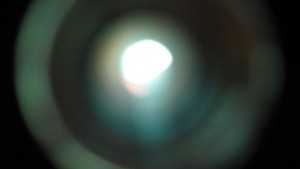
Peephole Close UpIn a knowing homage to Kubrick, I will use the peephole of a door in place of an eye. It implies the potential to be watched, without the observed knowing if they are. This is how a peephole looks, when seen close up and lit from behind…

The Kubrick Stare

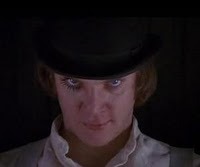
It is amazing what effects you can generate without CGI. Ask somebody to tilt their head forward, roll their eyes upwards as far as they can, and look into the camera. You have the Kubrick stare. Kubrick uses it to denote a kind of malevolent insanity. In a riff on how he uses it, I will ask actors to mimic the movement, but weave it into a natural motion, leaving the audience to decide if the character is mad, bad, or just tilting their head forward and rolling their eyes upwards. Here is a classic example of the Kubrick stare, by Malcolm McDowell in A Clockwork Orange.

Corridors

There is something alien about corridors. The space is unnatural. Human beings evolved to live on the plain. Even in a cave, you never find a space like the rectangular shard of a long straight corridor. Corridors are literally cross-sections of reality. Whilst convenient, they are dead space, that join together living space. I had this very much in mind when I began writing the screenplay, which features a character that loses their own sense of space and time within a labyrinthine apartment building. Corridors also make us aware of the possibility of many other lives around us, even though they are out of view. Only recently I remembered that Kubrick makes use of corridors in his films, also creating a sense of the eerie and alien. See below for the best known example of Kubrickian corridors, from The Shining.

Halfthoughts on Holiday(ish)

After 172 half-musings in a row, Halfthoughts finally had to go on holiday. That is, if you can call it a holiday. Some tourists choose to ride a dhow, a traditional Arab boat, around Doha’s harbour. But few would chose to do so at 3am whilst holding a microphone boom, recording an Indian family of amateur actors, talking in Hindi, pretending to be fishermen (or are they amateur fishermen pretending to be actors?) But I do have one comfort – if I fall into the water, at least it will be warm.

Halfthoughts will be away for two weeks in total. This weekend I will be sound operator for the lovely Suzi Mirghani’s directorial debut. Next weekend I will be directing the lovely Suzi Mirghani’s acting debut. I also volunteered to act in her movie, but at the audition, Suzi did not like my reprise of Alec Guinness’ performance in A Passage to India. Ms. Mirghani is a talented woman, so I cannot allow even a quarterthought to distract me from giving her my best, such as it is. Please feel free to send in advice about how to hold a boom, but please, no funny jibes about where I can stick it.

In the meantime, I refuse to believe you have read all 172 halfthoughts. Instead of bemoaning the lack of this week’s halfthought, go back and read the ones you missed. I rather like them all (but then, I would). You could read my comic assault on Stephen Hawking’s genius (and the comment from a reader who finds my cosmology to be more confused than space-time in the middle of quasar). Or you could try my thoughtful analysis of what would really happen if zombies rose from the grave. Think less George A. Romero and more Luton on a wet Tuesday. Or read what Bill Clinton thinks about being the only living Democrat President not to be a Nobel Peace Prize winner.

But perhaps you have read all 172 former posts. In that case, let me know, as you clearly deserve a prize. I will ask the lovely Suzi Mirghani to donate the title creature of her film: a great big hamour fish.

Something of You

In the kitchen,
Surrounded with the spice and flavour of cooking,
I rattle my pots,
Beat my eggs,
And pummel my dough.
The kids run all about,
Slamming the doors,
Shouting down the street,
And racing up the stairs,
Until I can never be sure which ones are in,
And which are out.

But when you creep in,
Trying to surprise me for the thousandth time,
You know you will fail,
Because I know when you are nearby.
Back from your game,
Showered and clean,
There is still something of you in the air,
And I do not need to look around,
To know that you are there.

The Hacker Store

[A surly man reads his paper, standing behind the counter of a general store. All sorts of tins, hardware and knickknacks are displayed on the shelves behind him. A teenage assistant in loose-fitting jeans is stacking shelves to one side. A customer enters the store, the bell on the door rings as it opens. The customer walks up to the counter.]

Customer: I was wanting to take up a new hobby, and I hear you can help.

Shopman: [Puts his paper to one side and sniffs] Oh yeah? Well, maybe I can, maybe I can’t. It depends on what kind of hobby you had in mind.

Customer: Phishing.

Shopman: Angling? You want the sports and country store, a hundred yards down the High Street.

Customer: No, not f-f-fishing. Phishing. As is in ‘Philip got his PhD in Ph-ishing’. [He winks]

Shopman: Oh, well why didn’t you f-f-flipping well say so? If it’s ph-ishing you’re interested in, [he looks around suspiciously] we can help with that. What kind of phishing are you wanting to do?

Customer: I thought I’d try to catch them on-line.

Shopman: Yes, that would be the best way to go about it. But you’ll still need a way to hook ’em.

Customer: How do I do that?

Shopman: With a worm. We’ve got a very wide choice of worms you could use, everything from one that caused a right storm, to one that’s so-big [gestures with his hands to indicate the size]. After you’ve hooked ’em, you’ll also need something to land them.

Customer: And what do I use for that?

Shopman: For that, you’ll need a net. A lot of people like to use bot-net, but if you want the very latest, most sophisticated gear, I recommend stux-net.

Customer: Okay, I’ll take the stux-net.

Shopman: [Pulls out a USB stick] Very good, and I’ve got the latest version here for you. [Turns the USB stick around to reveal an Apple style logo printed on it] It’s called “iRan”. This one reaches the places that others can’t.

Customer: Now, I also want to look the part when I’m doing my phishing.

Shopman: Of course you do sir, and we stock a variety of fashions which might interest you. First there’s spy-wear [puts on a trench coat and dark glasses] if you want the discrete look. Or there’s crime-wear [puts a stocking over his head]. If you want something more obvious, you could try ad-wear [unzips his jacket and points at a big Nike logo on his t-shirt], or to really stand out from the crowd, you could try scare-wear [he pops fake fangs into his mouth].

Customer: That looks monstrous.

Shopman: Yes, but be careful – you don’t want to end up a zombie.

Customer: I don’t think any of these styles will suit me.

Shopman: Well, like my assistant, you could go for the perennial fashion favourite, mal-wear [points to his assistant].

Customer: Why’s it called mal-wear?

Shopman: I have no idea. [Shouts to his assistant] Malcolm, why’s it called mal-wear?

Malcolm: [Pulls his jeans up] because it doesn’t fit.

Customer: Ok, I’ll take two mal-wear outfits. I won’t need to try them on. [Shopman pulls out pants and tops and puts them on the counter.] This is great, with my new look, I expect I’ll be a big hit with the ladies.

Shopman: That’s true, and in that case, you’ll also need some of these [pulls out a small box and puts it on the counter.]

Customer: What are they?

Shopman: Trojans [turns the pulls box around to reveal they are Trojan condoms].

Customer: That’s great! I suppose it’s no wonder that phishing is popular.

Shopman: True, though I’ve stopped doing it myself.

Customer: Why’s that?

Shopman: Me, I couldn’t hack it. I always went down with a virus.

Customer: Sexually-transmitted?

Shopman: Chance would be a fine thing! No, I got them from autorun [makes a wanking gesture with his hand].

Customer: Oh dear. So what if I don’t have any success with phishing? A man’s got to provide for himself.

Shopman: Well, you could always try growing vegetables instead. This’ll help you… [brings down a box from a shelf and puts it on the counter].

Customer: What is it?

Shopman: It’s a root-kit. Ideal for planting in difficult places. And if that’s not to your taste, we’ve always got plenty of this in stock [places a tin of Spam on the counter].

Customer: Thanks, but I think I’ll try the phishing first and see how it goes. How much do I owe you for all this?

Shopman: That depends. Are you paying with your credit card… or with somebody else’s?

Customer: I thought I’d use somebody else’s.

Shopman: In that case it’s free.

Customer: Thank you very much!

[Customer takes his bag and turns to leave.]

Shopman: Hey, where do you think you’re going?

Customer: I was just going to leave…

Shopman: Not that way, sunshine. From now on, you go through the backdoor [points over his shoulder and guides the customer through the exit behind him…]

Re: Move (Reprieve)

If ever you find yourself selected for a Doha Film Institute program, you may want to celebrate by sitting down and writing a dozen unrelated posts for your blog first. You will soon be pouring long hours into drafting screenplays, but those hours may still not be long enough, and writing blogs may finish you off. Crippling yourself with keyboard-inflicted RSI also tends to complicate the task of handling a camera. For all that, being put under the cosh at least makes you productive. Earlier screenplays First Person Singular and Remove have morphed again, into a story I now call Re: Move (geddit?). Re: Move is the script you get when you take the story of Remove and reflect it in a gender mirror, with a woman as the central character, instead of a man, and all the changes in nuance that come with that. I like it more. It is tighter, more natural, but also more challenging. When you swap a character’s gender, you realize how much sexually stereotyped baggage you lumbered them with. As a result, the new central character has imbued the characteristics of a ladette. This heightens the challenge to preconceptions about how somebody should behave in her circumstances, whilst giving her a paradoxical vulnerability. That is what I think, anyway. You can decide for yourself, by reading the screenplay here.

Talks with a Stork

Karen, stuck at Lundern Central, and frustrated by the unhelpfulness of the Ticket Inspector, is muddled and befuddled about what next to do…

Karen could feel her face turning hot, and red. It was beyond countenance that her father could not travel to her, and that it would be twelve months before she could return to London. Exasperated to the point of speechlessness, she found herself staring at the Ticket Inspector, then turning away, then turning back and staring again, then opening her mouth, not saying anything, closing it and opening it and not saying anything again. Some of Karen wanted to cry. Some of Karen wanted to scream. Thankfully, a lot of Karen was a big, sensible, level-headed girl now, as her father would proudly comment when he thought she could not hear. But still her mouth opened, and closed, to no effect, for want of words to utter. Karen could not think of what to say, but she did think her wide-mouthed silence might give her the appearance of a guppy, so she closed her mouth, and composed herself.

Steadying herself, and looking the Ticket Inspector hard in the eye, Karen stepped towards the Ticket Inspector’s window, and had worked out what to say when, the stork, which had passively kept one eye on proceedings, stretched one long limb ahead of Karen, stood in front of her, and addressed the Ticket Inspector instead.
“You’re a monstrous bully,” said the stork, to the Ticket Inspector, in feminine voice, both high-pitched and serene.
“I dispute that!” protested the Ticket Inspector.
“And I dispute this!” retorted the stork. It not being clear what the stork was disputing, the Ticket Inspector was rendered as speechless as Karen had been. The stork continued: “this poor girl is looking for a way to get home. Can’t you be a little bit more helpful?”
“No, not really,” replied the inspector. “It’s my job to inspect tickets, not to change schedules to suit young ladies who get on trains that go the opposite way to the way they want to go.”
“Very well,” said the stork. “Then perhaps you could be a lot more helpful?”
The Inspector sniffed loudly, and as he did his nostrils flared, completing an expression of contempt. “No, I can’t be a lot more helpful, either.”
“Well, could you be helpless then?” suggested the stork.
“I’m not helpless. I’ve got more help than you can shake a stick at.”
“Oh, so if you’ve got that much help, you must be full of help? Well, that’s good, because we were looking for someone helpful. All that help must really weigh you down. Maybe you should give some to this girl. She obviously needs some.”
“Very well,” the Ticket Inspector puffed out his cheeks, “I’ll try to help if I can, but what does she want me to do?”
The stork turned to Karen, and spoke very slowly, as if addressing an imbecile. “Dear girl, what do you want the Ticket Inspector to do?”
“I need to get back to Westminster,” said Karen to the stork.
“She needs to get back to Westminster,” said the stork to the Inspector.
“She can go back in a year’s time,” said the Inspector to the stork.
“You can go back…” started the stork, but Karen interrupted.
“Yes, I understand that already,” insisted Karen. “I was wanting to go back sooner. Is there another way to go back?”
“She could walk,” said the Inspector to the stork.
“You could walk,” said the stork to Karen.
“How far is it?” said Karen to the Inspector.
“Well I don’t know. Tell her that I only know times, not distances,” said the Inspector to the stork.
“He doesn’t know,” said the stork to Karen.

Karen noticed her foot was involuntarily tapping on the floor. Between the stork and the Inspector, she feared she would lose her temper long before the conversation made any useful progress. Karen took a sharp intake of breath, and tried to start again.
“Is there another way to get back to Westminster?” asked Karen of the Inspector, “like a bus?”
“What’s a bus?” asked both the stork and the Inspector, simultaneously.
“Like a coach,” said Karen.
“Are you in training?” asked the stork.
“Not that kind of coach,” said the Inspector. “You mean a carriage, don’t cha?”
“Well, yes, I suppose so,” responded Karen, tentatively.
“Well there ain’t any carriages that go that far,” answered the Inspector.
The stork interrupted before Karen could speak, “you said before that you didn’t know how far it is to London.”
“I don’t know how far, but I do know it’s too far,” insisted the Inspector. “Carriages don’t go outside the city limits, not since the Vizier ruled that horses can’t break curfew. If they was to go outside the city limits, they might not be back home in time, and then they’d be in a right load of trouble.”
“Are you saying that the carriages are pulled by horses?” asked Karen. She quite liked the idea of riding in a horse-drawn carraige, but wondered why they were suggesting such an impractical mode of transport. “Don’t you have ordinary buses?”
“Not that I know of,” said the Inspector. “We’ve got trains, both underground and above ground, and carriages, or coaches as you call them, and we’ve got canal boats and we’ve got airships, but we don’t have buses, whatever they are.”
If horses sounded exciting, airships sounded extraordinary. “Could I take an airship to London?” Karen secretly hoped she could.
“It’s possible, I suppose,” replied the Inspector, “but not from here. Perhaps if you check at Waterpool Station, or Liverloo Street, they might have one going the right way.”
“Well that’s something good. And how do I get to Waterpool, or Liverloo Street?”
“You can’t,” said the Inspector.
“He’s right, you know,” said the stork.
“No I don’t know,” grumbled Karen, “and why can’t I go to another station?”
“Well, first off, we don’t get along with those stations, so you’ll have to walk to them. Then, secondly, it’s too late to walk, you’ll never make it to either before curfew. And thirdly, you’re not ensured.”
“He means insured,” said the stork, not entirely clarifying the problem to Karen’s satisfaction.
“What do you mean, I’m not insured?” asked Karen, thinking it wisest to deal with the last obstacle first.
“Everybody needs to be ensured,” said the Inspector, “you have to have ensurance to insure you’re safe.”
“I know I do,” added the stork. “They make me take flight insurance, in case I fly into things. And bite insurance, in case something bites me. And fright insurance, in case I get scared and faint. And height insurance, in case…” but Karen butted in.
“Well, how do you know I don’t have insurance?” protested Karen.
“You’re having a laugh, aren’t you?” chuckled the Inspector. “If you had insurance, you would have telephoned the insurance helpline, and asked them for help with getting back home.”
“He’s right you know. If you had insurance, you would have called them already. They solve most people’s problems for them. They simply hate having to pay out on a policy and will do anything to avoid it.”
Karen slipped her hand inside her pocket and felt her purse. She squeezed it, as if to judge how much was inside. And then she asked: “how do I get insurance?”
“You can’t, at least not at this time of night. You’ll need to get some tomorrow morning,” said the Inspector.
“So I can’t leave this station until tomorrow morning?” exclaimed Karen.
“You can’t leave even then,” replied the Inspector, “not without ensurance. You can’t walk anywhere without first getting ensurance. But you could catch a train.”
“But I want to go back to London.”
“The next train to London leaves in a year.”
“She knew that already,” interjected the stork. Karen felt the stork was trying to help, though she was failing miserably. And then the stork surpassed Karen’s low expectations. “You could give her a waiver.”
“A waiver?” said Karen.
“A waiver?” said the Inspector, “I suppose I could. It’s irregular, though.”
“What kind of waiver?” asked Karen.
“An insurance waiver, my dear,” replied the stork, once again talking to Karen like she was the most ignorant girl in the world.
“But somebody will need to escort her as she walks around town.”
“I’ll escort her.”

Karen was unsure what to make of the stork’s offer, but her motives seemed kind and genuine. Though Karen would hardly have chosen to spend her evening following a stork around, it seemed the best of the limited options available, given the only alternative seemed to be living in the station for next year of her life. The Ticket Inspector, possibly glad to be rid of Karen and the stork, said nothing as he stood up and fetched a large pad of paper from a draw in a tall wooden storage cabinet at the back of his room. He carried it back, and sat down, and lifted up his pen.
“What’s your name?”
“Karen Zipslicer.”
“Not yours.”
“Cecilia Down,” answered the stork.
“Now yours.”
Karen hesitated, then realized it was her turn, “Karen Zipslicer. Would you like me to spell it?”
“No, I don’t trust your spelling,” was the Inspector’s gruff reply. He scribbled rapidly, and in a few seconds, tore the perforated paper from the pad, and slid it across his counter towards the stork, who we now know is called Cecilia. Cecilia picked up the waiver in her bill, and tucked it under a wing, saying thanks to the Inspector as she did.
“Thank you,” added Karen, after a moment.
“You’re welcome,” said the Ticket Inspector, in a not especially welcoming voice, especially as he immediately added, “now it’s time for my break,” and he pulled down a blind in front of his window. Words were printed on the blind in block letters: ‘Not here now. Back later.’

Cecilia turned to face Karen, but then looked past her, at a large rattling arrivals board suspended from a wall some way behind her. Karen looked around at the board too, and as she did, it rattled again, and a new train had risen to the top slot. “It’s time for me to collect my package,” said Cecilia. “You wait here, whilst I go and fetch it,” and with that, Cecilia stretched her long legs and rapidly walked away, towards and then down a stairway beneath the arrival board. With Inspector and Cecilia gone, Karen was quite alone. This side concourse was empty and quiet, but a hubbub emanated from the main concourse. At first Karen stood still, looking across at the scene as the strange passengers of Lundern made their way to and fro. After a few minutes, Karen ambled towards the glass partition that separated this part of the station from the main concourse, becoming more inquisitive, the closer she was to it. The station was populated by many peculiar characters, both human and animal. Many women wore bonnets, and men wore hats, whilst most animals went unclothed, though some wore caps fastened around their heads by string. The women looked like quite pretty, thought Karen, though some of their bonnet brims were so long as to completely hide the wearer’s face. There were many types of animal, from little mice to one tall llama, though all seemed courteous enough to mind where they trod, and none demanded right of way. Some of the people and some of the animals wore what looked like dark glasses, which was odd, as the evening light had faded, and the hall was lit only by dim lanterns. Animals acted like people, and people acted somewhat like animals, and none paid much attention to the other, except to remain a polite distance from one another, as if everything in the scene was ordinary, though disorderly, as they all weaved past each other. Karen was engrossed for a little while, and then it occurred to her that she was above ground, and she reached for her mobile phone. There was no signal, and Karen looked at it, disappointed. She mused about how to get a message to her father, reassuring him that all was fine, for the moment, though Karen more wanted to hear his reassuring voice. But there seemed no way to contact him. She supposed that Cecilia, the stork, would have to help Karen find somewhere to spend the night, so she could catch an airship home tomorrow. And whilst she imagined what it would be like to fly in an airship, and where she might find herself sleeping, Karen heard Cecilia’s high-pitched voice above the din of the crowds, calling to her from the other side of the glass. “Come along now,” said Cecilia, who spoke whilst taking care not to drop a package suspended from her beak by a muslin hammock.

Karen found a door and walked briskly across the main concourse towards Cecilia. Cecilia stood perfectly still and upright, looking quite majestic, unmoved by the streams of commuters that parted to pass around her. In contrast, Karen found it troublesome to navigate her way across the hall. She changed direction or broke stride after every few steps, such was the pellmell of people and creatures. A rabbit tutted at Karen, when she nearly stepped upon it, and a fox gave her a stern look when she obstructed its path. Karen felt quite awkward compared to Lundern’s inhabitants. Whilst the people and animals traversed the concourse with a grace that might match a dancer’s, Karen was as out of place as a fish on dry land. Eventually, after much stopping and starting, Karen arrived at Cecilia, who, without saying a word, lead the way to the exit on the far side of the station. Somehow it was much easier for Karen to make progress, now that she walked in Cecilia’s wake. Though glad to be going somewhere, Karen was eager to know more. She raised her voice, and asked: “where are we headed?”
“I have to make a delivery. They’re nice people; they’ll put you up for the night.”
“A delivery? Of what?”
“My dear, I’m an obstetrician, don’t you know?”
“An obstetrician… does that mean you’re delivering babies?”
“That’s right. I deliver babies.”
“They don’t deliver babies like this, where I come from.”
“Really?” and Cecilia seemed to smile to herself, like she thought that Karen was talking the most perfect nonsense. “Well, how do they deliver them, where you come from?” asked Cecilia.
“Oh, it’s complicated,” answered Karen, truthfully.

They had reached the grand arches of the exit now, and as they stepped outside on to the cobbled street, the crowds subsided and Cecilia could comfortably turn back to Karen.
“But you’re carrying a box,” said Karen, most bemused. “Do you deliver babies in a box?”
“I do sometimes,” said Cecilia. “Take a look inside,” suggested Cecilia, “but be very quiet – we don’t want to disturb the little mites.”
Karen bent over, and gently placed her hands underneath the hammock held in Cecilia’s bill. Lifting it closer to her face, she could properly see the box within the hammock. It was square, and made of cardboard. Round holes had been made in the top and one of the sides; they were large enough for an eye to look through. Lifting the box higher, towards the light from a street lantern, Karen placed her eye up to a hole in the side of the box. Inside, she could dimly see three white kittens, with eyes closed, seemingly sleeping on a thin bed of straw. Unable to resist, she commented: “they’re so cute.”
“They are,” agreed Cecilia, “but come, we have to get them home now.”

Eight Into None

0

The killing happened on Monday.
The grief poured out on Tuesday.
The rage built on Wednesday.
The tension rose on Thursday.
The rain poured down on Friday.
The mob hunted on Saturday.
The scapegoat was found on Sunday.
The killing happened on Monday.

Asking Questions of Pilger’s Research

The beginning is a good place to start a story.

The Euro-American attack on Libya has nothing to do with protecting anyone; only the terminally naive believe such nonsense.

After the heading and sub-heading, that was the first line of John Pilger’s 8th April column for the New Statesman. I have no strong feelings about Pilger, but I dislike bullying in any form. When someone begins an argument by asserting that anyone who believes the contrary is terminally naive, my first thought is that the writer is stooping to a kind of intellectual intimidation. Terminally naive? Is this the kind of naivety that might, in the right circumstances, be fatal? I prefer to hear arguments without a commentary that asserts anyone of opposing views must be a cretin. As an equal opportunities cynic, I am willing to adopt an equally low opinion of anyone in the world, no matter what nationality, race, religion, gender, political orientation or career. So I felt myself challenged by Pilger’s words. Might Pilger’s bombast be cover for a terminal weakness in his own argument? And if so, might someone, a mere blogger, be able to do research which exposes the flaws of a professional journalist?

I read on, alert to the possibility. Pilger’s next sentence:

It is the west’s response to popular uprisings in strategic, resource-rich regions of the world and the beginning of a war of attrition against the new imperial rival, China.

There would be no point arguing about the reasons behind the west’s response. That requires the interpretation of an intention, which is not something suited to objective fact-checking. In contrast, the extent of competition with China might be easier to validate or disprove. In short, it relies on the fact that China has an interest in economic relations with Libya, and this might be shown by the extent of existing trade, and indicators of how much the Chinese are fostering future trade.

Despite citing Chinese interests at the beginning, China gets hardly another mention in Pilger’s article. This excerpt is the sole exception:

[President Barack Obama’s] assault on Libya is run by the US Africa Command, which was set up in 2007 to secure the continent’s lucrative natural resources from Africa’s impoverished people and the rapidly spreading commercial influence of China. Libya, along with Angola and Nigeria, is China’s principal source of oil. As American, British and French planes incinerate both “bad” and “good” Libyans, the evacuation of 30,000 Chinese workers is under way, perhaps permanently.

There in the middle, was a fact to be checked. Is Libya, along with Angola and Nigeria, China’s principal source of oil? I was drawn to the statement because it is so curious. First, if you asked me which nation was the principal source of oil for China, I would presumably answer by giving the name of one country, not three. The way this is written, I can only assume that Pilger means Libya is one of the three countries that exports most oil to China, along with Angola and Nigeria. Secondly, without my doing any research, it is suspicious. There are nations that produce more oil than Libya, Angola and Nigeria. There are oil-producing nations which are closer to China. And there are oil-producing nations which are more overtly hostile to American interests, like Iran or Venezuela. If I was responsible for China’s energy strategy, and worried about American competition for oil, I would focus my strategy elsewhere than Libya. Libya creeps in at the bottom of the top 10 countries for oil reserves, but it is not currently one of the top 10 oil producers. More importantly, because of the distances involved and the nature of the region, supplies to China could be easily interrupted, especially at a time of crisis. Libya mostly trades with Europe, for obvious reasons. Finally, whatever else you may think of it, Gadaffi’s regime has long been eccentric and unreliable. None of these are conducive to China placing Libyan oil at the core of their energy strategy.

Before I continue to my findings, let me emphasize who John Pilger is. This is the bio that the New Statesman presented alongside Pilger’s article.

John Pilger, renowned investigative journalist and documentary film-maker, is one of only two to have twice won British journalism’s top award; his documentaries have won academy awards in both the UK and the US. In a New Statesman survey of the 50 heroes of our time, Pilger came fourth behind Aung San Suu Kyi and Nelson Mandela. “John Pilger,” wrote Harold Pinter, “unearths, with steely attention facts (sic), the filthy truth. I salute him.”

To summarize: Pilger investigates the truth, and can be relied upon to do so with steely attention to the facts. So he is no ordinary journalist, who we could already assume should check his facts with the usual degree of diligence of anyone working in that profession. We can expect to hold him to an even higher standard than that.

No sources were stated for Pilger’s assertion about Libyan exports of oil to China, so I was left entirely to my own devices. I began my research with the CIA Factbook. Admittedly, this may be part of the US imperial conspiracy, but it was an easy place to look. These are the stats on where Libyan exports went in 2009: Italy 37.65%; Germany 10.11%; France 8.44%; Spain 7.94%; Switzerland 5.93%; US 5.27%. And these are the stats on where Libyan imports came from in 2009: Italy 18.9%; China 10.54%; Turkey 9.92%; Germany 9.78%; France 5.63%; Tunisia 5.25%; South Korea 4.02%.

Looking at those stats, you might think this was a proxy attack on Italy’s economy, not on China’s. One reason why Italy ranks so high for Libyan imports is that (according to the International Energy Agency) Italy is the top purchaser of Libyan oil. Italy buys 376,000 barrels of Libyan oil a day. China buys 150,000 b/d from Libya, less than France and only slightly more than Germany. Europe, taken as a whole, currently does fine when it comes to buying oil from Libya, and buys much more than China. At present, the “Euro-American attack” on Gadaffi does far more harm to the European economy than that of China. However, this is not conclusive. Pilger was talking about how much Libyan oil was imported into China, not how much Libya exported elsewhere. This is what the International Energy Agency had to say on where China buys its oil:

In 2009, the top ten crude oil suppliers to China (in order of import volumes) were Saudi Arabia, Angola, Iran, Russia, Sudan, Oman, Iraq, Kuwait, Libya and Kazakhstan.

I take that to be pretty conclusive. Angola, Nigeria and Libya are plainly not “China’s principal source of oil”. Pilger lied, inventing a fact to support a shaky argument. Saudi Arabia is China’s principal source of oil, which is unsurprising. Saudi Arabia is the principal source of oil for very many countries.

However, I stepped back and considered if this really was so damning for Pilger’s argument. Irrespective of current imports and exports, perhaps I should focus on his main thrust – that this was the start of a war over resources. In that sense, the future is more important than the present. So I kept digging, to see what China is doing to invest in future oil supply.

My research found a very useful report from the International Energy Agency, entitled “Overseas Investments by Chinese National Oil Companies”; you can download it from here. The report is up to date; it was issued in February 2011. The report says the Chinese are investing lots of money into oil projects in Iran, Iraq, Qatar, Kazakhstan and Russia, in order to secure China’s future energy supplies. It barely mentions Libya, and makes no mention of Chinese investment into Libya.

If the Chinese are not currently buying that much oil from Libya, and are not investing in oil production in Libya, that rather suggests military intervention in Libya has nothing to do with Chinese access to Libyan resources. My argument could stop here… but then I stepped back again and thought about Pilger’s thesis. Put simply, he thinks the US wages war in order to secure vital but scarce resources, like oil. I would agree with that… sometimes. An obvious example would be Iraq. Iraq not only has huge and under-exploited oil reserves, but they have the kind of oil fields must useful for stabilizing oil prices – the kind where supply can be increased or decreased at short notice, and will turn a viable profit either way. The importance of Saudi Arabia is based not just on how much it supplies, but the flexibility of its supply. In contrast, Russia is a huge oil producer, but because its reserves are more costly to exploit, they cannot afford to turn the taps on and off at short notice. When people argue that the US invaded Iraq as part of their strategy for energy security, that argument makes perfect sense. A secular and pro-capitalist Iraq, capable of ramping up oil supply at short notice, would provide a very useful alternative to always asking the Saudis to manage the price of oil. Indeed, that kind of Iraq is just what would benefit the west right now – when oil prices are pushed higher because of the loss of Libyan oil. However, it will take prolonged investment before Iraq is ready to play its part in managing oil prices. So, yes, one can posit a credible theory that US military intervention is sometimes motivated by its energy security goals.

But look on the research from the IEA again. Iraq is one of the countries receiving most Chinese investment into oil production. Since 2008, there have been four major deals for Chinese oil companies to develop Iraq’s oil production facilities. The total long-term investment represented by these four deals could cost the Chinese firms well over USD20bn. The largest of these deals involves a consortium with BP and an Iraqi firm, with the Chinese share of baseline oil production delivering more than four times what China currently imports from Libya. But this is Iraq, the country invaded by the US (with some European support) at crippling cost to the US economy. If the purpose of American wars is, per Pilger’s thesis, to deny the Chinese access to oil, then the Americans screwed up. They failed to put in place a government that favoured US interests sufficiently over Chinese interests. And Anglo-US businesses, in the form of BP, are willing to do deals to share production of oil with Chinese oil firms. Iraq presented the ideal opportunity for the west to control oil supply, to the detriment of the Chinese and other nations. That the west failed to do so, or chose not to, blows a gaping hole in the theory that the current intervention in Libya is motivated by control of resources.

Call me naive if you will, but after checking the facts, I am now more inclined to believe that humanitarian reasons were a factor when western politicians decided on military intervention in Libya. Even in Iraq, the west did not monopolize resources. The real naivety is to trust a professional journalist that has lost objectivity. In this case, Pilger lied about China’s interests in Libyan oil, in order to exaggerate the importance of the conflict and support his grand theories about imperialistic intent. Pilger’s investigations can still serve a purpose, but his bias means everyone has to double-check his research. It would be naive not to.

***
Update 29/12/2011: It may not be about Libya, but Pilger’s terminally absurd theory of ‘the beginning of a war of attrition against the new imperial rival, China’ was dealt another hammer blow by news that Afghanistan’s first major oil and gas deal was signed with China. China’s CNPC will invest a minimum of USD400M in a deal which the Afghans estimate will generate USD7,000M of income for their country. You can read more at Reuters. It is comforting to know that traditional journalism still persists; I expect there will be one investigative reporter who will not cover this story.

Apart; Meant

0

There are fewer words, but more lights, camera, action with this post. Use the player to watch a short movie of sounds and still photo images, or you can download the file from here to play and use as you like, so long as you respect the Creative Commons license (see below). The story is derived from a segment at the core of my recent screenplays Remove and First Person Singular.

Apart; Meant by Eric Priezkalns is licensed under a Creative Commons Attribution-NonCommercial-ShareAlike 3.0 Unported License.

Creative Commons License

The Ticket Inspector

After disembarking at Lundern Central, Karen discovered the next tube from Westminster would be along not in a minute, or an hour, or even a day, but in a year. Following the advice of the hamster who was a tube driver and much more, she sought the help of the ticket inspector.

An old tin sign pointed Karen to the exit from the platform. Or it would have, if it pointed the right way. The sign hung from one nail, the others having rusted to a dim memory of functioning wall fastenings, hence causing the arrow to point straight down at the ground. There being no hole to descend down, this was obviously not the way the arrow should be pointing. Karen soon surmised the arrow was meant to point to an archway near the end of the platform where she stood. Another sign, which was slightly less rusted, read: “do not walk up the down ramp”, which meant nothing to Karen. Through the arch, Karen bounded up the broad stone stairs, taking them two by two. Karen was inclined to hurry, whilst the steps were only gradual in inclination. The staircase twisted around into a spacious spiral, so that it occurred to Karen that she was running a long way around just to climb a little way up. She skipped up them, undaunted, and determined to get to the top as soon as she could. A smoothly polished wooden slope wrapped around the outer rim of the stairs. Karen supposed this was the down ramp mentioned in the sign. A low, solid guard rail separated the ramp from the stairs. At first Karen could not decide what the wooden ramp was for, but she soon found out. A woman, followed by a man, rounded into view, sliding down it. They both glided silently and impassively, sitting on hessian mats with their legs stretched out before them. Both the man and woman were both oblivious to Karen, and to the entertaining nature of their mode of descent. The woman’s hands were crossed in front of her, holding her handbag on her lap, whilst the man was reading a newspaper, as if this was the most perfectly ordinary thing to do whilst riding the equivalent of a fairground helter skelter. Both were wearing old-fashioned clothes, but Karen had little time to observe them more closely, as they soon disappeared out of sight. She momentarily considered jumping on to the slide too, for the fun of it, but soon reminded herself of the task at hand. Up more stairs she skipped, intent on reaching the top, so that when she finally did, Karen was quite breathless.

The stairs had brought Karen to a large concourse, which was itself separated from an even larger concourse by a partition made of a metal frame and glass panes. Looking around, and catching her breath, Karen tried to spy somebody with an inspector-like uniform. People and animals were walking back and forth, but their haste suggested they were commuters, and not staff. Only one creature stood still, a tall and elegant stork standing near the wall to her right. The stork eyed Karen from a few feet away. It wore a peaked cap, and Karen took this as a possible indication that the stork worked at the station. Karen sidled up to the stork and asked, feebly at first, “excuse me, Mr. Stork, I am looking for the ticket inspector.” The stork said nothing, but a gruff voice answered from behind a dirty window, set back in a recess to the wall that Karen had not noticed before.
“Does she look like a ticket inspector to you?”
“I don’t know,” replied Karen. She turned to face the gruff voice, which belonged to a gruff-looking man in a gruff-looking uniform.
“Well, she’s not a ticket inspector. She’s an obstetrician, ain’t she? Can’t you see by looking at her? I’m a ticket inspector. I’m the Ticket Inspector for these here platforms. That’s why I have to sit here, stuck behind this glass, in this tiny little room, looking out upon this vast space and waiting for people to give me tickets to inspect.”
“So what happens if people don’t give you their tickets to inspect?”
“Well then, that’s not my problem, is it?”

Karen’s brow creased as she tried to understand the logic of the inspector’s job, especially as his window was so hidden from view, but she soon concluded that trying to understand the inspector’s job was hopeless, and a distraction. She decided she should stop working things out for herself, and just start asking questions. But before she had the chance to ask a question, she was asked one instead.
“So what is it you want?” demanded the inspector. “Your ticket for example, is it needing a thorough inspection?”
“No, my ticket is fine,” lied Karen, who assumed her ticket was far from sufficient for the extraordinary journey that had brought her to Lundern. “The nice hamster who drove my underground train said you might be able to help me. I want to know how to get back to Westminster.”
“Whatsminster? That’s a funny name for a place. Where’s Whatsminster?”
“Not Whatsminster, Westminster.”
“Wheresminster? What’s Wheresminster?”
“Not Wheresminster, and not Whatsminster, but West-minister, in London, is where I want to go.”
“There’s no Westminster in Lundern.”
“Not Lundern, London. Lon-d-o-n. London.”
“Lon-DON? Never heard of it. Perhaps you’re just a bad speller,” and the Inspector sniffed and then suggested: “Perhaps you mean Worstminster? Or maybe Bestminster? I know which I’d prefer…” and then he enigmatically added, “neither.”
“Westminster, you must have heard of it,” insisted Karen. “I got on a tube train from there just a quarter of an hour ago. It brought me here, by mistake. Now I want to go back.”
“Oh, I don’t think it was a mistake. Those underground trains run on rails inside tunnels, and no mistake. If there was a mistake, it was youse that must have made it by getting on the train. But the train went where it was supposed to. I’m sure of that.”
“Maybe you could look up Westminster in your train schedule?” pleaded Karen.
“Westminster,” mused the inspector, “come to think of it, that does ring a bell. Is it West of Eastminster?”
“Erm…”
“… and is it North of Southminster, and South of…”
“Northminster?” offered Karen, just a little sarcastically.
“I was going to say Bogham,” said the inspector, now flicking through his schedule, and sniffing as he did. Walking his fingers across one page, the Inspector pointed emphatically, looked up, and raised his timetable to the window, so Karen could see the relevant entry. “Yes, we have a train that runs to Westminster, once a year. You missed it. It left half an hour ago.”
“I know, I rode it on the way back.”
“Well, you obviously shouldn’t have ridden it on the way back. You should have ridden it on the way there. Then you’d be there by now, instead of being here. Not many people go to Westminster, though. It’s not what they call a popular destination.” The Inspector leaned nearer to his window, and in a stage whisper he said, “I hear it’s full of weirdoes, if you know what I mean.” Then he leaned back again and said, rather dismissively, “and looking at you, I think you know what I mean.”

Karen knew very well what the Inspector meant; she need only look to present company for an example. Karen compounded that thought by wondering if everything else in Lundern was upside-down, back-to-front, or, at the very least, slightly askew. The sooner she was on her way home, the better.