Home Blog Page 26

Parallel Return of the Jedi: Interruptions

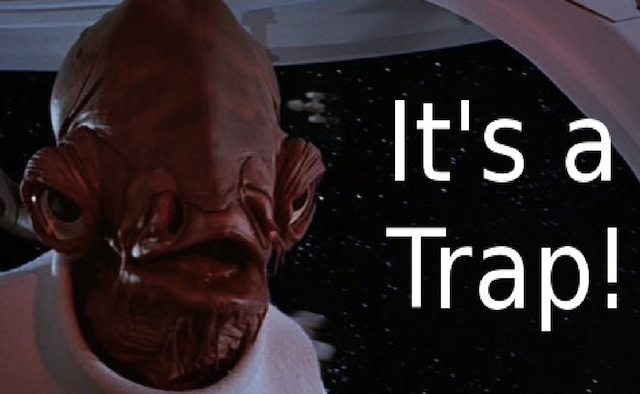
At a studio, nearly thirty years ago, somewhere rather near Borehamwood, they knocked up some plywood sets and pretended they were spaceships. The time was a fair while ago, and the place quite far away, unless you are currently doing your shopping at the Tesco’s on Borehamwood high street, in which case it is next door. It took extraordinary imagination to turn that fakery into a far-off galaxy, though alien monsters might blend in easily enough around chucking-out time at Borehamwood’s rougher pubs. The movie was an inspiration to many. The plywood sets and the plywood acting encouraged countless people, all over the planet, to grab the nearest mop and to hold it like a really really futuristic hi-tech sword. So convincing was the story, that nobody thought it odd that you might fly several hundred thousand light-years in order to fight people using an upgrade of a medieval weapon with an effective range of 1.33 metres. People thought the film was pretty darn fantastic (though not quite as fantastic as the two films that went before it) and to this day, some people still dress like extras from the movie, except that their stormtrooper outfits probably fit better. And so it is that, even after all this time, you know what I am writing about, and I can continue to parody that story.

Not that recently, in the last installment, we left the story with Darth Vader performing a time and motion study on Death Star construction, whilst the heroes had escaped the clutches of both Jabba and a big mouth in the desert…

[The Emperor’s shuttle lands in one corner of a cavernous docking bay on the equator of Death Star 2.0. Inside the shuttle, the Emperor prepares to make an impressive entrance.]

Palpatine: I’m ready. Hand me my cane.

[One of Palpatine’s guards, dressed all in red, hands him his cane. Palpatine gets to his feet and takes a deep breath. He runs his finger over his teeth.]

Palpatine: (to his guard) There’s nothing in my teeth, is there?

[The guard shakes his head.]

Palpatine: No? Good. And no bogeys up my nose? (he tilts his head back to make it easier to see.)

[The guard shakes his head again.]

Palpatine: Okay, boys, you go out there and warm up the crowd. (Turns back to the shuttle pilot) And you, don’t forget that I want plenty of dry ice as I walk down the ramp. It’s showtime!

[The shuttle ramp descends, and the Emperor’s personal guards file out. After the last guard leaves, Palpatine pulls his hood up and begins to make his own way down, then stops and turns back to shout at the pilot.]

Palpatine: You’re playing the wrong music!

Shuttle Pilot: It’s the Imperial March, sir.

Palpatine: I know what it is, you fool. It’s just that everybody thinks that it’s Darth Vader’s theme. They play it everywhere he goes, and he goes out a lot more than me. Put on my new music instead!

Shuttle Pilot: Are you sure, sir?

Palpatine: Just play it, you cretin.

[Palpatine slowly steps down the ramp, accompanied by the theme from Psycho. When he gets out, he finds Vader kneeling before him, and three nerds in ‘Star Wars’ t-shirts, clapping and hooting. The hanger is otherwise empty. Nobody else has come to greet him.]

Palpatine: (to Vader) Arise my friend… and tell me why there’s nobody here to witness my historic arrival?

Vader: Master, we did find three groupies to celebrate the occasion (he gestures towards the nerds).

Palpatine: Even so.

Vader: The Death Star will be completed on schedule – I thought you’d be pleased that I didn’t interrupt the construction work, just to have them come down here and pester you.

Palpatine: Blasted efficiencies. They take the fun out of everything. At the very least, somebody could have arranged a golf cart to pick me up. (Palpatine starts to slowly make the long walk towards the hanger exit, leaning on his cane as he does).

Vader: Master… the groupies? They’ve been waiting quite patiently for you.

Palpatine: Very well, but I won’t do autographs or pose for photos.

[Palpatine walks across to the nerds, intending to only briefly engage them in conversation.]

Palpatine: (to the first nerd) Hello there, my spotty young fellow. I understand you’ve been waiting for me.

Human Male Nerd: Yes we have. But the line was much shorter than for Boba Fett. We had to literally camp overnight to get his autograph.

Palpatine: Well, I don’t do autographs.

Human Male Nerd: You don’t? But the organizers of DeathStarCon 3030 said you would.

Palpatine: The Empire doesn’t officially endorse DeathStarCon 3030. They refused to pay the royalties we asked for. Take those tee-shirts for example. (Palpatine starts to point at the chest of the male nerd he was talking to, then prefers to point at the ample bosom of the female nerd next to him.) They don’t look like official Imperial merchandise. And why do they have “Star Wars” written on them?

Human Female Nerd: It’s a film, sir, based on a factual account of the events leading up to the destruction of Death Star 1.0. You could call it a disaster movie.

Palpatine: (Pleased) Oh really, they made a film about my first Death Star? And who did they get to play me? Nic Cage perhaps, or maybe Christian Bale?

Human Female Nerd: Actually, you don’t appear in the film.

Palpatine: What? How can there be a film about the first Death Star without featuring me? I paid for the blasted thing! (Turning pointedly towards Vader) Then some idiot son of Skywalker blew the whole thing up by firing a pea shooter down an exhaust vent that had no proper safety grill over the top. (Turning back to the nerds) That is why I’m here now. I have to take care of everything personally. I’m running the whole galaxy virtually single-handedly. (He lifts his hand up and makes a fist, which he shakes.)

[The third nerd, an indescribable alien nerd, decides he cannot contain his excitement any more, and he has to join the conversation.]

Indescribable Alien Nerd: That’s so so true, your imperial majesty. Anyone would think you were vacationing during that whole sordid incident.

Palpatine: (Evil laugh) I wish I had time to vacation. No, I was taking care of business. I was restructuring the crippling debt burden I inherited from the Republic…

Human Female Nerd: And greatly increased the visibility of law enforcement…

Human Male Nerd: And… and… carbon neutrality – your policy changes transformed it from a hopeless aspiration to a viable target.

Palpatine: Yes, but what thanks do I get? Not nearly enough! So which character was the lead in this movie, this “Star Wars”?

Indescribable Alien Nerd: That would be Lord Vader, your majesty.

Palpatine: (Looks at Vader again) Oh, it was, was it? And did they present him as a bumbling oaf who was lucky to escape with his life?

Indescribable Alien Nerd: Yes, yes they did, sir.

Palpatine: Well at least they got that bit right. Oh well, I’ve enjoyed talking but really I need to take care of some more business – like getting this new Death Star finished, and doing a better job than was done with the last one! Good bye.

[Palpatine turns and walks off. Vader follows two steps behind.]

The Nerds: Goodbye, your imperial majesty!

Darth Vader: (under his breath) And Goodbye to you.

[Behind Palpatine’s back, Vader force chokes the three nerds.]

[Luke visits Yoda’s hovel on Degobah. Yoda is feeling a little poorly, so his Jedi poker buddies are also hanging around, keeping him company.]

Yoda: (to Luke) That face you make, look I so old, to your eyes?

Bora Bodur: (interrupting, before Yoda speaks) Shaddap. Of course you look old. We all look old. You just look the oldest.

Yoda: When nine hundred years old you reach, look as good, you will not.

Bora Bodur: What nonsense! I’m nine hundred and two, you whippersnapper.

Tanah Lot: I’m so old I can’t remember how old I am.

Chechen Itcha: I’m so old that nobody had invented calendars when I was born, so I can’t really say how old I am.

Sha-na-ram-a-lang-a-ding-dong: I’m so old that they didn’t have numbers when I was born, never mind dates.

Tanah Lot: I’m so old that even if I lived to the end of time, I couldn’t be any older than I am now.

Chechen Itcha: I can’t make any sense of what you just said.

Tanah Lot: That’s because you’re not old enough to understand it.

Luke: I’m not old, but I feel like I’ve spent a lifetime listening to that conversation.

Yoda: Interrupted, my train of thought is. Saying, what was I?

Bora Bodur: You were saying you look old.

Yoda: That was it, yes! (To Luke) Look I so old, to your eyes?

[Luke sighs heavily. Two hours pass in conversation about how old everyone is.]

Luke: Okay, can I just summarize? You’re all old. You look old, you smell old, and certainly sound old and I’m a lot older for listening to you. You’d probably taste old if anything was desperate enough to eat you. Can we now switch topics to what I came here to talk about?

Yoda: Like before I said, the boy has no patience.

Bora Bodur: He’s not the patient. You’re the patient.

Yoda: I said patience.

Bora Bodur: Patients? No, I can’t manage more than one at a time. I’m too old for that. Now get back into bed.

[Yoda climbs into bed. Luke tucks him in.]

Yoda: Soon, will I rest. Forever sleep, hmmm. Earned it, I have.

Luke: Master Yoda, you can’t die. My training is not complete, despite what it says on this certificate (holds up the certificate from Yoda’s Jedi School). I fought Vader, but he totally won!

Yoda: Strong am I with the Force. But not that strong. Everything I could, taught you I have.

Bora Bodur: What he means is that you’ll need to pay extra if you want the advanced course. Whatever he’s charging, I’ll train you for half the price.

Luke: But I need help. I’ve come back to complete the training. And the Rebel Alliance didn’t pay me a cent for blowing up the Death Star. All they gave me was this crumby medal. (Pulls his shirt open to reveal his medal.)

Tanah Lot: It looks like that chocolate money they give kids at Christmas. That really cheap and horrible chocolate that kids throw away because they won’t eat it.

Luke: Is there chocolate in here? (Luke tries to open up his medal.)

Yoda: No more training do you require. Already know you, that which you need.

Chechen Itcha: Exactly. You should have learned your lesson. Stop wasting your money on courses. Just fight a lot, and if you don’t get killed, you’ll get better at fighting. That’s how we learned in the good old days.

Luke: Then I am a Jedi.

Yoda: Oh… (cough, splutter) Not yet. One thing remains: Vader. You must confront Vader. Only then, a Jedi will you be.

Luke: Come again? I’ve confronted him once already.

Chechen Itcha: And since when was that part of Jedi training? I never confronted him, and I’m a Jedi.

Bora Bodur: Nor I. When I was training, they made me confront a chicken. I won easily, and made a tasty meal out of it. Teriyaki, if memory serves.

Luke: Master Yoda, is Darth Vader my father?

Yoda: Rest I need. Yes, rest.

Luke: I must know.

Yoda: Your father he is. Told you, did he?

Luke: Yes.

Yoda: Unexpected this is, and unfortunate. A way to predict that he might mention his being your father when you flew off to try and kill him, there was not. A family bond, mention, to someone trying to kill you, such a thing, who would do?

Chechen Itcha: (aside to Bora Bodur) Yoda manages to make even nonsense sound especially nonsensical.

Luke: Unfortunate that I know the truth?

Yoda: No! Unfortunate that you rushed to face him. That incomplete was your training.

Luke: Hold on, you only just said “no more training was required”.

Bora Bodur: He gets easily confused. Whatever you do, don’t pay for the advanced course. It’s just the same as the basic course but he makes you run longer laps around the swamp.

Yoda: Luke, when gone am I, the last of the Jedi you will be.

Bora Bodur: (outraged) Hey, what about the rest of us!?!? We’re not dead yet!

Yoda: (to Luke) The Force runs strong in your family. Pass on what you have learned.

Bora Bodur: That shouldn’t take him too long.

Yoda: (his voice growing weak) There is another… Sky… walk… er…

Luke: (turning to Bora Bodur) Is he (pauses) dead?

[Yoda farts and his blanket billows at the edge.]

Bora Bodur: Not yet. But let him have his sleep.

Luke: So what do I do now? Although I flew thirty thousand light years to get here, I didn’t plan to stay over. I didn’t bring my overnight bag or my jim-jams or anything.

Bora Bodur: Just go for a wander in the swamp. The gas it gives off will probably cause you to hallucinate, and you’ll mistake it for a vision of a dead person telling you something useful. In fact, we’d better all go out. The gases in here are more noxious than the ones out there.

To be continued, at some time, and some place.

Remove

If you have read First Person Singular and Mohammed and Hanka, then you know that I am working on screenplays for a short movie. Remove is another screenplay, depending on how you count these things. As far as the Doha Film Institute is concerned, it is a revised version of First Person Singular. As far as I am concerned, it is a completely new story, that just happens to share a few elements in common with an earlier story. It all comes down to semantics. Writing a new story is unacceptable to the DFI, as they selected me for their film program on the basis of First Person Singular. Then again, my tutors are very insistent that I make changes – to the point where most of us would question what was left of the original. Ho hum. Think of it like Jimi Hendrix playing the Star Spangled Banner or Miles Davis performing My Funny Valentine. It has the same roots, but grew in a very different direction.

After all that wordplay about wordplays, here it is.

Questions at Lundern Central

After being separated from her father and brother, and being tossed head over heel during a topsy-turvy tube journey, Karen Zipslicer arrives at Lundern Central station…

Karen stood, taking pause. Her heart had been racing. She breathed deep, trying to restore her calm. Seconds passed. Karen was composed again. She reasoned that there was nothing to really worry about; her father would soon come and find her. He would be on the next tube train and then they would be reunited: Karen, Dad and James, together. The best course of action was for Karen to do nothing, to stay right where she was, waiting for her father to find her.

Wherever she was, and Karen was not confident she knew where she was, but wherever it was, she did not like it very much. She hoped her father would arrive soon. The platform was grey and dusty. The white tiles on the walls had long been discoloured by smoke, though she could not imagine where that smoke could have come from. The evening sun poured in through grills in the ceiling, several metres above Karen’s head. They left the train and platform striped by light and darkness. She was alone, and the platform was silent save for a gentle murmur of crowds walking and talking on the street above. The sound of the people slid through the ceiling grills along with the sunlight. As they bustled, they cast shadows, projecting slanted versions of themselves on to the wall by which Karen stood. At one point, the shadow of a horse clip-clopped its way along the full length of the platform, in time with the noise of its hooves on the street above. Time went by, and Karen waited patiently.

Whilst waiting, Karen started thinking about the tube train that had carried her here. It was still resting on the tracks in front of her. By now, it should have moved on. Karen reached a simple but indisputable conclusion: if it did not move, then no other train could come and take its place. And if no other train could take its place, then her father could not get to her. She became anxious. Karen looked up and down the platform again, but there was no sign indicating how long it would be before the next train arrived. She walked up and down the platform, but there was no schedule pinned to the wall. Karen bit her top lip, willing herself not to be nervous. She turned one way, then the other, then back again. It did not help. She walked one way, then the other, then back again. Karen was winding herself up. A deep voice resonated over the train’s tannoy: “Can I help you, young lady?” Of course! The driver of the train would know the schedule. Karen cocked one heely, and speedily wheelied herself down the platform, towards the driver’s cabin. She whizzed her way there as fast as she could, and at the platform’s end she pivoted sharply, abruptly stopping just like an ice skater. Karen faced the driver’s cabin. But Karen could see no driver.

“Can I help you, young lady?” repeated the deep and velvety voice, but this time without the tannoy. It definitely emanated from within the driver’s cabin. But no person was in there. Karen stepped up closer to the train. The windows were grimy, but a little square hatch was open in the platform-side window. Karen pushed her face right through it, to better see the interior of the cabin, though the hatch was too small for the rest of her head to follow. The cabin was narrow. There were no seats. At most, two people could have stood in it, side by side, facing forward. There was really not much to look at, yet Karen looked very intently. She searched with her eyes, but there was nobody to see. “Hello?” said Karen. On the dashboard of the train sat a cage made of wire, with a wooden base. From within the cage, the voice responded. “Hello. Are you having difficulties, young miss? You seem a little… agitated.” Karen stared. She looked at the cage, but was momentarily unable to think of a response. The cage was the sort that might house a small pet. It had a wheel for a small animal to run around, some straw bedding, and a long-spouted water bottle protruding through the bars. Karen stared, and hesitated, and finally she rediscovered her manners. “To whom am I speaking?” asked Karen, using her most polite voice. At this, within the cage, a hamster’s head popped up above the straw. Upon his head, the hamster wore a black leather helmet, and around his face he wore goggles with thick lenses. Through the lenses, the hamster’s tiny black eyes peered into the relatively enormous hazel eyes of Karen. Karen’s eyes peered back. He looked at her, and she looked at him, and neither broke their gaze, nor blinked. Their faces were, at most, a couple of feet apart. They looked at each other some more, in silence, and then the hamster said, most matter-of-factly, “you are speaking to me. Now, is there something the matter?”

It took a while for Karen to appreciate that the hamster was talking; the hamster’s mouth did not move in time with his speech. In fact, it looked like the hamster was chewing on a sunflower seed, or something similar. Also, the resonant and sonorous voice was not at all how Karen imagined a hamster might talk, if she were to imagine such a thing. “Are you a hamster?” asked Karen, and then immediately regretted such a stupid question.
“Umm. Yes, but I would have thought that’s fairly obvious, and unrelated to your apparent distress. You’re a human, are you not? But I suspect your being an ape is not what’s the matter, any more than my being a rodent is a matter for your concern.”
“Yes, yes I am. And no, you’re right, it doesn’t matter that you’re a hamster,” and Karen was flustered, both at having such an unexpected conversation and at inadvertently insulting a tiny furry creature that talked so intelligently. “I’m very sorry,” said Karen, and she genuinely was. “I’ve never spoken to a hamster before. Or, to be exact, a hamster’s never spoken to me before, at least as far as I know.”
The hamster stared blankly at Karen. And then he pointed out: “I’m not just a hamster, you know. I’m also the driver of this train. But I’m not just that either. I’m much more than both. Labels are so limiting. So let’s not descend into pigeon-holing one another, but instead focus on the matter at hand.”
“But perhaps you like holes,” said Karen, without thinking. She immediately regretted it.
“Young miss, are you insinuating something?”
“No,” said Karen, embarrassed, and she quickly changed the subject. “The matter at hand is that I want to know when the next tube arrives from Westminster. Can you tell me?”
“Yes, I can,” replied the hamster who was also the tube driver and was also, at his own insistence, much more. He paused and turned to look at the clock set into his dashboard, and Karen was about to impatiently say “well?” but before she did, Karen was told: “in three-hundred and sixty-four days, twenty-three hours and fifty minutes, assuming no delays.”
“You mean, in a year?”
“Ten minutes shy of a year, yes. We arrived ten minutes ago.”
“The train only runs once a year?”
“No, it runs all the time. But it only visits Westminster once a year.” There was another awkward pause, so the hamster added, “it’s not a popular destination.”
Karen did not know what to say, and the hamster discerned the bewildered emotion in her face, which was still protruding through the hatch. He said, as sympathetically as he could by lowering his lustrous bass voice, “if I were you, I’d talk to the ticket inspector. He’ll be able to help you. But I need to go now,” he gestured back to his clock set in the middle of the dashboard, “this stop is for eleven minutes, and we’ve been here for ten-and-a-half.”
“But, but…” but Karen then fell silent.
“Please step back, young miss,” and Karen relented, pulling her face out of the hatch and taking a step back on the platform. The hamster scampered across his cage, and climbed into his wheel. As the hamster’s wheel started to turn under his little feet, so the wheels of the train started to turn, propelling it forward. The hamster that was more than just a hamster soon disappeared from sight. As he gathered speed in his wheel, so his train gathered speed, and as his tail followed him wherever he went, so the tail of his tube train soon disappeared down its tunnel, sucking some air along with it, and the air was drawn from Karen’s lungs too, because she was sighing.

The sound of the tube train died away in the distance. The sound of Karen’s sigh died away also. She closed her eyes, and thought of her father and brother. At one and the same time, Karen felt sad to be apart from them, and angry at herself, for freewheeling into this mess. But there was nothing else to do. She would talk to the inspector, and ask for his help to get back to Westminster station. Karen instinctively reached into her pocket, pulling out her ticket, which was a travelcard covering zones one to four. And then Karen briefly pondered what zone Lundern Central Station might be in, and if the inspector would waive the penalty, if it applied.

UK Cut Loose

I used to be a leftie. The past tense is important; it does not denote a change to my values or beliefs, but it does denote a change of identity. Identity cannot be wholly negative. To have an identity, it is not enough to be against others. You have to be for something. The loss of my political identity has a simple root cause: I no longer know what the British left is for.

Take the example of UK Uncut, a… erm… a… ah… a… thingy that steadfastily avoids describing itself. Wikipedia pigeonholes them as:

a protest group started in October 2010 to protest against tax avoidance in the UK and to raise awareness about cuts to public services.

Protesting tax avoidance? Tax avoidance did not become a big political issue in October 2010. The big issue is that Labour lost the election in May 2010. Yes, they lost. Lefties should get over it instead of pretending it was some kind of draw and they were cheated out of office. Labour won by 800,000 votes in 2005, and got a huge majority. They won, pure and simple. The Tories won by 2.1 million votes in 2010, and had no majority. It beggars belief that some on the left argue that the absence of a majority means nobody won the 2010 election, because the people were evenly split. The people were less evenly split in 2010 than they were in 2005. That the Tory Government is making cuts to public spending is the real issue – and hence why the group refers to cuts in its name.

People have been avoiding tax for as long as there has been tax. One of the people targeted by UK Uncut’s campaign is Philip Green, a man who, pretty indisputably, dodged a lot of tax in 2005. 2005. Forgive me if I question why nobody felt the need to protest about Philip Green’s tax avoidance back in 2005, when it would have been more timely. Was it a coincidence that in 2005 there were no tax protests, and Labour won a significant majority by scoring 800,000 more votes than the Tories? I doubt it.

This leaves only one purpose for UK Uncut. The timing of their activities, and their anti-Tory rhetoric (near identical to that given by many a Labour politician) is sufficient to explain their purpose. The group opposes decisions made by the Tory government. There was a national vote, the government changed, some people are sore losers, they started UK Uncut. Tax avoidance of business or wealthy individuals is a smokescreen, affording protesters a softer and wider range of targets than the normal leftist protest choice: deface Churchill’s statue, jab a royal in the ribs, or lob a fire extinguisher at some policemen. The smokescreen works because it avoids confronting the real issues. There is no evidence that tax avoidance is any more or less than it was before. Indeed, we know it is less, because all those crooked MPs started paying Capital Gains Tax on their second homes. The reason for having UK Uncut can hence be prescribed. To use the words of Wikipedia, their purpose is to raise awareness of cuts to public services. But this is even more implausible than campaigning about tax avoidance. Is anyone unaware of the government’s plans to cut public services? Whose awareness needs to be raised?

If UK Uncut believes the UK tax system is too complicated, then I agree with them. I see no reason to have over-complicated tax systems that make it difficult to recover the amounts owed. I can also see that rules are rules and all rules ultimately come to a limit. Beyond that limit, you stop being able to tax people, unless you believe in some kind of Russian-style despotism, where tax rules can be conveniently reinterpreted by the authorities in order to grab money at will, or, as the Russians sometimes do, to put political opponents in prison.

And here is the nub of my argument, as much as I have one. The points I make here, meagre and unworthy as they are, are a lot more robust than the point of UK Uncut. UK Uncut is a protest movement which emphasizes decentralized action by anybody anywhere just to avoid the harder task of somebody stating what they actually want to achieve. Do they want more tax to be paid? Yes. But tax avoidance is perfectly legal. Tax avoidance means doing things just so you pay less tax. It is exactly like the traffic avoidance I perform when I cross the road. I try to time when I walk, and to pace my walk, in order to avoid being hit by a car. I could intend to be run over, but instead I try to avoid making contact with the moving vehicles. By the same measure, people could aim to pay more tax, but generally they want to avoid doing so. Their motivation is perfectly straightforward and reasonable. We play games according to rules. If someone wins by exploiting a flaw in the rules, then change the rules instead of blaming the player.

Arguing against tax avoidance is like arguing that people should leave bigger tips when eating at a restaurant. Maybe they should, but there is a big difference between not tipping and not paying a bill. If the tax system is fair and works, and people pay tax according to the rules, then UK Uncut’s arguments must be hollow. If the tax system is unfair and does not work… oops. Better not mention that. Because the extraordinarily complicated tax system in the UK is in large measure the work of one man: Gordon Brown. During Brown’s long spell as Chancellor, and much shorter time as Primeminister, the book of tax laws doubled in thickness. Clearly that was not the result of a drive to simplify the tax system. So UK Uncut’s protests should have begun long ago. Before the General Election, the only protests about the obfuscation of the tax regime were those found in the letters column of Accountancy magazine.

As for arguing against cuts, that might have some resonance, if the alternative was clear. Like it or lump it, the Tories scored more votes in the 2010 election than they had for a long time. They did so arguing they would cut more than Labour. It does not really matter if they were going to make cuts only for ‘ideological’ reasons. Presumably that means Labour only spends money for ‘pragmatic’ reasons. Arguing against cuts, and ending the argument there, is like arguing for irresponsibility. Avoiding the connection to tax revenues, or to economic growth, or to borrowing, ensnares the protester in a childish complaint. Children sometimes get sweets by making a fuss, even though they had already spent their pocket money. But nobody believes they got the sweets thanks to a coherent and reasoned argument. The tactic was to fuss, to bully, to irritate, to annoy. And that is the role of UK Uncut. They undoubtedly believe their tactics are justified. The problem is, they have not gone to much trouble to justify themselves to anyone who was not convinced in the first place.

Consider the most vital revelation of UK Uncut, the finding that motivated their first protest and gave them momentum. They say that Vodafone saved £6bn from their tax bill. Presumably, UK Uncut intend to keep invading Vodafone shops until Vodafone voluntarily gives HMRC another £6bn. That is not much of a plan. If they really believe that Vodafone is run a by a group of greedy despicable people, they should check out the going rate for assassinating people in Nepal. For £6bn, if Vodafone really had no scruples, they could easily wipe out every active supporter of UK Uncut, and still have plenty of hush money for the cops. So what does UK Uncut want? Well, as stated above, it must be just to raise awareness. The problem is, they do not do that either. For all the awareness of Vodafone possibly slicing £6bn from their tax bill, I am totally unaware of how that number was calculated. I cannot find a proper explanation of where this £6bn figure has come from, neither on UK Uncut’s site, nor any site they reference, nor anywhere else. That is pretty depressing. UK Uncut is a movement that proudly uses the internet. Is it unreasonable to expect they give backing to their accusations?

I am an equal opportunities cynic. It suits my worldview to find liars and hypocrites amongst all political hues and all walks of life. If somebody tells me a fact that suits their argument, my instinct is to question it until the fact is proven, no matter the fact, no matter the argument, no matter who makes it. I looked for an explanation of the £6bn figure that Vodafone supposedly owed the taxman. It is not on the internet. If it was, I would have found it. And, if the argument is strong, UK Uncut would have every reason to help me find it. That I cannot find it tells me that the truth is inconvenient to them. Repeating the claim of a £6bn dodge is obviously far easier than presenting any facts to back it up.

Perhaps it is no surprise that UK Uncut does not plainly present facts. They never really explain who they are, how they are organized, and who pays for things. They can hardly be considered a model of transparency. Everything about them is shrouded in a romantic haze. Within this leftist mist, we are meant to believe that the good morals of good people can overcome the evil ruthlessness of a government or corporations, or even of a conspiracy involving both the government and the corporations. Well-meaning activism is presented as the greatest force known to man. You do not need to read much history to be aware of plenty of counter-examples. Just look at Libya right now, where the brave insurrection is being stifled by superior firepower.

In the midst of UK Uncut’s fuzziness, you can find out some things about them. For example, Jonnie Marbles, one of the founders of UK Uncut, is a comedian. I am not joking. Jonnie Marbles, in contrast to me, does joke. Unfortunately, he has that comic style where you can tell the joke has ended by the silence that follows it. Here is one video of Marbles being unfunny, here is another of Marbles just making you feel bad because he is so bad, and here is a website where he writes a lot of things, none of which are remotely funny, or interesting. One of the UK Uncut protests was described by the organizers as “a live stand-up comedy show”. Whatever your politics, if Jonnie Marbles is on the bill, you would be advised to give it a miss. I would gladly pay a tax to avoid listening to his routine. But returning to my argument, if I can find out all this, and plenty more, about the people behind the organization, then why can I not find any decent justification of the claims that Vodafone dodged £6bn? All I can find is a series of pointers to other people’s allegations, which eventually ends up with some allegations at Private Eye. I love Private Eye, but I do not expect them to be top tax investigators, and they satisfied my expectations. They also resort to pointing at someone else. This someone else, the buck’s last resting place, is Richard Brooks, an expert who has consistently and carefully avoided giving a clear explanation of what he thinks Vodafone should have paid, and why.

In their latest stunt, UK Uncut persuaded some sympathizers to help them deface a Vodafone website with UK Uncut’s propaganda. Yes, I meant to use the word ‘propaganda’. Let me show you why. This is an excerpt from their blog, hailing the success of their internet vandalism:

Despite Vodafone trying to brush off the allegations, the National Audit Office have recently opened an investigation into HMRC’s controversial tax settlements with the company [4]…

[4] http://www.guardian.co.uk/business/2011/jan/19/national-audit-office-investigate-multinational-tax

Powerful stuff. Like they say, there is no smoke without fire, and this news that the NAO will investigate does seem to suggest that something went wrong with Vodafone’s tax bill. But like I said, I am an equal opportunities cynic, which is why I checked the source for this information – the Guardian. This is what they wrote:

The review would not rule on whether or not the Vodafone deal was a good one, an NAO spokesman stressed…

How do we interpret these two pieces of information? I would say the interpretation is pretty straightforward. The Guardian reported a story and UK Uncut lied about it, even though people could just go back to the source and read it themselves. Somebody in UK Uncut read a column in a newspaper that said NAO was not going to make a judgement about Vodafone’s specific settlement. The Guardian column does say that NAO are reviewing how tax settlements are reached in general. I interpret that to mean NAO will look at things in general, not at specific cases. Based on this, somebody in UK Uncut decided to misinform the world that NAO are specifically investigating the Vodafone deal. Part of the process for sharing this misinformation was to break the law by spreading the lies on one of Vodafone’s own websites. Does this make UK Uncut’s volunteers feel like proud fighters for social justice? It just makes me feel dirty. But it also illustrates the importance of checking facts. UK Uncut assumes its average follower is so lazy, or so partisan, that they will not check what few references they offer. If the British public has been lied to about tax, about cuts, and about the state of the economy, then it might help UK Uncut’s cause to stick to telling the truth, instead of resorting to spreading more lies.

Despite all I wrote, there is little doubt that UK Uncut is the best thing to come out of the British left for years. They are vigorous. They are interesting. They might have the common touch. But, in the end, identifying the best leftist protest movement of recent years is like identifying the best root vegetable at the village fête. Whatever the left does offer, you can guarantee it will be humdrum and hyped out of all proportion. Between Ken Livingstone and RMT strikes, the left has shown itself lacking in ideas for far too long than is healthy.

At present, the only thing holding the left together is their mutual antipathy of their enemies, by which they mean the Tories, corporations and the wealthy. UK Uncut is emblematic of the left’s malaise. It is the ultimate decentralized protest movement, that has even managed to defocus its purpose until it can no longer be identified. Opposition is not enough. To have an identity, you must offer something positive as well.

The River

“And again, because they saw that all this world of nature is in movement and that about that which changes no true statement can be made, they said that of course, regarding that which everywhere in every respect is changing, nothing could truly be affirmed. It was this belief that blossomed into the most extreme of the views above mentioned, that of the professed Heracliteans, such as was held by Cratylus, who finally did not think it right to say anything but only moved his finger, and criticized Heraclitus for saying that it is impossible to step twice into the same river; for he thought one could not do it even once.”

Aristotle; Metaphysics Book 4, part 5

Waldemar awakes. He blinks, then squints, then tries to focus. Water splashes into his face, and sprinkles on the lens of his spectacles. He shakes his head, as if to rouse himself. Morning sunlight glimmers off the river, imparting a golden hue. Waldemar tries to raise his hand to wipe the water from his face, and finds them both bound behind his back. He looks down; he notices he is wearing a red life preserver, keeping his chin several inches above the level of the water. He struggles and find his legs are tied together, at both ankle and knee. Waldemar tries to kick out in frustration, or perhaps to break his bonds.
“So you’re awake, then?”
Waldemar instinctively tries to turn body and head to face the source of the unexpected baritone, emanating from directly behind him. His efforts are to no avail.
“Don’t wriggle. You’ll just make me uncomfortable.”
Waldemar realizes that he is not just bound, but bound to something. To someone.
“Who are you?” asks Waldemar.
“Who are you?” he receives as reply.
“Waldemar”
“Vlad-e-mar?”
“Walt. Most people call me Walt. And who are you?”
“My name, what does it matter?”

The conversation ends. The two men float, back to back, down the river. As they do, their orientation occasionally revolves, so at times Waldemar is to the front, and other times to the rear. The steep sides of the riverbank afford little view beyond them. The water is cool, but tolerable. In contrast, the sun is hot on the skin.

“I told you my name. It’s only polite that you tell me yours.”
“This isn’t what I call ‘polite society’. You should be asking me why we’re here.”
“Very well. Why are we here?”
“I don’t know. You tell me. You must know. Otherwise you’d have asked me already.”

Waldemar thought about that for a moment. Why had he asked the man’s name? What did a name matter in a situation like this? What was this situation?

“I don’t know why we’re floating in this river,” Waldemar paused whilst he thought some more, “I can’t remember anything from last night. I don’t seem to remember anything relevant.”

A long silence ensues.

“I’m Adam.”
Waldemar laughs. “Well that’s just what we need. A dam. Then we’d stop floating downstream.”
“Very funny,” says Adam, dismissively, “a knife is what we need. Do you have one?”

Waldemar instinctively looks down and around his person. The action provokes no memories. Waldemar considers his senses instead. Both his shirt and trousers have pockets. By moving he tries to gauge if there is anything in them. There is something in his trouser pocket. Perhaps they are keys. As he thinks of what he can feel, his eyes stare forward, not seeing, until a patch of blue flowers on the bank capture his gaze. Waldemar thought they looked like bluebells but was unsure; he was not proficient with the names of wildlife.

“I don’t think I have a knife,” replies Waldemar, “and even if I did, I don’t see how I could reach to get it out.”

As he thinks about his trouser pockets, Waldemar notices the water warms a little.

“Did you just piss?”
“Yes I did. I didn’t know I needed your permission.”
“You don’t need my permission.”
“Good. I didn’t think so.” Adam’s voice has a condescending tone. Waldemar is unsure if it reflects Adam’s mood or is merely a symptom of Adam’s accent.

Adam starts to struggle violently against his ropes. He twists and writhes. He jerks his head backwards and forwards, knocking skulls with Waldemar.

“Hey, hey,” protests Waldemar, “calm down. Stop banging my head.”
Adam stops struggling. He is silent for a while, then says: “Shut up for a while. You give me a headache.”
“You’re the one who’s giving out the headaches, pal.”
“I just want to get out of this,” Adam resumes the fight with his bonds, and then is still, except that he pants with his former exertion.
“Use your head for something useful. Think. What do you know about how we got here?”
“I know nothing. I woke up and I was floating down this god damned river with you tied to my back. Who are you? What are you doing here? What is this about?”
“Look, pal, I don’t know what’s going on here. Just tell me what you can remember.”
“I told you already. I don’t remember anything about how I got here. I’m forty-two years old, I’m an engineer, I have a wife and four kids and the last thing I remember I was on a plane going home to see them. Then I wake up floating down a river, tied to some guy who speaks English. Now you have my whole life story.”
“I’m sorry. We don’t have to talk in English. Parlez-vous français? Habla español?”
“No, but I can speak English. And you can shut up in three languages.”
“You spoke first.”
“No I didn’t. You were talking in your sleep. You were saying something about when you were last in the mountains. I couldn’t understand much of it.”
“Well, we’re not in the mountains now. Judging from this river, we must be in flat country. This river has to be a hundred metres wide. I can’t see any hills or anything above the bank. Have you seen anything since you’ve been awake?”
“No. A goat.”
“Have you seen any towns, or people?”
“If I saw towns or people, I would have shouted to them. We should try to swim to the shore.”
“I don’t see how we can swim. I can barely move.”
“We have to try!”
“Okay. Which direction do we swim?”
“Follow me,” without further instruction, Adam leans to one side, thrashing his legs from side to side. Waldemar tries to move his legs in concert with Adam, but the motion is unnatural and the ropes dig into him.
“Swim like a snake!” shouts Adam, who is ineffectually wriggling his body. Trying to lean so they both point towards one bank, Adam’s movements cause them to roll around, so that he is face up and Waldemar is face down. The water is in Waldemar’s face. Waldemar responds by striking Adam any way he can – scraping his heels down the back of Adam’s heels, pushing his elbows against Adam’s elbows, and mostly by clattering his head against the back of Adam’s head.
“Stop, you cretin,” Waldemar splutters as he spits out water.
“Okay. I stopped.”
“You fucking idiot. You could have drowned me.”
“I’m sorry. I stopped. We had to try.”
Waldemar shakes his head and his wet hair. He looks over the top of his glasses. Drops of water obscure his view through them, but they were not dislodged from his face. Waldemar gets his breath back.
“I’m sorry. Are you okay?” asks Adam. “Walt, are you okay?”
“I’m alright. But I don’t see how we can swim to the side.”
“Maybe not. But I don’t see us just floating to the side either. We are stuck in the middle of this current. We could be floating like this for days.”
“There has to be a town eventually. You saw a goat. There must be people. We’ll wait to we see somebody and then we’ll call to them for help.”
“I don’t know,” responds Adam, “it seems like we’ve been on this river for a long while. Why has no-one noticed us already?”
“It’s still morning.”
“And who put us here? What is this crazy game? I didn’t do anything. I just want to see my family.”
“You say you’re an engineer. Maybe this has something to do with the project you’re working on. What is it?”
“I don’t remember. A pipeline, I think.”
“What kind of pipeline?”
“Oil? I don’t know. What about you, Walt? Why are you here?”
“That’s a very good question. I teach journalism and philosophy at the University of Chicago.”
“What kind of answer is this? Wait, you say you are a journalist? Are you maybe writing a story on somebody who doesn’t like you?”
“I just teach.”
“You just teach. Then maybe one of your students is unhappy with his grades,” Adam says, sarcastically.
“This isn’t helping. I have as little explanation of our predicament as you do.”
“Maybe you should apply some critical theory to explain the events,” and Adam snorts in derision, then continues, “you don’t sound American. How do I know you are who you say you are?”
“I’m not American.”
“So where are you from?”
“For the life of me, I can’t remember.”
“This is ridiculous. You don’t know me, I don’t know you. We remember half of our lives, not the other half. We are tied together in this river where we don’t know where we are or how we got here. And I’m hungry.”
“Maybe this isn’t real.”
“Shut up. Of course it’s real. It was real enough when you were complaining I was drowning you. Stick your face back in the water and see if that’s real.”
“Maybe this river is the Acheron, one of the rivers that borders Hades.”
“What an imagination. I know this river. I was born near it.”
“You know this river?”
“I know the river Acheron. We lived nearby when I was a child. This does not look like that river.”
“I see. Do you…”
“Shut up, I see something.”

Adam is facing forwards, in the direction the river flows. The river bends to the left, and he peers past the overhanging trees from that bank, to discern a man-made structure in the distance. Waldemar twists his around, in both directions, but is unable to see what Adam is looking at.

“It’s a bridge,” Adam shakes with the force he puts into saying this.
“Is there anybody on it?”
“No. We should try to grab a hold of the central pier.”
“What do you mean by ‘pier’?”
“Pier, a column that supports the bridge’s middle.”
“You mean ‘abutment’.”
“No, I don’t mean ‘abutment’. I mean ‘pier’. Shut up. We are getting close. When I tell you, I want you to try and swim to your right. I will swim at the same time. If we can get stuck on the pier, we can shout and then get the attention of anyone going over the bridge.”
“Okay. Just be more careful than…”
Adam shouts over Waldemar’s words, “now!”

The two men thrash, hopelessly. Their vigorous motions are so stymied and dis-coordinated that they fail to influence the direction of their movement. Nevertheless, they pass close to the bridge’s central pier. They come alongside the pier, passing underneath the bridge, so close that Adam sticks his neck out and abrades his forehead against the pier in an attempt to slow them down. As he does, his feet glance against a submerged ledge in the side of the pier. He bends his toes to try to place his feet upon it and so brake their movement. Adam’s toes grip the inside of his boots. Waldemar continues to jerk spasmodically, causing Adam to loose his footing. “Stop it!” shouts Adam. The two men spin around in the stream, now with Waldemar’s face pressed against the bridge’s central column. This cracks and twists the frame of Waldemar’s spectacles. And then the bridge is behind them, as they continue to float downstream. Both men’s faces are scratched. Waldemar’s glasses half hang from his face, with one arm bent and comically dislodged from his ear. They pirouette in the water as the bridge steadily recedes into the distance. After one revolution, Adam shouts: “Hey, there’s a truck. Hey, hey!”
“Help! Help us!” shouts Waldemar, and he gives a loud whistle. As he spins around, and catches sight of the vehicle, Waldemar thinks to himself that it is not a truck, but a delivery van, painted in green livery.
“Hey!” but the van has crossed over the bridge and is out of view and out of earshot. Not long after, the bridge is also out of sight. If the two men could have seen each other’s faces, they might have described each other as gloomy. They drift in silence for a long while.

“I think it is mid-day,” said Waldemar, at long last interrupting the nothingness which he found oppressive, though which Adam seemed to prefer. He half expects to be told to shut up, but there is no response from Adam. “Maybe it’s a Sunday,” he continues, “and hence why nobody is out.”
“We could suppose the world has ended, for all the value of supposing.”
“Hardly. There was that van. If they had seen us, we would have been saved by now. Our timing was just unfortunate. A minute earlier and we might have been spotted.”
“Or maybe, if they saw us, they would have kept on driving. Maybe they did see us. We must look very peculiar.”
“I imagine we look a little beaten up now,” Waldemar could taste a little trickle of blood in the corner of his mouth, the result of his impact with the bridge. There was something vaguely comforting about the sensation as it cut through the monotony.
“None of this makes any sense,” began Adam, after a pause.
“What does, when you think about it?”
“Most things. Everything.”
“Does it really? I mean, if you didn’t show up at work tomorrow, would it matter much?”
“My wife must be waiting for me at the airport. It will matter to her that I won’t be there as expected.”
“Then she can raise the alarm and eventually the authorities will send out a search party to find us.”
“Until then, we are as helpless as babies.” Adam pulls again at his knots, even though he knows it is useless.

“Would you like to play a game?” asks Waldemar, after a while.
“No.”
Waldemar is undaunted. “You start by asking a question. Then the other person answers the question with a question. Then you keep taking turns, answering each question with a question.”
“Wherever did you hear of such a stupid game?”
“I think I saw it in a play,” replies Waldemar.
“You lose. You had to answer with a question. Tell me, what kind of play is so stupid to include this game in the dialogue?”
“I don’t remember which play it was.”
“You lose. You had to answer with a question. Are you ready to start playing?”
“Does this mean that we’ve already started?”
“What does meaning mean in this context?”
“Are you asking what does the word ‘meaning’ mean?”
“Can you ask that without first knowing the answer?”
“Does asking a question imply you have to understand the question?”
“Need anything be implied other than wanting an answer?”
“Why imply anything when you can simply state what needs stating?”
“Is there enough time to state everything that needs stating?”
“How long does it take?”
“How long have we got?”
“What time is it?”
“In which timezone?”
“Which timezone is this?”
“Which country is this?”
“Which river is this?”
“Did anyone say it was a river?”
“Does it flow to the sea?”
“Will we see if it does?”
“How long does that take?”
“Repetition. You lose.”
“How do you know the rules?”
“What makes you think I know the rules?”
“Are we playing again?”
“Who can say if we’re playing?”
“Rhetorical. Now you lose.”
“But I wasn’t playing that time,” protested Adam.
“How am I supposed to tell the difference?”
“Who says that you should?”
“Are we playing again?”
“Repetition. You lose.”
“No, statement. You lose. Repetition doesn’t count across games, only within games.”
“Is this a stupid game, or what?”
“What?”
“Statement. You lose.”
“It wasn’t a statement. I asked what was what.”
“Then you should have said ‘what what?’. That’s what.”
“That’s not what I meant.”
“Don’t ask me what you meant. I can’t know the answer to that question.”
“But you do know how to ask the question.”
“That much is true.”

A goat is eating grass on the river bank. Waldemar sees it and tells Adam. Adam is unable to see the goat, but he hears the bell around its neck.
“What colour is the goat?” asks Adam.
“White. What does it matter?”
“I just wondered if it is was similar to the goat I saw before. That goat had a bell. Can you see anybody?”
“No.”
“Shout anyway,” and Adam starts to shout himself, “Hey! Hey! Is anybody there?”
“There’s nobody,” insists Waldemar. The goat is frightened off by the shouting.
“Whistle. You have a loud whistle. Maybe that will carry further than our voices.”
Waldemar whistles, but to no avail. They drift on. The sun has climbed to its peak and is starting to ease back towards its resting place.

“How long do you suppose we have been in this river?” asks Adam. “At least seven or eight hours now,” he says, answering his own question.
“Time has no meaning in a place like this.”
“My stomach marks the passing of time pretty well, let me tell you.”
Waldemar sighs and arches his neck backwards. Their heads glancingly touch. “My watch,” remarks Waldemar, “it’s not waterproof. It’ll be ruined.” Waldemar can feel its familiar strap around his wrist.
“Maybe you’re not wearing it.”
“I can feel the strap.”
“Maybe they swapped the watch as a joke, but put the strap back on.”
Waldemar thinks about that. The weight on his wrist feels about right, but it is light and it would be easy to be tricked. He asks: “why would they do that?”
“Why would they do this? This whole thing seems like a terrible joke to play on us. On me, at least. For all I know, you are one of the jokers.”
“I’m not finding this remotely funny.”
“Maybe not, but I still don’t know who you are, Walt.”
“This conversation isn’t get us anywhere.”
“Like this river, which doesn’t lead anywhere.”
“Well, that must be wrong. We’re obviously flowing downstream. If nothing else, we’ll eventually be washed out to sea.”
“Why are there no boats on this river?”
“Why are there no houses on the shore?”
“I don’t want to play that game again, Walt. It was a stupid game. And I won.”
“Look, Adam, if I talk to you, and if you talk to me, maybe we can find some clue as to why we’re here and what we’re meant to be doing.”
“Try prayer instead. He might have some answers worth sharing.”
“I don’t especially believe in God. At least not one that you can have a conversation with.”
“Maybe not, but perhaps he believes in you.”
“If there’s a God, this makes even less sense.”
“God can make sense of anything. His sense is nonsense to our puny minds.”
“Are you suggesting that God put us in the river?”
“Do you know who put us here?”
“No, I don’t know who put us here, but it wasn’t God.”
“God is responsible for everything in this world. In a sense, he put everybody in their place.”
“No, people choose where they are, more or less. People put us here, in this river. Perhaps we put ourselves in the river.”
“Now you make me laugh,” though Adam coughs rather than laughs, “why would we do this to ourselves?”
“I don’t know, but I don’t remember, and nor do you, so we can’t rule it out.”
“I don’t recognize this river. If I put myself here, how did I find this river to begin with? And why don’t I know it now?”
“Maybe you’d recognize it upstream.”
“It’s the same river. I should still recognize the countryside. I don’t know this place.”
“Where we are now isn’t where we started.”
“But still, I would know where we are.”
“Perhaps things have changed since you were here last time.”
“Enough!” Adam gets angry, and he starts to shake backwards and forwards, splashing the water and throwing Waldemar around. “Enough of this shit! I don’t know where we are.”
“Okay, okay. Calm down, pal.”
“Why calm down? Am I disturbing anyone?”
“Is there anyone else to disturb?”
“Who is not disturbed already?”
“Who is willing to be disturbed?”
“Are all men disturbed, to some extent?”
“Rhetorical, you lose.”
“Shut up.” Adam is sullen.
“Hey pal, don’t be sore. Tell me about your kids.
“I don’t remember them. I have a daughter. She has blonde hair. But I don’t remember the rest. How is it that I don’t remember her face, or her name, or any of my other children?”
“Maybe this isn’t real?”
“What, like this is some kind of dream? How can we both have the same dream?”
“It’s not a dream. Dream’s aren’t wet.”
“They are if you piss yourself in your sleep.”

Both men pause for a while, contemplating what Adam said.

“I don’t remember ever wetting the bed when I was a child,” said Waldemar, breaking the silence.
“Maybe you are still a child. You’re a child dreaming of being an adult.”
“And dreaming of floating down a river, strapped to a man called Adam… I don’t think so.”
“It would explain why our memories are so…” Adam pauses whilst he thinks of the right word, “hazy.”
“This isn’t a dream. I’m thinking it’s more like a metaphor.”
Adam snorts and laughs to himself, “a metaphor?”
“Yeah, like a metaphor for drifting through life, without purpose.”
“I’m wet and I’m hungry. I never heard of a metaphor that made you wet and hungry.”
“Maybe we’re looking at this all wrong. Maybe this is like an impressionist painting. If we look at the brushstrokes, it makes no sense. But if we stand back, we can see what the picture is.”
“I don’t understand you.”
“Listen to me, I don’t need to make sense. I’m just making conversation. I’m drifting down a river and I’m making conversation.”
“You like the sound of your own voice, that’s a fact.”
“What makes you so angry?”
“Maybe it’s not me that’s angry. Maybe it’s whoever is writing this metaphor that’s angry. And then the metaphor is making me angry.”
“Yeah, maybe you’re right. Maybe you know more than you’re telling.”
“I don’t know anything you don’t know.”
“I mean, maybe the answer’s are somewhere in your mind, without you realizing they’re there. Maybe if I ask you questions and you just give me the first answer you can think of, without stopping to think, then we’ll find out why we’re here.”
“What is this stupidity?”
“Why are you here?”
“To make your life miserable.”
“Why am I here?”
“To make my suffering real.”
“What does that mean?”
“It means suffering is more real when witnessed by someone else. Suffering means less when suffered alone.”
“Because we’re social animals?”
“You could say it like that. Suffering is worst in polite society. The suffering of poor lonely barbarians is hardly worthy of remark, and goes unnoticed even by the sufferer.”
“Are you saying that what is public is more real that what is private, so I need you, in order to make this experience real?”
“That doesn’t sound any more crazy than anything else you said, or I said.”
“I’m asking about what you said.”
“You said, I said, who can tell the difference? What difference does it make?”
“Of course it makes a difference.”
“Not if we forget the difference.”

Waldemar laughs. He laughs long and hard. He tries to look around at Adam. He stops laughing and is mildly disappointed that he can see somebody behind him, with short brown hair, fair skin, wearing an anorak and a red life preserver that matches the one Waldemar is wearing. As Waldemar stops laughing, Adam begins to talk again.

“Critique this. We’re floating down a river. By having me here, this experience is made more real for you. Without me, what commentary could you give? You saw a bridge, a goat, some repetitive scenery. That’s all. You’re not attached to anything, but at least you’re attached to me.”
“Because you’re here, this has meaning. With meaning, it could go on indefinitely. Without meaning, it never occurs.”
“This could go on forever, so long as it has meaning.”
“Forever?”
“Forever.”
“Like Waiting for Godot with waterwings.”
“It would be difficult to put on the stage.”
“Then put the audience in the river.”
“A waterpark would be better. The spectators would stand at the poolside.”
“Yes, it would entertain kids waiting to go down one of those slides. They could paint our faces and make us wear silly hats.”

They both fall silent for a while. Then Waldemar cranes his neck forward and starts to bob up and down.

“Sorry, I just realized how dehydrated I am. This sun is really beating down.” Waldemar is trying to splash water into his mouth. The life preserver means his mouth is inconveniently, if safely, above the water level. As he splashes, he sees similar blue flowers to those he saw before. He stops bobbing and looks at them more intently. They are pretty. After a while, he realizes that Adam is not moving. He starts to shake him.
“What?” asks Adam, curtly.
“I wanted to see if you were alright.”
“I was alright. I was sleeping. I was dreaming.”
“What were you dreaming about?”
“I don’t remember. I never remember dreams. Wait a moment…”

Adam is facing forwards, in the direction the river flows. The river bends to the left, and he peers past the overhanging trees from that bank, to discern a man-made structure in the distance. Waldemar twists his head around, in both directions, but is initially unable to see what Adam is looking at. This time he exerts himself until he has turned the both of them around, meaning both Adam and Waldemar can see the bridge ahead.

“It’s another bridge,” states Waldemar.
“No, it’s the same bridge as before.”
“That’s impossible.”
“Maybe so, but it’s the same bridge even so. It’s pointless to try to stop, like last time. Just shout and hope somebody arrives to go over it at the right time.”

The two men start shouting. Waldemar intersperses his shouts with loud, piercing whistles. Their wild exertions contrast with their stately pace, meandering gently down the river. As they reach the bridge they hear the echoes of their calls from its underside, bouncing back at them, taunting them. They pass through, and under. Of the two, Waldemar looks a little more desperately at the bridge as he passes beyond it, slowly leaving it behind. Adam is unruffled. He just shouts and shouts, making himself increasingly hoarse. As the bridge recedes into the distance, a delivery van drives over it. They shout at it. The van does not stop.

“That was the same truck. It was the same bridge and then the same truck.” Adam goes quiet.
“Don’t be ridiculous. Maybe it was the same truck, that’s possible I suppose, but it can’t be the same bridge. It just looks similar.”
Adam gives no answer.
“It just looks similar.”
Adam does not answer.
“It can’t be the same bridge. Rivers don’t go round in circles.”
Adam says nothing.

The sun is setting. Waldemar starts to yawn. He is tired and can think of nothing to say. After a long period where he refused to acknowledge Waldemar’s attempts to initiate smalltalk, Adam says: “don’t let me go to sleep again. I’m afraid that if I sleep I will forget.”
“What’s to forget?”
“Where should I start to answer that question?”
“What do you remember?”
“I don’t remember the rules of this game.”
“Statement. You lose.”
“No, repetition. I lose.”
“You lose either way.”
“Losing is better than playing forever.”
“Nobody plays for ever.”
“Then there has to be an end. But what is this end?”
“I don’t know. We have not reached it yet.”
“Will we recognize it when we do reach it?”
“I suppose not. Only if we already saw it before.”
Mohammed and Hanka

A couple of months ago, I wrote a screenplay for a short movie. This week I was at it again, coming up with a completely new story for film. That might seem a tad ambitious – it is not like the first one has been filmed. Even so, I had the idea, so I put finger to keyboard whilst my thoughts were most vivid. The draft is rough, and it needs work, but it has some good elements to it. Take a look, but before you do, I must warn you this is no light-hearted romantic comedy; this is a story containing sexual themes. To read the screenplay of ‘Mohammed and Hanka’, look here.

MaV-Eric’s Pioneering Marketeering

Life, chez nous, is going from bad to worse. The University of Berkhamsted has cancelled my study into the homing instincts of Bradford’s bitter drinkers. Darn those austerity cutbacks. My research plan was cunningly simple. Step one: I lure unsuspecting ‘ordinary folk’ with the promise of ten public pints of free ale at the real house. Or ten real pints of public ale at the free house. Or ten free pints of real ale at the public house. Yes, that last one sounds right. I get the terminology confused – you are more likely to find me in a wine bar than a pub. But I digress. Step two: once the unsuspecting quaffers are sufficiently inebriated, I slip a miniature radio tag into their pork scratchings. They swallow it down, usually without being able to tell the difference. Step three: come closing time, the combination of the little beacon in their belly and my GPS handset means I receive the perfect plot of their meandering route home.

When I sat down and calculated the value of this research to social planning, I was forced to conclude that the benefits were incalculable. Incalculable as in incalculably high, not infinitesimally small. More data on the nocturnal wandering of Britain’s pissed would greatly improve the future location of public urinals, kebab shops and golf course bunkers (which are potential death traps for those taking a short cut). What is more, this research was set to complete my triumvirate on the travails of the intoxicated traverser. Previous bug-scapades involved the lager drinkers of Pontypridd and the Chardonnay girls of Clacton-on-Sea. But, alas, the government’s plans to cut the number of visas for foreign students means that the University of Berkhamsted will see a precipitous drop in its income, and they rejected my research proposal as ‘frivolous’. How insulting. They also noted that I should have secured sponsorship from one or other maker of alcoholic beverages before I came to them. Ideally alcopops – they pay better and it is easier to arrange tie-in promotions at the student union bar. Hmmm. But, I suppose it is not all bad news. With fewer foreign students, the reduction in traffic cone theft and inter-racial gang violence will somewhat lighten the load on our overstretched local constabulary. But I digress again. Without the university’s grant, I was in deep doo-dah, and would find it a struggle to pay the fees at my gentlemen’s club. There was nothing else for it – I had to go up to the loft and tell my favourite clone, MaV-Eric, that I needed to double his rent…

Eric: [Climbing up into the loft] MaV-Eric! Are you here?

MaV-Eric: [Staring blankly at the screen of a laptop computer whilst lying front down on his bed. He is watching an anthology of Andy Gray’s most sexist comments on YouTube.] Yes. Yes, I am. Can’t you see I’m working?

Eric: Working? But it’s the weekend. Is it busy season at Perkins and Parker?

MaV-Eric: It is now. The boss, Claire, says a third of us are for the chop. There’s just not enough marketing work to justify keeping us all on the payroll. So I’m spending the weekend coming up with new marketing ideas to impress her.

Eric: That’s good. I need to increase your rent, so you’d better not lose your job.

MaV-Eric: What?!?

Eric: I said that I need to increase your rent, so…

MaV-Eric: Yes, yes, I heard. How much do you need to raise my rent?

Eric: By no more than 110%.

MaV-Eric: Does that mean the rent might go up by a tenth?

Eric: Yes. But only after it goes up by a lot more first.

MaV-Eric: Why do you need to raise my rent?

Eric: It’s a long story, but basically there is not enough research into the ways people get lost once they are drunk.

MaV-Eric: Yeah, I can see why that might be a long story.

Eric: I’m sorry, but there’s no other way to pay the bills.

MaV-Eric: Why don’t you send one of the other clones out to work for a change? You made a whole bunch of them. But you only ever pick on me.

Eric: You’re the only one capable of holding down a job. The others are hopeless. Lim-Eric fancies himself a poet. Cube-Eric spends all his days planning film projects that never get made. νM-Eric gets lost in equations. col-Eric is too irascible. And ChiM-Eric is… well, he’s just impossible.

MaV-Eric: Okay, okay. I’ll pay more rent. But you’ve got to help me come up with some marketing ideas.

Eric: You want me to help you come up with marketing ideas? I’m not wacky enough to think of marketing ideas. You’re the wacky clone.

MaV-Eric: Hmmm. Two things. If I’m wacky, then wackiness must be in your genes. I’m your clone, after all. And do you ever read your research proposals? They’re so wacky that if you repeatedly whacked them with a whacking stick, whilst keeping tempo for Shakira as she sings ‘Waka Waka (This Time for Africa)’ over and over, and did so until both you and Shakira were totally whacked out, you still couldn’t make them any wackier.

Eric: [Speechless for a while] Okay. I’ll help with your marketing ideas. What have you got?

MaV-Eric: First off, variety packs of carbonated soft drinks.

Eric: Well, that’s a no-brainer. Of course they should make variety packs of fizzy pop. Why would anyone buy 24 cans of the same flavour of pop? Mix up loads of cans in the same multipack – a Coke, a Sprite, a Tango, a Lilt, even maybe a Vimto… variety is the spice of life. And the best part is that you can smuggle in a few cans of the stuff that no-one in their right mind would buy.

MaV-Eric: I’m pretty sure that nobody has ever tried Dandelion and Burdock. Somebody must have made a batch in the 1930’s and they’ve been left untouched on the supermarket shelves ever since.

Eric: That’s right. And Dr. Pepper. Have you ever tasted it? It’s enough to make a toilet bowl barf. It’d probably be good for getting it clean though.

MaV-Eric: Yeah – it’s got a powerful under the rim action. That’s why it’s approved by medical professionals.

Eric: But if people love variety, it does make you wonder why people stopped buying Sodastream.

MaV-Eric: For health reasons. It’s good exercise to carry a crate load of drinks cans from the supermarket. It helps burn off the calories from drinking lots of sugar water.

Eric: Okay, that’s one good idea. What’s next?

MaV-Eric: Sell bicycles that come with a dynamo-power mobile phone charger and a bluetooth headset fitted into a cycling helmet. Then people can talk to each other whilst they are safely riding around. And it’s good for the environment too.

Eric: Sorry mate, that’s a stinker of an idea. Freewheelin’ hippy types just want to ride side-by-side, blocking the road whilst they gab to each other about saving the whale. They simply don’t appreciate the pollution they cause by slowing my Range Rover down to a crawl as I wait for opportunities to overtake.

MaV-Eric: That’s a bit negative, isn’t it?

Eric: Maybe so, but I don’t want any excuse for pesky cyclists not to hear my horn. Beep, beep, get outta my way!

MaV-Eric: Okay, forget that idea then. If it was any good then the phone companies would be giving those chargers away for free, just to encourage people to make more calls. [Pauses] How about this for a promotional loyalty scheme – Starbucks or other coffee shops give you a thermos cup to keep, instead of wasting money on a paper cup each time you come in. To give people the incentive to remember to carry their cup, they run one of those ‘buy 10, get 1 free’ schemes, but instead of a loyalty card, they scan the code printed on the side of the cup.

Eric: It could work, but it’s a bit touchy-feely again. Did you ever see those cups with the pictures of women on the outside? Pour in a hot drink, and their clothes vanish. Voilà! Naked ladies. Naked ladies and caffeine. Now that’s a combo guaranteed to get you up in the morning.

MaV-Eric: Do you really think there is a strong crossover opportunity for selling lattes and porno?

Eric: [Pauses] No. Not really. I just wanted a free cup with naked ladies on it.

MaV-Eric: Exactly. You’re not going to carry a cup like that around in public. You’re more likely to keep it for special private moments.

Eric: Okay, I like the bar coded loyalty cups. No need for naked ladies. What else have you got?

MaV-Eric: Prescription drugs – pills. Sell them in consistent-sized packets so when people need to take two kinds of pills at once, none are ever wasted. At the moment, they might get a prescription of six packs with five pills in, and four packs with seven pills in, so two get wasted at the end.

Eric: You’re being too hippy again. What size packet would be consistent for everyone? Five? Seven? Ten? The only consistent sized packet would be… [stops and thinks.]

MaV-Eric: One? But individual blister packets of one each would be too fiddly – and too small to be practical to handle and transport.

Eric: Yes – but not if you perforated them. Sell them on a long roll. The pharmacist then tears off the number required. He sells the exact amount the patient needs, of every type of pill the patient needs, each and every time. No waste.

MaV-Eric: It works for stamps! I knew you’d be good at this. Maybe you should take up a career in marketing too.

Eric: I wasn’t successful at selling my research project. If I knew how to market, I’d have done a better job with the things I actually want to market.

MaV-Eric: The mistake you made was selling something that gets paid for by the taxpayer. They can’t afford anything these days. Selling crap to ordinary people is the best bet – they always have money to waste.

Eric: That makes no sense at all.

MaV-Eric: I know, but I didn’t invent the system. Whoever did, they pulled off the greatest marketing trick of all…

With

0

With three, a hand of bridge,
With two, a ménage à trois,
With ten, a football team, and with twenty-one, a game.
With eleven, a jury,
With four, a full car ride
On a weekend jaunt to the seaside,
And with one, love.

With eggs, an omelette,
With kindness, a smile,
With bricks, a house, and with family, a home.
With water, yourself clean,
With books, a full brain
That fizzes ideas like champagne,
And with love, a life.

Your Year to Go

0

This is a poem about being thirty-nine years of age.

To attain the age of thirty-nine
Should, all things considered, be very fine,
As was Neil Armstrong, when he walked the moon.
It is the number of novel steps by Buchan,
And could be the age of a vintage wine,
Now ready to drink.

Although the number thirty-nine
Happens to be one which is not prime,
It is three times thirteen, meaning triple the luck.
It is also the sum of five primes,
Which must be some kind of indicative sign,
That you are at your best.

Oddly, at forty, life begins,
Because, forgotten, are our earlier sins.
Minds are still fresh, yet with judicious contents.
We are imaginative but wisened,
Kids within worn-in skins,
Who know how to wear them.

Try to enjoy all of the time
For which you find yourself thirty-nine.
In Japanese slang, thirty-nine means ‘thank you’.
So be grateful as you approach
Your second starting line.
Everything before was just practice.

Better Together

1

Sun on skin
Butter on toast
Sport on telly
Arriving on cue
Ham on rye
Eye on you
Some things are good together

Out with friends
Service with smile
Tea with milk
Room with view
Spoken with feeling
Old with new
Some things should be together

Travel in style
Rest in peace
Fire in belly
Water in well
Pig in muck
Pearl in shell
Some things belong together

Yin and yang
Rhythm and blues
Fish and chips
Sand and sea
Heart and soul
You and me
Some things are meant to be together