Home Blog Page 28

The Movie Demagination Index

Sex in the City 2. Predators. Iron Man 2. Jackass 3D. Saw VII 3D. The Twilight Saga: Whatever. A Recurring Nightmare on Elm Street. Toy Story vs. Shrek, round 2. Harry Potter and the Please Kill Me Now. Do you ever feel that the movie industry plays it too safe? I admit I do. There is always a pressure to rehash the same old ideas. Nobody wants to finance a box office flop. But am I being fair? Am I only doing what the movie industry expects me to do: to notice the follow-ups to the biggest grossing films, and to ignore everything else? There is good reason why the industry puts its biggest advertising budgets behind the remakes, sequels and franchise films. Surefire hits make money, which in turn pays for riskier movies. Sequels and remakes count for 7 of the top 10 all-time highest grossest films. 44 out of the top 100 are. 116 out of the top 400. In short, people can be relied upon to pay to see films where they already know the characters, and maybe know the story too. But notice the trend – as you go down the grossing list, there are fewer and fewer rehashes. To illustrate, between 391 to 400 on the all-time gross rankings there were three franchise-perpetuating movies: Jaws 2; Clear and Present Danger, sequel to Patriot Games; and Red Dragon, part of the Hannibal Lecter series. Between 381 to 390 there is only the loathsome Ace Ventura: When Nature Calls that cashes-in on previous box office success.

It would be daft to suggest that there is no imagination in movies any more. The mind-bending surrealist thriller Inception illustrates that new movies can be truly unique. To measure movie-making conservatism, we need a fair and objective measure. We need a demagination index – the opposite of an imagination index. It needs to apply a simple repeatable numeric rule to tell us how many movies directly lever previous movie successes. So here is the metric:

– Score 1 for a film if no other film went before it, 2 if first sequel or remake, 3 if second sequel etc.
– Add up the scores for all films released in a year (I use the date of release in the US)
– Divide the total scores by the number of films released in the year

Using this basis for calculation, the lower the score, the more imagination. The higher the score, the less imagination, and the more demagination. The lowest possible score is 1, if not a single sequel or remake was released in a year.

Calculating the demagination index for 2010, we find that 329 films have or will be released by the end of the year, the total score worked out at 429 and the index comes to 1.304. 297 of the films were one-offs, but this includes a lot of films with more limited releases. There were 17 films that were the first follow-up to an earlier movie (such as the remake of Clash of the Titans). A further 15 films were extensions of longer franchises, like as the latest in the Harry Potter series. The scores were skewed by Robin Hood, because this particular character has inspired no less than 36 movies, starting with Robin Hood and His Merry Men in 1908.

But is the movie industry getting worse? On the face of it, not in the short run. In 2009 there were 276 releases and the index came out at 1.399. The lower number of releases mean that new films in long-running franchises like Halloween, Star Trek and St. Trinian’s were watered down by fewer creatively unique productions. 2009’s figures were also subject to one big skew film, with the CGI version of A Christmas Carol, the 21st film to be based on Charles Dickens’ story.

Here are is the demagination index for every year since 2004.

2010: 1.304
2009: 1.399
2008: 1.342
2007: 1.276
2006: 1.422
2005: 1.718
2004: 1.481

I could go on… but there seems to be no obvious trend here. The overall feeling is that there have always been franchises. Some are short-lived, and burn out after a few years. For example, Blade: Trinity features in the stats as it was released in 2004. Whilst vampire movies remain as popular as ever, Wesley Snipes has been on the wane; his career has turned predominantly direct-to-DVD. Longer running franchises are best exemplified by James Bond and Zorro; the release of The Legend of Zorro messed up the numbers for 2005. Adaptations of ‘classics’ like Oliver Twist keep coming around every so often. Movie-making keeps mixing imagination with demagination, looking for the right balance between the new and the familiar. These sometimes get reborn as reimaginations or reboots. Perhaps that should be no surprise. King Kong and Batman have been around for a long time; I am sure we will see them both again in future. Stories about King Arthur have been around longer still. And as noted above, 2010 saw the release of Ridley Scott’s version of Robin Hood, who once again used a bow and arrow to pursue his own brand of progressive redistribution. Some stories just want to keep being told.

The Digital Crossfire

There was a time when communications were mostly harmless. Sure, people might be badgered by nuisance calls, but that was the limit. Not so any more. Now, the global communications industry is the carrier of a lot more than words. It is becoming the proxy battlefield of choice, a warfare deployment network of staggering proportions. Want to inflict damage on a faraway target? Do not waste money on building an aircraft carrier. Recruit a team of hackers instead. The grim USP of neutron bombs is said to be that they kill people whilst leaving buildings undamaged. Cyberwarfare goes one better – it threatens to kill an economy or shut down society but without fatalities. And the most terrifying aspect is that an attack can be launched without anyone really knowing who was behind it.

Sensational stuff, but it is a reality. In the last few days we have seen a ramping up of a massive Distributed Denial of Service (DDoS) attack against Burma. The attack is producing packet rates that are many times greater than the capacity of the country’s main internet feed, effectively knocking the country off-line. There is plenty of speculation about who might be behind the attack. The more fundamental lesson is that what was just a potential danger is now well proven in practice. Cyberwarfare is not science fiction and the impact is very real even if the techniques are invisible.

Whilst Burma may not enjoy the greatest bandwidth in the world, it does not take much to imagine similar attacks scaled up, though denial of service is only one kind of threat. The European Network and Information Security Agency (ENISA) has just concluded its first pan-European ‘wargame’ exercise. This involved unleashing 320 injects in a bid to test the strength of current defences. ENISA will give a media briefing about the results on 10th November. It should be well worth hearing their draft conclusions.

Individual nations are also keyed up for the cyber security challenge. For example, the UK has been reviewing its defence plans as part of fixing the national budget in the wake of the global financial crisis. In a period of austerity, the British government said GBP500m (USD800m) of new spending will go towards cyber security. The announcement came shortly after the publication of a national security strategy. The national security strategy identified “hostile attacks upon UK cyber space by other states and large scale cyber crime” as one of the four highest-priority security risks, measured by both likelihood and impact. Both the security review and government announcement were presaged by a rare public speech by Iain Lobban, Director of the UK’s GCHQ. GCHQ is one of the three British intelligence agencies. It is best known for its role in electronic information gathering (techno-whizz spying) but the agency is also keen to assert its role in protecting information too. In his speech, Lobban said that:

“It is true that we have seen worms cause significant disruption to Government systems “” both those targeted deliberately against us, and those picked up from the Internet accidentally. There are over 20,000 malicious emails on Government networks each month, 1,000 of which are deliberately targeting them.

It is true that we have seen the use of Cyber techniques by one nation on another to bring diplomatic or economic pressure to bear.

It is true that we have seen theft of intellectual property on a massive scale, some of it not just sensitive to the commercial enterprises in question but of national security concern too. As Jonathan Evans said in September, Cyberspace lowers the bar for entry to the espionage game, both for states and for criminal actors.

And of course it is true that the risks in all these areas are growing along with the enormous growth of the Internet. At the moment it’s expanding by about 60% a year. There are around ¼ of a trillion emails sent every day – even if 80% of these are spam. Cyberspace is contested every day, every hour, every minute, every second. I can vouch for that from the displays in our own operations centre of minute by minute cyber attempts to penetrate systems around the world.

Lobban’s point about ‘lowering the bar’ is well taken. The internet lowers barriers for entry. Criminals and talented amateurs can also get to play on this battlefield. One recent story highlights the vulnerabilities with stupendous irony. ACS:Law is a British legal firm that specializes in intellectual property. I would point you at its website so you can check for yourself, but I cannot… it has been taken down. ACS:Law has been heavily engaged in sending claims letters to suspected online pirates on behalf of copyrights holders. Their nemesis has been the anarchic pranksters who congregate around the 4chan bulletin board. They launched ‘Operation Payback’ as punishment, a DDoS attack to wreak some mob revenge, but they could not have anticipated what mayhem would ensue. When recovering their site, ACS:Law briefly allowed an unencrypted backup of email correspondence to become publicly visible. These emails included spreadsheet attachments listing ACS:Law targets. In other words, the ‘Payback’ crew obtained access to personal details of thousands of people listed by ACS:Law as having unlawfully shared copyrighted content, including pornography. The 4chansters, being who they are, soon spread this personal data around the internet. The fallout has been significant. To begin with, the data breach is being investigated by the UK’s Information Commissioner. It is likely the underpowered Commissioner will make best use of a rare opportunity and make an example of ACS:Law. Lax security is the norm, but it is rare for a business to be caught out so dramatically. The Commissioner will likely be keen to use his new power to levy hefty fines. But the consequences of this incident do not stop with ACS:Law. Incumbent telecoms operator BT also got caught out, when it transpired they had emailed an unencrypted list of suspected filesharers to ACS:Law. BT responded by toughening their stance on disclosing information required by court orders. In a move welcomed by the Consumers’ Association, BT has imposed tougher conditions on firms like ACS:Law before it will send them customer information. In addition, the focus on security has made it easier for BT to justify its data retention policy. This policy prompted the deletion of 80% of the filesharing data sought by lawyers working on behalf of Ministry of Sound, the nightclub and record label business.

The internet closes the gap between big and small, giving everyone access to a global playing field. When it becomes a battlefield, then every level of security comes into play: national security, corporate security, and the security of the individual. Nobody would ever have sued a phone company just because somebody used their network to make an abusive call. Now those networks are in the middle of the digital crossfire – and bear far more responsibility for what they carry. There is not much mileage in an argument that says telecom operators can peek into their customer’s data when it helps them to make money, but that they should take no interest otherwise. When looking at security, it is tempting to focus on the technical aspects, but the risk implications are very diverse. Telcos are expected to retain data about organized criminals and terrorists… but not be excessive in keeping data about the ordinary man in the street. The sliding scale of security, from national to personal, creates room for dispute about how to balance risks and responsibilities, and who exactly should be held responsible for what.

There is a long relationship between communications and national security. I once worked for Cable & Wireless in Bletchley. It is not a coincidence that they had a facility just a short walk from Bletchley Park, famous home of the WW2 codebreakers who cracked the Engima cypher. What is new about the relationship between communications and security is the scale of the potential harm when security fails. The damage caused can range from the macro to the micro, hurting a country or ruining the life of an individual. That means security risk can no longer be considered solely the responsibility of unknown teams of technical boffins. The risks are manifold: political, legal, operational, regulatory, reputational, and even personal. Networks sit in a nexus between governments, criminals, terrorists, spooks, nihilists, conspiracy nuts, public services, pirates, big businesses, small businesses, regulators and, lest we forget, everybody else. They somehow need to navigate a middle course, genuinely serving everyone’s needs, whilst minimizing the risk of harm. That last point is no longer trivial. The great Liberal thinker J.S. Mill asserted that power should only be exercised over an individual in order to prevent harm to others. Through the network, many can do harm to many others, but to deny them access and freedom to use the network is also a kind of harm. Humankind has had the genius and drive to build networks that join up the world. Now our rational powers face a potentially greater challenge. The relationships between freedom and security have never been so complicated. Having joined-up the world, we need to join-up our thinking.

Placating Placards

Rally for Sanity and/or FearLike many distant observers of US politics, I was heartened by the Stewart-Colbert Rally for Sanity and/or Fear. These two presenters of topical comedy conspired to deliver a unique event: part-spoof of other rallies, part-statement in opposition to extremism, part-jamboree, stand-up show and rock gig, this rally did not so much stand for anything in particular, as much as it sat for everything within reason. Though unclear what else the participants agreed on, they were unified in one belief – it is okay to disagree, so long as you are moderate in how you do it. By some reports, possibly over 200,000 Americans descended on Washington D.C. to show how they feel about those who feel too much. This is quite a reverse from Nixon’s “silent majority” who repeatedly put that old conservative crook into the Whitehouse. The Tea Party’s rebels of the right have become America’s most assertively vocal minority. With all the noise they make, they may not notice they are outnumbered. The Rally for Sanity demonstrated just how moderate so many Americans are, as they quietly go about their lives and business, and wish everyone else would do the same.

Comedy, especially satirical comedy, is the great counterweight in any public discourse. However earnest or extreme an opinion, good comedy should pull faces from the opposing podium. Mirth brings us back to earth, and helps us find our centre, when anger or fear threaten to push us over the edge. America’s reputation for wit was given an inestimable boost by the many hilariously conceived placards brought by the rally’s undemonstrative demonstrators. The rally website offers a sample of signs and asks the visitor: ‘sane or not’? Here are some of my favourites:

“Ruly mob”

“We have nothing to fear but fear itself and spiders”

“Somewhat irritated about extreme outrage”

“I disagree with you but I’m pretty sure you’re not Hitler”

“God Hates Flags”

“Hyperbole is the antichrist”

“Repeal Murphy’s Law”

“I leave binary thinking to computers”

“Signs are an impractical medium for civil discourse”

“I’m a little annoyed but I’ll get over it”

Inspired by these Saturday satirists, I hope that sanity spreads across the seas, and soon gives me the opportunity to create some sympathetic signage. I am ready for the task – and here are my own pithy placard punchlines to prove it…

“What do we want? Carefully considered action! When do we want it? In a reasonable timeframe!”

“Just say no to inflexibility”

“2-4-6-8, who do we appreciate? Anyone who expounds their beliefs in a calm, rational, and unemotive way”

“I’m open to persuasion”

“No message will ever bring back the tree that died to make this”

“[Imagine your argument here] – [Imagine opposing argument here]”

“Ask not what your country can do for you, ask what time is dinner”

“If you weren’t reading this placard you’d be home by now”

“This space intentionally left blank”

“Don’t honk if you oppose noise pollution”

“Slogans are superficial”

“Before you master debate, first love thy neighbour”

“Even if you don’t like this sign, you’re still entitled to your opinion”

“Grey is the new black and white”

Progress Without End

In the year 4010, U2 lead singer Bono is hosting a dinner party for his rich, beautiful and powerful friends. Their meal finished, the group adjourn to the forward viewing bay of Bono’s personal star cruiser, the GSV Still Haven’t Found What I’m Looking For. The group awaits an imminent supernova explosion. Bono’s ship is placed to get the best possible view of this spectacular event, the first of its kind for fifty years. As typical of Bono’s parties, the guests spend most of the time complaining about life.

Amongst the party are:

– Bono; the celebrated singer and philanthropist won the Nobel Peace Prize in both 2014 and 3260. He has managed to stay alive through repeated transplants of almost every organ in his body. He is wearing sunglasses.

– Barbarella; a beautiful and sexy woman known for her sexy erotic adventures. She won the Nobel Peace Prize in 3988 after she defeated the evil scientist Durand Durand with her erotically sexy sexiness. Her outfit is made of rubber and she looks utterly miserable.

– An artificially intelligent download of the soul of Mark Zuckerberg, Facebook founder, and the richest living entity in the known universe. He won the Nobel Peace Prize in the years 2021, 2024 and again in 2780. Because he exists in the cloud, he can be wherever the internet is. For the purposes of attending the party, Bono has persuaded him to come dressed in a vintage 21st century XO laptop by One Laptop per Child.

– Ellen Ripley; the umpteenth clone of the original Ellen Ripley that spent much of her time fighting, killing and being killed by xenomorph aliens. The royalties from the movie serialization of her ancestor’s alien encounters made this Ripley very wealthy. She is wearing a tasteful green dress with a brooch and earrings of matching emeralds.

– Lille Clinton-Palin-Bush; 393rd President of the United States of Earth and the 14th President to come from the Clinton-Palin-Bush bloodline. Winner of the 4007 Nobel Peace Prize in recognition of her saying something nice about peace in her inauguration speech. She is wearing a pale blue pant suit.

– Stephen Hawking’s voicebox, the last remnants of the physicist who won the Nobel Prize for Literature in 2018. As well as sharing insights into cosmic events, the voicebox also serves as a doorstop.

Hawking voicebox: As the white dwarf gains mass from its red giant binary partner, it reaches a point where the density is high enough to initiate the nuclear fusion reaction of the white dwarf’s carbon…

Bono: I’m a humble old Oirish rock star, Stephen. My Nobel prizes are for peace, not physics, and I don’t understand a word you’re saying. All I know is three simple things: how to compose and sing really brilliant, emotive, passionate songs that everybody loves; that an economic policy that favours loose supply of money is not a viable alternative to targeted stimulation by the state; and that we’ll never end poverty if the rich star systems don’t cancel the debt of the poor star systems.

Barbarella: Puh-lease. Let me tell you I’ve travelled the galaxy and there’s no poverty left any more. People who complain about poverty are just a bunch of whingers asking for a handout.

Bono: My dear Barbarella, I’m surprised at you. I’d have assumed you would be full of love for your fellow man.

Barbarella: When I was younger I loved my fellow man a little too much. Now I’ve had my fill of men. (Winks discretely at Ripley.) But we digress. People are spoiled. They just don’t appreciate how lucky they are.

Clinton-Palin-Bush: I have to agree, not that I’d say so in front of the voters. The very last traces of poverty had already been eradicated in the 22nd century but still people never seem to be satisfied.

Zuckerberg AI: (elated) Status update: I now have a duodecillion friends!

Hawking voicebox: (to Clinton-Palin-Bush) Madam President, I cannot agree. There will always be those who are in some way impoverished.

Ripley: (to Zuckerberg) How many is a duodecillion? Is it more than a googolplex?

Bono: (responding to Hawking) That’s true. Not everyone can be blessed with natural gifts. When I walk on stage, the audience gets so excited that the hairs stand on the back of their neck. It’s an involuntary reaction. But not every person can prompt a reaction like that. (Laughs) Lucky for me! If they could, I wouldn’t be able to afford this grand spaceship! Saying that, everybody deserves a good job and a living wage.

Zuckerberg AI: (downbeat) No, it’s not more than a googolplex. A duodecillion is a one followed by thirty-nine zeroes. A googolplex is a one followed by googol zeroes. That’s a lot of zeroes. (Turns bitter in tone) Which is only right, because the forces of Google turned out to be a lot of zeroes when they started that intergalactic war against me in 3121. Bam! We blasted them right out of space and right out of cyberspace too.

Ripley: It all went downhill for Google after they changed their motto to “Do evil, it’s profitable”.

Barbarella: Being ugly or stupid is not the same as being poor. There’s plenty of ugly and stupid people, despite what the doctors do to augment brains, fix up bodies and cosmetify faces. But nobody – and I mean nobody – is genuinely poor anymore. It’s the 41st century. After all, absolutely everybody has at least one spaceship these days.

Hawking voicebox: Please let me observe that the entire human race numbers much less than a duodecillion. It’s around a trillion, which is a one followed by twelve zeroes. Mark, how can you claim to have more friends than there are people?

Bono: Dear sweet Barbarella, I hear what you’re saying, but most poor people only have spaceships capable of travel at sub-light speeds. Sub-light speeds! Imagine that, if you can. How can you say you’re not poor if you’re stuck in the same star system, year after year after year, doomed to circle the same boring star with no reprieve. That’s no way to live life. Pity the poor children raised under those conditions.

Zuckerberg AI: Many kinds of thing want to be my friend. Toasters. Refrigerators. Automated car washes. So long as it has an IP address, I can be friends with it. I’m friends with this spaceship, for instance.

Clinton-Palin-Bush: Now, now – our government has invested a lot of money into trans-warp gateways, just to make it easier for people to leap to distant parts of the galaxy. So the quality of life is definitely improving.

Hawking voicebox: Machines are not people. I’m not so sure you should count them all as friends.

Bono: I think it’s great that there’s been lots of tax money invested into public transport, but look at what has happened to the tolls for using the transwarp gateways. The cost of using them is going up at 3% above the rate of inflation. It’s another squeeze on poor families who deserve their occasional break to the pleasure moons of Alpha Centauri.

Zuckerberg AI: (To Hawking voicebox) Look who’s talking! I can’t agree. You and I are both machines.

Ripley: Aren’t you gigging Alpha Centauri on the next leg of your tour?

Hawking voicebox: True indeed. But we retain some of the memories, thoughts, passions and personalities of the living human beings that went before us. A toaster couldn’t possible convey the full range and deep subtleties of a human personality, unless it’s Gary Lineker’s.

Bono: We’ll be playing Alpha Centauri next week and it’s only right that billions of fans should be able to come see us. We’ll be putting on the show in our very own portable giganto-dome stadium. We’ve found just the right spot to assemble it – surrounded by a lush, unspoiled rainforest where people have never walked before. The fans in the corporate VIP boxes are sure to love the views. The giganto-dome weighs a few billion tons and cost plenty more, but it means every fan sits in a seat which doubles as a toilet, so they never have to miss a moment of the show. But the best part is that U2 make even an average song sound great, not that I’ve ever written an average song. And the even better part is that we’ll be raising a lot of consciousness.

Zuckerberg AI: You have a point. We did do some experiments on putting the personalities of people into simple household appliances, and soccer players were chosen as the natural candidates. With soccer players there was far less concern about an appreciable reduction in cognitive capacity – rather the opposite. But we abandoned the program after one particular series of experiments went horribly horribly wrong. We were using the personality of a top English international – Gascoigne was his name. Whatever we put his consciousness into – an iron, a trouser press, whatever – would blow up and burst into flames, destroying itself and everything around it.

Ripley: In what way will you be raising consciousness?

Bono: In the middle of the show we’ll be asking the audience to join us in ten minutes of complete silence, except for the noise of the jungle critters outside, of course. The silence is meant to encourage people to remember all the poor little children from all the poor star systems on the far side of the galaxy who aren’t so fortunate as we are. To get the audience in the right mood beforehand we’ll play ‘One‘, and afterwards we’ll get them ’em all stirred up again with another classic – perhaps ‘Even Better Than the Real Thing‘ or maybe ‘Hold Me, Thrill Me, Kiss Me, Kill Me‘. But it’s no good raising consciousness if people can’t come to get their consciousness raised. So this is a vital time for saying we won’t tolerate an average public transport infrastructure any more. We want transport to be great – and affordable for all.

Barbarella: Excuse me for being so blunt, but if you wanted to make your concerts more affordable you could easily do that by cutting the extortionate price of the tickets.

Zuckerberg AI: My friend count is helped by there being two hundred times as many robots as there are people. Robots like me, and I like them too.

Bono: But the distribution of robots is all wrong. Do you know how many families have to get by without a single robot to take care of the household chores?

Clinton-Palin-Bush: None. Surely everybody knows that my great-grandmother, Dallas Clinton-Palin-Bush, pushed through the Robot Necessity Act in 3899, mandating that every home should have a robot, whether they liked it or not.

Bono: Yes, but that robot’s really there for security and spying on people so they don’t get into trouble. I meant a robot to do the household chores.

Clinton-Palin-Bush: The state-provided Orwellomatron is perfectly capable of helping with a host of duties.

Bono: Drive the kids to school? Squeeze the spots on your back? Pop to the shops just to buy scented candles that will improve the ambiance of your living room? Compose and read a poem in celebration of your birthday, written in the style of Edward Lear and recited with the voice of Michael Caine? Pick your nose for you? Bake you a fresh pain au chocolate? Muck out your pony stables? Can it do all that?

Clinton-Palin-Bush: Yes, of course it can.

Bono: I meant, can it do them all at the same time?

Clinton-Palin-Bush: Of course not. For a start, that wouldn’t be very hygienic.

Bono: That’s my point exactly. One robot isn’t enough. Everybody needs a dozen robots at least, if they are to escape the crushing grasp of poverty.

Zuckerberg AI: I’ve updated my profile: I used to wet my bed until the age of sixteen.

Ripley: That must have been awful for you, but why are you telling us this?

Zuckerberg AI: Sorry, you weren’t meant to know that. It’s a glitch with my privacy settings.

Bono: That’s another reason why everybody needs lots of machines – backup when they go faulty. I mean, if you live in a house with just the one mandatory Orwellomatron robot, and it breaks down, you might have to wait twenty-four hours for it to be serviced. Imagine the crippling poverty of taking care of your own needs, of having to do everything for yourself. That’s not something I’ve experienced since I was… erm… since ever, come to think of it. Which is why I’m so thankful I’ve never had to suffer like others.

Barbarella: But you have suffered.

Bono: That’s true, but what makes you say it?

Barbarella: (Points at Bono’s sunglasses) You’ve had everything else transplanted. Isn’t it about time you had those defective eyes of yours replaced? Then you can walk around like a normal person instead of looking like… well, Bono. Aren’t you even going to take off those shades so you can see the supernova properly?

Bono: I’m sorry to say Barbarella, but your manners don’t match your legendary beauty. Everybody knows I wear chic rock star dark glasses all the time because I have sensitive eyes, and they’ve become much more sensitive over the two thousand years I’ve been wearing dark glasses.

Barbarella: Bad manners? You’ve been badgering the President (gestures towards Clinton-Palin-Bush) all through dinner about spending more taxpayer’s money on poverty-reduction programs, yet you’re a notorious tax cheat! How ill-mannered is it to lecture everyone else whilst doing the opposite yourself?

Bono: Efficiently managing your business affairs has nothing to do with morality. I’ve always been a progressive, and I’m not ashamed of it. Like I said when I spoke at the 2004 Labour Party conference, “I know progress when I see it” and we had it back then. We had it in spades. Like I also said, “if Britain can’t turn its values into action against extreme, stupid poverty… if this rich country, with the reins in its hands, can’t lead other countries along this path to equality, then the critics tomorrow will be right: I am Tony Blair’s apologist.” That was a great government, Blair and Brown, good chums of mine and very close, politically and personally, with your ancestors, Madam President (turns to that Clinton-Palin-Bush). I’m referring to Bill and George, of course. Yup, those four agreed on pretty much everything. They all knew how to generate wealth, and then they used that money to give back to the people who really needed it most.

Barbarella: Rubbish. Your brain must be due a transplant. But you were right on one score. You were Tony Blair’s apologist. Whatever you think about poverty, the promise to donate 0.7% of GDP to international aid wasn’t kept by Labour. It was only kept by the Tory coalition that came after them. And their thanks was to be criticized by everyone. They got bashed by everyone on the left for making too many cuts that hurt the relatively poor in the UK, although the UK’s ‘poor’ were rich if measured on any global scale of the time. And they got bashed by many on the right for massively increasing foreign aid instead of cutting it. I’ve read the histories of your backward era, Bono. Back then there were people who really knew what it was to be poor – poor enough to starve to death, poor enough to see their children starve. Your words and money had a habit of disappearing when plain talk and paying taxes didn’t suit you. Progressive? You don’t know the meaning of the word, and you wouldn’t recognize progress if it was staring you in the face.

[The supernova explodes into a violent cascade of blues, purples and reds. Everyone but Ripley is too engrossed in the conversation to notice. To be fair, Hawking’s voicebox would also have noticed, but being a voicebox, has no eyes to see it with.]

Ripley: It’s happening. Hawking – tell me more about what’s going on…

Hawking voicebox: It’s new life from old. The explosion will spread heavy elements into the cosmos, and the shock wave will trigger the formation of new stars.

Zuckerberg AI: The password to access my bank account is “Priscilla”. (Long pause) If any of you heard that, could you please forget what I said?

10 Reasons to Give Qatar the 2022 World Cup

I am a sourpuss contrarian. Show me an argument, and I will show you the opposite argument. Hence, after re-reading my arguments for why Qatar should not host the 2022 World Cup, I am now compelled by my own contrary nature to give you ten reasons why they should host this great event – and not necessarily the reasons the bid team have put forward…

1. They can afford it

If ever a small country had the resources needed to host a World Cup, it is gas-rich Qatar. Money does not guarantee it will be a good tournament, but it will sure help them to avoid some of the potential pitfalls.

2. Small is beautiful

It makes sense that if you spread people around a vast continent, they will not spend much time in each other’s company. In contrast, Qatar’s diminutive size means that whoever comes to play really will be all together in one place. There is great appeal in the prospect of a global village where many nationalities coexist peacefully. Fans of all nations will be together in the same place, meeting and getting to know each other. It is hard to imagine another small country with the wealth to host the World Cup, so this could be a once-in-a-lifetime opportunity.

3. Qatar is already a multi-cultural and cosmopolitan meeting place for peoples of the world

Qataris are a minority in their own country, with 80% of residents being expats from a wide mix of countries. Walking around Doha, you are at least as likely to hear people talking in English, Tagalog or an Indian dialect as you are to hear Arabic. If anywhere has the potential to show how a decent, tolerant and open-minded Arab and Muslim state could play a role in fostering better relations between diverse peoples, it is Qatar.

4. The World Cup will further help Qatar, and Arabs in general, to engage with the rest of the world

In any culture, there are opposing forces. Some will want to reach out across borders, whilst others prefer more isolation. Holding the World Cup in Qatar is an opportunity to improve understanding and mutual respect between Arabs and other peoples. It should be encouraged. The Qataris are already showing how they look outward, not inward. Thanks to Al Jazeera they punch above their weight when it comes to the free sharing of news and information, and by so doing they have delivered a welcome alternative to the Western domination of news reporting. Young Qataris are encouraged to receive their education from abroad, whilst the Qataris have also introduced Western universities to their local campuses. The World Cup would be another step in ensuring Arabs look beyond the Arab world and that, in turn, the rest of the world better understands Arab culture.

5. Israel might qualify

Israel has had its ups and downs in world sport, and the tragedy at the Munich Olympics was a very low point. But there is no gain without risk. If Israel qualify for a World Cup hosted by an Arab nation, it should give reason for optimism as well as fear. Some Israeli sportsmen have already participated in competitive events in Qatar. If the Israel’s national football side could participate in a free and friendly tournament on Arab soil, it will go a long way to show that the ordinary people can learn to coexist peacefully.

6. Qatar’s leadership is willing to embrace innovation

Qatar’s bid has some revolutionary ideas. They intend to provide air conditioning powered by solar energy. Stadiums will be designed so they can be disassembled and rebuilt as facilities for use in developing countries. Partly thanks to their economic might, Qatar might pioneer ideas that would be too much of a challenge for other countries. By doing so, a Qatar World Cup might be a gift that extends far beyond the borders of the country and the duration of the tournament.

7. Everyone likes an underdog

The general rule is that the most popular teams are the ones that never offend anybody else. If the Qataris can field a team which plays with the good manners and grace that typifies what is best about Qatari customs, they will be appreciated. Whether they have the players to compete is irrelevant.

8. It is called the World Cup, after all

To truly be a World Cup, every part of the world should have the hope of being its host. The Arabs do love football and are serious about investing in it – just look at how they have put their petrodollars into various clubs in the English Premiership. Though Europe is the spiritual home of football, the greatness of the game is that it now belongs to everyone. Whatever the reservations, the World Cup should eventually come to Arabia and Arab nations need to feel like they have a fair chance when bidding to host. If the Qataris show they can run a tournament, prejudice should not be allowed to get in the way of the first World Cup hosted by an Arab country.

9. Whatever obstacles I can imagine, the Qataris have the ambition to overcome them

It was not that long ago that Qatar had a tiny population and barely any industry. Fortune has favoured them with enormous fossil fuel resources, but the leaders of Qatar deserve praise for many of their decisions on how to use this great gift of wealth. They want to create a knowledge economy, to diversify their interests overseas and to transform the lives of Qataris. They invest in luxury stores in the UK and telecoms operators in Indonesia. They also try to project everything positive about culture, becoming home to a world-class orchestra, ever improving museums and art collections, and Robert De Niro’s film festival. Wanting to host the World Cup is just another step forward. Based on previous progress, they can take it in their stride.

10. The England team will not be able to complain about the heat

A perennial excuse for England’s poor performances is that games were played in the sun, that the air was too humid, that the altitude too high, or many other cobblers excuses for the rubbish failure of the preening multimillionaire yobs that fill the England side. But there is no chance of that excuse in Qatar, thanks to their plans to provide air-conditioned stadiums. If England do not like the conditions, they could merely ask someone to turn a dial on the climate control…

10 Reasons not to Give Qatar the 2022 World Cup

There cannot be anyone living in Qatar who is unaware of its bid to host the 2022 World Cup. The tiny Arab state is one of five countries competing for football’s greatest tournament. It shows. For months there have been billboards all over town, exhorting people to support the bid (though it is never clear how they are supposed to do this). On my drive home I circle a roundabout with a giant purple football in the middle, exhorting people to support the bid. And the entire side of the 34-floor tower block where I live has been turned into a giant mural exhorting people… well, you get the idea by now. There is no shortage of official enthusiasm for Qatar’s bid. So being the sourpuss contrarian that I am, here are ten reasons why Qatar’s bid should not succeed.

1. Qatar’s national side is poor

As hosts, Qatar will automatically qualify for the World Cup. At date of writing, the current FIFA rankings put them at 104th in the world, below Thailand and Azerbaijan and above Armenia and North Korea. Yes, that is the same North Korea that got walloped 7-0 by Portugal in this year’s World Cup. At least North Korea have qualified for the World Cup a few times; Qatar never has. 104th in the world is actually pretty good when you appreciate there are only 200,000 Qataris in total. But it still means they would be destined to be embarrassing cannon fodder for any teams good enough to genuinely qualify. After all, they are a team that rarely gets the chance to play against the big guns of world football. When they do, the results are not good: a 6-1 loss to Ivory Coast, a respectable 3-2 defeat by Croatia and a 3-0 loss to Argentina. The bid emphasizes that the Qataris are football mad (more about that later) but they would have to be seriously mad to want to see their national side humiliated. Which brings me to my next point…

2. Qatar pays sports stars to change nationality

With the world made so cynical about the influence of money on sport, I doubt anyone wants to see a Qatar side full of bought-in players who should really be representing other nations. However, Qatar unfortunately deserves to be considered as pioneers when it comes to inducing sports stars to change nationality. Finding a mysterious and convenient great uncle in a different country is nothing new. Many a mercenary player has been willing to shop around to secure the prestige of playing at the national level. However, the Qataris have gone one step further, by abandoning the pretense of any familial connection to Qatar. This is not completely unsurprising – history being what it is, people are more likely to have some family roots in Ireland than in a desert country that used to be barely inhabited.

Consider the story of Angel Popov, or Said Saif Asaad as he is now known. He was one of eight Bulgarian weightlifters paid by Qatar to become Qataris. The investment delivered when Angel/Said won a bronze medal in the 2000 Olympics. However, money does not always mean Qatar gets its way. In 2003, Kenyan steeplechaser Stephen Cherono decided it was time to become Qatari steeplechaser Saif Saaeed Shaheen. Only the year before he had won a Commonwealth gold for Kenya, but when he switched allegiance, the Kenya refused to waive the 3-year ban that prevents athletes from competing in the Olympics for their new nation. He was hence unable to take part in the 2004 Olympics, although he would have been strong favourite, setting a new world record that year.

Perhaps the Qataris would resist the temptation to bolster their national football side by simply buying in foreign players, but the precedents are not good. If they did field a team of mercenaries, it would permanently tarnish the World Cup’s reputation.

3. The average Qatari’s love of football is exaggerated

On the official bid’s website, we hear that:

Football is by far Qatar’s most popular sport, and legions of fans follow both the local and international leagues.

Well, I am from Britain, and there is little evidence to suggest that Qataris have anything like the passionate love of football that so many Brits have. I have seen Caribbeans going crazy over their home side scoring, South Koreans literally standing and chanting for the entire length of a game, Poles singing of their love for their team at weddings, Indonesians who crowd the beaches to play day in and day out, and had Chinese dragging me to see their local club play. Qatari reserve might lead the casual observer to underestimate their strength of feeling, but even so, the Qataris simply are not that keen on football.

On the Wikipedia page about the Qatar bid, it says at one point that

Qatar gave a feel of what the World Cup would be like by holding a friendly match between Brazil and England. Furthermore, people coming from different nations visited Qatar for this match, and thus, strengthening the image Qatar will depict of their interest in the World Cup 2022.

Well, if people coming from other nations strengthened Qatar’s image, then something else ruined it. Huge swathes of the stadium were empty. Of those that did attend, most were expats; only a tiny minority were Qataris. Admittedly this was a friendly game between two foreign sides, but one of those sides was Brazil. The mystique of Brazil is enough to sell out stadiums around the world, yet in Qatar it barely registered a blip of interest with the local people.

I spent half of this year’s World Cup in London, and half in Doha. Much was made of Mayor Boris’ decision not to provide public screens, but at least all Brits could watch the action on television. Not in Qatar, where the World Cup, like all other football, is but another excuse to extort money from fans. Doha did have a public ‘fanzone’ with a screen, but its small scale rather reinforced the lack of interest in the game. Most importantly, because Doha has no culture of setting up big screens in places like bars for people to watch games together, it was desperately hard to find somewhere to watch the game without paying an extortionate price – and that before the high cost of a drink or two.

If that was insufficient evidence that Qatari football fandom is overstated, let me recount one story of attending a local cup final. Walking across the car park to the stadium, I was bemused to observe a mile-long queue of Indians, all standing very close together, in very disciplined and orderly fashioned, all wearing identical yellow polo shirts. Why? Well, it is not because they are football fans. They were there to fill seats so the stadium looked full.

4. Qatar lacks the organizational talent needed to run the World Cup

Hmm… this might seem like a harsh statement, especially as Qatar hosted the 2006 Asian Games. However, let me expand on the stories given above. For the England-Brazil game, the selling of tickets was a fiasco. Poor information was given to the public, the dates for when tickets went on sale kept being put back… but the worst part came when they eventually did go on sale. Several booths were opened up in malls to sell tickets. In addition, sales were made online. It is no exaggeration that some people were forced to queue six hours for a ticket, and that online purchases were near impossible (bear in mind what I said about empty seats at the stadium itself). All ticket purchases slowed to a crawl because there was too much load on the servers that were supporting both the mall booths and the public website. A purchase that should have taken a few minutes would take crushingly long in practice, only for the transaction to fail and force the customer to start again at the beginning. Yet selling tickets is a commercial challenge that has been solved by many international firms. The task could have been outsourced to literally hundreds of companies around the world who have shown themselves capable of processing far higher volumes of ticket sales than that generated by the friendly between England and Brazil.

You want another story to demonstrate Qatari managerial failings? Well, let me go back to the story of that cup final with the Indians queuing up to fill the seats. I had tickets. I did not get in. The reason? Because my tickets were for a section of the stadium that was full. You tell me how that was possible. It is important to let the right people into grounds, whilst keeping the wrong people out. This is not just important for the enjoyment of the game. It is vital for public safety. In the event of a genuine sell-out, there is good reason to doubt whether the Qataris could maintain everyone’s safety if they end up turning away fans with genuine tickets. Nobody wants to see a World Cup marred by the kind of tragedy that Liverpool fans underwent at Hillsborough stadium. If the British police could make such severe mistakes, with all their relative experience of handling big crowds, then one has to question why the inexperienced Qataris feel so confident that they will be able to do so for big international games. This is made much worse by the current habit of treating match tickets like an entry to a lottery.

5. Qatar’s travel infrastructure is currently inadequate

Some pundits think that Qatar is too small to host a World Cup. I do not believe that, because being compact has some logistical advantages. However, any driver around Doha would marvel at how the road planning in what is essentially a flat desert expanse could so badly fail to keep up with the growth in traffic. The Aspire Stadium is currently Doha’s biggest. It is right next to the Villagio Mall. Though the Aspire car park is plentiful, based on the jams that occur on a typical shopping night, there are just too few ways for drivers to leave the area.

It does not help that there is no meaningful public transport. The Qataris promise to address this, but as with other aspects of their bid, having the money to build something big does not mean they have demonstrated the nous to run something big. Their old airport is overloaded but the new airport is behind schedule. There is the stated aspiration to introduce rail, but an aspiration is not the same as proof of the ability to deliver.

6. Absolute rulers can mean sudden changes in laws

This may seem like an outlandish concern. After all, why would the Qataris want to embarrass themselves? Then again, the Indians did not want to embarrass themselves with the recent Commonwealth Games in Delhi, but they still did. Earlier this year, the Qatari government executed a bizarre flip-flop on tourist visas, first announcing that tourist visas would no longer be issued on arrival, and then almost as quickly reversing the decision. In a nation with more checks and balances, such rapid upheavals – and the stress caused to ordinary people – would be avoided. At the very least, the public tend to get plenty of notice when laws change. Imagine a sudden change in visa rules on the eve of the World Cup. The Qataris can give assurances they would not do anything dramatic that would ruin the event, but there are no guarantees in an autocracy like Qatar. Like other Arab nations, Qatar is fixated about security. Doha has suffered terrorist atrocities. Qataris are undoubtedly tetchy about the incident where Mossad agents forged passports so they could assassinate Mahmoud al-Mabhouh in Dubai. If Israel were to qualify for the 2022 World Cup, there would be intense and competing pressures on Qatar’s security forces. Whilst I do not want to judge Qatar’s ruling class based on what it might do, the only way for Qatar to demonstrate that there will be no arbitrary and sudden changes in law or policing that might hurt the World Cup is to… well, to not make any arbitrary and sudden changes between now and then. Better still, they should have stopped making sudden and arbitrary changes before now, but it is too late for that.

7. Qatar is an expensive place to visit

Food is expensive, because they import it. Alcohol is expensive, because they do not like it. Hotels are expensive because they are all upmarket. The Emir’s son Sheikh Mohammed bin Hamad bin Khalifa Al-Thani, president of Qatar 2022, said of the bid:

The first global sports event in the Middle East provides an opportunity for greater understanding and unity between the Arab and western worlds…

But that will only be true if ordinary Westerners actually attend. The emphasis on Qatar’s geographical location should not blind anyone as to what the actual cost will be for Western fans to visit Qatar.

8. Everybody will assume that FIFA was bribed

Recent newspaper revelations seem to show that World Cup votes can be bought for a price. If the World Cup goes to an extraordinarily rich country with no significant footballing history, then everybody will think the decision was corrupt, whether it was or not. One has to hope that FIFA does not want that.

9. It is too hot

The Qatari bidders have repeatedly emphasized how their stadiums will be air-conditioned to make it possible to play during a summer where daytime temperatures will typically be over 40 celsius. But this misses the point. The fans cannot spend the entire tournament sat in the stadiums. They will have to venture outside sometimes. That is, unless you seriously expect them to spend all their time in a hotel room, hotel bar, or pacing the length of a shopping mall – ingredients for a pretty boring holiday. Qatar’s dry and pleasant winters would be ideal for hosting an event where large numbers could enjoy its open spaces. In contrast, the summers are insufferable and even the Arabs like to escape it with holidays abroad. Big, bored crowds, with little to do, fed up with long queues and poor transport infrastructure, under a hot beating sun… the potential for trouble gets worse the more you think about it.

10. Qatar will struggle to be tolerant of the ‘guests’ in their country

Qataris are extraordinarily tolerant by Arab standards, which means they are relatively intolerant by Western standards. Let us be honest. It is hard to imagine a large group of England fans following their team without at least somebody trying to have sex on a beach, somebody urinating in public, somebody drunk to the point of vomiting, somebody flashing their boobs, somebody shouting obscenities and somebody being racist. In many countries they will know how to handle people like this. The response may not be nice, but it will not be disproportionate either. In contrast, the Qataris are not geared up to deal with behaviour like this. They would find it an affront, but their instinctive reaction will be perceived to be an enormous overreaction. Whilst the average Westerner who currently visits Qatar will be mindful of their actions, it would be unreasonable to expect thousands of football fans to alter their behaviour to the same extent. Just as importantly, these fans will see themselves as tourists and customers. They are unlikely to see themselves the way the Qataris would like to see them – as guests. Tourists and customers have expectations, and the Qataris will struggle to find the compromises that accommodate them.

My final observation about Qatar struggling to be tolerant relates to this post. I feel unease about writing it. I anticipate that if a Qatari reads it, they will get overly upset, because they are uncomfortable dealing with negative views about their country. Qatar is rife with stories about censorship and disproportionate reactions to perceived criticism. But the freedom to express an opinion is perfectly normal in much of the world. I doubt anyone would feel great trepidation at criticizing the World Cup bids of Japan, the US or Australia. The freedom to criticize serves a useful function – it helps to prevent terrible mistakes being made, and ensures they get reversed when they are. Qatar likes to think of itself as a bastion of free speech in the Arab world. It is home to Al Jazeera and the Doha Debates. The last Doha Debate lead to condemnation of laws passed in France. The Qataris need to accept that the freedom to criticize should be symmetrical – if Qataris can criticize the French, and the French can also criticize the French, then Qataris should be prepared to receive criticism from the French, from Qataris, and from anyone else. The World Cup is more than an opportunity for cultural exchange and financial gain. It could also be a conduit for criticism that Qatar is not used to receiving. The Beijing Olympics were also a spur for people to review China’s human rights record. Whilst the Qataris might generally welcome their foreign guests, they may not be so keen to hear all of their opinions.

The Golden Cupid of Pickled Lily Circus

Karen Zipslicer woke, and sat bolt upright in her bed. She gasped. The room was black and cold. Then Karen quickly huddled back under the duvet, pulling it over her head. Strange dreams had taken over her nights; Karen could describe them as blessing or curse. Uncle Karl had encouraged her to write down her nightly fancies before they faded in the sunlight. A notepad and pencil sat on her bedside table. They could both wait until tomorrow. Karen tunneled her face into her pillow and wrapped the duvet tight around herself.

As usual, Uncle Karl had made croissants and coffee for breakfast. Karen sat at the kitchen table in her jim jams. Uncle Karl was no longer there; he had left early for some important meeting. The coffee in the pot was still piping hot. Karen poured another cup and dipped her croissant in it. As she chewed, she picked up the pencil and began to write…

To the North End of Lundern lies the major thoroughfare of Pickled Lily. Its name stems from the flower preservers who work in the upper stories overlooking the street. At its Southern end is the open space of Pickled Lily Circus. At the heart of Pickled Lily Circus stands the Golden Cupid, surveying all who walk by. Its rusted joints turn slowly. But they still turn.

In the morning rush, thousands spill out and across the circus. The thronging crowd hustles and bustles, noisy and intense to the point of fervour. But they hush if they near the Golden Cupid, becoming watchful, careful, even stealthy. There is a line almost all fear to cross. That line is painted a golden hue of yellow on the cobbles, encircling the Golden Cupid. The brave, the desperate, the foolhardy may sometimes cross into Cupid’s territory. Those that do generally do so behind Cupid’s back, and then hurry back to the safety that lies outside of Cupid’s range. Occasionally, later in the day, a youth will try to impress a friend or prospective partner by dancing into the danger zone. They taunt Cupid to fire his arrow, then scurry away before met by Cupid’s gaze. The daemon Cupid scans his horizon with icy blue laser beams emanating from his eyes. Cupid’s head pivots, his neck twists, his torso turns, his base rotates. His swings and hinges are now languid, but Cupid does so ceaselessly, day and night, year after decade. When a target crosses his line of sight, Cupid fixes upon it. His shoulder opens and his right arm pulls back with a dreadful ratchet sound. Fortunately for the target, accumulated corrosion has dulled the pace of this once rapid motion. If anyone dared maintain him, a few spots of oil might have restored Cupid’s once fearsome speed and the deathly silence of his action. Instead, the victim and many a passerby are alerted by the sound of Cupid drawing his bowstring. Ratatatatatat-tat-tat-tat…tat…tat! At the moment of greatest extension, Cupid shudders, then steadies himself. And SNAP! Cupid’s fingers release the bow. The string whips through the air and the arrow is hurled forward, toward its target.

Gilbert the Grievous, 123rd King of Great Lundernia, commissioned the Golden Cupid for no reason other than to discourage his subjects from lingering in public places. There were to be many cupids in many public places, but the ingenious mechanisms of the Golden Cupid could not be mass produced and Grievous Gilbert abandoned his plans for the sake of saving money. For around a hundred years Cupid kept the crowds away from Pickled Lily Circus. Then Gilbert the Grievous’ great grandson, who soon after acquired the fitting title of Gilbert the Gubernatorial, rose to the throne. Gubernatorial Gilbert did not see the point of the statue, and hence removed its point, in order to give it a new one. Cupid’s arrow was shorn of its head and an inky rubber stamp was put in its place. Furthermore, his range was constrained by attaching a tether to the arrow’s tail. This was done for the highest moral reasons. Gilbert the Gubernatorial largely agreed with the religious leaders of his time, and held that the divorce of a married couple should be difficult and discouraged, though he did not desire to make divorce as difficult as the clergy wanted, for the clergy felt it should be impossible, except on those occasions that suited the King. Gilbert’s solution was to decree that anyone wanting a divorce should have their papers stamped by an inhuman authority; the Golden Cupid. To impress upon all the seriousness of marriage, Gilbert reasoned that divorce proceedings must leave a similar impression. They should be painful enough to bring tears to the eyes of even the hard-hearted, and a lengthy period of discomfort whenever the divorcee sat down. Whilst the requisite stamp tipped Cupid’s arrow, the necessary forms were only provided printed on the backside of bloomers (for women) or boxer shorts (for men).

From the date of Gilbert’s decree to this, the citizens of Lundern have enjoyed and endured the equitable yet uncomfortable and humiliating divorce procedure administered by Cupid. On a typical day, a few unfortunate souls will cross the yellow line, turn their backs to the Golden Cupid, drop their trousers or raise their skirts, and grasp their ankles with their hands. In this position they will wait patiently, looking backwards and upside-down between their legs, staring back at the automation with the authority to end their marital strife. For some, the anticipation is too great, and they flee back to safety and reconsider their marriage vows before Cupid can leave his mark. Others grit their teeth and await Cupid’s laser blue scrutiny. When the butt is found, most yelp and jump in the air. They run back to safety and away from the hoots of derision from onlookers. Moreover, they must resist the temptation to rub their bottom in instinctive relief of their pain, else they risk smudging the stamp they so sorely attained, before it can be returned to a notary for validation.

The social scientists of modern-day Lundern sometimes ponder the wisdom of Gilbert the Gubernatorial. However, none has been able to sustain an argument to reform the divorce laws and the Golden Cupid’s role in administering it. Some say the process is too arbitrary. They argue it is too disconnected from the real rights and wrongs to be a worthy way to end marriage’s bond. Others observe that in Lundern, divorces are few in number and remain so, and that married couples vow to love, honour, and protect each other’s backsides.

Karen’s last croissant was cold, and her coffee was tepid. She topped up her cup from the pot and reviewed her story. Karen concluded it to be satisfactory, and wondered at what other Lundern wonders and terrors she would dream up next.

Favourite Film Instant In-Jokes

Hollywood moviemakers must be full of mirth. As well as having a job that many people envy, and laughing all the way to the bank, they get to indulge themselves with momentary in-jokes, so short and subtle that few viewers would ever notice them. These hidden novelties are sometimes labelled ‘easter eggs’. Here are six of the best second-long snippets of silliness you may ever find (and may well have missed).

Branson in Bond

Richard Branson
Branson: Sold Out
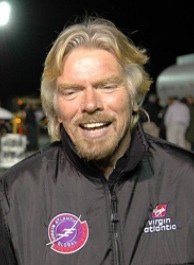
“The name’s Branson. Sir Richard Branson…” Branson as a secret agent? Maybe not. The beardy entrepreneur chases publicity with more enthusiasm than a paparazzi-obsessed moth. Then again, Bond is the only secret service employee who announces himself as he walks into his enemy’s lair, just prior to bedding his enemy’s girl and pinching the enemy’s secret weapon. When the Casino Royale crew needed a Virgin flight at short notice, Branson negotiated himself a bit part in exchange. In the film, we see Daniel Craig’s Bond trailing a baddie through an airport. Instead of enjoying his usual VIP treatment, Branson is seen getting the security once-over…

Richard Reid
Reid: Sole Soldier
After discounting the question why Branson has time to waste on a subliminal film appearance (answer: because other people run his businesses) we can turn our attention to the serious flaws in the scene itself. A close inspection reveals Branson is allowed to keep his shoes on. Are we meant to believe that modern airport security allows a scruffy-looking guy, with straggly hair and unkempt beard, to stroll through with his loafers still on? The man should be strip searched, just to be on the safe side. Whoever wrote this scene obviously never saw the mug shots of the original shoe bomber, Branson namesake Richard Reid.

Hands Up

When a well-loved television show is turned into a movie, the standard marketing ploy is to give cameo roles to the original TV stars. Hence original hulk, bodybuilder Lou Ferrigno, played a pizza-munching security guard in the movie version of The Incredible Hulk, whilst David Soul and Paul Michael Glaser sold a familiar red and white Ford Torino in the remake of Starsky and Hutch. But when the original show stars puppets, and the remake is live action, how do you reference the original? The movie version of Thunderbirds was a flop, but director Jonathan Frakes found a warmly affectionate way to doff his cap to the original television series. In the TV puppet series, real people’s hands were used in close-up shots of the characters playing with dials and controlling machines. In the movie, a brief close-up shows a hand on a lever… with the hand being pulled by strings!

Rock Bottom

Con Air is the greatest film ever made, at least according to writer Toby Young’s alter ego in How To Lose Friends & Alienate People. Before Con Air, producer Jerry Bruckheimer had delivered the mega-grossing hit The Rock. The films had refined a winning formula developed over the years through blockbusters like Top Gun and Beverly Hills Cop. Stellar cast + popular soundtrack + avalanche of action + lots of comedy + insanely stupid story + not caring about the reviews = lots of money at the box office. The Rock boasted Nic Cage, Sean Connery and Ed Harris, about as heavyweight a Hollywood line-up as anybody could muster at that time. Bruckheimer’s follow-up, Con Air, had to have an even more popular cast. In fact, it had the perfect cast, according to How To Lose Friends & Alienate People

It’s got everything, hasn’t it? You know, you’ve got Malkovich for your acting chops, you got Nicky Cage for your action, Steve Buscemi for your comedy, John Cusack for the gays. Right? It’s like a smorgasbord, isn’t it?

The moviemakers hint at what they think, giving the acerbic Malkovich a cutting line in Con Air

Trekking from Far Far Away

There is a theory that trekkies are somehow antagonistic to fans of the Star Wars franchise. A closer look at the Star Trek movies suggests the people who make them feel no antipathy, though you have to have inhuman powers of perception to have spotted the evidence on screen.

Millennium Falcon in First Contact In Star Trek: First Contact (also directed by Frakes) the initial assault on the alien borg cube includes one unlikely Federation ship – the Millennium Falcon. One wonders if Han Solo and Chewbacca are at the helm.
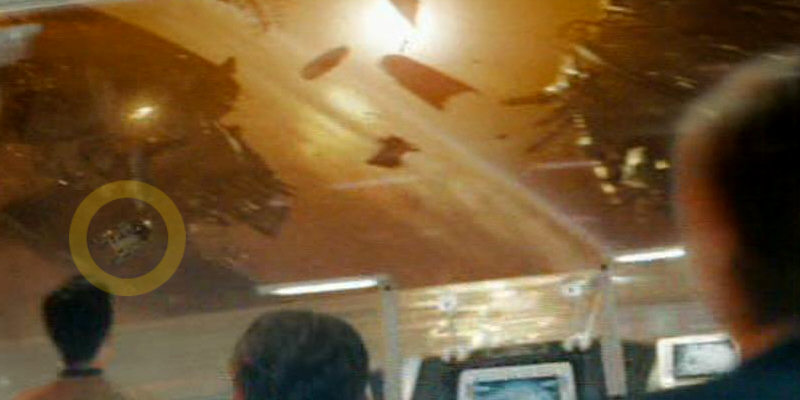
J.J. Abrams’ 2009 reboot/restart movie, the eleventh Star Trek film, manages to smuggle in another piece of old machinery from the Star Wars Universe. The Enterprise encounters some debris in space – including one familiar robot that had been built a long time ago. R2-D2 is briefly seen on the viewscreen, whizzing through space. Poor old R2 should have been retired to the rest home for elderly robots long before. And they could have had the decency to let him end his days in the company of his grumpy old robot pal, C-3PO.

R2-D2 in Star Trek

A-Grade Connections

There are hidden easter eggs and then there are hidden easter eggs. In the movie remake of the A-Team, the character of Murdock plays a 3-D movie in the insane asylum, whilst waiting for his buddies to bust him out. The movie in the movie is called ‘The Greater Escape’, and it starts by listing the cast, which includes…

Reginald Barclay – Dwight Schultz played Murdock in the TV version of the A-Team, and he also played the character of Reginald Barclay in Star Trek: Voyager.

G.F. Starbuck – Dirk Benedict, who played the original ‘Faceman’ Peck in A-Team, was also Starbuck in the original Battlestar Galactica.

Thomas Banacek – George Peppard, the original Hannibal, played the title role in the detective series Banacek.

Perhaps Hollywood wants us all to get better value for money. To spot everything they load into a film, you have to be watching them in slow-motion, and with IMdb or Wikipedia easily to hand…

Desks and the Diseased Mind of Preston Dirges

Preston Dirges sloped into the shapeless beige office building, basked in the piercing rays of the morning sun. His mood absorbed that light, chewed it and spat it out a denuded grey. Preston considered himself a master of changing the spectrum of any electromagnetic radiation unlucky enough to blindly encounter him. At will, he could choose to radiate a freezing blue, a lascivious red, a glorious gold or a fetching harlequin bouquet. But most of all he wanted to be grey. Grey discouraged attention. Preston’s only regret was that, try as he had, absolute invisibility was beyond him. If he could have removed the last scant evidence of his existence from the eye of any onlooker, he would have, at least for the duration of his so-called working hours.

There was the usual criss-cross bustle of people in the office foyer. Preston had lost his security pass three weeks ago. He had resolved soon afterwards to take it as an opportunity to thoroughly punish his employer. Knowing that securing a replacement would certainly consume a full couple of days, plus a more than nominal penalty to his payslip, he concluded it was better to simply push through the security barriers like a dozen other people did every day. A new pass would take a month to be issued. It would be at least two more months before anyone suspected that Preston had lied about applying for his. By simply not bothering, Preston considered this a moral victory over the irrelevance of the two perspex sliding doors that everyone had long since learned served only one purpose: to impede access to a multitude of genuine workers. New recruits, suppliers, contractors – all were ostensibly prohibited from reaching the very location where a similiarly inhuman machinery also compelled them to go. Circumstances had trained Preston’s genuine, conscientious colleagues to maintain order by subverting it. They could be relied upon to acquiesce to tailgating, or would even hand their passes over with a smile, lending their identity to Preston for a brief moment. They did this though only a tiny minority would betray a glimmer of recognition when Preston caught their eye. Preston thought it likely that those who did know him would be less likely to accede to his entry.

The night before, Preston had been drunk. He was not drunk now, which he considered a pity. Work would be much more fun if drunk. It was with regret that Preston acquiesced to the norm, wasting his precious leisure time languishing in liquor when it might be better spent achieving something substantial. Aiming to accomplish in his off hours would at least afford Preston some compensation for the time he was forced to waste when on. Preston felt he had once been from somewhere, but he was certain he was nowhere now. He had forgotten where he was from. It might have been Little Rock, or Auckland, or Buenos Aires. It was somewhere like that. Somewhere real. Somewhere that real people lived. In places like that, people drink for pleasure, and they even did things when not drinking. Now Preston drank for want of an alternative way to expend and diminish time. Preston lived somewhere to work there, which means he forfeited living anywhere.

Whilst in the elevator, Preston’s engulfing grey mist was split asunder by a person of seemingly Chinese extraction. The Chinaman knew what Preston looked like. Preston had been hiding in the corner, behind an especially large woman dressed all in black, but the Chinaman had not colluded in the usual pretense to have overlooked Preston’s presence. Preston momentarily considered that he should ask the Chinaman’s opinion of where Preston had come from, just as Preston was in turn thinking his Eastern colleague must be from China or from one of those other countries where the ethnically Chinese remained ethnically Chinese, which might presumably be anywhere on the planet. Maybe there was some trace of an accent, something in Preston’s face or manners that might betray to this cosmopolitan Oriental a subtle clue, a long-forgotten memoir of where Preston belonged. Preston knew the Chinaman was talking, but was unconcerned. After a while, he relented, and started to listen to the words pouring from the Chinaman’s mouth like a hot sticky custard of tommyrot.

Chinaman: “… and add to your pack some detailed numbers on revenue projections which we will dial up in order to convince the ExComm to green light after they deep dive into the data.”

At least, that is what it sounded like. It was hard to be sure without paying more attention. Preston had competitors for his attention. Preston Dirge’s diseased mind had long stopped screaming in order to be noticed. There was no longer sufficient competition for its lovingly malignant abstraction of an embrace. Preston’s diseased mind metaphorically tapped on his shoulder, which was sufficient to instigate an internal dialogue far more satisfying than anything that might come from talking with the Chinaman.

Preston Dirge’s Diseased Mind: Ignore the Chinaman. The ExComm aren’t going to ask you anything. They aren’t going to ask you because their meeting will overrun and your presentation will be postponed to the following meeting. Again.

Preston: You’re right.

Diseased Mind: You don’t even want them to approve the project. If they do, that means more work for you.

Preston: No argument here.

Diseased Mind: Man, you’re like a zombie. You need to snap out of this shit and wake up. Perhaps you should take up a hobby.

Preston: Why?

Diseased Mind: Okay. You got me on that one.

The Chinaman was still talking. It was a long elevator ride for Preston. Like most people of ambition, the Chinaman thought there was something intrinsically interesting in whatever he did, and nothing of interest to anyone else except to the extent that it was likely to further the Chinaman’s ambition. It had finally reached a time where Preston would have to acknowledge the Chinaman’s request or else be categorized as odd. Or maybe categorized as odder, if the Chinaman was merely inscrutable and not just oblivious to Preston’s disengagement.

Preston: No problem. I’ll add the extra numbers to the pack.

That is what he told the Chinaman. “Like hell you will,” thought Preston’s diseased mind.

After coffee, emails and some mindless surfing of the web, Preston found himself unable to further suspend the commencement of actual work. Some external consultants were due to arrive in about ten minutes, and Preston had not found anywhere for them to sit. This could cascade into a crisis of even more work if not resolved with alacrity. Preston had sent some emails two weeks ago. These had concluded that the person in charge of desks had no desks at his disposal, despite the ample rebuttal afforded by looking around, and that the meeting rooms on the 28th floor were owned by parties of continuous meeting habits and hence unwilling to accommodate others. Last week the emails reached the further conclusion that the meeting rooms on the 29th floor, the floor where Preston spent most of his working hours, were all owned by the alien reptiles that controlled the 29th floor. They were hence off limits per the strictures of Happy Joy Joy One United Team Policy Wisdom Offering number 72, though it took much longer to find out the content of this previously undiscovered rule.

Preston was not of the alien reptile tribe. Preston was of the amphibian swampdwellers of the 28th floor, as much as he was of anything. But the 28th floor was too crowded, and Preston too peripheral, for him to be based in close proximity to his brethren. He had been sent to an outpost in alien reptile territory. In trying to secure a room, Preston concluded the alien reptiles barred all earthly creatures from their meeting rooms, in case these mortals knew what they were talking about and shamed the aliens’ ignorance, though as in all such cases, this was not how their justification was worded. Instead, the relevant rule with no name, until named by Preston as Happy Joy Joy One United Team Policy Wisdom Offering number 72 for ease of reference, was understood to be: “within the unity of the one team there are many tribes and for their happy cohabitation all earthly tribes should limit their exertions to those activities that are blessed by the aliens, or else which are undetectable to their refined reptile senses.” In other words, never do anything unless the aliens first calculate it is to their unworldly advantage or irrelevant. In the event of doubt, just never do anything. This necessarily was interpreted to mean that external consultants were not allowed to use desks, meeting rooms or set foot on the 29th floor, even if their aim was to speak with, learn from, engage and gather the knowledge of that floor, though it could be agreed that for some of these tasks a fleeting visit would soon exhaust all potential.

Ten minutes was an underestimate, of course. Preston would have ten minutes to find desks if the consultants arrived on time and had the uncanny sense to come directly to him. Chances were the consultants would not call Preston, instead opting to bust through the security gates and make for Preston’s boss’ boss on the 28th floor. Consultants generally could be relied upon to entertain the false hope that spending time in the company of budgetholders will lead budgetholders to spend more money on them. As a consequence, such consultants swim towards the budgetholders like sperm swims towards the egg, frenziedly and in a mindless hope they will be first to bury their heads into the ovum’s magnificent munificence. Little do they realize that they, most of the time, serve as much purpose as masturbation, but with less of the associated guilty pleasure.

Preston’s calculations were correct. There was still no call from the consultants at the allotted hour. Meanwhile, Preston had resorted to asking for help from someone young and junior. She might have been called Mel or Belle or Molly or some other name that Preston cared not to consign to memory. Mel/Belle/Mol, being young and junior, and proven to be helpful in the past, demonstrated a naive faith in the idea workers should uncritically do the bidding of other workers who do not directly influence their pay. She found two desks, one right next to her, the other opposite her desk-nest on the 24th floor. Both workspaces were evidently long unused; covered in empty boxes, discarded debris from long-forgotten activities, large hole punchers and other unloved miscellany of stationery of too infrequent use to be worth stealing or even locking away in someone’s greedy drawer. Job done, thanks to Mel/Belle/Mol, though it was best not to be too thankful and perhaps encourage her to think about why she had been helpful. Now Preston could refocus his energies on what he was really paid to do: keeping people on their toes by complaining they were underperforming, but only when the people still cared enough to listen. Complaining to people past caring was obviously pointless, so Preston never did that, unless forced to by the complaints of a superior too scared to complain directly to the source of their frustrations. This time, Preston would call the consultant’s boss’ boss, stating some vague unhappiness that his underlings had not yet arrived. Preston did so from his mobile, whilst walking back to the stairwell. He chose a route designed to ensure he was not seen by the consultants who patiently and impotently sat on the leather sofa outside the office of his own boss’ boss.

Colouring Pleasant Lands

0

Green was my shortest colouring pencil.

The acorn and the oak.
Sherwood Forest and Robin Hood.
Pasture and hedgerows.
The Hundred Acre Wood.

Card tables and snooker baize.
My lady in greensleeves.
Bowls to the Armada.
Fish and chips and mushy peas.

St. Andrews old course.
Headingley and Twickenham.
British Racing Green.
Anfield and Wimbledon.

The leather of the House of Commons.
How green was my valley.
Ten bottles sitting on the wall.
Holly, ivy, Christmas tree.

The transformation of light into air.
The sea that surrounds this island.
Moors, fens and glen.
Climbers midst the arbor, in the garden.

Green was my shortest pencil,
The colour of a pleasant land.