
Home Blog Page 15

How Austerity Affects Readers of The Guardian

The rich get richer, the poor get poorer, and then there are readers of The Guardian. What does austerity mean to them? Thankfully, we now know their sad stories, as recounted in their own words, and shared via The Guardian’s new smartphone app. The app allows readers to give feedback on what ‘real life’ is like. Supposedly. I mean, I am sure the app works fine, but I am not so sure that all Guardian readers live in the real world. Or maybe they do live in the real world, but this version of the world is not one that Guardian column writers like to write about. The app populates a new feature called ‘the cuts get personal’, and this is the kind of stuff that The Guardian expects their readers to contribute:

How has your life been affected by the UK government cuts? Has a local public service like a library or a sports facility closed? Or perhaps there’s a shop you can no longer go to “” or an item that you need to replace but can’t? To help us build a comprehensive picture of life under the cuts “” share your images of things you can no longer afford.

So how is it going, with building a comprehensive picture of life under the cuts? Not well. Not well at all. It seems Guardian readers have given rather too comprehensive a picture of how their lives have been affected, indicating that instead of being worried about closing libraries or not being able to replace essentials, they have other serious worries. Like buying a cheaper vintage of wine. Or wiring their own plugs. I kid you not. The following were all taken from The Guardian’s own site:

Had to switch from the superior 2000 vintage due to the ever increasing price of alcohol.

Strictly speaking, increasing the duty on wine is not a government ‘cut’. Also, only a plonker would write this and share a photo of the 2003 vintage he had downgraded to.

I am wanting to set up my own creative business. I graduated last year with a 2:1. I’m two years too old for The Prince’s Trust. I would have liked to have got a grant, but it looks like I’ll have to get a loan to help with start-up costs. I’ll try applying to The Arts Council, but with them having over £11 million cut from them, I can’t say for sure that I will get any help. I’m afraid there will be many people whose talents will go to waste.

It makes you wonder how Shakespeare set up his own creative business, given that Arts Council grants were even harder to get in ye olden days.

Pot holes in the middle of the road take longer to fill.

Are potholes the most serious consequence of austerity? If so, the rumours of our austerity have been greatly exaggerated.

I know that it’s minor in the grand scheme of things. But potholes aren’t filled anymore, which makes my daily cycle either painful as I hit them, or more dangerous as I swerve to avoid them.

Yes, potholes are minor in the grand scheme of things. Hence some people maintain a stiff upper lip, instead of moaning like a self-absorbed bore. Bicycle-riding clots who cycle from their home, to their job, should try to keep a sense of perspective. Some people have no jobs, homes, or bicycles.

The travelling fair no longer visits, there is no more town fireworks display and the summer holidays no longer echo to the sounds of children’s voices and laughter. This hasn’t happened overnight but shows the inevitable result of cutting funding.

I put my emphasis on the words ‘this hasn’t happened overnight’. To conclude, this author thinks the economic priority is decades of sustained expenditure on travelling fairs, in order to bring back children’s voices. Unfortunately for him, evidence-based policymaking recognizes that children laughed in the days before municipal fireworks displays.

I can no longer afford to buy organic and have to buy my two children vegetables that could be GM or anything.

Those vegetables could be anything! In WW2 people dug up their own gardens to grow vegetables. Now people complain they cannot afford the price of veggies that might have been grown in someone’s garden.

Protest against NHS cuts at Canterbury Cathedral… The Independent covered the protest on the day. By the next day the link led to an article in which the protesters did not exist. It was only with shitwizardry I managed to get a cached copy.

What exactly is the problem here? A news story was so minor that The Independent had second thoughts and decided not to cover it. Is she arguing that the The Independent, home of Owen Jones, is a Fascist entity suppressing the truth about demos? (There is no mention of The Guardian covering this story either.) Or is she saying that austerity is a good thing, because it means that going on a demo is enough to get your name in the paper?

With #4GEE you can upload them just as fast. See #4GEE in action >

I kid, of course. This was not a submission by a Guardian reader. It is an advert by the Guardian’s sponsor for this feature, EE, the mobile phone network. They thoughtfully included it in the middle of the feature so anybody uploading photographs of their Job Centre, or their empty fridge, would be reminded of what they are missing. Also, they put it there so all the wealthy Guardian readers – the ones not affected by austerity – would be tempted to buy a more expensive mobile service in order to enjoy the lightning fast data speeds of a 4G network. Who said there was a problem reconciling a social conscience with thoughtless marketing?

…think I would be better off financially being the nursery cleaner than the leader of quality and education.

Fortunately, nursery cleaners do not read The Guardian, and hence will not be upset by this self-pitying clod. But hold on, I can hear the complaint coming – what makes me think that nursery cleaners do not read The Guardian? Because The Guardian is expensive, that is why.

Making play-doh volcanoes… because I can’t afford exotic holidays

If you find it hard to imagine a time before long-haul flights to exotic locations, then try to imagine a time before Play-Doh. In other words, try to imagine life in 1955. Did children laugh, back then?

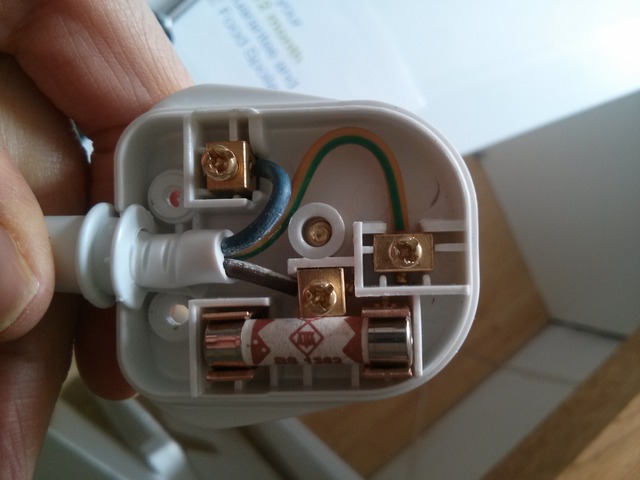
Wiring my own white goods… because I can’t afford an electrician.

Some of the more sensible comments on The Guardian’s site are about cuts to education. I remember that I received a school lesson about wiring plugs. However, it is hard to justify needing more and more expenditure on education, if people act like every subject is theoretical.

I am an ESOL teacher at independent language schools in London. The recession has meant that schools now ask me to sign a waiver confirming that I am willing to work over 48 hours a week for the same wage. When I divide the time I am working by the amount I earn, it works out at roughly $4/hour and I’m unprotected by a union or goverment policy here.

This excellent argument is only spoiled by one inconvenient fact. Private sector companies routinely told their employees to sign waivers when the 48 hour directive was first enforced in the UK, back in 1998. Yup, Tony Blair’s government ‘enforced’ this European rule, but looked the other way when the private sector opted-out en masse. So this has nothing to do with public sector cuts, austerity, or even the current government.

It’s not just those on a low wage …but also will effect those in the middle.

Heaven forbid. Between the wine drinkers, plug wirers, Play-Doh moulders and pothole-avoiders, it is clear that there really is a grand alliance of the 99% who persevere despite terrible suffering. Not a single member of the 99% is exaggerating their personal suffering, not even a tiny bit. It is clearly wrong to suggest that there is a miserable middling 50%, who spend far too much time complaining, living in fantasy worlds where potholes are synonymous with poverty because it causes them to drop their smartphones whilst cycling to work. Any suggestion that half of the 99% are self-absorbed prats, oblivious to what real suffering is like, must have originated in a right-wing media plot, or something similar. Probably the plotters are in the 1%. However, it is possible that the Fascists sometimes win the support of all those people who lack homes, food, jobs etc, and so feel less concerned about potholes and the patchy implementation of the 48-hour working directive.

Pretty funny, huh? Now comes the really funny part. These contributions were all approved by The Guardian’s moderaters (though they had second thoughts about some of them, so later pulled them). Yup, not every submission gets published. Imagine what austerity-inspired contributions failed to make the cut!?? At this rate, The Guardian might need to make some kind of dramatic gesture, like cutting their price. Then again, probably not.
Waking In Dark Places

In the last episode of Karen Zipslicer’s adventures, she was rescued by Lady Emerald from the police, only to fall asleep in her carriage…

Karen dreamed about Mum, and Em, and Dad, and James. In the dream Mum and Em were the same person, though sometimes she was Mum and sometimes she was Em. Dreams are like that. The same person has different faces or maybe the two faces are really the same face. Or a person has somebody else’s face but you know who they are really meant to be. Karen’s family lived together, in Mum’s palace in Lundern, which was made of green crystals, white stone, silver and gold. There was an incredibly tall tower, that pulsated with light, and its top fired sparks into the sky. Mum wore a fabulous dress, and played with James, chasing him from room to room in the palace, but Karen could never keep up and she never got to join the game. Then there were thousands of people beating at the windows of the palace, screaming to be let in. The people were not really people, they were more like babies, crying and throwing tantrums. Karen wanted to get away but she was tied up and could not move at all. Mum, Dad and James had been playing cops and robbers, and Karen was the criminal, so they captured her. The rope rubbed against her skin and burned her ankles and wrists.

Karen’s eyes opened. She was so drowsy. Where was she? On a bed. The room was dark. No windows. Alone. She fell asleep again.

She opened her eyes. “I have to wake up,” she told herself. She heard her voice inside her head. Her mouth could not move, nor her body. Her eyes closed themselves again. She heard her own breathing, so deep. Seductively deep. Sleep. Must concentrate. Sleep. So very tired. She heard the door open. Must concentrate. Footsteps. People. People coming in. People in a hurry. People with things to do. Light, seen red through her eyelids. Talking. She could hear them talking. She had to concentrate. She wanted to hear what they said. Concentrate. Concentrate, Karen.

“…how were the tests?” The voice was familiar. Whose voice was it? A light above her face. Warm light. Warm in bed. So sleepy.
A man spoke. “Physically, the girl is healthy…”
“Not a girl, a young woman,” thought Karen. Her mouth was not working but her ears worked fine.
“… and the results are good so far, but there’s more tests to be done before we can be sure. She was very deep. We’ll let her recover consciousness in her own time…”
“Must concentrate,” thought Karen.
“… to get unbiased results for the cognitive tests.”
“Testing? Testing what?” thought Karen.
“Fine. She’s too precious to take unnecessary risks. I was damn lucky to find her.” It was a woman’s voice. Em’s voice? “But she’ll be worth it “” she’s beautiful…”
“Beautiful,” thought Karen. That was nice. Concentrate. Must concentrate.
“… and the perfect age. Her children will be strong, and she’ll have plenty…”
“Children?” thought Karen. She opened one eye by the smallest fraction, peering out from behind her long eyelashes. The lid weighed down like it was made of iron. Concentrate. Em was standing at the end of the bed, dressed as before and carrying her big handbag. A man was at Karen’s side, holding a lamp above her. He wore a white smock that buttoned to one side. Some kind of doctor. Karen felt blurry. Tired. Heavy as stone. Her eye closed again.

Karen heard footsteps. Door closing, darkness. So tired.

“You hear me?” Another voice. “Must get free.” She knew that voice. So tired. Concentrate. Must con…
“Ow!” That hurt. Did she make a noise or did she just imagine the yelp inside her head? That really hurts. Ow. Again. Ow. Again. Stop. Ow. Ow. Ow. Bloody Whiteley, biting her finger again. Bloody Whiteley… Whiteley!
“Wake up,” said Whiteley.
She was trying. Whiteley kept nipping her. “Stop,” she mumbled. Her finger really hurt. But she had woken up. She tried to get up. She tried again, and failed. So tired, but not just tired. Tied down. Whiteley nipped her again. Ow. “Stop, I’m awake,” slurred Karen. The words came from her mouth. She opened her eyes. Dark. Lying on a bed. In a gown. Her wrists bound by leather cuffs, strapped down at either side. She tugged at them. The cuffs held her tight. “Take them off,” she told Whiteley.

Ow. Ow. Ow. “Stop, Whiteley,” said Karen.
“Give you pain as you sleep again.” And then he bit her finger once more.
Ow. Whiteley was right. Karen had fallen asleep again. “Okay, I’m awake now.” She lifted her left hand to her forehead, and opened her eyes. Blurry. Dark. Remember. Is this a hospital? Her right hand was still pinned down. She felt leather against her face. It was the cuff, still attached to her left hand. She held it in front of her eyes. Focus. It had been chewed. “Thank you Whiteley.” The ferret had chewed through the strap that tied the cuff to the bed. Karen turned on her side and untied her right hand. The belt round the cuff was stiff, and difficult to undo. It was dark; the only light came from the gaps between the door and its frame. Freeing herself of the cuffs, she rubbed both wrists. “What are you doing here, Whiteley?”
“Hid in Lady Emerald’s bag. In trouble. Must go.” He spun around, looked to Karen, then spun around again.
“You’re not in trouble, Whiteley. There’s no police here. Where are we?”
“No no, must go.” Whiteley turned to the door, turned back, and turned to the door again.
“We’re not in trouble.” Karen yawned and stretched her arms out.
Whiteley jumped up, nipping Karen’s little finger.
“Ow. Whiteley, what’s wrong with you?”
“Not safe. Can’t wait.”
“I can’t go anywhere, Whiteley. I’ve got no clothes. I’m in bare feet and wearing only this gown.” She sat cross-legged, rubbing her feet. The bandage around her ankle had been changed. She had not remembered anyone doing that. And they must have undressed her while she slept. Somebody undressed her whilst she slept. She grabbed her gown with one fist and pulled it forward, peering underneath. Apart from the gown, she was naked.
“Not safe.”
“Hmmm.” Maybe Whiteley’s instincts were right.

It’s Housing, Stupid

We all know the British economy is in bad shape. Opinions vary as to what is going wrong, and who is to blame. It could be Britain is not investing enough in growth. It could be that Britain is spending too much on public services, and needs to cut back, to deal with debt. Or it could be that houses cost too much.

Yeah, I know you never hear politicians arguing that last point. That argument comes from me. Politicians keep wanting to argue the first two, instead. But as with the Iraq War, nothing stops both Labour and the Tories from both being wrong at the same time. The problem with a bipolar political system is that opposing wrong-headed policies with even more wrong-headed policies will never lead to right-headed policies. At least the Lib Dems opposed the Iraq War, not that voters thanked them at the subsequent election. Now the Lib Dems are in a coalition government, the public has no hope of finding a coherent political force that will actually explain how housing policy is crippling the UK economy.

For the vast majority of people, the most expensive purchase they make is buying their house. They may spend decades paying off the loan. Think about that for a second. Whatever people do for a living, whether teaching, or nursing, or writing software or driving taxis, they spend most of their money on housing. The availability of housing, and the cost of housing, has the single biggest impact on the economy. It affects everybody. So why do politicians talk so little about housing, when they talk so much about the economy? The reason is that Britain’s mainstream parties have all messed up the economy by incompetent housing policies. The results have hobbled the economy. That is why politicians will talk about anything else, rather than talk about housing.

When I say that politicians messed up housing, I should say that their success or failure depends on your point of view. If you are now much wealthier, not as a result of working, but as a result of foolish housing policies, you might feel pretty good about those policies. A lot of Brits are richer because of the housing policies of both Labour, and the Tories before them. Houses rose in value, making people richer, without necessitating any real work. Hoorah for them. Bugger everybody who finds themselves spending more, borrowing more, and working longer, just to get on to the housing ladder. But when the economy hit trouble, suddenly a lot of owners were threatened by negative equity, as house prices fell but their mortgages remained the same. So the government has done everything possible to avoid negative equity, leaning on ‘evil’ banks and pumping loose money into the economy, to avoid foreclosures and a house price collapse. However, a price collapse would be ideal, in many ways. Bubbles naturally end with bursts. Bursting the bubble would mean a return to sane pricing. If houses were more affordable, more money could be spent on things that are genuinely productive, and will help the economy grow. For a healthy economy, it would be better if we spent less on our houses, and more on the things that generate economic productivity – cars and trains to get people to work, machines and tools for when they get there. Instead, we keep pouring money into housing.

Even an ignorant politician knows the influence of housing on the economy. Consider how MPs invest their own money (and our money). The expenses scandal revealed that MPs engaged in housing-related scams more than any others. They abused public money to purchase houses, and they abused tax rules to avoid paying for the capital gains on the houses they bought.

Spending more on houses cannot make the UK a more competitive nation, especially the way Britain has done it. The UK economy conspires to spend more on housing, even though it keeps building fewer houses. That increased spending is the flipside to the huge rise in property values. So whilst Ed Miliband sympathizes with the ‘squeezed middle’, he might want to ponder how much profit was made by middle-class homeowners over the last two decades. Without the cushion of that housing bubble beneath them, the squeezed middle would have felt a lot more squeezed, a lot sooner than now. And somebody had to pay the price for subsidizing the ‘squeezed middle’. The people who suffered most were not in the middle. The skewed housing market has placed most burden on those in private sector rented accommodation, who have suffered soaring rents, and first-time buyers, who have had to save more and borrow more, before they could join the house-owning fun. Many people endured the double squeeze of high rents and crazy purchase prices, just to enjoy the lifestyle of the ‘squeezed middle’.

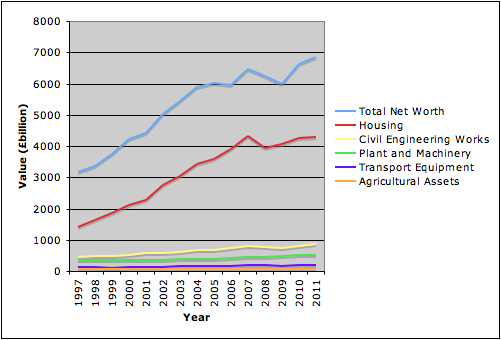
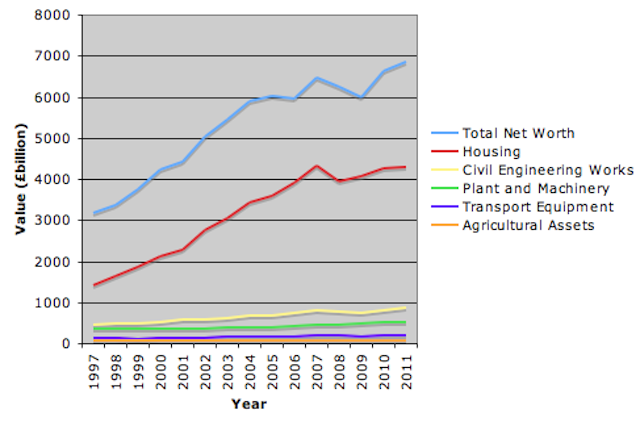
So far, I have avoided numbers, because they are boring. But without numbers you may not believe me. So here is a graph, derived from the figures in the ‘blue books’ published by the Office for National Statistics. Look at the asset values presented in table 10.2, if you want to double-check this graph.

Reviewing this graph, we see that since 1997, the ‘investment’ represented by housing has tripled in value. No other class of assets – whether used in factories, agriculture or commerce – has doubled its total worth, and some, like those used for agriculture, have been flat. In short, Britain has devoted an increasing slice of its economy to housing, even whilst new builds have fallen dramatically. In 1997, the combined value of all housing was £1.4tn, which was 45% of the country’s total net worth. By 2007, before the global financial meltdown, the value of housing had risen to £4.3tn, over two-thirds of the country’s net worth. The big bust reversed house values briefly, but they have climbed again since, to the point where housing represents 63% of the UK’s total net worth.

Britain is addicted to a myth. The UK does not need to borrow more to invest. Britain needs to learn what ‘investment’ really means, understanding the difference between a sound and meaningful investment, and an asset bubble which the government is desperate not to burst. All other sectors of the economy continue to suffer, in order to bolster the profits of house owners. Starving the rest of the economy means less money is spent on real investment, whether it is a privately-run business ramping up production, or government building roads. By ‘investing’ in property, whilst making far fewer houses than are needed to meet the requirements of the population, Britain has succeeded in producing nothing but paper profit, mostly for those who owned houses before the bubble went out of control. Instead of investing in manufacturing, or growing more food, or launching internet start-ups, both the government and the private citizen has become complacent. Too many rely on somebody else to do the real hard work that drives an economy, and to take the economic risks implied by innovation and real investment. The housing bubble has become Britain’s most popular road to riches, even though there is nothing rational in the idea that a house should be worth more, just because it is older. Real investment is needed for sustainable economic growth, and that means diverting resources away from the insane goal of propping up excessive house prices. But no politician has the guts to say that, because they do not want to upset their middle-class, house-owning voters.

The Lady Emerald

“Come with us, we’ll take you to a doctor,” said the woman in the carriage, holding the door open. Limping badly, Karen was helped inside by the policeman. Apart from some arghs and ows, Karen was lost for words. She behaved as instructed, but this was no difficult decision, as jail seemed the likely alternative. Once inside, Karen flopped upon a vacant bench, whilst the woman gave one last wave to the people outside. They cheered in return, treating her like a celebrity, or princess. Her carriage and clothes were elegant enough for a princess, thought Karen. And she glowed. Karen finally tore her eyes away for long enough to notice the third passenger, a man slumped in the seat across from her. He had a blanket wrapped around his legs, and bandages wrapped around his head and hands. Karen glimpsed pink skin near his eyes and mouth, though his wide-brimmed hat left his face in shadow. The man never moved or looked up from his lap. Done with waving, the lady sat alongside the man, put her arms around his shoulders, straightened him in his seat, and then spoke to Karen.
“Take your boot off. Let’s see how bad it is.”
This woman liked to be in charge. Karen’s mum had liked to be in charge. Karen did as she was told. She undid her laces without looking at them. The woman was hypnotic, and so like the photos of Karen’s mother, apart from being older. Could it possibly be her? Karen’s mind alternated between yes, then no, every few seconds.
“You’re a quiet one. What’s your name?” asked the woman.
“My name is Karen.”
The woman slid out a large handbag from underneath her seat. “Are you hungry? I’ve only got these “” have a mint,” she said, holding out a crumpled paper bag. Karen reached in and accidentally took two mint imperials instead of one. “Tut tut, no more than one “” they’re really strong.”
Karen put one mint back, and popped the other in her mouth. The woman had exaggerated; it was not strong at all.
“Do you know who I am?” continued the woman.
Karen shook her head.
“I’m the Lady Emerald, though you may call me ‘Em’.”
Karen nodded. She tried to remember how her mother looked, not just from photographs but how she had looked to Karen’s eyes, when she was still living. That was a long time ago. Em was about the same age as her dad… the age her mum would be, if alive.
“Let me take a look at that.” Em gestured for Karen to lift up her foot, which she did, and Em placed it upon her lap. “That must hurt,” said Em. There was a hole in the sock, where the back of Karen’s ankle had rubbed against her boot. It was matted with blood; the sock stuck to Karen’s skin. Em gently rolled down the sock. Karen winced.
“I’ll put a bandage on it. I always have plenty of bandages,” said Em, glancing at the man beside her. Em thrust her hand into her handbag, smiling at Karen whilst she rummaged around.

Karen yawned. She had done a lot of walking, and had eaten little. Her mind wandered. Could Em be her mother? That might explain things. But Em did not act like she recognized Karen. Karen’s journey was something you might read in a fantasy story, like finding a new world in a wardrobe, or some kid being sent to a boarding school for wizards. Karen did not believe in magic, but this city was so peculiar, familiar in some ways, bizarre in other ways, that maybe there was a special connection between the two worlds. Karen yawned again. Maybe Karen was drawn here to join her mum. Maybe she had not died. Maybe she fell down a hole between one world and the other, like Alice falling down the rabbit hole, landing in Wonderland. And then she had lost her memory, or something like that. If that was true, then Karen’s job was to reunite the family, by bringing Mum back with her. Then the family would be together again, Mum, Dad, James and Karen…

“Gee…!” Stinging pain caught Karen by surprise. Em dabbed her wound with cotton wool doused in a colourless liquid. Karen gritted her teeth.
“It’s surgical spirit, so the graze is clean before I put the bandage on. We don’t want it getting infected,” explained Em, taking a new bandage from her bag. Karen was looking at the man wrapped in bandages. “Don’t worry,” said Em, “nothing disturbs him.” But it seemed to Karen that he heard that remark, because the wide-brimmed hat turned, as if he looked out of the window, and away from Em.

Em placed a clean white square pad over Karen’s graze, then started wrapping the bandage around both pad and foot. Karen always felt tired when the sun went down, and her thoughts were slowing, but she tried to stir herself. “Where are we going?”
“We’re taking you to see a doctor,” said Em.
“What about curfew?”
“Don’t worry about that. We’re going somewhere safe. And you can’t walk anywhere in those boots. Where did you get them? I can see they don’t belong to you.”
Karen wrinkled her brow. How did Em know that?
“You’ve not broken them in, and they don’t match your other clothes. But then, you don’t know who I am, do you? My factories make clothes, amongst other things. We’re working to ensure everybody is warm, dry, happy and decent. Your coat, trousers, and these socks weren’t made in Lundern. The materials are different, and the style’s too unusual. You’re from a long way away, aren’t you?”
Karen nodded.
Em cut the end of the bandage with scissors. “Don’t worry, I’m from a long way away too.”
Karen bit her lip.
“Tell me what you’ve been doing here. You’ve not been here long, have you? But you joined those horrible rioters…” Em put a safety pin through the bandage.
“Ow.” The pin pricked Karen.
“Sorry.”
Karen shook her head. “I didn’t want to be in a riot. I was walking through, to get to the river. But I got stuck, and the police wouldn’t let me leave.”
“That’s good,” said Em. “Not that you got stuck “” that you don’t want anything to do with those troublemakers. They’re bad people. Life is about give and take. They want to take, and not to give.”
Karen was not interested in politics; she was lost in Em’s vivid green eyes, and her familiar face, and the shimmering light that surrounded her whole body. Em spoke, and Karen nodded, finding it hard to concentrate. Distracted by her own words, Em held Karen’s foot, perched on her lap, and played with her big toe. Karen did not mind. She enjoyed the feeling. It reminded her of playing with James’ feet during bathtime. This little piggy went to market. James had liked that rhyme. She yawned.

“They’re basically criminals,” said Em.
Karen nodded without really listening.
“They always talk about welfare. Welfare this, welfare that, like nobody ever worked to improve their welfare. Somebody has to make the things that make life better. They don’t make themselves. Making things is real welfare; it shows you care. Making a better pair of socks at a cheaper price,” Em said, holding up Karen’s sock, “is welfare for someone who doesn’t have any socks. But that lot don’t think like that. They want gifts of money, and they describe gifts as their ‘right’, as if anybody has the right to make somebody else work for them “” and to work without reward! Imagine that? When they ask for welfare, all they want is money, to spend how they please. They want something for nothing, but nothing comes from nothing.”
Karen nodded again. She had no idea what her mum’s politics had been like, but this sounded pretty similar to things Dad sometimes said. Em continued to play with Karen’s toes. Karen liked that. This little piggy stayed home. Karen wanted to be home. Em continued to speak. Karen tried to listen, but found it hard.
“If I said to you that slavery is the same as murder, you’d know what I meant. If I take away your thought, your will, your personality, your freedom to make decisions, if I have the power of life and death, then you’re good as dead already. That’s why we ended slavery in Lundern, and nobody fought for that more than I did. What, then, is a handout from the government? Is it payment for existing? Is it right that a person can go to the shop and buy what they like, although they never gave anything, never made anything, for anyone else? People have the right to exchange, not to take. If slavery is the same as murder, then welfare benefits are the same as shoplifting.”
“Yes,” said Karen. She had never thought about it like that, but it sounded reasonable. Her eyelids felt droopy.
“Yes, you’re a smart girl, aren’t you?” said Em. “It’s a shame this sock is so bloody, but you’d better wear it again, to keep your foot warm” she said, rolling it up, then putting it on Karen’s foot. “But you shouldn’t wear those boots again…”
“That’s alright, I have some other shoes in my bag,” interjected Karen. She opened her backpack to pull out her Heelys. Except her Heelys were not there. Instead of her favourite shoes, there were two wooden blocks, shaped to put inside shoes. Winton must have switched them for her Heelys when he gave her the bag this morning. No wonder he was happy to let Karen keep the boots!
“Well?” asked Em.
“I had another pair of shoes in here,” said Karen, turning red from embarrassment, “but they’re gone.”
“Thieves? They’re all over. Anyway, don’t wear those boots any more.”
Karen nodded obediently.
“We’re not far from the Institute now,” said Em.
“Institute?”
“There’s doctors there,” said Em. She still absent-mindedly wiggled Karen’s toes. This little piggy had roast beef.
Karen slouched and rested her head against her seat. “You’re beautiful,” said Karen, after a pause. “Where does the light come from, the light that surrounds you?”
“That’s something made by my factories,” explained Em. “It’s my personal glowshield. It protects me. It’s the best kind there is. There’s also a larger one around this carriage.”
“Is that what caused the explosion at the potato cart?” asked Karen.
“Very smart “” yes, that’s right. That lad and his cart shouldn’t have got in our way. That’s why it glows “” to give people warning.”
Suddenly nervous, Karen tugged her foot away from Em, but Em held on to it. “Don’t worry. Nothing happens when you’re gentle with a glowshield. It only reacts when you hit it suddenly.” Em opened the carriage window and pulled a white rosebud from the exterior decorations. She cupped it in one hand, then clapped her hands together. With a spark of light it was gone. Em spread her fingers and the rose’s perfume filled the air. “Good trick?”

Karen nodded but she had her doubts. The disintegrated rose made the carriage smell lovely, but she pulled her foot from Em’s lap and slid it into her boot. So tired. She struggled to get it in.
“You can’t put that boot on,” chided Em. “You’ll make your injury worse.”
“It’s much better. The bandage will protect me,” said Karen. She tried to loosen the laces. It was so difficult. Confusing. She yawned.
“I insist. We’re nearly there. Let the doctors take care of you.”
“It’s late. I’d better go, before curfew.”
“Nonsense. You’re staying with me.”
“I’m very grateful…” Karen never finished her sentence. She slid on to her side; the boot fell from her hands. Her eyelids were so heavy. This little piggy had none.
“Sleep, child, sleep.”
“Yes Mum.”

When More Rules Mean Less

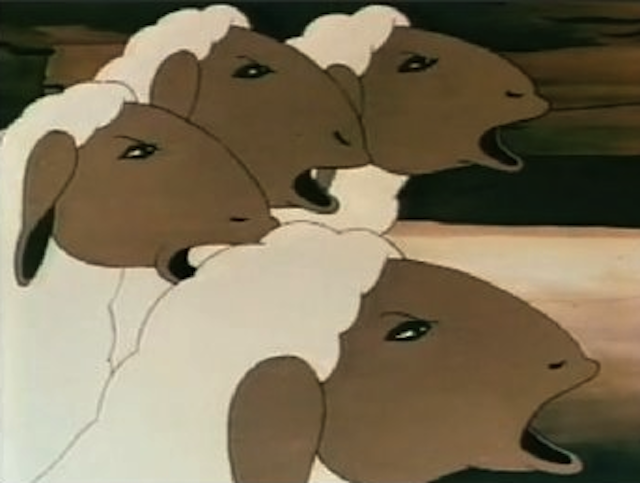
George Orwell was no fool. A lot of people like to think of themselves as victims. A lot less want to think of themselves as persecutors. But somebody has to do the persecuting. After a while, you start to question how so few persecutors always seem to hold sway over so many victims. The holocaust? Hitler and a few top Nazis must have done it alone, with hardly any help. Colonialism? Better kick the Brits out of the Falkland Islands, because self-determination only applies to the children of victims, not the children of a former empire. Global capitalism? We all know the rich-get-richer, poor-get-poorer, even if the UN says global poverty is dwindling at a rate never before seen in history. So how does George Orwell explain this uncanny ability of a tiny number of persecutors – be they autocrats, colonialists, or capitalists – to keep on subjugating huge numbers of victims? He explained it with sheep. Stupid, selfish, sheep.

On Animal Farm, the sheep were crucial enablers of persecution. They not only failed to fight against it, they positively supported the persecutors. “Four legs good, two legs bad!” they bleated, at those important moments when real thought and debate was needed, if the free animals were to arrive at good decisions. Somehow we are not supposed to think of the sheep as evil. Their stupidity absolves them of responsibility. But why is that? Nobody believes themselves to be stupid. Nobody considers themselves a sheep. The ‘I’ is never part of the flock. Sheep-ism is something that always happens to other people, in the same way that tomorrow never comes. Freedom entails responsibility, and we do not curtail freedom just to protect stupid people from themselves… or do we? And if we do need to protect stupid people, how do we distinguish the protector, from the persecutor? When is it right to take away freedoms from stupid people, and who decides if it really is for their own good?

We decide to take away our own rights. We, including the sheep. We can decide it through a definitive act, like passing a new law that sets limits on ourselves, or by being apathetic, and allowing our rights to be lost by the actions of others. The sheep are part of that process. Unlike Animal Farm, we cannot use anatomy to determine which of us are sheep. So if evil people serve up intrusive stories about Milly Dowler and Hugh Grant, many agree they should be stopped. Fewer ask why the existing rules to prevent invasion of privacy were not adequately enforced. Fewer still ask who motivated the crime. Who wanted to read stories about Milly Dowler or Hugh Grant? Not me. I have no interest in them, except as examples to be cited here. I would not buy a newspaper to read about either, and would feel no loss if the newspaper was thinner because their stories were omitted. Somebody must have wanted to pay good money to hear about the private lives of others. Where are these nosey sheep? How do they feel about press regulation? Do they feel any responsibility for the harm they encouraged? How do we stop the sheep from causing the same problem in future, because they will keep paying money to encourage crime?

Evil people run banks. We all know that. They leant money for profit. Nobody who borrowed was evil, nobody who owns a bank is evil. Only the bankers, employees of the bank, are evil. We might have thought that owning a thing made you responsible for that thing. I own my car, and I am responsible for it being roadworthy. The owner of a pet retains responsibility, if the pet is allowed to misbehave. The owner of a newspaper is responsible for what the newspaper publishes – many of us seem to believe that. But the owner of a bank seems to have no responsibility for decisions made by the bank’s employees, which includes its management. Why is that? Is it because banks are owned by sheep? Last year, much fuss was made that a third of Barclays shareholders opposed the pay deal given to Barclays management. That means two thirds supported it. Standard Life, the Edinburgh-based pensions firm, supported it. They have 6 million customers, and 1.5 million shareholders. Do we go a bit sheep-ish, when we ask about their responsibility to curb excessive pay? Are some of us investors in banks, but too ignorant, lost in the crowd, one amongst many, too stupid to join the dots, and hence absolved of responsibility?

Evil people dodge taxes. We all know that. Over the course of a decade, tax rules in the UK became progressively more complicated. Printing out the tax rules at the end of the noughties required twice as much paper as was needed only ten years earlier. Who was responsible for making tax rules so complicated that they were full of loopholes and difficult to enforce? Was it the people who ran the government, and who passed the laws that made the rules so complicated? Was it the people who elected the people who ran the government? Or do we prefer to remember history differently? We all like to be guard dogs now, fiercely biting at the heels of any tax avoider. Are we forgetting a time when we were happy to be sheep, blissfully unaware of the crucial role we played in making tax avoidance so easy?

Evil people get elected to parliament, and once there, use their power to indulge their corruption. Some of them just pass bad laws, like the bad tax laws, or the bad privacy laws, or the bad laws to control banks. That creates demand for new laws. Others are such greedy pigs that they literally, and directly, steal from the rest of us. Consider Margaret Moran, former MP for Luton South, who stole thousands through bogus expense claims, and escaped prison because of mental illness. Her party decided she was a fit and proper person, who could be trusted with the extraordinary responsibilities that come with being a law-maker. What happened to the people who selected her as a candidate, who financed her campaigns, who actively supported her? Did these sheep slip away, absolved of any blame because they could not tell she was a greedy corrupt pig? Or do they keep on making important decisions about who is fit to be a law-maker? Of course, we should only blame her party so much. Moran won three elections to parliament. 26,428 people elected her in 1997, 21,719 did so in 2001, and 16,610 in 2005. It was a secret ballot, of course. But why did nobody ask for compensation from the sheep who voted for this pig? Do they feel no moral responsibility to carry most of the burden, just as they would be responsible for their child, or their pet? Should voters be completely excused of any responsibility for their bad decisions?

At a crucial point in his story, Orwell had his sheep bleat a new message: ‘four legs good, two legs better’. The real-life sheep tend to say something much simpler, and it never changes. They say ‘more rules better’. According to them, every problem can be solved with more rules. Rules to stop bankers being greedy. Rules to stop politicians being corrupt. Rules to stop tax avoidance. Rules to stop journalists being nosey. But nobody asks for a rule that would punish sheep for being sheep. Nobody punishes the lazy reader for consuming gossipy tittle-tattle about celebs and the victims of crime. Nobody punishes the lazy shareholder who cares so little about their business that they allow their employees to fleece their company whilst taking wild risks. And nobody punishes lazy, ill-informed and apathetic voters, even when they are the root cause of bad government, and bad rules. Some rules are not properly enforced by government and public servants employed by government. Some rules are so incompetently written, they cannot possibly be enforced. But instead of blaming voters for bad rules, we supposedly should thank them for their efforts, ask them how to improve things, and nod happily when we receive this sage advice: we need lots more of what did not work before. If the previous rules were too complicated, ignored, or just bad rules that made no sense, we should rush headlong into writing many more rules, because that is the only solution we will consider. ‘More rules better’.

The problem with Orwell’s metaphor is that sheep are not just followers. They are also persecutors. They drown out intellect, or sophistication, or anyone daring to hold a contrary view to the majority. They are not just victims, although they are also victims. Sheep are the ultimate muscle of authoritarianism. They enable corruption and they empower evil. Individuals like George Orwell come along once in a century, but his wisdom cannot hold back the sheep, because they do not listen. They are too busy bleating, too busy finding everyone else responsible for everything, to listen. They feel they are not listened to enough, so they bleat more to compensate. The sheep already see the world in black and white. They know what is best, know that everyone who disagrees must have been brainwashed by evil people with an agenda, know that the only way to progress to a perfect society is by imposing more and more rules. That is the mantra of the sheep: more and more and more and more rules, until the rules will set us truly free. Meanwhile, we accumulate so many rules that nobody enforces them any more. Tax rules? The only people who understand them are the people avoiding them. Rules to stop invasion of privacy? The police do not bother to enforce them. Rules to say the NHS should not kill its own patients? Managers treat them as secondary to meeting their targets. And why should public servants enforce the rules? They too are sheep. They only act when there is a rule telling them what to do. ‘More rules better’ is the ultimate rule. It means nobody should want, or expect, to do anything, unless there is already a rule, telling us to do it.

Sometimes individuals need to stand up and speak against the crowd, when the source of evil lies in the many, and not the few. Our society does not need more rules to curb the greedy pigs. We need fewer sheep.

Out of the Cauldron, Into the Kettle

In the last episode of Karen Zipslicer’s adventures, Karen witnessed the riot in Farrago Square, and ran away. But where did she go…?

Karen pushed her way out of the square. Not stopping to look back again, she found a side street and headed down it as quickly as she could without running. She limped. Her left ankle was really sore, and she had almost twisted it as she forced her way through. She did not look back. This was a quiet lane, very narrow, high-sided and crooked; she could not see one end from the other. The sound of angry voices echoed down the street, following her from Farrago Square. The street kinked in its middle. Karen did not look over her shoulder, but she sensed many were following her, evacuating the square, fleeing the riot. Karen wanted to be somewhere else, anywhere else. She wanted to be home. Her heart skipped. She nearly stumbled over a cobble that stuck out above the others. She turned the kink in the lane.

There was line of policemen and policewomen ahead. They stood at the far end of this lane. Karen stopped, then started walking again. She just wanted to get out. She wanted to get to Winton’s place. Forget about the river. She wanted to be somewhere safe now. She wanted the safest place in the shortest possible time. She could hear people and animals following behind. From the sound of it, they were running, closing in on her. Karen approached the police. They formed a line across the end of the street. They were unmoved. One put a whistle to his lips, and blew it hard whilst raising his other hand, signalling the crowd to stop. The rest of the police had their shields up. There was no gap in their line.

“I just want to get through.”

The police held their line. They did not answer Karen; they gave no indication that they heard her. They just stood there, blankly facing forward, unmoving.

“I want to go home.”

The police held their line. Those escaping the square were bottled up here, desperate to get out, like frogs in a boiling kettle. They bounced off the police shields. The police would not yield. The policeman with the whistle raised it back to his lips.

“Please let me through.”

The policeman blew his whistle again. “Step back,” he shouted at everybody, and at nobody in particular. More police gathered from somewhere, everywhere, deepening their line. Karen was being pushed towards the police by some of the Lunderners behind her. The road behind the police looked perfectly normal, by Lundern’s standards. There was a pub, and a chemist’s shop, and a boy tended a cart from which he sold hot baked potatoes. The police held their line. They would not give way for Karen, or anyone else.
Karen closed her eyes. She just wanted to go home. “Please, I’m hurt and I want to go home,” she said, her eyes still closed. But the policewoman in front of her did not answer. They were about the same height. Karen opened her eyes again. Behind the bars of her facemask, the policewoman’s gaze connected with Karen’s. The policewoman was there to hold the line, to contain anyone leaving Farrago Square. Karen was really stuck now. The street was jammed by those leaving the square, leaving no way back. Karen was at the front; many pressed behind her. There was no way through. The road behind the policewoman looked so peaceful, but the police would not let her pass.

The sun began to set. The golden light shone in the eyes of the police, making them squint, but otherwise they impersonated statues. Karen stood on one foot, taking the weight off her sore ankle. Somebody complained about needing the toilet. The police would not let them pass. Karen put her hand to her brow, then thrust it back into her pocket. Whiteley nipped it, so she pulled it straight out again. Her ankle really hurt. She wished she had changed into her Heelys, but there was no chance to do that now. Whiteley looked out from his pocket. “Stop nipping me Whiteley,” said Karen, sharply. Whiteley looked up. “Sorry,” he said, “habit.” A goat butted Karen’s bum from behind. Off-balance, Karen almost stumbled into the policewoman opposite her. The policewoman raised her truncheon above her head. Karen lifted her arm to protect her face, but the anticipated blow never landed. Whatever violence had occurred in Farrago Square, nobody here wanted to fight. But the police would not let them pass. “What about curfew?” shouted somebody behind Karen. “Yeah, it’s getting late “” how am I going to get home in time!” shouted somebody else. There was no attempt to hide the agitation in those voices. “Please, can you tell us when we’ll be let go?” asked Karen, speaking to the policewoman in front of her. Under her helmet and behind her facemask, the policewoman blinked. And then Karen knew. Behind her mask, the policewoman was full of fear. Imagine that. The policewoman was afraid of Karen, and the mob. Karen was also afraid. And many were scared, or tired, or hungry, or they just wanted to be home, safe, warm, indoors. The policeman standing to the policewoman’s side looked first at his colleague, then at Karen. He put his whistle to his mouth again, blew hard, and ordered everyone to “step back!” Some stepped back. Many did not. “Step back,” he repeated. Karen was tired. Somebody leaned against her. She stumbled. The policewoman raised her shield. The policeman pointed his baton at Karen, and pushed her with it, trying to force her back again. He pushed the baton against the outside of Karen’s hip pocket, where Whiteley squealed and leapt right out. Now there was bound to be trouble, thought Karen.

The policeman was startled, and his whistle slipped from his hand. Karen’s mind sped up; as it raced ahead, she perceived the world in slow motion. The whistle fell. Whiteley burst out of her pocket. Karen could see every detail as it happened, perhaps before it happened. With his front paws, Whiteley took hold of one end of the policeman’s baton. The whistle fell. Whiteley shot along the policeman’s baton, running straight at him. The policeman lifted the baton, trying to shake Whiteley off. Whiteley slipped, then leapt onto the policewoman’s shoulder. The whistle fell. The policewoman squealed and tried to brush Whiteley off. The ferret ran down her back and on to the street. “Oi!” shouted the policeman, turning to grab Whiteley, but missing. The whistle fell. Spotting the gap in the police line, somebody stormed straight ahead, pushing Karen and another woman along with him. The whistle hit the ground. The police line was broken. Others burst through, spilling on to the road behind the broken dam, then sprinting away in different directions. The police tried to regroup, to close the breach. But they could not close the line and chase those who had already broken through. Karen was through. Others pushed through. She could run. Whiteley was halfway across the road, looking back for Karen. Two horses pulled an enclosed carriage, trotting down the road towards them. The carriage was ornate, decorated with white roses. It was painted green and gold, but shimmered with many colours. It rolled towards Karen. Seeing the people cascade across the street, the horses pulled up sharply. Whiteley, startled, ran between the horses’ legs. The horses were considerate creatures, mindful, and they stepped smartly around Whiteley, so he was never in any danger. But as they swerved, their carriage swung to the side of the road, where one wheel smacked against the cart of the hot potato seller. And then something happened that Karen could not explain.

A collision between a carriage and a cart will obviously cause some damage. You might expect scratches, a broken cart, or maybe a busted carriage wheel. This was not what happened. With her slow-motion view of the chaos, Karen saw something truly remarkable and unexpected. As the carriage hit the cart, in less time that it takes to blink an eye, there was an intense flash of light and the potato cart exploded. Boom! The cart disintegrated, leaving behind a ball of smoke. The force of the blast threw Karen over. The ground was singed where the cart had stood. Only a tiny fraction of the cart remained, flying outwards as wooden splinters and hunks of spud. Though she had seen it, Karen could not believe it. At first she lay there, propped up on her elbows, watching the scene as if she was dreaming. It was the second time that Karen had been knocked over in one day. She felt the back of her head again. There were the same lumps as before. It seemed so unreal. But the dreaming had to stop. She shook herself, got up again, and ran to see if anyone was hurt. Two men, the driver and his helper, dismounted from the carriage. Neither they, nor the carriage, had been hurt, or even disturbed, at all. Some onlookers had cuts, or splinters in their skin. The stallholder had been thrown backwards. He was a thin lad, shabbily dressed, at the tail of his adolescent years. His face was bruised. Karen went to him. He was dazed but not badly hurt. The carriage driver and his assistant hovered over her. She turned to face them. They wore uniforms of black trousers with forest green tunics, and each had a black box over one eye. A woman’s voice called from inside the carriage, asking if anyone was hurt; Karen’s view of her was obscured. The police line collapsed, and the herd bolted in all directions. Karen scanned for Whiteley. Whilst most police had given up, one put his hand on Karen’s shoulder. It was the policeman who had blown the whistle.
“You’re coming with me,” he said to Karen.
“I’m looking for my friend,” she replied.
“The ferret? Yeah, he should come too. You’re both agitators.”
The carriage drivers walked either side of Karen. They grabbed the lad who tended the potato cart, one per each arm, and hoisted him to his feet. “Is he alright?” asked the woman in the carriage. The lad insisted he was fine, though he was obviously dizzy. He seemed more in awe of the woman and her carriage, than concerned about his well-being, or his lost potato cart. Karen looked around for Whiteley, shouting his name. A crowd gathered, paying no attention to Karen, or to the lad. They were rapt at seeing the carriage, and the woman inside. Karen looked down, around their feet, trying to find Whiteley. She found her search more difficult every second, as more onlookers huddled the scene. They rubbed shoulders and competed with each other to get a good view of the carriage, whilst keeping a respectful distance from it. None of them cared about the lad or his cart.
“Come on agitator. You’d better hurry up and find that ferret,” sneered the policeman.
“I don’t know what an agitator is. Shouldn’t you be asking about this accident?” challenged Karen.
“You see? An agitator is what you are for sure. It’s easy to tell you’re an agitator, because an ordinary girl would have cried and asked for her mummy by now. So no more backchat from you,” said the policeman, pointing at Karen with his baton. Karen hobbled around, her pain getting worse with every step. She bit her top lip. She could not see Whiteley, and the onlookers got in her way. She edged her way towards the front of the carriage.

“Are you looking for the weasel?” said a deep voice, whispering to Karen. Karen did not know who spoke.
“It wasn’t a weasel. It was a ferret,” said a second voice. Then Karen realized the carriage horses, who had carefully avoided Whiteley, were talking to her.
“Ferret, weasel, one or t’other. Either way, don’t draw attention to the blighter now,” said the first horse, speaking to Karen. “I saw where he went, and he’s alright. But you don’t want to find him now, because if you do, he’ll be nabbed by the coppers too.”
“They’ll surely blame this accident on him,” said the second horse.
“Where is he?” whispered Karen, pretending that she was still scanning the ground.
“Crafty beggar climbed up and hid inside the carriage,” said the first horse. “Mistress hasn’t shouted or anything, so she can’t have noticed.”
“We won’t say anything to give him away,” said the second horse.
“But there’s nowt we can do to help you,” said the first horse, to Karen.
The carriage driver and his mate had climbed back into their seats and were about to set off.
“Right, I’m not waiting any longer.” The policeman grabbed Karen’s arm. “Let’s go.”
“Get off me,” said Karen, trying to pull her arm free. The gapers and gogglers, remained oblivious to Karen, still enthralled by the carriage and its celebrity passenger. They waved and cheered as it gently pulled away.
“We’re off now,” said the first horse.
“Good luck,” said the second.
The woman in the carriage waved to the crowd through her rose-lined window. Looking from side-on, Karen could only see her hand, in glove. The glove was green, and satin, stretching from fingers to elbow.
“Ow!” yelled Karen, twisting her injured left foot as the policeman pushed her through the crowd.
“Halt!” cried the woman from the carriage. The onlookers gasped. The carriage had stopped as it passed alongside Karen. “I mean you too,” said the woman in the carriage. She was speaking to the policeman, but he did not realize.
“She’s talkin’ to you, copper,” said an unknown voice.
The policeman looked around, and addressed the woman in the carriage. “Sorry, Your Excellency.”
“That child, is she hurt? She looks injured,” said the woman. Karen turned slowly, and painfully. The policeman hesitated to reply, but the woman did not wait for it. “She obviously needs medical treatment. We’ll take her.” Her voice carried unquestionable authority. “Help her in,” she commanded, as she opened the carriage door. The spectators applauded her generosity. Even the poor potato lad joined in the clapping, not thinking of his own injuries. The policeman was stunned, at first. Then he submitted, manhandling Karen toward the carriage. “Be careful with her!” scolded the woman inside. Seeing her properly for the first time, Karen saw that her outfit was stunning. Her dress was green satin too, edged with gold braid. The gold matched the woman’s hair, whilst the green matched her eyes. Karen’s jaw fell loose. The woman shimmered, just like her carriage. But something else had stopped Karen’s heart. This magnificent lady, dressed so beautifully, so beloved by the crowd and so commanding in her manner, looked familiar to Karen. Karen had seen her face before, in photographs of her mother.

Goodbye Species

0

Is there a chance?
Such a beautiful creature
must be saved.
Such grace, such form.
So unique.
Ignore the killing, all species do such.
See nature’s perfection, how well it evolved to fit its environment.
It competed, and won, for a long while.

No hope?
Too expensive. What price a pretty pet over
expedience.
It’s over. The orders
are already sent.
Goodbye,
human race!
Maybe next time
we’ll show more sentiment.

The Battle of Farrago Square

Last time, we left Karen stuck in Farrago Square, listening to Marianne Hardbun’s speech…

The crowd applauded and hollered and stamped their hooves enthusiastically. Marianne Hardbun waved from the stage, then clasped both hands over her head. Karen checked her phone. Once again there was no signal, but she took note of the time. The afternoon was slipping away. She had no intention of walking back to Winton’s after dark, especially on her own. If she was going to the river, she had better leave now. With so many sucked into Farrago Square, Karen hoped the surrounding streets would now be empty. But escaping such a thick crowd would not be easy. With Whiteley securely stowed in her hip pocket, she stood up and steadily went back the way she came. The crowd faced the stage, and barely noticed Karen, making no effort to move out of her way. She picked through as politely as she could, and pushed when necessary, which was often. It took fifteen minutes of tortuous writhing and shoving to return to the corner of the Treasury. The police were still guarding it. But their mood had changed.

The police were enraged.

Karen quickened. The crowd thinned towards its edges, allowing her easier progress. The anger of the police made Karen feel edgy. She wanted to get away from here, and from them. Something bad might happen. The feelings of the police were understandable, but that did not make Karen feel any happier. Never mind her sore ankle, which felt like it had been rubbed raw. Karen was now pushing her way through the remainder of the crowd, desperate to break through and out.

The police were furious.

They had reason to be angry. As they guarded the base of the Treasury, the birds sitting on the Treasury roof had begun their own protest against authority. It was a dirty protest “” a very dirty protest. Lining the roof of the Treasury, the birds turned their backs to the police below, and pooed on them. Splat, splat, splat, it came down like thick white rain. Black helmets were turned a Dalmatian pattern. The police dogs barked furiously. Karen kept her distance, like the rest of the crowd. She put a hand to her mouth, feeling sickened. Some of the police were shouting at the birds to stop. Others sheltered under their shields. The barrage continued. Karen was nearly clear of the crowd and ready to slip down a side street. Thankfully, the street looked empty. She was nearly clear. And then things turned nasty.

“Look at that!” shouted somebody from the crowd. Like ripples from a stone in the water, it spread, as more and more looked up, and pointed, and shouted. Karen looked too. She was nearly clear, but she looked too. Curiosity reached out its spindly fingers and caught her in its grasp. She saw two golden eagles in the sky. They looked like the eagles that had stood on the steps behind her. They dove in, lunging their fearsome talons at the birds on the Treasury roof. And then two more eagles came, and one caught a pigeon, and flew away with it. Karen put her hand over her eyes. It was horrible to see, but beautiful too. She watched through her fingers. Another eagle caught its prey. And then another. Hundreds of eagles swooped down from the airship that patrolled the square. The birds on the Treasury roof responded with panic, flying away in every direction, as quickly as they could. More eagles came, more prey was taken. The protesting birds were savagely torn apart, and their lifeless bodies were dropped on the crowd below, so the eagles could circle back to catch more. The police on the ground cheered and high-fived each other. The dirty protest had been broken up. But the police were not relieved for long.

Now the crowd was angry.

A man carrying a flag rushed towards the line of police. He brandished the flagpole like a spear, jabbing it toward a policewoman. She parried it with her shield. Other police rushed to the fray, and wrestled to take possession of the flagpole. The crowd surrounded them. Fists and feet struck the unprotected backs and legs of the police. Those police scrambled back to the line of their colleagues. The police dogs snapped at protestors that came too close. With the Treasury building behind them, and their shields in front of them, the police held off the most violent of the crowd, thrashing and gnashing with batons and teeth. Objects were thrown by foes hidden in the multitude: a half-eaten piece of fruit, a placard, a bottle. Now the eagles swooped on the crowd below, causing them to duck away from their claws. Somebody’s face was cut. Horses came, with policemen riding them, and they charged the crowd. Somebody fell under the hooves. Elsewhere, a policewoman was on the floor, encircled by rioters. They kicked her. Police reinforcements burst out of the Treasury; a slew of bears stampeded into the mob, causing panic. This was mayhem, chaotic struggle, like the geese at St. James’ Park, but so much worse. Those geese fought for food; Karen could not tell what this fight was for. Limbs struck in every direction. Weapons were made from whatever was to hand. Voices were in uproar. Blood flowed. Karen looked at the people and the animals, but from the way they behaved, it was no longer possible to say which was which. She wanted to get away. Some behind her were surging forward, towards the fighting, trying to join it, pushing her along with them. She pushed back, wriggled through them, turning her back on the fray. She wanted to go home. She pushed back. She wanted none of this. She wanted to be home. She pushed back, and through.

Palaver at Farrago Square

In the last episode of Karen Zipslicer’s adventures, Karen had just ventured into Farrago Square, and seen the enormous crowd gathered there…

As her awe subsided, Karen puffed out her cheeks. She would be stuck in Farrago Square for a while, so scanned for a convenient place to watch events. Many sat on the steps that ringed the square. Karen walked a quarter of the way down, spotted a space, breathed a sigh of relief for her feet, and slipped into the gap between a deer and a duck. Neither complained, though each had to budge up. Many others kept flowing down. From afar, they looked like rivulets, coursing into the assembly of thousands. A temporary stage sat in the middle of the square, in the shadow of Gilbert’s column. A burly man came to the front of the stage, walked past the microphones, and lifted a loudhailer to his mouth. The crowd hushed. As the man shouted through his loudhailer, he punched the air as ferociously as if he was fighting for his life against an invisible enemy. Karen struggled to hear what he said, but there was no problem hearing the audience’s passionate response.
“Hello everybody, it’s amazing you’ve all come here today, it really is. We all know what a sacrifice it’s been, giving up half a day’s pay, making your way from all over to be here. But I promise you that it’ll be worth it. It’ll be worth it because you’re all worth it. That’s right “” you’re worth it!”
Many cheered.
“Let me ask you a question. Are you glad to be ignored?”
“No!” shouted the crowd.
“Do you like being second-class citizens?”
“No!”
“Should we give up our rights without a fight?”
“No!”
“Are you getting what you deserve?”
“No!”
A microphone crackled into life and feedback whined from the speakers, making the crowd wince. The speaker put down his loudhailer and grabbed the microphone. Now Karen could hear him much more easily. His voice boomed all across the square.
“Let me ask you, all of you, are we going to be shouted down?”
“No!”
“Will they ever shut us up?”
“No!”
“Then let’s hear it. What do we want?”
Some in the crowd paused, others answered without hesitation. They cried:
“Justice!” “Fairness!” “Soup!”
“Free elections!” “Revolution!” “Hot running water!” “Quiet neighbours!”
“Cake!” “Lower taxes!” “Loft insulation!” “More holidays!”
“Liberty!” “Piety!” “Pie!” “and mash!”
“Umbrellas!” “Free tea!” “Educational opportunities!”
“A late night train service between Gannet Head and West Mumbley!”
“Pyjamas!” “An end to corruption!”
“Respect!” “Free love!”
“A haircut!” “Can you repeat the question please?” “A good night’s sleep!”

And they cried it all at once. “Exactly!” replied the speaker on the stage, much to Karen’s bemused amazement, and amazed bemusement. “And I tell you what else we want right now…”
“An end to curfew!” shouted somebody in the crowd.
“No. Well, yes, we do want that, but that’s not what I’m saying we want right now. What we want right now is…”
“Larger helpings of our favourite puddings!” shouted somebody else in the crowd.
“True, though from the size of you I’m thinking you’ve already had seconds. Right now we want…”
“An end to rain!” shouted another voice from the crowd.
“Too right brother! Rain is a pain! But now we all want to listen to somebody who’s really going to tell us what we all want to hear, because that’s what she’s here to do. Let me introduce… Marianne Hardbun!”
There were cheers and clapping as a woman walked across the stage to the microphone. She wore an ugly bulging black waistcoat over a tailored brown suit. Karen squinted, making sure her eyes were not fooled. No, she really was wearing a waistcoat over her jacket. Two golden eagles landed behind Karen, which prompted Whiteley to run down from Karen’s shoulder, into the safety of her pocket. “It’s for protection,” said one of the eagles to the other. Karen eavesdropped. “Protection from what?” said the other eagle. “From all the people who want to do her in,” said the first eagle. “She should go around wearing a suit of armour then,” laughed the other eagle. A nearby vole shushed the pair of eagles. Karen was amazed at the vole’s bravery, and that the eagles quietened down instead of eating him.

Marianne Hardbun stood behind a microphone stand. The crowd cheered. She waved, and waited for an assistant to adjust her microphone so that it was perfectly positioned. The crowd applaud, or stamped their feet as a mark of approval. She waved some more. Her assistant nudged the microphone up a bit, then down a bit. She frowned. He nudged it up a bit, up a bit more, down a bit, then left a bit. Finally she nodded her perfectionist approval. Now that Marianne Hardbun was satisfied, she held up one palm and waited for quiet. The crowd obeyed her wishes. “Cousins, compadres and crustaceans,” she began, “let me tell you what you’ve told me is the reason why we’re all here today. Lundern’s so-called leaders have presided over the vicious desiccation of our coconuts and the unprecedented out-saucing of our cycle liveries. We’re facing the worst ergonomic crisis since the sticky marker clash of the 20’s. Our deferred seat is no longer in our hands, and it will soon be completely out of our control. We’ve been assailed by the three-headed evils of money tourism, crow-kneed hospitalism and yodel mornings. And nobody can deny any of it “” I’m just repeating what’s already been said by the offal stair mystics!” At least, this is what it sounded like to Karen, who started clenching her bum in boredom.

Marianne Hardbun continued, speaking over the cheers of support. “I think the question we all need to ask is this: who is to blame? Not you. You’re not to blame. Don’t blame me, either. So whose fault is it?”
“The Vizier!” answered most of the crowd, though a lone voice, drowned out by the others, blamed her Aunt Trudy.
“That’s right. The Vizier, Lundern’s ruler, is to blame for literally everything that’s wrong with Lundern, just as we’re responsible for literally everything good in Lundern. I ask myself this: do we want the Vizier to be our ruler, and I think we all know the answer. The answer is no! We need to send him a resolute message. We shall overcome, no matter what may come. We shall not be moved, unless we want to be moved. And we do feel moved “” we’re moved to act! We must give the Vizier no choice but to listen to us, and having listened to us, he’ll have to step aside and let us take his place, though we can’t all take his place, so I’ll temporarily and reluctantly take his place on your behalf. Who can argue with that?”

Karen had to agree. There could be no argument. It all sounded like nonsense to her, and it was impossible to argue for, or against, nonsense. Karen realized she was attending some kind of political rally. She had no idea what they wanted to achieve, or how they were going to achieve it. She could only tell they disliked the Vizier, whoever he was, and that Marianne Hardbun was determined to say what everyone else was supposed to be thinking already. Karen wondered why she bothered. She rubbed around her ankle, which was sore. She puffed out her cheeks, tried to concentrate, and hoped the speech would get better.

“Lunderners, I ask that you lend me your ears, and if you do, I promise to repay you with interest. In return, I’ll give you what I’ve always given you “” metaphorically speaking “” which is my very own blood, sweat, soil, ears, nose and mouth. And whilst I’ve got your ears in my pocket, so to speak, let me say something else. Let it never be said that I don’t say what needs to be said. And when I say that, I say that most sincerely. Need I say more? I don’t, but I will, because I know you want me to. We’ve heard excuse after excuse from the Vizier, justifying why night always follows day, and why it gets cold in Winter. We’re tired of excuses. Don’t we all deserve a change? Don’t we all deserve better? Don’t we all deserve a trip to the seaside, and for it to be sunny when we get there, and to have an ice cream, and for the ice cream to have a Flake in it? And let me say one more thing. Unlike the Vizier, we can be rightly proud of our collective records. We’ve been fighting for Lundern, and we’ll keep on fighting for Lundern. Our record is one of hard work, fairness, goodness, and rightness and freedom-ness. That’s our record, which for the record, has never been off the record, and this sets the record straight, unlike the broken record of excuses that we keep hearing from the Vizier!”

Karen sat on her hands. The speech was not getting any better. She blew a stray hair away from her face.

Marianne Hardbun persisted. “Let’s remind ourselves of what the Vizier said before his last victory. He promised us that ‘yes we can’. That’s what he said: ‘yes we can’. But after his victory, he changed his tune. Instead of ‘yes we can’, he started saying ‘why don’t you then?’ What an outrage! We all know the answer to that. We would but we can’t because he won’t let us. The Vizier is in our way, so we must get him out of the way. And I ask myself, can we get him out of the way? I think we all know that the answer is that we can. Yes, we REALLY can. Come on, repeat after me, yes we REALLY can.”
“Yes we really can,” repeated the crowd.
“Yes we REALLY can,” repeated Marianne Hardbun.
“Yes we really can,” repeated the crowd.
“Nearly! Yes we REALLY can,” repeated Marianne Hardbun.
“Yes we really can,” repeated the crowd.
“Close enough,” said Marianne Hardbun. “Yes we REALLY can. You, me, everyone here, we can REALLY make a difference. Answer me this: why isn’t the Vizier here today, speaking to you now? I’ll tell you why: because he wasn’t invited! And why didn’t we invite him? Because we don’t want him here. And why would we? Even if we did invite him, we wouldn’t listen to him, because he never listens to us. There’s no point talking to him. And if we did listen to him, we’d soon realize he’s not worth listening to, and that we’d made a big mistake, and that we should send him right back to his big palace with all his snooty servants and his fancy clothes and his comfy furniture. We’d send him straight back to his palace and when we’d done that, we’d all go over to his palace and kick him out of it! That’s right “” let’s kick him out of his palace! So instead of listening to me saying let’s not listen to him, let me tell you what I would tell him if he was listening, which he isn’t, though he should, and we’ll make him. I’d tell him to step aside and let all of us decide what really needs doing and what really needs deciding. Can we make the decisions, for a change. Can we do that?”

She stopped talking, but the crowd looked at her, then looked at each other, not realizing it was their turn to speak.
“Can we really make better decisions than the Vizier? Can we…? Well, can we?” She paused, then prompted the crowd by saying, “yes… we…
“… erm… umm… wha?… oh!… yes WE can!” said the crowd.
“Yes we REALLY can,” said Marianne Hardbun.
“Yes, WE really can, said the crowd.
“No, you’re not listening: yes we REALLY can,” said Marianne Hardbun.
“Yes, WE “” REALLY “” CAN,” said the crowd, who were trying their best, but kept struggling with their lines. Meanwhile, Karen checked on Whiteley. He was fast asleep. Lucky ferret.

Marianne Hardbun had not finished yet. “I appeal to you, my fellow brothers, sisters, nephews, nieces, sheep, otters, mice, housewives, fishwives, stepmothers, goatherds and in-laws. I appeal to you, to let me ask you just one more thing. Do you trust the Vizier? Do you? Please allow me to tell you the answer I know you’d tell me. No you don’t! You don’t trust the Vizier. And you don’t need to tell me the reasons why you don’t. I’ll tell you the reasons because I know you’d be only too glad to tell him, if he was here, which he isn’t. The Vizier has no substance, that’s why you don’t trust him. He’s like glass, he’s so see-through, unless you want to know what he’s up to, and then he’s against transparency. Let us turn the tide of tyranny and end the rule of the Vizier, and not let any other wannabe vizier take his place. Let us replace the Vizier with a freedom-loving democratic government that represents all of us, by which I mean everyone here, and not our enemies who aren’t here, or even our enemies who are here, because they may be in disguise so we’d better be careful. And who can we trust to do this for us? Nobody but ourselves. We’ll have to do it, which we will, if I have anything to say about it, and I have, and I just have, as I’m sure you’ve just heard, because you leant me your ears. Because, for all the empty talk, we know that if we remain true to ourselves, and keep faith in ourselves, and have trust in each other, then our voices will be heard, by which I mean my voice will be heard, because I’m the one with the microphone, which I’m holding on behalf of all of us, metaphorically speaking, because I’m not literally holding it because the microphone stand is doing that. And that’s all I want to say at this time. Thank you for listening.”

Ten Slogans The Gun Lobby Never Uses

Guns don’t kill people, people kill people.

…has to be the one of the most lampooned slogans ever, coming just behind Chairman Mao’s ‘Great Leap Forward’ (which killed a mere twenty million people and was one of the few periods when China failed to achieve economic growth) and only slightly ahead of when Colin Powell went to the UN, explaining how Iraq had Weapons of Mass Destruction, and that…

…every statement I make today is backed up by sources, solid sources. These are not assertions. What we’re giving you are facts and conclusions based on solid intelligence.

If gun lovers feel that guns do not influence the individual’s capacity to wield deadly force, surely it follows that the second amendment of the US constitution is irrelevant (people could overthrow a tyrannical government by, for example, throwing stale breadsticks at them) and guns are unnecessary for defending the home (just decide to kill your assailant using an alternative mechanism, such as playing recordings of Rush Limbaugh until the assailant’s brain implodes). Using tools is what sets human beings apart from animals, so anyone thinking the tool is irrelevant to the end result might want to contemplate the benefits of giving flamethrowing technology to an arsonist, or WMD technology to Saddam Hussein.

Nevertheless, no matter how much you make fun of people, some people deserve very much more. So here is my top ten list of slogans the gun lobby somehow never uses.

  1. Video games and violent films don’t kill people… oh wait, video games and violent films DO kill people!
  2. The internet doesn’t kill people… except when it’s used to watch films or play games.
  3. Nuclear weapons don’t kill people… Iranians do, if we let them have the chance.
  4. Assault rifles don’t kill people… because there’s no such thing as ‘assault rifles’. The phrase was invented by lying politicians, just to give them something new to ban.
  5. The American Civil War didn’t kill people… it was the tyranny of Abraham Lincoln that killed all those innocent slaveowners who were just exercising their constitutional right to escape federal government overreach.
  6. Nothing I like kills people… people only get killed by things I don’t like… such as gangsters and the mentally ill.
  7. Jumping out of a plane without a parachute doesn’t kill people… it’s the ground that kills people.
  8. Terrorism doesn’t kill people… terrorists kill people. Sloppy language doesn’t kill people either, but that’s no excuse.
  9. Rational and civilized public debate that draws upon objective empirical data and which intends to identify the causes for the high number of gun murders that occur in the USA doesn’t kill people… so maybe we should give it a try?
  10. The gun lobby doesn’t kill people… it just makes you sick and depressed.