Home Blog Page 14

Introduction to Life

Last time, we left Karen Zipslicer following Dr. Grieg around the Institute, being shown the experiments they perform on foetuses. The group is heading towards the end of its tour, at the ‘Decanting Room'”¦

The group stood by the exit of the maturation chambers. “Do keep up,” protested Grieg, “I can’t shepherd you all day.” Karen was last in his headcount, again. “You’re always at the back, aren’t you?” sneered Grieg. Eeyore had returned with a trolley. Upon the trolley was a baby in its womb-sac, ready to be born, but still in its jar. “And now comes a very important phase, of course,” said Grieg, signalling Eeyore to go through. “You can’t hang around during this phase,” he continued, as Eeyore walked through the next set of doors, under a sign that read: ‘Decanting Room’. “But, unfortunately, we can’t go in. There’s too much risk of infection. Only vital personnel are allowed in there.” Instead, Grieg led them left, through a different set of doors. “In that room, they’re always scrubbing and disinfecting themselves, to be on the safe side. It’s a tricky process, decanting. And after all the time and money invested on incubation, we don’t want to kill the infant at the moment we’re finally going to earn a profit. But here you can see my colleague…” His voice trailed off, as the group assembled at a window, observing the Decanting Room. Eeyore rolled the trolley in front of them. And then, without any ceremony, she sharply pulled the womb-sac from the jar, pinched it at one end, snipped it with scissors, and tore the sac open, revealing the baby boy inside. Karen felt queasy. Some of the trainees looked worse. The baby screamed. No wonder, thought Karen.

The next window looked on to an adjoining room, with the newborns lying in cots. They all looked normal, and healthy, though Karen realized that ‘newborn’ was not the appropriate word, as these children had not been born in the normal sense. The babies lay in a sequence of cots. Nurses walked around, checking on them, attaching tags to their feet, or feeding them bottles of milk. “And there they are,” said Grieg. “These are ordinary ones “” no yellow labels in this batch. The yellow ‘uns get decanted at midday. Now all that’s needed is to package this lot up, ready for delivery to their parents, or their business custodians, depending on who ordered them. It’s best to get them off the property as soon as possible. We don’t want to pay for their upkeep, or be held responsible if they fall ill, so we deliver them on the same day they’re decanted, if they’re decanted before three in the afternoon. Otherwise they get delivered first thing the next morning. As you can see, the nursery is packed right now, as we wait for the overnight batch to be sent out.” And with that, Grieg walked on. The note-takers scurried after, whilst Karen lingered, her fingers on the glass of the observation window. A nurse had picked up a baby, and was about to give it a bottle to feed. Seeing Karen, the nurse turned to the window, and shooed Karen away.

“You’ve had enough of me, I think,” said Grieg, as he led the group upstairs. Some tut-tutted and no-noed in response. Even the Gingers nodded their appreciation. “My portion of the tour is over, but you’re going to have a special treat before I hand out your first assignments. We’ve got a very important person in the building today…” having ascended to the next floor up, Grieg led the group down a brightly-lit and sparklingly-polished corridor, “… and she’s kindly agreed to give you all a pep talk on the importance of our work. And let me tell you, she certainly knows what she’s talking about. Wait, wait!” He halted and did another headcount. Karen was at the back. Her ankle bothered her again. She motioned to lean against the wall, then stopped herself, as she realized she was about to put her hand through a laundry chute. “Yes, you’re all here. Now, as I was saying, she’s one of our most important sponsors… the Institute bears her name… and she invented the artificial womb, as well as inventing vision-boxes and other modern marvels that have so improved the life of the common Lunderner. Yes, of course you all know who I’m talking about. And this is her office.” The door was already open. He leaned through as he knocked upon the doorframe. “The new trainees are here. Should I bring them in?” The response must have been positive; Grieg signalled them to enter. Because Karen was at the back, and because there was only standing room in the office, she could not see the very important person from where she stood. Grieg pushed inside, standing beside Karen. “Your Excellency, please allow me to introduce our latest crop of trainees. Trainees, this is Her Excellency, The Lady Emerald.”

Cube-Eric Writes a RomCom

Things have been going from bad to worse, here at chez nous. My local wine merchant has refused to send me a case of the 1997 Chapeau-de-neuf-plonk, citing my previous unpaid bills! I am now reduced to drinking the inferior 2003 vintage, like those poor common-or-Guardian readers who rely on the webbernet for their news, instead of getting a decent broadsheet delivered on a daily basis. Also, the local newsagent has cancelled my newspaper subscriptions, citing previously unpaid bills. In desperation, I phoned the VC of the University of Berkhamstead, begging him for a short-term cash advance to fund my new research project. He refused, even when I offered him a five percent share of future royalties! It seems corruption is not what it used to be. Also, he cited my history of failing to pay out on previous royalty bribes. I pleaded with him, explaining that there were no royalties to distribute yet, but he hung up on me, mid-sentence.

However, I am not totally discouraged. So long as I can emulate Greece, and get over this short-term liquidity blip with the equivalent of an IMF payday loan, I am confident I will be raking in the spondoolicks when my new project is completed. It is very exciting, for reasons that are about to become apparent. It occurred to me that modern academics never do proper, boring research any more. Real research is hard work, no fun, and the only people who read the resulting papers are other academics, who find them equally as boring as their own research. Unless the other academics are plagiarists, in which case they find reading other people’s papers to be very productive. Anyhow, the secret to modern academic success is to be popular. Instead of doing a lot of genuine research, my new goal is to deliver a lecture to the general public, to recycle the notes into a populist book, then turn that book into a TV series or film, like Stephen Hawking’s Moment in Briefs and Al Gore’s My Perfectly Convenient Storm in a Teacup. So I decided it was time to dumb down and reconnect with Joe Public, giving him the kind of accessible grot he loves so much. I am sure this will be my big comeback smash, returning me to the pantheon of academic A-listers. (Or, if not the A list, then it’ll put me back on the B-plus list.) And boy, when you hear the idea, you are going to love it. So much so, dear reader, that you will probably want to fund it via Kickstarter (as soon as I have sorted out a dispute about some money I owe them).

My great new idea came to me when I wandered down to the local cinema, and saw that the new Star Trek flick was showing. In true Da Vinci style, I had a flash of inspiration. I should explain, to a lay audience, the science behind Star Trek! Unfortunately, it turns out that several thousand academics have done this already. But the basic principle was sound, so I merely glanced over what other films were playing. And hence my new project: The Science behind Fast and Furious. As my new Kickstarter pitch explains:

Fast and Furious is a great film franchise that everybody loves, all over the world. But is the science realistic? If you drove around a multi-storey car park like that, wouldn’t your car suffer a lot of scrapes and dents? How often do you need to change tyres when you pull heists on four wheels? Would putting The Rock in the boot lead to a measurable reduction in acceleration? Is Vin Diesel faster than petrol? This documentary aims to find out.

Whilst waiting for the Kickstarter money to roll in, I wondered if I might get an advance from a major motion pictures studio, intent on securing a share of the smash-hit documentary film before it is even made. So I decided to seek the help of Whale and Purview, a couple of screenwriter chappies I know, to see if they can help with scheduling meetups and all that malarkey. Whale and Purview mostly write Bond films but I was confident that they would pump in loads of creative input, as we say in the movie biz. Being too busy to see Whale and Purview in person – our meeting clashed with a court appearance, concerning a dispute over unpaid cinema tickets – I sent a couple of my clones in my stead. Cube-Eric was an obvious choice to send, as he is a big moviemaking buff. And MaV-Eric is a marketing whizz, so I thought he would open doors that stay locked for most people. Alas, they botched the job, and came home with the screenplay for a romcom instead. Nevertheless, I am hopeful it will be a smash, so long as I can find a big star who is prepared to work cheap, possibly because they have just come out of drug rehab. Lindsey Lohan would be perfect, but at a pinch I will settle for Philip Seymour Hoffman (on condition that he first spends some time down the gym)…

[Cube-Eric and MaV-Eric wait outside the offices of Whale and Purview, well-known screenwriters of Bond films and other popular movies. Whale calls them inside.]

Whale: Come in, sit down. So you’re Eric’s clones? Cube-Eric and MaV-Eric is it? Great! What can we do for you?

MaV-Eric: We have this wonderful idea for a documentary…

Purview: Is it by Michael Moore?

MaV-Eric: No, it will be by us.

Purview: Then is it about nerds, video games, cyberwar, government conspiracies, or how eating burgers will make you fat?

MaV-Eric: No, it’s about…

Purview: Forget it then, you’re wasting our time.

Whale: (Laughing) My friend jokes. But seriously, you’re wasting our time. Nobody is going to make your movie. Perhaps you should try to raise funds independently, via Kickstarter, and see how that works for you. So that’s goodbye, unless you have another idea for a film – one that might actually get made.

MaV-Eric: You mean, like an action adventure, or a superhero adventure, or a (gulp) romcom?

Purview: Yes, romcoms especially. They make lots of profit, but they’re cheap as chips to make. Girls are so much easier to please than boys. Boys always want stunts, and explosions, and CGI. Girls just want to look at pretty people for two hours continuously.

Cube-Eric: Yes, I have analysed this phenomenon. Yes. Hmmm. Yes. Troubling, but profitable also. Hmmm. Romantic comedy. Date movies. Sad women dragging their unfortunate boyfriends to a dark room where they do not have to talk to each other. And so she can imagine she’s going out with the film’s leading actor, instead of her boyfriend. Whilst elbowing him, every time he gropes her. Hmmm. I have seen many romantic comedy movies over the years, but the epitome was one called The Holiday. Yes. Hmmm. It had romance, comedy, and a holiday in it. Very ingenious. And they released it in cinemas during a holiday. It was quite innovative, as far as romcoms are concerned, and set quite a precedent.

Purview: Yes it did. Since then we’ve had…

Cube-Eric: Please don’t interrupt! I was mid-thought. Where was I? Ah yes. Hmmm. The Holiday. It was a terrifyingly obvious movie pitch. Brits and Americans – hence good US domestic and overseas sales. Four big name stars. Two very attractive women, one unattainably attractive for those wanting out-and-out desire-slash-wank-fantasy, the other slightly more attainably attractive for everyone else. One very attractive guy for confident girls to slaver over. And a very funny but fat guy for the less confident girls to imagine themselves with. People swapping places and living in foreign countries and finding love. Or just staying home and finding a foreign person turns up and falls in love with them. Hmmm. Oh, and forgive me saying so, but with just two heterosexual couples, half of them British, they didn’t even need to make allowance for any affirmative action roles. Yes. Hmmm. The robots down at the Hollywood factory had a good day when they churned that one out. But I’m being horrible, of course. I’m just jealous because I could write something much better.

Whale: Really?

Cube-Eric: Yes, I could do better. Just give me… hmmm… which actors do I want?… I’m annoyed because I’d have picked Jude Law also… just give me… James McAvoy, Amy Adams, Emily Blunt and… who should be my funny guy?…. not too good looking but good looking enough that any woman would want to straighten his ruffled hair and tell him off because his shirt was sticking out of his trousers… I can’t decide between Rainn Wilson (a bit old?) and Michael Cera (a bit young)… probably Wilson because he’s got a rounder shape. Give me them and I’d write a great story about…. hmmm… something original but that takes two seconds to explain the idea and people will find it instantly appealing… an American brother and sister (Wilson and Adams) run a failing… can’t do bookstore, it’s been done before… music store in Los Angeles, which was left to them by their pop. They are always looking out, envying the surfheads who seem to have much more exciting lives than them. Wilson feigns to despise them, whilst Adams just dreams of travel. They learn of a possible inheritance that could bail them out, so they visit their ancestral home in Scotland after the Laird (their pop’s brother) passed away.

Purview: Sounds great so far!

Cube-Eric: Yes it does, doesn’t it? Now, let me see… Hmmm… The new Laird (McAvoy, the old Laird’s stepson from his second wife’s first marriage, to avoid any inbreeding complications with Adams) doesn’t want the job of being the Laird. He’d rather be a surfboarding playboy instead of living in the rainy cold miserable Highlands. He thus renounces any claim to the title and leaves a rights-of-succession crisis between Blunt (adopted, estranged, wants the job but can’t have it because she’s a woman) and Wilson (who needs the money, but hates travel and just wants to go home to watch his beloved baseball team). Adams and McAvoy scheme, out of mutual convenience, to unite Wilson and Blunt in a short-lived marriage of convenience and so solve everyone’s problems. Wilson and Blunt, on the other hand, take an instant dislike to each other and are scandalized by the very implication that they would even pretend to get-it-on, even though they are not related by blood. Adams starts to fall for the dashing wayward McAvoy. Wilson punches McAvoy in defense of Adams’ honour, towards the end of the very drunken wake. Blunt scolds Wilson but helps him drunkenly stagger to his bedroom. She returns to the tail-end of the party, where her frosty businesslike demeanour melts as she comforts Adams, who is crushed that McAvoy has run away after the fight. Wilson wakes up wondering if he had sex with Blunt and wrongly keeps on thinking it all the next day. As a result, he starts to warm to the idea of being with her.

Whale: Wow! It’s so original! And yet, it’s so familiar. Haven’t we all been in situations just like that?

Cube-Eric: Yes, hmmmm, but please stop interrupting. The next morning, Wilson goes for a walk with Adams to get their mind off things, they get lost up a foggy mountainside, they have a huge row, she cries but they hug and make up and realize they’ll always be brother and sister and in-it-together. They return for the will-reading that evening, where Blunt makes it abundantly clear that she didn’t have sex with Wilson. McAvoy returns unexpectedly, blaming the local Police bobby for apprehending him, though really he put up no fight. The will is read and it is revealed that the Laird was in enormous debt and the castle will need to be sold just to pay those debts off, leaving nothing of value to anyone. McAvoy is perversely relieved, Blunt is phlegmatic, as she didn’t expect to get it anyway, Adams and Wilson disappointed, as they spent the last of their money coming to the funeral. Nevertheless, somebody has to be Laird, and it is also revealed that none of them were in line for it, because the very old and totally useless butler was the Laird’s first-but-illegitimate-and-previously-unknown son.

Whale: That’s a brilliant twist.

Purview: Yes, and these romcoms always need a brilliant twist. Well done.

Cube-Eric: Yes, it is brilliant, isn’t it? Hmmm… McAvoy, Adams, Blunt and Wilson help the weak old butler pack away the last of the Laird’s belongings before the house is sold to its new owners. Amongst them they discover the Laird’s collection of ‘gramaphone’ records, as the butler calls them. It turns out these are a priceless collection of rare Elvis recordings. Blunt runs off with them and chucks them into the boot of her mini. McAvoy, Wilson, Adams and the butler give chase in Wilson’s rental, which he can’t drive very well because it’s stick shift (as the Americans would say) and they are on the wrong side of the road. Comedy pursuit ends in comedy accident as Blunt skids to avoid the Policeman on his bike, and ends up in a ditch instead. Wilson, without hesitation, leaps down to her rescue. She’s quite alright but is stunned by the strength of Wilson’s emotions for her. The Policeman decides not to arrest them after Adams charms him furiously and McAvoy reminds the doddering butler-Laird that he’s now the local magistrate and can let them all off anyway. The butler-Laird doesn’t want the gramaphone records as he downloads all his music from the internet, so he gives them to Blunt and Wilson as a ‘wedding gift’, something that first embarrasses them but they soon realize is a sign that their attraction was obvious to anyone who looked closely enough. Blunt and Wilson hastily arrange a trip to Gretna Green to get married, so Blunt can come with Wilson (and Adams) and run the music store in the states (where they will sell the Elvis records for enormous profit). McAvoy and Adams are the lone guests at the wedding, best man and bridesmaid respectively.

Whale: I love it! Go on!

Cube-Eric: I would, if you stopped interrupting. Hmmm… After the wedding, McAvoy and Adams never get an opportunity to speak romantically with each other, and neither makes a move. McAvoy waves goodbye to Blunt, Wilson and Adams after driving them to the airport. Six months later, Blunt, Wilson and Adams are working at the music store when McAvoy strolls in unexpectedly, explaining he’s there for a surfing tournament. In fact he’s there to promote the new surfboard and extreme sports store that opened next door, in which he also owns a minor stake. He asks Blunt, the natural businesswoman, if she might keep an eye on his investment, as she’s been very successful in turning around the fortunes of the music shop, partly by broadening its range to include video games, cosplay outfits and sex toys. Blunt says she will help, but questions why McAvoy does not stay to look after his own business, nodding him towards Adams as she does. McAvoy says he would stay, but he’s committed to his international surfing tour, which is now much more lucrative after the butler died and McAvoy become a z-list celebrity as ‘the surfing laird’. But McAvoy won’t leave unless Adams joins him on his journies. She does. The end.

Whale: Bravo!!! It’s bound to be a smash.

Cube-Eric: There’s only one problem. I refuse to do it. The world doesn’t need another romcom. What it needs is to learn the real science behind Fast and Furious. For me the true story of the science of Fast and Furious is as important to me as the story of Napoleon was to Stanley Kubrick, my near namesake.

MaV-Eric: You know that he never made that Napoleon film, don’t you?

Cube-Eric: Such is the tragedy of creative genius. There will be no McAvoy-Adams-Blunt-Wilson Laird-surfing-record-collecting-transatlantic-romantic-comedy unless the world is first willing to watch a documentary on the science of Fast and Furious.

Whale: Perhaps that’s for the best.

[MaV-Eric shakes his head, knowing Cube-Eric’s artistic integrity has cost them the opportunity of a lifetime…]

Making Monsters

In the last episode of Karen Zipslicer’s adventures, our heroine was following Grieg and the trainees on a tour of the Institute, and had just left the ‘Fertilizing Room’…

Above the next pair of doors, the sign read: ‘Implantation Room’. Grieg carried the tray with the blastocyst, the egg which had been fertilized five days ago. “At last!” he said sarcastically, when Karen arrived at the end of his headcount. The others had gathered around Grieg. He sat in front of an apparatus, in which a brownish-pink ball was held in a mesh below a steel ring, like a basketball stuck in a net, except the ball was slightly smaller, and it looked like it was made of flesh. “This is the best part,” said Grieg, “the implantation.” He pointed at the flesh-ball. “Though this looks like an ordinary ball, this was not made for sport. This is the single greatest invention in Lundern’s history “” the artificial womb.”
“You implant the blastocyst in that?” asked Ginger One.
“Precisely.” Grieg used another microscope to collect the blastocyst in a syringe. He lifted the syringe way above his head, and said “are you watching?” He then paused for dramatic effect, and swung his arm downward, stabbing the syringe into the flesh-ball, and pushing the plunger down. Karen gasped. Others clapped. “This artificial womb will do everything that a woman’s womb can do, whilst ensuring no pollution gets into the growing child, the chance of disease is minimized, and there’s minimal fuss to society. And it’s all perfectly controllable.” Karen did not like the sound of that.

Grieg took the flesh-ball from the net, and juggled it from hand to hand. He passed it behind his back, and threw it over his shoulder, whilst the trainees looked aghast, only to catch it again, then spin it on one finger. “It’s perfectly safe “” so long as I don’t drop it on the floor. And if I do, I can always make another.” He attached a sticky label to the flesh-ball. The label named both mother and father. “Now follow me,” said Grieg, passing through the double doors at the back of the room.

The next room was small and bare, and dimly lit by a single red bulb. Grieg passed the ball from hand to hand, as the trainees squeezed in. “Let the door close behind you.” Grieg waited, allowing everyone’s eyes to adjust to the scarlet darkness. He performed a headcount, then opened the next door, nodding to the sign above: “can you all read that sign? Answer yes or no, all of you!” Everyone said yes, including Karen. “Good, I don’t want you blundering around in the next room, because if you get off the beaten track, you’ll get a big dose of…?”
“Radioactivity!” said some of the frightened trainees.
“Precisely. So be sure you can see where you’re going, if you’re coming in.” The sign said they were entering the ‘Maturation Chambers’.

“As our embryos develop in their artificial wombs, they become rather like photographic film,” said Grieg, rolling the ball from one hand to the other. “They can only stand red light.” The crimson illumination accentuated Grieg’s demonic features. “Where does this one go?” asked Grieg. Karen turned in the direction that Grieg had spoken. She was startled, as a dark figure loomed, right next to her. Karen had not noticed anyone there. “Follow me, sir,” said the figure, which was a podgy woman with a miserable Eeyore donkey voice. Eeyore walked ahead. Grieg followed Eeyore. The trainees followed Grieg, with the Gingers up front, Karen at the rear. They passed glass cabinet after glass cabinet, containing flesh balls suspended from thick rubber tubes, immersed in jars of transparent fluid. The cabinets hummed. Some of the flesh balls had changed shape. They were elongated, thicker at the base than the top, with an outline of arms, legs, and heads visible under the surface. “It’s incredible science, yet so simple to reproduce,” said Grieg, “no pun intended.” He opened a cabinet with a jar full of clear fluid, but otherwise empty. Grieg pulled down a rubber cable from the top of the cabinet, and jabbed its sharp metal point into the ball. “This tube carries away the waste material, and supplies the necessities of oxygen and nutrition. The baby develops into its sac, and is suspended in this protective fluid, like so,” and he plopped the ball into the jar. “And then things get really interesting. Show us some of the good experiments,” said Grieg, to Eeyore.

Eeyore waddled through the labyrinth. It baffled Karen that anyone could navigate this murky maze. Tagging along at the back, she put her hand on Whiteley, feeling the comfort of his presence. He was sleeping again, lucky animal. Eeyore stopped at some of the most interesting “yellow-label freaks,” as she put it. One was fed special hormones to increase strength whilst reducing intelligence. Another was manipulated to become a deep sea diver, by starving him of oxygen. A third was undernourished, to make her grow small, so she could work in confined spaces. “Now for one of the specials,” said Grieg. Eeyore took them down a dead-end. But it was not a dead-end. Eeyore pushed against the wall at the end. It swung open. Inside, the group found themselves standing on a balcony. They overlooked a lead-lined room beneath. The room was filled with buzzing; the source of the noise was hard to pinpoint. A jar, with an artificial womb, stood on a podium in the centre. A man positioned a machine, rolling it in front of the jar. He wore a helmet with a visor, and the rest of him was dressed in thick leather. His machine looked like an anglepoise spotlamp, attached to a car engine, attached to a telescope, on tricycle wheels. He twisted and extended the lamp, pointing it at the artificial womb. Then he looked through the telescope. He readjusted the lamp, then checked through the telescope again. When satisfied, he took a vial of luminescent powder from the front pocket of his apron, slid open a compartment on the side of the engine, and poured all the powder inside, like he was putting washing powder into a washing machine. Then he pressed a button, and stepped smartly behind a full-height lead shield. The humming got louder, and higher in pitch, then suddenly stopped. Karen’s ears continued to ring, though there was absolute silence. “There’s nothing else to see,” said Grieg, “because the radioactivity is not visible to our eyes. But let me tell you, we blasted that baby with a huge dose. It’s very exciting work. Selective breeding, by matching mothers to fathers, is doing a lot to improve our species by picking and refining the most desirable human traits. But if we can discover how radioactivity alters the codes inside humans, we’ll be able to design people like never before. They’ll be super-people, if you like. Current mutation experiments are crude, and the test subjects always die, but we owe it to future generations to conduct this research. And with our in-house yellow-label supply, we’ve always got plenty to experiment with.”

The back of Karen’s mouth tasted metallic. She felt she was going to be sick. Karen closed her eyes, and bit her bottom lip. “It’s okay, I’ll be out of here soon,” she whispered to herself.

Grieg led them away. Karen remained at the back, shuffling her feet in her ill-fitting pumps. Her knees felt weak. Her mouth was full of bitterness. She was sure she would vomit, but fought the impulse. Karen turned down a quiet aisle of cabinets, to be alone. She leaned her forehead against glass, eyes closed, breathing shallow, sweat on her brow. When she opened her eyes, she found herself looking at a baby, suspended upside-down in its jar, almost ready to be born. Born: the B-word. She steadied herself. A man in a white coat emerged beside her. He seemed to step out of nowhere. Had he been watching her all along? The deep red light robbed Karen of her sense of depth. She was disoriented, unsure of where the walls were, even as she stared right at them. His deep-set eyes were in shadow, but the light showed lines etched into his brow, and gaunt, sharp cheekbones. There was compassion in his voice. “You’d better not fall behind,” he said. “It takes a special kind of sight, to explore the recesses of this chamber.” As his face drew closer, Karen saw more of it. The shadows over his eye sockets had hidden vision-boxes over both his eyes. He tapped one with his forefinger. She arched her neck back. “Yeah, you’re right,” she said, “I don’t belong here.” Composing herself, she felt pity for him. He was another of Lundern’s fabricated monsters, roaming its dungeons. Wiping one hand across her forehead, she followed the sound of Grieg’s pack, scribbling notes and gossiping about the ‘wonders’ they had seen.

Obama Listens to Everybody, and Nobody

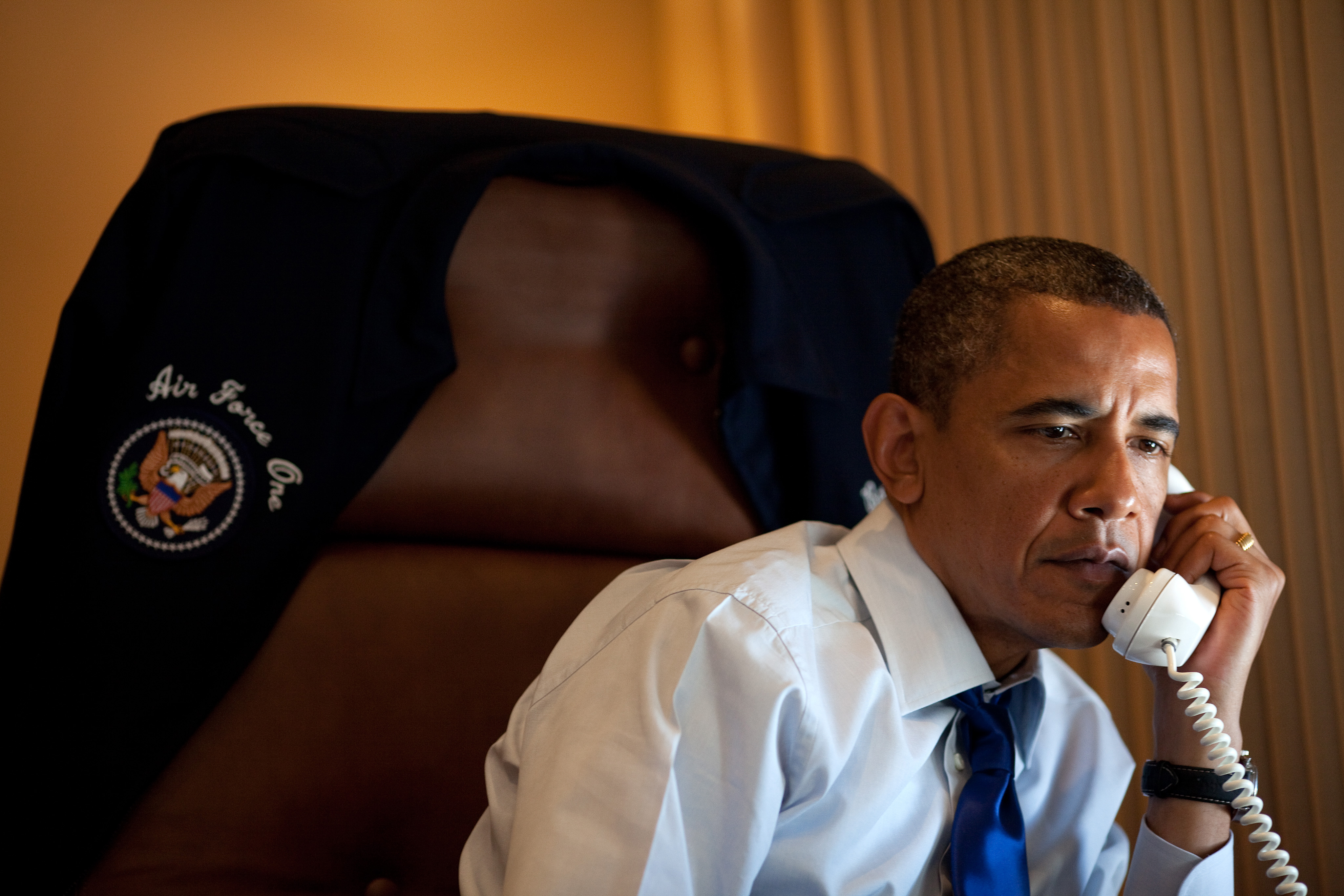
There are times when US President Barack Obama is amazing… an amazing douche bag. He entered the Oval Office with an extraordinary inheritance. He was a charismatic, intelligent, erudite black man. Better still, he replaced the worst President in living memory, a man so misunderestimated that he could barely string a sentence together. In contrast, Obama was misoverestimated. He was going to end global warming. And close Guantanamo Bay. And turn around the US economy. And end conflict in the Middle East. And he deserved a Nobel Peace Prize for what he accomplished. But beyond all the abject failures, Obama has rolled on, trading on the lucky fact that many of his supporters were hopelessly unrealistic (as they now, grudgingly, admit) and because Obama was better than any of the dreadful alternatives. In 2012, after a long and painful nomination dogfight, the Republicans backed a stiff-as-cardboard cutout, scissored straight from a 1950’s magazine article on the benefits of clean living. Mitt Romney was so unproven in politics, and so incompetent as a statesman, that he tried to boost his credibility as a future world leader by flying to London and disparaging the Brits’ ability to manage the Olympic Games, just before they hosted the most successful Olympiad ever. Yet Obama still found himself embarrassingly outdebated by a man who had struggled to beat a gaggle of loose-lipped flops and fools, including Michelle ‘retardation’ Bachmann, Newt ‘moonbase’ Gingrich, Herman ‘no foreign policy’ Cain, and Rick ‘oops’ Perry. But even Obama’s most passionate liberal supporters must now be wondering how they found themselves saddled with such an illiberal president.

Recent events have revealed that the 44th President of the United States is a power-mad absolutist jackass. First, his lackeys procrastinated when asked to rule out the possibility they might use flying drones to execute American citizens, on American soil, without the inconvenience of a trial (or guilty conviction). Stand up, Senator Rand Paul, who accumulated maximum political advantage from that unforced error. And now, the ‘leader of the free world’ has shown he really does not give a damn about freedom, condoning a massively over-the-top government surveillance program which applies to everybody, everywhere.

To clarify, nobody has complained that the United States’ National Security Agency (NSA) might want to monitor the actions of suspected terrorists. However, it was leaked that the NSA had obtained a court order allowing them to obtain every record, of every call, made by, and received by, every phone served by a major American telecoms business over a three-month period. Surely I am not alone in spotting the difference between monitoring suspected terrorists and monitoring every phone serviced by a big telecoms business. Unless the NSA thinks that every customer of Verizon Business Network Services is a potential terrorist. Maybe they do. It seems increasingly likely that Obama can justify such excess, at least to himself, through a heady mix of paranoia and conceit.

To make matters worse, a second leak suggested that the NSA has the ability to spy on every message, by every human being, that flies through the American portion of cyberspace. Whilst Google, Microsoft and their peers denied all knowledge, the American government proffered the scanty justification that they were spying on everybody else in the world. That tells us a lot about a President that leans so heavily on his supposed ability to maintain good relations with other countries. Next time the Arabs, Communists and totalitarian dictators demand that the UN take control of the internet, what will be the American diplomatic response? Will they say that it is safer to keep control in the hands of private American businesses, rather than trusting governments to oversee it?

Instead of allaying the understandable anger of millions of freedom-loving Americans, the Obama administration went into spin overdrive. In doing so, they rolled out a succession of twisted deceits and contorted rationalizations. Let us examine them, one by one:

1. The government didn’t kill your cat

The top rationalization, as repeatedly deployed by Obama and his cronies, was:

So I want to be very clear — some of the hype that we’ve been hearing over the last day or so — nobody is listening to the content of people’s phone calls.

But nobody said that. Literally nobody accused the US government of doing that. Obama’s response would be like George W. responding to questions over the use of waterboarding by saying nobody pulled anyone’s nails out and that thumbscrews have been banned. Also, the NSA obviously do listen to some calls, so this is not even true.

2. We have no idea who we are spying on (or who anyone is)

As was indicated, what the intelligence community is doing is looking at phone numbers and durations of calls. They are not looking at people’s names…

In other words, the NSA is not really spying on anyone, because a phone number is a phone number, whilst a name is a name. Who has the power to match those two things up?? Not them! Which makes you wonder why they bother.

3. What the public doesn’t know, won’t hurt them

Apparently terrorists are really stupid. Which is undoubtedly true, in many cases. Even so, not all terrorists are that stupid. Only ordinary Americans are that stupid, on average. At least, Obama must think they are that stupid.

Now, the programs that have been discussed over the last couple days in the press are secret in the sense that they’re classified. But they’re not secret in the sense that when it comes to telephone calls, every member of Congress has been briefed on this program.

Meanwhile, Obama’s Director of National Intelligence, James Clapper, issued a statement saying:

The unauthorized disclosure of information about this important and entirely legal program is reprehensible and risks important protections for the security of Americans.

The terrorists had no idea that governments might spy on them!! But the idiots in the ‘free’ press have given the game away. And by doing that, they have put American lives at risk. That is no exaggeration.

Anyhow, why should any member of a free society want to know if the government spends taxpayer’s money on spying on a very large proportion of the populous? Why should they care? They should chill out, because Members of Congress knew what was going on. Yes, there were some who strongly hinted they do not like what is going on. And yes, the law meant they could not speak openly about what was wrong with the government’s behaviour. But keeping a gag on the elected representatives of the people is very important, because otherwise the terrorists will discover that the NSA sometimes does spying-type stuff.

Terrorists are pretty odd, when you think about it. On the one hand, they want to overthrow governments. On the other hand, they assume governments are really easy-going and chilled-out. They assume the NSA is a bunch of fat guys who do nothing. Terrorists are such dopes. But now the free press has alerted them to the truth of what the NSA really does, and that means none of us can feel safe any more.

And when Osama Bin Laden made his messengers travel long distances by car, crossing national borders, just so they could use a completely new prepaid SIM to make a single phone call, before throwing the SIM away, it was because Osama wanted his assistants to get out of the house for a while, and it had nothing to do with any suspicions that the US government might use phone data to try to locate his hideout.

Meanwhile, Al Gore tweeted:

Is it just me, or is secret blanket surveillance obscenely outrageous?

Well tweeted, that former Vice-President. But he obviously has no understanding of national security ‘risks’.

4. Trust us; government always knows best

The corollary to argument 3 is that it is better if some things are decided by government, without involving that messy democracy business. That way, the voters do not need to be confused. Or given a choice. Or as Obama puts it:

These are programs that have been authorized by broad bipartisan majorities repeatedly since 2006

But are they supported by voters? Obviously not. Because voters should not know what is done to them, because if they did, they might disapprove be upset vote for somebody else to represent them in government fail to keep it secret from the stupid terrorists who had no idea that governments spy on millions of law-abiding citizens anyone.

5. We have to indiscriminately collect huge amounts of data in order to do something very specific

According to Obama, there is no need to limit data collection to existing suspects because:

…by sifting through this so-called metadata, they may identify potential leads with respect to folks who might engage in terrorism.

Yes, and they might get leads on who is homosexual. Or who is cheating on his wife. Or who is cheating on his taxes. Or who is friends with a union leader. Or whether a CEO is about to engage in a hostile corporate takeover. Or who is a secret communist. Or who is a secret conservative. Knowing who somebody speaks to, and when, can reveal a lot about that person. Which is why spying should be limited to those people who are already under suspicion of something serious, and not applied wholesale, to everybody using a telecom operator’s phones.

6. There is no such thing as a bad law (after all, we wrote them!)

This program, by the way, is fully overseen not just by Congress, but by the FISA Court — a court specially put together to evaluate classified programs to make sure that the executive branch, or government generally, is not abusing them, and that it’s being carried out consistent with the Constitution and rule of law.

If gathering every record, of every call, to every phone served by a big telecoms company is not an abuse, then what is the legal authority of the FISA Court to limit abuse? The answer is none, because when the NSA ask for excessive amounts of data, there is no legal definition of what is ‘excessive’.

7. Focus, focus, focus

Obama said:

But I know that the people who are involved in these programs, they operate like professionals. And these things are very narrowly circumscribed. They’re very focused.

In March of this year, Senator Ron Wyden asked the following question to spy boss James Clapper.

So, what I wanted to see is – if you could give me a ‘yes or no’ answer to the question: does the NSA collect any type of data at all on millions or hundreds of millions of Americans?

The correct answer to this question is ‘yes’, because the NSA has, at least once, requested the right to all call records for literally millions of American users of Verizon Business Network Services. Clapper answered:

“No sir.”

8. We only spy on Americans
9. We only spy on foreigners

Obama said:

Now, with respect to the Internet and emails — this does not apply to U.S. citizens and it does not apply to people living in the United States.

Clapper’s statement said:

Section 702 is a provision of FISA that is designed to facilitate the acquisition of foreign intelligence information concerning non-U.S. persons located outside the United States. It cannot be used to intentionally target any U.S. citizen, any other U.S. person, or anyone located within the United States.

The first leaked court order said:

It is hereby ordered that, the Custodian of Records shall produce to the National Security Agency (NSA)… an electronic copy of the following tangible things: all call detail records or “telephony metadata” created by Verizon for communications (i) between the United States and abroad; or (ii) wholly within the United States, including local telephone calls. This Order does not require Verizon to produce telephony metadata for communications wholly originating and terminating in foreign countries.

In summary, if they want to spy on Americans, they will spy on Americans, as per the law that allows them to do so. And if they want to spy on foreigners, they will spy on foreigners, as per the law that allows them to do so.

10. Society has to make tough choices (by which we mean, President Obama has to make tough choices, on behalf of society)

I came in with a healthy skepticism about these programs. My team evaluated them. We scrubbed them thoroughly. We actually expanded some of the oversight, increased some of the safeguards, But my assessment and my team’s assessment was that they help us prevent terrorist attacks. And the modest encroachments on privacy that are involved in getting phone numbers or duration without a name attached and not looking at content, that on net, it was worth us doing.

Some other folks may have a different assessment of that, but I think it’s important to recognize that you can’t have 100% security and also then have 100% privacy, and zero inconvenience. We’re going to have to make some choices as a society.

To summarize, Obama made some choices, and they were the right ones, and involve modest encroachments on privacy. And if you think indiscriminately obtaining records of calls made by, and received by, millions of Americans is more than a ‘modest’ encroachment on privacy, then you have to recognize that you cannot have everything you want, you unreasonable son-of-a-bitch. Yes, he was talking to you, Mr. Man-in-Society!!!! Obama has always always always made the right choices for society, the tough choices for society, and if somebody in that society disagrees… well, nobody should have told them what Obama decided. Fortunately, nobody in Obama’s administration gives a goddamn what you think. It is their duty to spy on everyone that they consider a threat… so you had better not threaten them, if you know what is good for you society.

Fertile Study

We left Karen exploring the institute in the last episode of her adventures in Lundern. Now we pick up the story with Karen about to be taken on a guided tour…

“Trainees, listen up. We shall begin at the beginning “” by which I also mean, the beginning of everyone here,” said Dr. Grieg. Some of the group snorted or chortled or tittered; Karen did not get the joke. Grieg pushed his way through a pair of swinging doors. The sign above them read: ‘Fertilizing Room’. “Are you ready?” asked Grieg. At this signal, everyone, but Karen and Grieg, pulled out their notepads and pencils. Grieg had no need of a notepad. He did the talking. Karen had no notepad. Hiding at the back, she cupped her hand and playacted holding a pencil, hoping nobody would notice the difference.

“As the sign said, this is the Fertilizing Room,” said Grieg, pulling on a pair of clean white gloves, “and this is where life begins.” The trainees wrote this down. Karen pretended to write. The near side of the room was filled with glass cabinets, an aisle running between them. Grieg walked to the first cabinet, and opened its door. “These are our raw materials “” our inputs, if you like. They’re the gametes “” what’s a gamete?” he said, pointing at a young woman near the front. “Quickly, quickly,” he said, clicking his fingers, but she did not know. “A sperm or egg,” said a ginger freckled lad. “From a male or female respectively,” said another ginger freckled lad, standing alongside the first. They must have been identical twins. “Very good, that’s right,” said Grieg. “Each parent contributes a gamete, and each gamete has half the code needed to construct a new person.” Within the cabinet, there was a rack, with glass shelves stacked from top to bottom. Each shelf was filled with flat circular glass trays, ten wide by ten deep on every shelf. “In this cabinet we keep eggs. You can see each of these have white labels, meaning they came from the wannabe mothers in Lundern’s general population. Whilst over here…” Grieg went to the cabinet on the other side of the aisle, “these eggs have yellow labels. Yellow means they came from our in-house, factory, sources.”

The others were taking notes. Karen bit her lip. Eggs? Human eggs? Taken from inside women? And those ‘in-house sources’ he referred to… were they the women that Karen had seen upstairs? Karen shivered, though the room was warm.

“Will we see the in-house sources later?” asked one of the ginger lads.
“No, Ginger One. They only interact with the doctors assigned to care for them,” said Grieg. “They have no contact with the outside world, to protect them from infections, terrorists, and such.”
“Do you tie up the in-house sources?” asked the other ginger lad.
“Are you sick in the head? We’re not barbarians. We only tie them up when we absolutely have to you, usually after they first arrive. But they soon learn to like it here, Ginger Two.”
“I’m Robert McDonald,” said Ginger Two, “and my brother’s name is Derek…”
“I don’t have time to learn names, Ginger Two! Let’s move on, shall we? Over here we keep the male gametes, the sperm,” said Grieg, walking to a different cabinet. “Whilst the eggs are kept at 37 degrees centigrade, our little boys like it a tad cooler, at 35 degrees. Now, what you really want to see,” and he spoke as he continued down the aisle, “is the process of fertilization itself “” how our doctors combine the codes to make a new life.”

Beyond the cabinets, the second half of the room held an array of workbenches and machines. Most of the machines looked like crosses between dishwashers and fridges. Many white-coated staff hunched at their work. They examined glass dishes under microscopes, poked the contents with syringes or other instruments, and shuffled them between machines. They wrote out sticky labels to attach to the dishes, or wrote up their progress in hefty logbooks. Grieg said a lot of things that Karen did not understand, though she tried. He talked about inspecting the eggs, checking for abnormalities, and selecting the best ones from each batch. He talked about washing the sperm, to remove inactive cells and fluid. The trainees took turns to sit with a doctor at his work, watching through a special microscope where two people could observe the same dish. Karen waited until last. “At the back again?” commented Grieg. Through the microscope, Karen saw the round shape of an egg. Then a needle was inserted, and a tiny individual sperm was pushed inside the egg. “And that’s how we achieve fertilization in Lundern,” said Grieg. “With the code combined, the cells now have all the instructions they need to multiply, making more and more cells until we have a complete human being. But what do we call the product of two gametes? Anyone?”
“A zygote,” said Ginger Two.
“That’s right, Ginger One,” said Grieg.
“I’m Ginger Two.”
“Does it matter which one you are? Now, the cultivation dish for the zygote is filled with yummy ingredients that zygotes love to feed on.” Grieg listed them, and the trainees wrote them down. Karen did not recognize the names of the ingredients, except for glucose, which she knew was a kind of sugar, and vitamins, which she knew were meant to be good for people. Then the dish would be placed in the ‘tank’ for five days. From the outside, the tank looked like a safe, and a brawny white-coated man was responsible for logging every deposit and every withdrawal from the tank, including the three dishes that Grieg removed so the trainees could examine them. Under the microscope, the first dish contained a zygote which had divided into two cells, the second had divided into four cells, and the last, which had been in the tank for five days, was divided so many times it was impossible to count all the cells. “And what do you we call an embryo that has developed this far?”
“A blastocyst,” said Ginger One.
“Correct, and in the bad old days, the poor blastocyst would have to attach itself to the wall of the mother’s womb “” a risky activity for both mother and would-be child! But thanks to our modern techniques, we’ve eliminated such dangers. Now we control everything. For every thousand healthy blastocysts, we create nine-hundred and ninety-nine healthy children “” much better odds than Mother Nature!”
“What about cloning?” asked Ginger Two.
“Why am I not surprised that you asked that question?” said Grieg.
Ginger Two looked blank. He turned to Ginger One, who said: “because we’re identical twins?”
“You mean, you’re clones,” said Grieg.
“No, we’re identical twins,” insisted Ginger One.
“That’s the same as a clone,” said Grieg.
“No, it’s not,” chipped in Ginger Two.
“A clone is a new human made by copying another human’s code. Hence, you’re obviously clones. Or, to be precise, one of you is a clone of the other. Which one is it? Are you the copy, Ginger One?”
“We’re not clones, because neither of us is a copy of the other. Our zygote split naturally.”
Grieg looked disgusted. “You mean, you’re genuine identical twins? Created by accident, inside your…” and he gulped heavily, “…your birth-mother?”
A number of the trainees looked sickly, or shocked, at the word ‘birth’. Grieg apologized for using such vulgar, but precise language.
“Yes, we were born in the Periphers,” said Ginger One.
“Stop using the b-word,” said Grieg.
“The b-word? You mean ‘born’?” said Ginger One.
“Stop it, I said. Don’t use that word. There’s young ladies present. You’ll make them faint. It’s bad enough that the two of you are both freaks and immigrants, without repeating the words B-O-R-N and B-I-R-T-H all the time. You must be aware that… that… that all B’s have been banned in Lundern, for the sake of women’s health and equality, and for the sake of a healthy and productive populace in general.”

Karen was glad to be at the back. If she had a real notepad and pencil, she would have dropped them by now. In Lundern, they really made babies in a factory… and this was the factory. That explained why they employed storks, like Cecilia, to deliver them.

“Can you tell us when cloning would take place?” asked Ginger Two, returning to his original question.
“We don’t do cloning here,” explained Grieg, tight-lipped. “This isn’t one of our larger production facilities. Cloning is used for mass production of basic human stock, which will be used for labour, so the quality of the product isn’t so important. And we use cloning for animals, of course.”
“What’s the problem with the quality of clones?” asked Ginger One.
“There’s too many errors in the copying process. Our clones are poorer copies of the original than you are of each other, even though clones are made by design, whilst you two were an accident. Errors in copying mean the code is degraded, and the resulting person is… sub-optimal. But now we’re falling behind schedule. Let’s press on.” Grieg flounced away. The trainees hurried after him. For a moment, Karen was left behind in the Fertilization Room. Slowly and silently, all the white-coated doctors, turned from their work, to face Karen. Spooked, Karen hurried out as well.

How You Once Told Me What I Needed To Know

I bought you a river but it was dry
I bought you an escort but he was shy
I bought you the truth but you made it a lie
Why don’t you please tell me what I should buy?

I opened a door but you closed it again
I opened my home but then nobody came
I opened my mind but found I was insane
Won’t you please tell me how to win this game?

You told me you’d love me if I was a man
You told me you’d love me like nobody can
But now I feel lonely and don’t understand
Why don’t you just love me for who I am?

I walked down the path that I’d been sent
I walked down the road as far as it went
By then I’d grown tired of this lament
So that’s where I ended…

And now I’m content

Mr. Wrong Forgets His Facts

I know nothing about teaching. Nothing. But I hear that Michael Gove is terrible. Really terrible. He is possibly the worst Education Secretary that Britain has had since all the others. As far as I can tell, all teachers have been perpetually on strike since I went to school, and their reason for striking is a lot of bad government, as routinely elected by voters who (ahem) learned how to reason when they went to school. Teachers only ever strike because of bad bad bad government, because almost every teacher is a wonderful human being and doing a fine job. So if I remember that some of my teachers were lousy, and that I had to correct the mistakes they made, or had fun by getting different teachers to contradict each other, then we should still be careful not to throw away the bath water because of a few rotten apples etc etc. (Note the use of the word ‘some’ which, as even Sesame Street will tell us, is not the same as ‘none’ or ‘all’. This is an important distinction that some teachers may struggle with.) Now, because I know nothing about teaching, but I keep hearing how terrible Michael Gove is, I have been itching to find a pithy test case of Gove’s rightness and wrongness. And, by extraordinary good fortune, thanks to Gove’s entertaining and sometimes neo-Clarksonesque way of expressing himself, an example came along…

One set of history teaching resources targeted at year 11s “” 15 and 16 year olds “” suggests spending classroom time depicting the rise of Hitler as a ‘Mr Men’ story.

If I may quote “” “The following steps are a useful framework: Brainstorm the key people involved (Hitler, Hindenburg, Goering, Van der Lubbe, Rohm”¦). Discuss their personalities / actions in relation to the topic. Bring up a picture of the Mr Men characters on the board. Discuss which characters are the best match.”

I may be unfamiliar with all of Roger Hargreaves’ work but I am not sure he ever got round to producing Mr Anti-Semitic Dictator, Mr Junker General or Mr Dutch Communist Scapegoat.

But I am familiar with the superb historical account Richard J Evans gives of the rise, rule and ruin of the Third Reich and I cannot believe he could possibly be happy with reducing the history of Germany’s darkest years to a falling out between Mr Tickle and Mr Topsy-Turvy.

Now, on the face of it, describing the rise of Hitler by using Mr. Men characters would seem to be a bad idea. And easy to mock. And rightly deserving of being mocked. But I claim no expertise on this subject (neither teaching, nor the rising of Hitler). I just know how to read, so this little headline-generating example of Goveism at its best/worst (delete according to your own taste) does lend itself to a test case, especially when the author of the Mr. Men ‘rise of Hitler’ teaching resource stepped up to defend himself. So we heard what Gove had to say… what did Russel Tarr, the teacher in question, write in response?

On Thursday of this week I was the subject of an attack by the Secretary of State for Education, Michael Gove, in what’s being called his “Mr. Men” speech. According to Mr. Gove, my approach to teaching is apparently symptomatic of all that is wrong with UK secondary education in general, and history teaching in particular.

Straight away, alarm bells are ringing. Did Gove really say that the Mr. Men lesson plan was symptomatic of all that is wrong blah blah? Maybe he implied it, though. Let us move on.

The following morning I found the story all over the national newspapers including the front page of The Times. Today, Mr. Gove repeated his criticisms on the BBC’s Andrew Marr show.

Mr. Gove focuses on a particular activity on my website www.activehistory.co.uk in which students are required to produce children’s stories in the style of the well-known ‘Mr. Men’ books to explain the rise of Hitler. For Gove, this provides irrefutable evidence of the ‘infantilisation’ of history teaching and a ‘culture of low expectations’…

Gove did not use language like ‘irrefutable evidence’. On the other hand, I think it would be strange to argue there is no prima facie evidence to support his observations. The reason why Gove’s speech is being quoted is because it does sound infantile to try to explain the rise of Hitler by analogy to Mr. Men.

… (although as AaronStebbings puts it, “I imagine Michael Gove would have a go at George Orwell for using farmyard animals to explain the rise of the Soviet Union”).

So far, so many (low) blows to Michael Gove for things he did not say. Tut tut – can we actually analyse what Gove did say? Or should we get bogged down in straw man arguments about what Gove thinks about Animal Farm (a book which is not very like a Mr. Men story).

Gove and his advisors – either through stupidity or mischievousness – failed to place me, my website, or the lesson into its appropriate context.

Lack of context? Is that really the way Tarr wants to defend himself against Gove’s accusation? Rather than putting Gove’s argument into context, it has been wildly exaggerated so far (‘symptomatic of all that is wrong’, ‘irrefutable’, ‘Gove would have a go at George Orwell’, etc etc). Now seems like an appropriate time to put Tarr’s own arguments into context. Alongside his words, he placed on his website an animated graphic of Michael Gove, in which Gove spouts (in a voice nothing like Michael Gove’s voice) the following words:

Hello, my name is Michael Gove and if, like me, you prefer to have your opinions unfiltered by rational arguments and evidence, then I suggest you read no further into this piece by Russel Tarr of activehistory

Seriously? This is the ‘context’ provided by a man trying to make an intelligent argument about context? Is this an example of the sophisticated reasoning and language skills that teachers encourage in their pupils? But back to what Tarr wrote…

His criticisms betray a lack of knowledge, understanding, and interpretation that would make a GCSE History student blush with shame.

Also Michael Gove is worse than Hitler. Stupider than an ox. Has more ear wax than an earwig. Various other insults. Antichrist. More insults. Snooze… zzzzzz… Sorry, I nodded off. Where were we? Oh yes, we were in the middle of a ‘rational’ argument.

Ironically, given Mr. Gove’s supposed commitment to rigorous academic standards, it appears that much of his research comes from dodgy marketing surveys from Premier Inn and UKTV Gold (I kid you not)!

That seems to be the first genuinely good and accurate point that Tarr has made. Though it is not, strictly speaking, a defence of using the Mr. Men to explain the rise of Hitler.

Moreover, other commentators have inferred that these books address “Nazi Germany” and thereby repackage World War Two and the Genocide into bedtime stories for primary school children. Not so. To clarify, I do not teach the Third Reich – with all its attendant horrors – through children’s storybooks. The actual topic in question is “The Weimar Republic 1918-33” with a focus on why democracy failed in Germany after World War One: in other words the topic does not begin, but instead ends, with the declaration of the Third Reich. This is not a ‘lesson about Hitler’ in that sense and I think this is an important point.

This is an important point, in so far as it relates to flawed criticisms of Tarr. But it is not an important point in response to Gove’s criticism of Tarr. Gove stuck to the facts. Tarr’s intention was to encourage children to use Mr. Men analogies as a way to understand the rise of Hitler.

Tarr’s own point is undermined because he deliberately misquotes himself. The lesson plan that Gove discussed does not cover “The Weimar Republic 1918-33”. The lesson plan covers “The Rise of Hitler”. Here I am using the same words that Tarr uses to describe his own lesson plan. To my ears, it sounds pedantic to insist that a lesson called the “The Rise of Hitler” is not a ‘lesson about Hitler’.

General Points about the website Mr. Gove is attacking, and its author

ActiveHistory is a well-established and highly respected website which has been in continual development for more than 15 years. Its resources and interactive simulations have been praised in the press, used by tens of thousands of teachers all over the world, many of whom have provided glowing testimonials about its effectiveness. It was awarded first prize in the previous Guardian/BECTA Awards as early as 2002 for its innovative Head2Head interviews with historical characters.

I am sure this is all true. On the other hand, it feels odd that a historian is actively encouraging his audience to pretend that there is no such thing as bias in the world. Tarr is well-respected because Tarr says so. Gove is a prat when Tarr says so. Hence we have eliminated any bias? On the contrary, Tarr’s glowing account of himself is so gloriously one-sided that it makes me blush as a reader (and yes, I have a GCSE in History). Gove attacked a lesson plan which involved Mr. Men and Hitler, and Tarr is defending himself by pointing out he helps old ladies to cross the road and he diligently recycles. Why not stick to the point, which is the appropriateness of using Mr. Men to form analogies to German politicians of the 1920s and 30s?

Russel Tarr graduated from Lady Margaret Hall, Oxford University, in 1993 with a 2:1 in Modern History (in a strange quirk of fate, this is also Mr. Gove’s old college – perhaps I knocked over his gin and tonic in the college bar back in the day…). I have been a full-time teacher of History since 1997, mainly in the UK (at Wolverhampton Grammar School) and more recently in France (at the International School of Toulouse). I’ve written plenty of academic articles (e.g. for History Review, the Times Educational Supplement, IB World Magazine) and also authored a textbook for A-Level on Luther and the German Reformation.

Gove once used the words ‘yadda yadda’ to put down an opponent on Question Time. The phrase seems oddly appropriate here. Presumably if somebody attains a 2:1 from Lady Margaret Hall, Oxford University, we should all shut up and stop being critical of anything they do. Following that logic, we would all have been forced to agree with Hitler’s plan for the Third Reich, if only Adolf had earned a 2:1 from Oxford, before embarking on his rise to power.

Particular Points about the “Mr. Men” activity

At long last. Tarr finally gets around to defending himself for doing the thing that Gove actually criticized him for doing. At long long last.

The creation of children’s storybooks is an excellent revision exercise, but not the primary method by which I teach any topic whatsoever.

Oh no. More digression. More feeble straw man antics. Gove’s argument is straightforward: using Mr. Men to learn history is, on the face of it, so daft that it can never be acceptable. He may be wrong. But that is the argument. He was not making an argument about whether this is Tarr’s ‘primary’ method, ‘secondary’ method or even his ‘tertiary’ method.

My students spend six solid weeks, plus homework time, studying the Weimar Republic through an academically rigorous unit of study. They then write a 1000-word, externally moderated coursework essay (without further assistance and during their holidays) analysing the causes for Hitler’s election as German Chancellor in January 1933.

Yadda yadda, I am sorry to say.

Only then do they (and, indeed, can they) consolidate their knowledge as a revision exercise by converting this sophisticated story into a children’s book.

As Gove put it: “one set of history teaching resources targeted at year 11s “” 15 and 16 year olds “” suggests spending classroom time depicting the rise of Hitler as a ‘Mr Men’ story.” So Gove has not taken anything of context. On the contrary, he states a fact, and lets everybody draw their own inference. Not surprisingly, many people draw an inference that Tarr does not like. So Tarr ignores that inference and just bangs on as if Gove said something different to what he actually said.

I totally agree that the ability to read in depth, take effective notes and memorise facts is an essential part of every child’s education. However, I utterly reject the idea that these skills are an end in themselves, and that effective learning should be measured by a teacher’s ability to cram as much information, in as dry a manner as possible, into a student’s head.

Interesting point. Unfortunately, it seems to bear no relationship to what Gove said. I hope teaching has not been reduced to two alternatives, where either teachers insist that ‘the rise of Hitler must be taught using analogies to the Mr. Men’ or else they must ‘cram as much information, in as dry a manner as possible, into a student’s head’. Maybe Tarr thinks those are the only two options. Arguably he is the one who is reluctant to embrace a middle ground, with less dry cramming, and less Mr. Men.

The memorisation of dates, events, people and places is merely the first step in helping students to form valid opinions, make substantiated judgements and to argue a viewpoint effectively. The joy of History is its focus on debate, discussion, interpretation and personal reflection. Any teacher worthy of the title knows that the best learning takes place when students are engaged, interested and stimulated in lessons. It is a terrible mistake to assume that academic rigour and creative teaching are mutually exclusive.

Yadda yadda. False dichotomy. Yadda yadda. This guy has a 2:1 from Oxford, apparently.

The “Mr. Men” approach is highly effective…

Great! Is there where Tarr shows some evidence to defend himself?

… but does not provide a ‘typical’ example of how history lessons are taught in my classroom or anyone else’s.

No. No evidence. Just take it on trust. Mr. Men are highly effective. So highly effective that they are highly atypical of the other highly effective techniques that Tarr advocates.

The whole idea of taking one activity and using this to illustrate how children are taught in general is laughable.

Anyone who has got this far has long stopped laughing. Tarr has made his point, as much as he ever will. Gove was wrong to imply that every lesson involves Mr. Men doing algebra, Mr. Men teaching French and Mr. Men explaining sexual reproduction. But then, Gove did not say that. He just picked a laughable example of one loony teacher who clearly went too far with his creative approach to teaching history. And who is actually undermining himself, because he does not defend what he did. On the contrary, he defends himself by pointing out that how extreme it is to teach about the popularity of Nazism by analogy to the Mr. Men.

My students will use the Mr. Men approach on just two occasions in their seven years with me: once when revising the rise of Hitler, and once when outlining the Causes of World War One.

‘Just two occasions’. Tarr needs a defence lawyer. He is not a good advocate for himself. One the one hand, he is keen to admit that using Mr. Men to teach history is not normal. Phew. We can breathe a sigh a relief, because Tarr must be faintly self-aware. On the other hand, it is not a one-off fluke either. The mind boggles at how the causes of World War One can be related to the Mr. Men. Were the many conflicting ethnic groups in Austro-Hungary personified by the naive Mr. Multiculturalism?

The approach is easily transferable to other subjects such as science, politicians in general and Mr. Gove in particular.

Hitler’s approach to the Jews was transferable to gypsies and disabled. Just because something can be transferred, does not mean it should be transferred.

Outside of this they will have an endless range of other experiences designed to appeal to as broad a range of learning styles as possible, at different ability levels, for the appropriate age range under consideration. It’s a little trick we in the teaching procession call ‘differentiation’, Mr. Gove!

The argument for differentiation, when used like this, could be used to justify anything. Imagine taking one student at random, and gassing them, in order to explain the holocaust. That technique would be ‘different’ but still ‘wrong’.

This exercise is highly challenging and in no way represents the ‘infantilisation’ of students ‘on the verge of university’…

Here comes the good bit, that you have all been waiting for…

These are Year 10 students (14 years old).

This is factually incorrect. Incredibly, in an argument defending his own lesson plan, as published on the internet, Tarr misrepresents his own lesson plan. This is what Gove said:

…targeted at year 11s “” 15 and 16 year olds

And this is what Tarr’s lesson plan states:

Pre-activity preparation for Year 11

Prior to this activity, Year 11 students should have finished studying the Rise of Hitler.

Year 10 versus Year 11. This is a simple matter of fact. For a man who wasted so many words lecturing Gove about the importance of context, and a supposed overemphasis of facts, it beggars belief that Tarr misrepresents which age group he wrote the lesson plan for. Gove quotes Tarr correctly: he wrote a plan for year 11s, who are 15 to 16 year olds. Tarr misquotes himself: this is not a plan for year 10s (14 year olds).

For me, an error like this suggests Tarr’s pompous arguments have no credibility whatsoever. He does not respect the most basic facts, and changes them to suit his point of view.

Beyond that important clarification,…

Err… that would be a misclarification. Or we could call it lying. You pick.

it is anything but ‘infantilisation’ to get secondary school students (or indeed adults) of any age to produce an effective children’s storybook on a complex topic.

Tarr is so right. Here is my children’s storybook version of this spat between Gove and Tarr:

The nasty funny clever politician, Mr. Horrible Gove, came along and pointed out silly boy Tarr had pooed his own pants and was smelly. Everybody laughed. Tarr was deeply upset and argued that pooing his own pants was a good thing to do because he only did it twice a year.

But back to Tarr’s never-ending saga…

The process of YADDA YADDA YADDA YADDA YADDA YADDA YADDA YADDA YADDA YADDA YADDA YADDAYADDA YADDA YADDA YADDA YADDA YADDA YADDA YADDA YADDA YADDA YADDA YADDA YADDA YADDA YADDA YADDA YADDA YADDA YADDA YADDA YADDA YADDA YADDA YADDA who regard Hitler’s speechmaking skills and charisma as the key to his rise to power will choose a different character to represent the Nazi leader YADDA YADDA YADDA YADDA YADDA YADDA YADDA YADDA YADDA YADDA YADDA YADDAYADDA YADDA YADDA YADDA YADDA YADDA and so on.

Sorry. He did not actually write the yaddas, but I lost respect for someone who admires the pithiness of the Mr. Men books, but takes several years to make his own, deeply flawed, arguments. Also, his argument is boring.

Closing Remarks

Yes he really needed to make yet more remarks. They were:

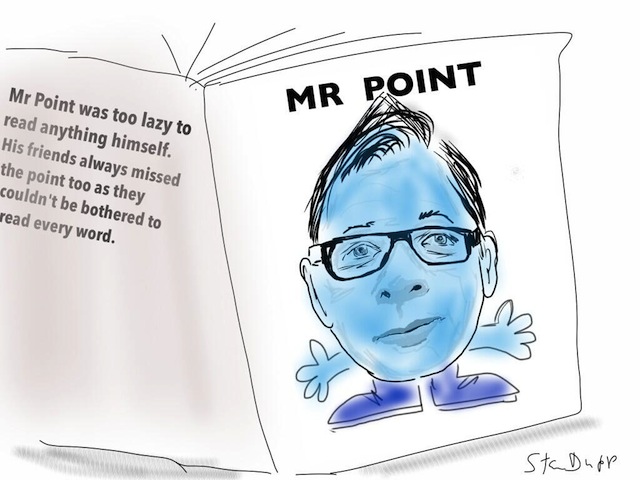
This week has been the strangest YADDA YADDA YADDA YADDA For anyone out there who still doubts the literary power and gravitas of the Hargreaves canon YADDA YADDA YADDA YADDA And just in case you’re reading, Mr. Gove, I’d be more than happy to engage in a direct debate if you are ever interested in shedding your reputation as “Mr. Point”. YADDA YADDA YADDA YADDA

Yes, Tarr wants to engage ‘Mr. Point’ in debate on the merits of using Mr. Men to explain the rise of Hitler. Of course, Gove will not be entering into debate, and the reason why is straightforward. Adolf Hitler was a very evil man. He and his Nazi henchmen were responsible for some of the most terrible crimes in human history. It is distasteful and unhelpful to compare the top Nazis to characters from children’s stories aimed at five year olds. Rather than stimulating children by teaching them how to use metaphor, using the Mr. Men as analogies can only over-simplify the moral and personal flaws of the leading Nazis. As such, this is a deeply mistaken way for children to think about the Nazis and what motivated their rise to power.

I tried to make the argument in simple language, as might be appropriate to a 15 year old. But try telling this argument to a blowhard schoolteacher with a few hundred years experience and a 2:1 from Oxford. When you point out their mistakes, they simply cannot comprehend your criticism. Instead, they remark their own work, giving themselves an A+.

After finding my test case, I discover that I like Michael Gove more than before. He pointed out that citing the Mr. Men was not an appropriate way to teach the rise of Hitler, and the teacher responsible was unable to present a decent counterargument. I am sure there are many experienced educators who would insist my reasoning skills are faulty, because I also reached the ‘wrong’ conclusion, where we determine right and wrong by whether an opinion matches the teacher’s opinion, and not by reference to any objective truth. That makes me wonder if teachers are really suited to the task of developing the reasoning skills of children. Perhaps they should limit themselves to facts.


Exploring the Institute

In the last installment of Karen Zipslicer’s adventures in Lundern, our heroine discovered other prisoners of the Institute. Now she searches for a way out…

Nobody was about. There were no windows, nor clocks, but Karen guessed it was the middle of the night. She found a staircase and went down, exiting at the bottom level. The lights down here were dim. Karen realized this was the basement. The first room she checked was used to collect the hospital’s garbage. There was a line of large cylindrical bins on wheels, all waiting to be taken out. Karen tried to lift the roll-up metal shutters to the outside; they were locked. The next few rooms were storerooms. There was a caretaker’s room, with mops and cleaning equipment, and an unlocked locker! The overalls inside were far too baggy for Karen. But the white pumps were wearable, after Karen stuffed the toes with paper towels. They were too loose for running, but Karen was glad to wear something on her icy cold feet. Shuffling about, she next found the boiler room, and after that, the laundry…

Karen lit the laundry’s gas lamps, and looked in every closet, washing machine, and drying machine, but there was not a stitch of clean clothing to be found. Her only option was to rifle through the dirty pile, sitting in a skip beneath the laundry chute. That did not appeal, but she needed to put something on, if she intended to go outside. Her gown was far too flimsy, and disturbingly revealing at the back. “Never mind,” she said to herself. The sides of the skip rose as high as her neck. Karen reached over, but only managed to pull out some dirty sheets that lay on top. She brushed the hair from her face, then carried over a chair, to stand upon. From that height it was much easier to reach in, so she did. Karen reached in, and reached across, and put her knee on the edge of the skip so she could reach further… and before she knew it, she had kicked the chair from under her and was diving headfirst into the dirty laundry. At least it was soft, she thought, as she righted herself again. Now Karen and Whiteley were inside the skip, it was much easier to scavenge for clothes, which they did, with gusto.

Though she still worried about being discovered, Karen was pleased with her disguise. The doctor’s coat fitted her well, Whiteley was snug in its pocket without bulging too much, and she pulled the surgeon’s mask over her face. Sadly, there were no socks for her cold feet. Dressed like this, she could walk out of the front door, without anyone suspecting. Now she just had to find the front door. But then she found something better: a back door. ‘Emergency exit’ was written upon it. Underneath her mask, she smiled to herself, and walked quickly towards the door, placing both hands on the bar marked ‘push to open’…

“Hey!”
Karen looked around. A thin man in a brilliantly white doctor’s coat stood at the opposite end of the corridor. “We’ve been waiting for you.”
Karen looked left and right, but there was nobody else around. She pointed to herself.
“Yes, you. Come on, this way.” He beckoned her with one finger.
Karen had no choice; she had to go with him.
“Come on,” he repeated. He had a narrow face, with a long and pointed noise, and thinning hair scraped back across his scalp. He held a door open for Karen, who found herself in…

A really dark room. Much darker than the corridor outside. Too dark to see anything, at first. Her eyes adjusted, and as they did, she realized she was in a little cinema. The seats were almost filled with white-coated people. The film had not started. Karen froze for a second. She could not back out. The doctor stood right behind her, closing the door, then leaning in front of it. There were no spare seats along the aisle, so Karen walked, as calmly as she could, down to the front row. That way, she would not need to say ‘excuse me’ or brush past anyone. At the front row, she picked the seat furthest to the side. It was the worst possible place to watch the screen, but she planned to leave last, and sneak away then. The film started. It was black and white, covered in scratches, and the image sometimes skipped around the screen. The film featured two men who also wore white coats, each smoking a pipe. They stood in front of the camera, and spoke to it in extraordinarily posh accents.

Reginald: Hello. My name is Reginald Cuthbert-Ethelbert-Schubert-Smythe, and I’m joined by my eminent colleague and very dear friend, Sir Humphrey de Canella.
Humphrey: Hello.
Reginald: We’re sorry we can’t be there to introduce ourselves in person, but, by now, we’re both thoroughly dead.
Humphrey: Dead as a dodo, I’m afraid. Ghastly business.
Reginald: That’s right. And whilst we presently look like two hearty fellows in strapping good health, enjoying our fine pipe tobacco, always ready for a morning of vigorous country pursuits, or an evening of jolly roister-doistering around town, we can’t do that any more because we’re so very very dead, and we’re speaking to you now because we don’t want you to end up the same way.
Humphrey: Not yet.
Reginald: Quite right, Humphrey. I suppose we all have to go in the end. But you don’t want to go the way we went.
Humphrey: Rather.
Reginald: We may have been two of the leading scientific minds of our generation…
Humphrey: No doubt about it, old chum.
Reginald: …but we want to ensure you don’t make the same dreadful mistakes we did. So, on your first day working here at the world-beating Tolyens-Green Institute for Medical Science, we strongly recommend that you stay close to the guide during the orientation tour, and never stray off the beaten path. Otherwise, you might find yourself like a lamb to the slaughter, by which I mean you’ll suffer a short sharp blast of what did for us…
Humphrey: Radioactivity!
Reginald: Precisely. Whilst radioactivity has been a tremendous boon to the practice of medicine, if not treated with respect, it’ll kill you for sure, as sure as it’s going to kill poor old Humphrey.
Humphrey: Damned shame for you too, old chap.
Reginald: To summarize, follow these three steps and you’ll enjoy a long and healthy life in the employ of the Tolyens-Green Institute. First, stick to the safe areas as described during your orientation tour.
Humphrey: Second “” don’t go anywhere you oughtn’t to.
Reginald: And third, don’t tell a living soul about what you’ve seen inside.
Humphrey: Pardon me, my dear fellow, but what does that last point have to do with radioactivity?
Reginald: Nothing, but I thought it worth mentioning anyway.
Humphrey: Quite right! Carry on.
Reginald: So there you have it. Be sure, be safe, and keep schtum, if you want to prosper at the Tolyens-Green Institute for Medical Science. Or if you just want to enjoy a longer life than poor old Humphrey.

There was a pause as the two men looked into the camera, smiling whilst holding their pipes in their teeth, and then Humphrey turned to Reginald and said:

Humphrey: Is the camera off yet? I thought that went bally well, if I…

And then the film suddenly stopped. The lights came on, and everyone filed out of the room. Because she had sat right at the front, Karen was now right at the back. But there was no chance to escape; the doctor who ushered her in waited for the group outside. With the whole group assembled, he introduced himself as Dr. Grieg. After doing a quick headcount, he led them around the facility. Karen had no chance to slip away, no choice but to follow.

Guardian Readers Tell Their Story; puts austerity into perspective

A few weeks ago, I noted how Guardian readers were sharing their stories about Britain’s austerity, using The Guardian’s new smartphone app. Since then, I have monitored the ratio of stories which reflect genuine hardship (for example, a photo of an empty fridge) compared to excruciating self-pity (such as complaining about the cost of exotic holidays). Sadly, I have nothing new to report. Because Guardian readers have nothing new to report. There are still another three days left to go before their month-long austerity-inspired exercise in citizen journalism comes to an end. But even so, the conclusion is clear: austerity has not affected Guardian readers. Over the space of a month, Guardian readers have contributed a measly 55 examples of austerity, and many of them were laughable. The most recent additions – a photograph of an empty jar supposedly used for collecting spare change, and yet another complaint about potholes – were submitted over a week ago. When it comes to austerity, the reader of The Guardian undergoes some kind of cognitive dissonance. Whilst all Guardian readers know that austerity is a terrible thing that is affecting very many Brits (after all, that is what they read in their newspaper), none of them can give a personal example, apart from complaining about potholes in the road. So if Guardian readers do not experience austerity on a personal level, what is included in their experience of life?

When it comes to suffering, Guardian readers are deeply troubled. By bad cycle lanes. If you thought a weak economy, debt mountain, and strained government finances was a problem, then reflect on the hardships endured by these bike-loving stoics, forced to speak out against the vicious crimes they endure every day. Not only do they have to ride on narrow cycle lanes, but some of them are potholed. In total they shared 217 experiences of what is wrong with Britain’s cycling lanes. Consider this harrowing account:

Narrow and overgrown bumpy tarmac 2-way cycle path beside busy main rd

And my heart goes out to this person:

Lazy Parking on Stretford Road – often more cars stick out in this spot, straight after a busy crossing…really bad cause you are likely to be overtaken by a tail of cars, and have to fight a bit to get out…

What a tragedy – a cyclist being overtaken by cars, thus usurping the natural order of things! And there are many more horror stories, such as painted white lines for cycle paths that go around trees, because the council decided not to rip up the tree in order to make space for the cycle path. Clearly government spending focuses too much on hospitals, jobs and feeding people, and nowhere near enough on the vital infrastructure that cyclists deserve. I suppose those few unemployed Guardian readers who took photographs of their empty fridge must be feeling pretty selfish, after discovering what some people suffer during their daily bike ride to work.

You might argue that cycling is the kind of topic which excites Guardian readers, which is why they have so much to say about cycle paths compared to austerity. But it turns out that Guardian readers find many topics to be more important than the worst austerity Britain has faced since the Great Depression yada yada the sky is falling. The Dutch Queen’s Day Celebrations has racked up 93 contributions, which makes Dutch royal pride approximately 70% more important than Britain’s austerity. Readers sent 80 contributions about visiting their record store, suggesting it is more important to save vinyl than save public sector jobs. And Guardian readers are more likely to come into contact with Syrian refugees (59 contributions) than Brits who suffer from austerity.

The reader who reported that austerity was stopping him from having exotic vacations was rather unrepresentative, it turns out. Through a feature called “Lights, camera, location” we discover all the famous movie locations that Guardian readers get to see on their hols, including trips to Ka’a’awa Valley in Hawaii (where they filmed Lost), the Harry Lime doorway in Vienna, Ha Long Bay in Vietnam (apparently used in Bond films), and Mendoza in Argentina (which I learned was the location for filming Seven Years in Tibet – thus proving the contributor was a double-barrelled movie bore + holiday bore). In total, Guardian readers shared four times as many contributions documenting famous film locations than examples of austerity. And even the person who holidayed in Rome let us down, by failing to mention whether austerity-struck Italians had resorted to fishing out coins from the Trevi Fountain.

What has technology enabled you to do?” has received 82 contributions, despite being an advertorial by EE, the mobile phone network which sponsors The Guardian’s interactive capabilities. Inoculating yourself from the suffering of others is, seemingly, one of the many benefits conferred by expensive gadgets. And for those who are more socially conscious, technology is also a great way to participate in TV debates, as emphasized by an individual who sent in a photo of his smartphone, tweeting this message:

The government want to tax pensioners but your safe if your a big business #questiontime

Hmmm… let us put aside the fact that technology may still fail to correct your grammatical mistakes, and instead focus on the irony of attacking big business by using tech provided by big businesses. This person responded to a big business marketing ploy (from EE) by showing how he spends a lot of money on equipment made by a big business (the manufacturers of his smartphone) and on services provided by a big business (Telefonica, the Spanish telecoms giant that owns this customer’s network) in order to send a message via a big business (Twitter) that tells the BBC (big, but not a business, as it receives taxes, instead of paying them) what he thinks about government taxing big business. On the plus side, he is likely ignorant of all the ways that all those big businesses avoid tax, thus keeping down the cost to him, the end user.

But, of course, I am being silly. Politics, holidays, the economy, and even cycle lanes pale into insignificance compared to the things that really, really matter to Guardian readers. Imagine a drum roll as I reveal the top three:

3. Cats, with 869 contributions.

2. Dogs, with 1029 contributions.

1. And on a mighty 1674 contributions, the most important thing in the life of a typical Guardian reader is: tall buildings. Tall buildings? Yup, it turns out that when Guardian readers are not enjoying the view from a skyscraper in New York, Hong Kong, Sydney, Dubai or Tokyo, they tend to be in the Shard, looking down on all the little people below. In more sense than one.

Seeing in the Dark

In the previous episode of Karen Zipslicer’s adventures in Lundern, Karen woke to find herself strapped to a hospital bed. She escaped with Whiteley’s help, and must now explore the rest of the facility…

Karen opened the door barely enough to peer around. She peeked with one eye. Whiteley peeked with two. The corridor was long, white, with polished floors and bright gas lanterns. And it was empty.
“Let’s go,” said Whiteley.
“Which way?”
Whiteley had no answer. He just looked up and squeaked.
“You’d better follow me then,” said Karen.
There were lots of numbered doors. Karen had been in room 439. She tried the door to room 440. It was dark inside, and the bed was empty. In room 441, a woman was lying on her side, sleeping. The light from the corridor illuminated her face. She was older than Karen, possibly thirty, and she had vision-boxes over both her eyes. Karen gently closed the door again. Another woman slept in room 442, her back turned to the door. 443 was empty. Karen turned the handle to room 444. A scream came from within. Karen let go of the handle, but the screaming continued. She looked around. Nobody was coming down the corridor. The screaming continued. Karen bit her lip, then stuck her head around the door. A girl was in the bed. She was a few years older than Karen, and terrified of her. She had also been tied down by her wrists; she thrashed her legs and body, trying to break loose.
Karen put her finger to her mouth. “Shsssh. It’s okay.”
The girl was shouting something, hysterical. Karen did not understand. It sounded like Chinese.
“Please, quiet, please,” said Karen.
The girl was fighting to tear herself free of the bed, shaking it as she did.
Karen told Whiteley to keep watch. She stepped inside, leaving the door slightly ajar. The girl responded by screaming more loudly and thrashing more violently, but she calmed as Karen walked slowly toward her, her hands held up, gently hushing her.
“I’m going to take these off,” said Karen, pointing to the cuffs around the girl’s wrists.
The girl spewed more words in Chinese, then said a word which sounded like “help.”
“Yes, that’s right. I’m going to help you,” said Karen, as she reached for one cuff. Rope had been tied around it, for extra security. Karen struggled to unknot it, talking to the girl as she did, trying to calm her. “Yes, first we’ll take these off, and then we’ll get out of here, you and me. This is tied tight, but I’ll get it off…”
“Hear somebody coming,” said Whiteley.
“Help,” said the girl.
“I’m nearly there,” said Karen. She bowed and wrestled the knot with her teeth, as well as both her hands.
“Hear somebody coming!” said Whiteley.
Karen stood and looked at the girl. The girl said “help,” again, pathetically.
“I’m so sorry,” said Karen. She squeezed the girl’s hand.
“Hear somebody coming!” said Whiteley.
Karen turned and fled, scooped up Whiteley, then slid down the corridor, diving into room 443. She put her ear to the door, and listened to the footsteps as two people strode toward them.
“I’ve had it with this one.” It was a man’s voice.
“She’s already had the maximum dose.” That was a woman.
“I wasn’t thinking of that. These vee-bees will shut her up.”
“They weren’t designed for her.”
“They’ll do.”
“What about the brain damage?”
“What about it? Nobody can understand her anyway.”
The footsteps reached Karen’s door. She held her breath. The footsteps went by. The door to room 444 was opened. The Chinese girl screamed and shouted again; she may have been swearing in her language. Karen trembled. The girl cried for help, but none came.

Then there was silence. Karen listened to her own heart’s beating. The footsteps returned to the corridor. Karen bit her knuckle as they went by. She waited until they had grown too faint to hear, then asked Whiteley if they had gone, because his hearing was excellent. “Long gone,” he said. They crept back to room 444, to check on the Chinese girl. Karen opened the door ever so slowly, ready to run if there was the slightest noise from within, but there was none.

“Hello? Are you okay?” asked Karen. There was no answer. “Hello?” Silence. As she opened the door wider, the light from the corridor spilled on to the Chinese girl, stretching from her feet upwards. She lay on the bed, serene and still. Karen opened the door to its widest extent. The light reached the girl’s face. It was graced by a gentle smile; two black vision-boxes hid her eyes. Now Karen wanted to scream; she held her hand across her mouth. Karen walked to the girl, and bowed over her. “Hello? Can you hear me?” The cuffs were gone. Karen shook the girl’s arm. There was no response. Karen passed her hand in front of the girl’s face, across her eyes. Still no response. Karen pinched the girl’s arm, then punched her in the shoulder. Nothing. The girl did not care. If anything, she smiled a little more sweetly. Karen placed her fingers on the black boxes. Their surface was smooth, and warm to the touch. “Can you hear me?” There was no reply. “Can you hear me? I’m taking these off.”
“Can’t do that,” said Whiteley.
Karen ignored Whiteley. She pinched one of the vision-boxes between thumb and forefinger, and pulled, but her fingers slid straight off. Karen took hold again, this time grabbing the black box with all the fingers of her one hand, whilst she placed her other hand against the Chinese girl’s forehead. Karen’s hand slipped off again.
“Can’t get them off,” repeated Whiteley. Karen slid her thumb between one vision-box and the bridge of the girl’s nose, then wrapped the other hand around the girl’s forehead, and pushed the vision-box sideways. It would not budge.
“You’ll hurt her,” said Whiteley. Karen believed him.
“I’m so sorry,” said Karen, to the Chinese girl. Karen bit her top lip, and held the girl’s arm in both hands.
“Us go,” said Whiteley. Karen followed, repeating she was sorry.