

Home Blog Page 13

The Guardian Hates Britain (whilst the BBC is undecided)

Something peculiar happened the other day. A British leader said that Brits have done some good things. This very rarely happens. Whilst in shock, most of the British press agreed. They know that bad news sells more newspapers than good news, but outright abuse of Britain might dampen sales even further. And it should be no surprise that British journalists, writing for a British audience, might know of reasons for Brits to feel proud, and patriotic. Perhaps they learned some of them at school, at the same time that Argentinean kids learned how Brits are evil colonialists who stole an (unpopulated, barren) island from them before their country even existed, and in the same way that Russian kids are taught that being gay is the kind of disease you catch by hanging around with Brits.

Whilst David Cameron was still in Russia, looking for ways to prevent Syrian children from being gassed, the BBC had sharply focused on its public service mandate, striving for balance in the reporting of every word that Cameron uttered. To achieve this goal demanded a search of the internet, looking for supportive and negative responses to Cameron’s passionate defense of Britain. Already, wise reader, you will have noticed the flaw in the BBC’s approach. However much an ‘objective’ journalist may want to find ‘balance’ by lazily looking up all the usual suspects, normally guaranteed to give kneejerk disagreement with what the politician said, it is going to be hard to find ‘balance’ when the politician is only saying nice things about people who come from the same country as you. Whilst the BBC found three articles that backed Cameron (in the Times, Daily Mirror, and Financial Times), and three that were less keen on what Cameron said (in the Daily Mail, The Spectator and The Guardian), they managed to ignore all the supportive press that Cameron received elsewhere, in The Independent, The Telegraph and The Sun. In the Scottish Daily Record, The Scotsman and The Belfast Telegraph. And from the Daily Star, The Express and the London Evening Standard. In fact, our balance-seeking BBC journalist even missed the positive article that a different BBC journalist had already written for the BBC’s own website.

Whilst the BBC listed three negative pieces, we should examine exactly how negative they were. Wise reader, you may also have noticed that The Daily Mail and The Spectator are two unlikely sources for stinging criticism of David Cameron’s full-on patriotism. As the BBC points out, both The Daily Mail and The Spectator used the word ‘bizarre’ to describe Cameron’s rhetoric. It is significant that the BBC highlighted how they used the same word. A good writer might look for contrast, to make his piece more interesting. This writer was unable to do so, because both The Daily Mail and The Spectator used one word – and only one word – that could be spun as having a negative connotation. Neither journal published anything else – not one more sentence – that could be interpreted as disparaging.

Of course Cameron’s speech was bizarre. The UK is a country where a self-styled cosmpolitan elite insists that the British Primeminister should spend all day, every day, apologizing for events that occurred before he was born. There is a class of rich person, raked with guilt at living a meaningless but materially wealthy life, made possible by inheriting their parents’ wealth, and sustained via a property bubble that they sometimes bemoan, but always seek to profit from. As befits their lack of real skill or merit, they often end up in high brow but low paid jobs, like those in the media. To comfort themselves, they loftily recast British history as if Satan was personally responsible for every domestic and foreign policy adopted by Britain since the Middle Ages. Yes, it is bizarre to hear a British leader express pride in his country’s accomplishments – though in any other country it would happen far more often.

Apart from that, Cameron took a whimsical turn when listing boy band One Direction amongst the country’s success stories. But whilst there is a dismissive class of Brit that loves to accuse every opponent of vulgarity and barbarism, taste is irrelevant to determining if One Direction are successful. One Direction’s popularity is a matter of fact, and there should be nothing ‘bizarre’ about acknowledging it. During 2012, the band had two albums amongst the five biggest sellers worldwide (though Adele deserved to be mentioned, for selling even more albums overall). Whilst some Brits conveniently forget that The Beatles started out as a clean-cut boy band, it is hard to think of many countries where a similar scale of global success would be so openly, and toxically, sneered at. ‘Bizarre’? It is to Cameron’s credit that he praises Britain’s winners, whoever they might be, without taking a snooty attitude to the pleasures of millions of people around the globe.

But speaking of snooty and dismissively high-handed cosmopolitan elitists, the BBC did find one newspaper willing to publish an out-and-out diatribe against everything that Cameron said: The Guardian. Lest we forget, The Guardian is an unpopular, loss-making, tax-dodging experiment in social activism. It has long outlived its usefulness but will not outlive the death of the printing press. As a subsidiary of Auto Trader magazine, its capacity to make the world a better place is entirely dependent on extracting exploitative profits from Brits who want to sell their cars. So what does Stephen Moss, Guardian feature writer, think of Britain? Well, not very much:

Cameron is said to have got very little sleep last night and it shows, because none of his speech stacks up.

“Britain may be a small island, but I would challenge anyone to find a country with a prouder history, a bigger heart or greater resilience”

First things first: Cameron was responding to somebody else’s alleged comments that Britain is a small island. So only a moronic pedant would criticize Cameron for using the same words. Cue Moss, who rushes to oblige…

Well, for a start Britain “” the landmass that comprises England, Scotland and Wales “” is not a particularly small island. It is the ninth biggest in the world.

Yes, a Guardian writer wrote that, as if Cameron was at fault because he did not assert that Britain is the ninth largest island in the world. Which, as far as most people in the world are concerned, means Britain is a pretty small country, irrespective of whether it is relatively big, or small, as islands go.

Also, Great Britain is a political concept too. We know this because we Brits learn history whilst at school, and are fully aware of how the term ‘Britain’ was used to build political support for the Acts of Union. Or we would know this, if learning British history was not looked down upon by the cosmopolitan elite.

Smaller, admittedly, than Baffin Island but marginally more powerful, even if a football match between the two would be hard to call.

I guess this is what passes for wry humour, if you write for The Guardian, and hate Britain. In the FIFA charts, England is ranked the 14th best team in the world, Wales is 46th, Scotland is 50th, and Northern Ireland is 109th. There is no ranking for Baffin Island. Let me emphasize the ranking of Northern Ireland. Whilst Cameron made it explicit that he was also speaking on behalf of Northern Ireland, our geographically clever-clever Guardian writer may not be aware that phrases like ‘Team GB’ are often, though imprecisely, used to refer to the whole of the United Kingdom. You can learn that by observing how ordinary Brits behave, which makes me wonder what kind of company a typical Brit-hating Guardian journalist chooses to keep.

For the sake of clarity, the occupants of Baffin Island are Canadian citizens, and hence would be eligible to play for the Canadian national side, ranked 91 in the world.

More to the point, everyone makes the claim that their country has the proudest history of all. Peruvians, Paraguayans, Papua New Guineans, you name it, they’ll all put their arms across their chests and swear fealty to their beloved country.

Funnily, not everyone claims that their country has the proudest history of all. For example, David Cameron did not make that claim, a fact that should be appreciated by any wordsmith, even one of the low grade required to work for The Guardian. There is a difference between saying you are the proudest and saying there are none prouder. As a clever politician, Cameron does not deny any country’s citizens from being equally proud. As a stupid Guardian journalist, Moss is unable to distinguish the subtle difference in meaning.

“Britain is an island that has helped to clear the European continent of fascism “” and was resolute in doing that throughout world war two.”

This is at the very least arguable.

Britain helped to clear the European continent of fascism. Helped to clear. In what way is this arguable? Britain was engaged in a war for six years, longer than some of its eventual allies. The countries that fought against Britain were run by fascists. Britain was on the side that ‘won’, as far as any side can win a war. The fascists were ultimately routed, following seaborne invasions of Italy and Northern France, both involving British troops, planes and ships. Alongside the huge financial cost, which it took Britain 60 years to pay off, the price paid for Britain’s involvement in WW2 included the lives of 382,600 troops, and 67,100 civilians. But according to Moss, it is ‘arguable’ whether Britain ‘helped’ to win WW2. What kind of hatred must a human being have, to dispute that Britain even helped to win a war against fascist dictators? Moss should be made to personally visit every single one of the remaining WW2 veterans, and be forced to explain what he means by implying they were no ‘help’ at all.

By being arch-appeasers during the 1930s, the UK helped make Hitler possible.

Is Hitler to blame for Hitler? No. Were Nazi sympathizers to blame for Hitler’s rise? Surely not. Was Germany to blame for Hitler? Nah. Should France have acted sooner? Who knows. Was the Nazi-Soviet pact an enabler for Hitler’s aggression? ***Shrugs shoulders*** Did the weakness of the League of Nations encourage Hitler? Nope. Then who is really to blame for Hitler? According to Moss, we should blame the UK! Such is the warped logic of the true Britain-hater. Even whilst Brits were amongst the victims of Hitler’s aggression, there are some self-loathing individuals who insist that the same Brits must be blamed for making aggression ‘possible’. And this is written, without irony, in The Guardian, following a summit where Cameron was limited in his options to threaten military intervention in Syria because of the actions of present-day appeasers.

And lest we forget the lesson of history, the leading appeasers in 1930’s Britain were the British Labour Party, who described Neville Chamberlain as a warmonger, not as an appeaser. In the mid-30’s, Clement Attlee, Labour Party leader and patron saint of the NHS and the Welfare State, repeatedly accused Chamberlain of spending excessively on rearmament and of deliberately increasing the likelihood of war. Would any present-day Guardian journalist care to name Clement Attlee as one of the Brits responsible for Hitler? Somehow, I doubt anyone in the Guardian would dare to blame that particular Brit, though they rush to blame Brits in general.

After 1940 we did our bit, but it’s a myth that the Battle of Britain alone saved us or that the UK won the war.

Whilst Moss talks about myths, he conveniently shifts the ground away from what Cameron actually said. Cameron did not say that UK won the war. He did not say the UK did it alone. He did not mention the Battle of Britain. Moss wants to desecrate the memory of Britain’s role in WW2, not because he is countering what Cameron actually said, but because he wants the British people to hate themselves.

Hitler lost interest and looked east, and it was on the eastern front “” at the cost of countless Russian lives “” that Germany was ultimately beaten.

And here we see the hints of the left-leaning apologist. Thank the Soviets, for they won the war single-handed! Even whilst the Soviets were splitting Poland with Nazi Germany, we should give all our praise to them, and none to the Brits. But note Moss’ pig ignorance, even of the country that he thanks for winning the war. Of the 26 million Soviets who died in WW2, 7 million were Ukrainian. In total, 12 million of the Soviets who died in WW2 came from outside Russia. But whilst Moss seeks to give all Brits a history lesson, he only reveals his astonishing ignorance of who were the combatants in the WW2. And for a man who flippantly tosses out geography lessons about the difference between Britain and England, Scotland and Wales, he desperately needs to be taught the difference between Russia and the Soviet Union.

“Britain is an island that helped to abolish slavery.”

OK, yes, allowable once morality kicked in at the start of the 19th century, but that was only after we had profited from slavery for 300 years.

Note Moss’ style of argument. He grants what Cameron says is true. After all, it is true. Britain did help to abolish slavery. But instead of taking pride, we should feel shame. Why? Because Britain did not do more, and did not do it sooner. And who else did more, and who did it sooner? Well, heaven forbid that we should list every country that engaged in slavery, or profited from slavery. That would spoil Moss’ argument. His argument is that Britain – and Britain alone – failed to do enough. He applies a higher standard to Britain, so he can enjoy the agony of seeing Britain fall short.

Per Moss’ logic, if slavery was never legal in Britain itself, we should ignore that fact, because it does not suit the argument he wishes to make. If Africans enslaved Africans, if Muslims enslaved Christians, if Catholics enslaved South Americans, if the USA’s founding fathers declared the unalienable rights of all men whilst owning large numbers of slaves – every fact about human behaviour and worldwide history must be ignored, for fear that Britain’s influence might be interpreted as relatively progressive and humane.

If Cameron is wrong about anything, he is wrong to say that slavery has been abolished. Britain led the charge when it came to making slavery illegal, though many countries were slow to follow Britain’s lead. But slavery still persists today. Will Moss name the countries where slavery persists, and chastise them accordingly? No – he would rather reserve his bile for Britain. The Britain of the 19th Century, and of the 300 years before, must be held to a higher standard, much higher than the standard applied to slavers who live in the world today.

And as recent documents revealed, the slave traders “” including ancestors of David Cameron “” were given huge payments in compensation for their losses.

Who paid for this compensation? Britain! And yet, we should feel shame because Brits received compensation, without feeling any pride that other Brits paid for that compensation. And whilst Moss holds Britain to the highest standard, does he argue that British policy was mistaken, because it sought peace and compromise with its pro-slavery opponents, rather than lengthening the struggle and leaving them embittered? Brits should take pride in a history where practical solutions were sought, in order to end slavery as soon as possible. But for Moss, it is better to insist on utopian ideals, without ever dealing with the messy business of compromise. Hence, he can chastise Britain’s current leader for expressing pride in our country, whilst nothing is said about the villains and despots who tyrannize millions of people around the world today.

“Britain has invented most of the things worth inventing.”

Oh for goodness sake, what about the Greeks, Romans, Persians, Chinese, Indians? Until about 1500 the countries that now make up the UK were a complete irrelevance “” true minnows in the global pond “” while China was the centre of the world.

So, to rephrase Moss’ argument, a British-centric view of world affairs is gauche, but it is okay to argue that China has always been the centre of the world? So was Marco Polo a backwater ignoramus, before he travelled to the world’s centre? And Moss may be shocked to learn that whilst ‘the countries that now make up the UK’ were minnows, China has not always been China. China has had civil wars, split apart, been invaded, reunified, split apart, and reunified again (and that is without arguing the toss about the relationship between Taiwan and the People’s Republic).

Focusing on the word ‘invention’, I think that Cameron’s argument has some merit. There is a difference between discovery and invention. There is also a difference between invention and other kinds of learning. Whilst we can agree that the question of who invented the most will always be difficult to measure objectively, look around your home and think about the objects that make life worthwhile. A staggering number depend on British invention and insight, whether it was Turing’s genius when realizing that computer programs could be abstracted from the hardware that runs the programs, or Faraday’s insights into electricity. How do Chinese innovations compare?

The Chinese invented gunpowder, printing, banknotes, the blast furnace, the toothbrush, fishing reels, harnesses and stirrups for horses, kites, nail polish, porcelain, playing cards and puppets.

There you have it. Brits gave you boring electricity and computers, whilst the Chinese gave you the life-enhancing technology of puppets. And whilst Britain’s inventions rapidly spread around the globe, thanks to Britain’s shipping fleets and telegraph cables, Moss finds it literally impossible to imagine that other nations might have independently devised their own ways to fish, or clean teeth, or ride a horse. Bear in mind that this is the same China that practised Chinese medicine, right up to the point when some Europeans showed up and explained to the Chinese Emperor what a body looks like on the inside. Since that time, they have learned Western medicine, which actually works, leading to longer Chinese lives and less Chinese pain and suffering. And some of the advances in Western medicine were thanks to Brits, funnily enough.

“Including, every sport currently played around the world.”

Sorry, but the ancient Greeks played rugby; the Chinese and the Romans played football (though not against each other); and cricket is probably Dutch. British blazers codified a lot of these games c1880, but they didn’t invent them. Basketball and volleyball are American; baseball is French; and as for Greco-Roman wrestling, the clue is probably in the name.

And yet, the Incas also played their own version of basketball, long before it became popular several hundred miles to the north of them. Again, there is a difference between doing something that looks superficially like something else, and doing something which others genuinely copy. We say Basketball is American, and not Incan, because of who standardized the sport and lead to its popularization elsewhere. By that standard, the Greeks did not invent rugby, and the Chinese did not invent football. The British did not merely ‘codify’ games, as if Brits only sat around, wondering what to do, whilst waiting for Marco Polo to come back and show them some sports he learned in China. The reason why rugby is called rugby is because Rugby is in Britain, and the reason why soccer is called soccer is because posh Brits transmuted the words ‘association football’ into ‘soccer’. On the other hand, mahjong is called mahjong because anyone who now plays mahjong is directly or indirectly copying the Chinese who used to play mahjong and who called it ‘mahjong’. Nobody on this planet is copying the Chinese who used to play football, which is why the Chinese play the game according to the rules ‘codified’ in Britain, and not vice versa.

We are “responsible for art, literature and music that delights the entire world”, according to Cameron, who goes on to praise “our contribution to philosophy and world civilisation”.

Well, up to a point, but are we really so special?

It was at this point that I started to wonder if Moss had even heard, or read, Cameron’s speech. Why is that awkward ‘according to Cameron’ bit inserted into the text, if he is just quoting the PM?

By now, it feels tedious to review the corrupted thought process of a numbskull who wants to demean anything and everything that is British and special. Moss is offended if Brits feel special. Imagine how he would feel, if Brits really are special!

We would get an A* for literature and score highly for pop. We can hold our own in philosophy “” David Hume could indeed out-consume Schopenhauer and Hegel. But in art, classical music and film we would be struggling, and facing a stern Govian lecture. We may not quite be the “Land ohne Musik” of Germanic imagination “” Purcell, Elgar and Britten would make the all-time composers’ top 40 “” but we can’t match Bach, Beethoven, Brahms and Bruckner, and that’s just one letter.

The lesser spotted British cosmopolitan elitist briefly leaves the safety of his underground warren, revealing his true colours. We may be good at ‘pop’, but we are not good enough at classical music (let us ignore rock, or any other genre of music). We ‘struggle’ in art, though Damien Hirst is one of many British artists who suffers no shortage of overseas buyers. We had, and have, one of the most vibrant and productive film industries in the world, not that Moss seems to be aware of that. Perhaps he thinks that Hollywood is filming the new Star Wars film in the UK because Brits know nothing about making films. Or maybe he is comparing British films unfavourably with those made in India, or Nigeria, or Korea. But I doubt it. We all know that the British cosmopolitan elitist also sneers at those countries too, and spends all his time admiring the French, who make films with subtitles and which are rarely seen by common people, including the common people who happen to be French. Anyway, what really matters is Bach, Beethoven, Brahms and Bruckner – certainly not world music, or K-pop, or anything else that fails to fit Moss’ elitist straitjacket of good taste. As such, he does not mind that all the classical composers whose names begin with ‘B’ manage to sell, each year, less than 1% of what One Direction sells every day.

One of our greatest assets is our collective sense of humour.

And yet, where was the humour in Moss’ piece? Instead of being collectively apparent, it was individually absent.

With the word ‘collective’, we get a proper understanding of Moss’ outlook. There have been many outstanding British comic geniuses: Monty Python, Peter Sellers, Eric Morecambe, Sacha Baron Cohen, Steve Coogan, Peter Cook… it soon becomes boring to list them, though it is never boring to think of them. And both Ricky Gervais and Rowan Atkinson have attained extraordinary levels of success overseas, though I fail to understand why. Some of Britain’s comic geniuses have even appeared in brilliant British films, though Moss was seemingly unaware of the greatness of our film industry. And yet, whilst lauding British humour, Moss prefers not to list great individual British comics, though he was quick to list individual German composers.

Examples of successful British individuals always stimulate fear and jealousy in the collective subconscious of the middle class, middle-of-the-road mediocrities that enjoy this brand of Guardian tripe. And how could it be otherwise? They embrace the collective, whilst despising common tastes. They appeal to a single sense of British identity, which allows no Brit to rise up and become a world beater. At the same time, they bemoan that the average Brit prefers One Direction to Debussy, and is more familiar with world-beating British TV like Downton Abbey, than the philosophy of David Hume.

Another is “” or used to be “” our stiff-upper-lipped modesty. If you need to boast of your greatness, it probably means you are not very great.

Stiff-upper-lipped modesty should be preferred to bragging. But Britain does not boast; Moss is wrong to claim otherwise. Britain is endlessly deferential and polite – to the point of excessive appeasement of rapacious enemies. On this occasion, Britain was insulted, attacked and demeaned, though the provocateur’s identity remains a mystery. This kind of thing happens often, due to the envy which is inevitably stimulated by Britain’s success, wealth, and extraordinarily good manners. Britain’s leader responded politely but firmly – and this is hardly the first time that Russians have behaved in an aggressive and inflammatory manner.

But instead of backing Britain, Moss’ species of insidious parasite takes joy in seeing Britain attacked. And he is not alone, as is wearily apparent from reading the comments left by jubilant Guardian readers, eager to blame ‘Britain’ for everything from syphilis to slow broadband connections to the sores on their collective backsides.

Rather than standing with their fellow Brits, in a common chorus of patriotic praise for our country, there is a special band of weasel that wants only to belittle everything about Britain, from how we play football to how we fought in World War 2. To them, our island is small and unimportant, criminal, undeserving, evil, and silly. To them, half of Britain is comic tragedy, and the other half is unspeakable villain. In truth, Britain is neither of those things. If Moss, and the average Guardian reader, wants to know what is wrong with Britain, they need to look into the place that they are running from, but will never escape. It lies inside them, in their cold black hearts. There they will find jealousy and misery, where they should find pride and joy. Moss and his ilk should be pitied, but otherwise ignored.

Out of Mind

0

Where is it, if not here?
It’s not here either.
Or here. Or there. Or where you are, or is it? Is it? Is it?

I left it somewhere.
In a glass, I think.
An empty glass.

Pour it out, pour it in,
Bottoms up, chin chin.
Chink goes the glass and I feel better at last.
Here’s to you, and to me,
And the baby makes three, if there was one.
There is! I’ve shit myself and will need changing soon.
Hurry; it’s increasingly uncomfortable, you know.

Voluptuous. You’re voluptuous.
I smell. You smell too, but you smell of tasty fish. I want to taste your fish.
I smell of baby bottoms, the way they really are, not when put on public parade. No wonder that you won’t come near me.
Kiss me, don’t run away.
Kiss me, why don’t you?

I’m out of place, out of mind.
I should have been born at the turn of the last century, or fought against Napoleon, or at Agincourt.
This time is dreadful, this life is death.
We’re all dead nowadays.
Better to die on a foreign field, in a silly costume, then to patiently asphyxiate in the vacuum of our present.
Drink, and fetch another bottle, will you dear?
I’m out of mind, and out of luck.
I’m out of mind, and best forgotten.
I’m out of mind, best left that way.
I’m out of mind.
I’m Out Of Mind.

Out Of Mind is unwell.

Never Ending

Karen closed the book, and sighed.
“Is that it?”
“That’s it,” answered Uncle Karl.
“I don’t know, it just seems… it’s not finished.”
Uncle Karl picked up the coffee pot, but Karen waved it away from her cup. She already felt anxious, which was unusual for her. A second cup of coffee might make her feel worse. Karl drained the pot into his own cup, then immediately emptied the cup into himself. Crumbs were scattered across the kitchen table, but the rightful Prince of Delfthia sat satisfied, looking into Karen’s face, trying to gauge her reaction. He was not his usual fussy self, and he let the crumbs lay where they were, undisturbed. She had a faraway look in her eyes.
“I don’t know who was meant to be good, or who was meant to be bad,” she said, after a minute.
“Well, we don’t know who is good, or who is bad, in life. Or rather, we have to decide for ourselves. In the real world, there’s no narrator to make it easy for us.”
“But I don’t read stories to learn about the real world. If I wanted to learn about the real world, I’d go out.”

Karl grinned, and then laughed. Shaking his head, he finally succumbed to temptation, brushing the crumbs with his hand, over the side of the table and on to his otherwise empty plate. He stood, and started clearing away the breakfast detritus. Karen rose as well, eager to show how helpful she was. She returned the butter and jam to the fridge. He placed the plates and cutlery in the sink, and turned the hot tap.
“You’re not stacking them in the dishwasher?” asked Karen.
“I’ll just quickly wash these few pieces. Then we can go out, and see the world, as it really is.”

Karen retrieved a tea towel, though there was ample room to allow the few items to dry on the drainer. She not only wanted to help, she wanted to be seen to help. “I didn’t like the ending,” she said, as he handed her a spoon.
“Did you like the central character?” asked Karl, deliberately changing the focus of conversation.
“I suppose she was meant to be like me,” said Karen, “so I should.”
“She’s based on you. But you can think what you like, without worrying about shoulds or should nots.”
“Yeah, I like her. She was very believable. But I didn’t find the ending believable,” she said. “It wasn’t even an ending.” Karen clunked down the cup she had dried, a little too sharply.
“What makes you say that?” asked Karl, trying not to wince at the unnecessary thought that his cup might have been broken, because it was not broken. Karl’s nose was itchy, so he rubbed it with a dry part of the back of his arm. The dishwashing done already, he dried his hands with a loose corner of the same tea towel that Karen held.
“No bad people were punished, no good things happened either, and everyone’s mostly stuck in the same place they were before.”
“That’s a lot like life, isn’t it?” Karl helped with putting the crockery away.
“Stories should be better than life,” insisted Karen.
“Life should be better than life is, but it isn’t,” chirped Uncle Karl. With everything tidied up, he shrugged his shoulders and asked: “so where are we going now?”

Not so bad

0

Bad enough that we broke, our
Frustrations had multiplied like bacteria.
Our dreams weren’t realized, and had grown spiky in parallel, like the deepening lines on our faces,
And compromise squeezed us like a vice, harder than we chose to hold each other.

Years later, I look for recollection
Of that other flow, above the overpowering undertow,
Tracing the course of a blue stream that we had willingly dived into together,
thinking it would carry us in the same direction, forever.

I had a vague aspiration, to take stock,
Of the residual evidence of all that time spent in your presence.
There’s a briefcase I still use for work; a present from you, when you were proud of me.
There’s a litre-sized drinking glass, which you’d fill to defend me from dehydration.
There’s a shirt you said I was too fat to wear, speaking so loudly that every other shopper was alerted to the dying embarrassment of our former love; it was a casual cruelty I still can’t forgive.

There’s nothing here that you made, except memories, and most have faded so badly that they’ve permanently retired from the theatre of my mind.
A few persist.
My hand down your jeans, when supposedly birdwatching.
Footsie under the table.
A takeaway curry in a microwave oven in a car dealership in Kent.
Our lying in somebody else’s bed in the sunny morning, talking in High Bo-ish.
Your laugh, when I played the Pixies, saying I had to wash the pollution of your musical taste from my ears.
How your sense of humour grew flavourful and ever more complex, like a fine wine.
Sneaking into a second film at the Sunday afternoon cinema, not knowing what to expect, and so discovering Amores Perros, whilst I forget which film we saw first.
Looking for flamingos on your birthday, and your not minding that we never found them.

It wasn’t so bad, though we both found that hard to say.

Poetry is good for you

0

Reading poetry is good for you
Like broccoli and sprouts
Like vaccinations
Like checking the pressure of your car tyres
Like removing the matted hair that blocked the plughole
Like jogging around the estate whilst wearing-in your new running shoes which you will probably never wear again
Like learning your multiplication tables and how to conjugate irregular French verbs
Like cleaning the filters on your vacuum cleaner
Like taking an interest in local democracy
Like defrosting your fridge
Like arriving early at work
Like polishing boots
Like ironing

Reading poetry is so good for you
That you’re forced to wonder
Why you don’t read more

My Mind Opened (as their world closed)

0

The beauty
The delight
The agony
The fear
The endless possibilities built above the vault of emotion
I listened to them being described, plotted and extrapolated
Like Euclid’s parallels, stretching to infinity
Like Borges’ library, home to every possibility
Like the shape of water in a snowflake
Like starlight seen from every vantage point in this and every universe

Drawn out
The ideas became endless architectures of potential
And I believed
As my every thought led to another
That every thought must lead to another
An unbreakable flow of energy
Opening the petals of my mind
Like a flower turning to the light
And I thought that thought might be limitless
And how this thought would let me touch the sun

But the eternal fire was out of reach
Which was the real agony
What had been unimagined was now denied

A line had coiled snakelike around every idea
It prescribed
It strangled
A limit was set to every possibility
Until my only choice was a choking destiny
And the commonwealth of mankind was revealed to be a prison

Those once thought to be victims, were found identical to their supposed persecutors
The righteous had proved themselves to themselves, and to no others
(Because how could the righteous choose to learn from the profane?)
And so attaining their own definition of wisdom, they sought to spread it
And their minds became juries
Where every supplicant must be plaintiff or defendant
Measured relative to their judgement
Against standards claimed to be absolute through their endorsement

And so I learned they had nothing left to teach
That their command was confused with instruction
That they walked all over this world, in grand circles of their own design

I listened no more
As no voice spoke on any other’s behalf
And I examined the scars they had left behind
As I walked through them
Their words had done violence, carving tracks into our world
Leading slaves like me to trudge through the recurring rut
Deeper every year
Consuming the surface of this Earth

Weighed down by gravity
I shed my smile
I shed my tears
I shed my dreams
I shed parts of me that were born into this world but never yet named
And I left them all by the wayside
As I toiled onward
I looked ahead, at the footsteps I followed
Knowing there was no escape to the sky
And I walked along
But my spine connected feet of lead with a head still craning for even the darkest cloud
So I bolted from their cattle train, and sought the solace of a private silence

So much was promised
But promises are not guarantees
Lost alone, comforted only by my own quiet
I realized my error
I had heard words
I should have listened to the world, instead of its occupiers
This world, my world, lies beyond anyone’s possession, and lies mute whilst others talk
It is a world whose presence is felt, unspoken, everywhere
A world that promises nothing to nobody
A world that promises nothing but itself
And freed from mortal concerns
I found the soul can transgress every boundary
And shape a heaven made of every room

They Killed Us

It’s us versus them
And I’m them; I don’t know us
And I’m weak
And I’m bad
And I’m down
And I’m one

I’m speaking
No-one else is listening
The chorus
Comes towards us
Breaking over
My head
Like I’m drowning in bed
That’s why I don’t get up in the morning

They’re all of them, and not of us
You’re all of them, and not of me
I’m the only one hearing my voice that is shouting
Screaming
But might as well whisper
Might as well sew my lips shut
In this madhouse
Surrounded by the din
All night, and then when I wake
This echo chamber of talking heads and piped music
Spirals on
Spews on
Floods over
And over my head
With the blankets pulled over it

There are words that are wanted
But they’re not what I’m saying
They’re not the sounds that I’m making, my grunting and baying
The words that I’m producing
Mean nothing outside me
Because nobody’s listening
There’s nobody here but me
There’s no us and no them, no somebody else
That’s why there’s no-one to listen
They’re too busy talking, discoursing, to tune into my ravings
That’s why they are them and why there’s no more of us
They killed us
We killed us
There’s no more of us

Family Fortunes for Morons

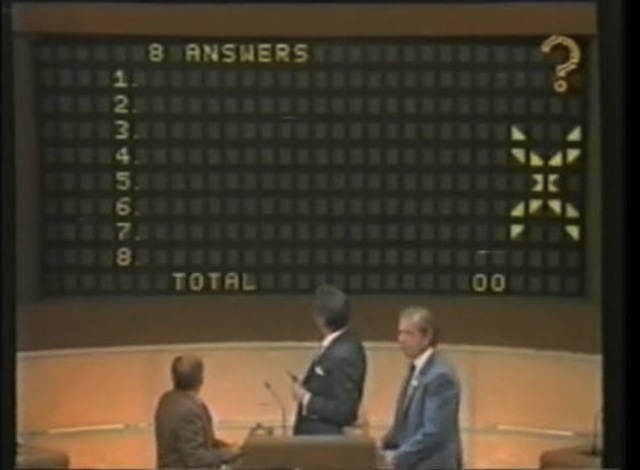
In the game show Family Fortunes, families were tested to see if they thought like the general public. They gave answers to a series of braindead questions, such as naming a vegetable that you chop, or suggesting something you might write on a postcard. These answers were then compared to the answers given by a survey of the general public, with the highest score for the answers that matched what the public said. Nobody ever stopped to question why anyone should deserve a prize for thinking like the general public. To my mind, prizes might be deserved for thinking differently, but not for thinking the same as the average dolt-in-the-street. But possibly I am alone in that respect.

One of the most memorable features of Family Fortunes was the display of a big ‘X’, and the accompanying duh-durr sound effect, whenever a contestant gave an answer that matched none of those given by the survey…

Cheesy presenter: We asked a hundred people to name something you wear two of, at the same time…

Contestant: Hats!

Cheesy presenter: You said ‘hats’. Our survey said…

Display: DUH-DURR!!

Cheesy presenter: I’m sorry, nobody said hats. Top answer was ‘socks’; 39 people surveyed gave that answer.

But you have to wonder what the answers would have been like, if the questions had been a little more difficult. Not very difficult. Not finding-the-secret-of-delivering-cheap-and-plentiful-nuclear-fusion difficult. Just so difficult that we might expect the average voter to have some have knowledge of the issues, before they mark their own ‘X’ on a ballot paper. Thanks to Ipsos Mori, we now have a survey of what the British people think they know about important topics. And the conclusion is that they know bugger all. Now, I could have a lot of fun by pointing out how most people are pretty ignorant. But lots of people have done that already (see here, for one example). Instead, I will have even more fun by pointing out what the outlier answers were – the answers given by small percentages of the population, but which are so stupid, that you begin to understand why they would struggle with questions about vegetables.

Consider the following. 1% of the population think that over 70% of Brits are Muslim. Do these people live in Bradford, and have they never left the city? Even in Bradford, Muslims will comprise less than 70% of the population. However, that skewed view is pretty mild, when you see that 1% think that 90% of Brits are over 65 years of age. These people probably heard the message that the country is facing a pension crisis, and the fear grew so large that they now see geriatrics wherever they turn. And there is another 1% who believe over 90% of Brits are black or Asian. Which would imply the English Defence League is unlikely to prevail. And it would explain why the British National Party does not discriminate in who can be a member.

Immigration is a hot button topic in British politics, but you have to wonder if some people are training themselves to spot an immigrant from a mile away, and why they are not given the job of guarding the country’s borders. Without being prompted about possible answers, 12% believe that more than half of the population are immigrants. Maybe they are thinking of how the original Anglo-Saxons were Germanic immigrants from the European mainland, but I doubt it. Oddly, a bit of prompting lowers the answers given to this question. Even so, after prompting, 6% still think that over half the population are immigrants.

It is well known that the population is cynical about politics, but some people’s cynicism about politics is so great, that the rest of the population cannot keep pace. For example, 5% think that fewer that fewer than 10% of the population voted in the last general election. In fact, over half the population voted, which is not bad, considering more than a sixth of the population is not eligible to vote.

There is also a lot of cynicism about declining moral and family standards. 1% think that over 90% of the population (the whole population!!!!) is a single parent. Clearly these people need to be forced to attend remedial maths lessons. It is not even possible for 90% of the population to be a parent (single or otherwise), given that some of the population has to be the kids. And yes, kids can be parents too, but eventually somebody has to have a kid who is too young to be a parent. Although some people have doubts about that too. 7% believe that more than 40% of girls under the age of 16 get pregnant. And 1% believe that 90% of kids live in poverty. Which is not that surprising, if you believe the average newborn is raised by a schoolkid, perhaps with a little help from a single parent grandmother and a single parent great-grandmother.

It seems many think the worst of their fellow man. 17% believe that more than half of all crimes are violent. That seems an odd belief, given that bankers and politicians get accused of an enormous number and range of crimes, but rarely violent ones. We all know the rich are getting richer, and the poor are getting poorer, even though this is a falsehood repeatedly endlessly by people who believe nonsense they hear down the pub. Even so, you have to wonder about the state of economic pessimism in the UK. When asked how many working age people are unemployed, 1% believed that over 90% of the country is unemployed. 8% think it is more than half. 51% think it is 11% or more. A further 23% were unable to give an opinion. Only 29% correctly stated that unemployment lies in the range of 1-10%. Presumably some of these people must commute to work with big grins on their faces, overjoyed at their good fortune to have a job. And when they arrive, they must be slightly surprised to find that other people work at the same place that they do.

Even workers seem to have little idea about how much people get paid. 11% of the population believes that the median annual salary, before tax, is less than £10K. In total, 54% of the population underestimated the median annual salary. And they did this despite headline after headline being devoted to the new government policy of implementing a benefit cap so that no family can receive benefits that add up to more than the median salary, which is £26K per annum. Apparently, some people are very upset by the benefit cap, believing that families cannot survive on less than £26K per year. And yet, most of the population thinks most people earn a lot less, even before tax is deducted. This leaves it unclear if times are hard, because people earn so little, or if we are enjoying relative prosperity, because most people are earning far more than what they believe to be average.

Nevertheless, some Brits have clearly succumbed to wild optimism. Politicians often like to remind the public that the country (and the world) is gripped by the gravest financial crisis since Henry VIII ran out of monasteries to dissolve. However, some people still fail to comprehend. 18% of Brits think that government debt has actually gone down in the last two years. Which is odd, because a brief review of history shows that reductions in government debt occur even less frequently than Kings called Henry. Even so, Brits were asked to help with solving the nation’s problems. Respondents were given a list of 8 ways to cut government expenditure. When asked which of the 8 cuts would save most money, 4% said “none of them”. Yes, you read that correctly. When asked a question which demands an answer is picked from a list, some people are so stupid that they still give a different answer instead. When the question was reversed, and people were asked which of the 8 cuts would save the least money, 2% answered “none of them”. It now becomes difficult to understand what cuts they had in mind, when contemplating how to save the least money, without limiting themselves to the list in front of them. Perhaps we should save money by taking away their right to vote, and seeing if they can calculate the implications of that. To my mind, there could only be one outcome: a better government. As Churchill once said, democracy is the worst form of government, apart from all the others. And yet, if reduced in the right places, a little less democracy might be a very good thing.

Talk is Dear

At the conclusion of the last episode, Karen Zipslicer found herself stuck with the trainees at the Institute. They are about to receive a lecture from Lady Emerald…

Karen stood in the corner of Lady Emerald’s office, leaning against the door, keeping the weight off her ankle. However, she had to move when Grieg left. As he did, he muttered, “at the rear, again?” Karen pulled up her surgeon’s mask, lowered her neck into her chest, and bent her knees, ducking behind the rest of the group. Then Karen pondered. Maybe she should approach Emerald for help. Em had saved Karen from the police, and had taken care of her. But Emerald was also responsible for this horrific institute. And Karen had not liked waking to find herself tied down, her clothing changed. Whiteley wriggled in Karen’s pocket. He had woken, and was hot and restless. Karen placed her hand on his back, calming him. Oh well. Karen did not want to make a fuss. She would wait for Emerald’s speech to end, and then quietly slip from the building. Mindful of the door, Karen leant against the side wall instead. She glimpsed Emerald, between the sea of shoulders. Instead of dressing like royalty, Emerald had her hair tied up, and wore a lab coat and white gloves. She looked very scientific.

“Time is precious. I’m not going to talk for long, so listen, don’t write.” Emerald gestured that the group should lower their notepads. “I know you’ve all made sacrifices “” studying when you could have had fun, taking out loans to pay for your education. Without those sacrifices, you wouldn’t be here today. My message is straightforward. You won’t regret those sacrifices. Now is the time to press on. Sacrifices lead to rewards, and the rewards get better as you go further. That’s fair, and it’s one of the ways we’re making a fairer society. Lundern is changing, improving, because of the hard work done by people like you: scientists, engineers, technicians, doctors, and other professionals. We combine our efforts to make our world more controllable than it’s ever been before. But there’s much more we need to do. We work for reward, and to better ourselves,” she stood and stepped toward the open window behind her, “and by so doing, we make life better for everyone out there. The only limits you’ll face are those that exist inside you “” the limits of your imagination, and your ambition.”

Emerald admired the roses in her window box. They were a medley of vibrant colours. She bowed and smelled one. “Our achievements have been amazing. We combat hunger, through modern farms in the Periphers. We manufacture clothing, to keep Lunderners warm and protected. New financial products allow Lunderners to save for their old age. Or they can borrow, to invest in the future, like you did with your education. We create jobs to occupy idle hands, and we invent new entertainments, to combat boredom, and the damage that bored people inflict on the rest of society. The inventors are revolutionaries “” our goal is to change life forever. It’s a one-way journey, and some people are scared of change. Don’t listen to negative voices. Perform your duties, learn, persevere “” maybe some of you will join the ranks of the inventors one day, and receive the considerable benefits, and responsibilities, that come with that rank in society.”

Emerald snipped a bright blue rose, and threaded it through a button hole in her lab coat. “Your work is as important as anything I’ve mentioned so far. Your work matters to me not only as a leader, but also as a woman. Managing reproduction lets us tackle many misfortunes that bedevil Lundern, especially its most vulnerable “” the women and children. Thanks to the work done here and at other reproduction centres, we’re ending the curse of families with too many mouths to feed. That also means less brutality, and less crime. We’ve progressively reduced the numbers of diseased and disabled who clutter Lundern’s streets “” pitiful souls doomed to be a burden on everybody else. We’ve freed women from the pain and danger of pregnancy, allowing them to work without interruption, exactly like a man. Controlling the population means workers match the available jobs. That lowers unemployment, and guarantees that everyone makes a real contribution to society. Deserving adults, previously unable to have children, can now have them. But only deserving, hard-working parents can have children in our society. The undeserving can no longer exploit their natural fertility, recklessness, and lack of self-restraint. No child is allowed into this world, unless their parent or guardian has proven their worth, and proven they can provide for their children.”

“And whilst we’ve succeeded in controlling the quantity of children, we’re hoping to do much more: to improve the quality of children. That will be your contribution. Fitter, stronger, healthier, more intelligent individuals “” that’s what we’re making here. We weed out the bad traits, and promote the good ones. That’s exactly what our ancestors did, when they discovered how to cross-pollinate roses, making them more beautiful, or when they bred animals, refining them into workhorses and thoroughbreds, sheepdogs and terriers. Now we’re doing the same for the human race. Your individual specialisms will be woven together, supporting one common plan. Together, we’ll make better people, and so, a better world.”

Emerald paused, then walked along the front of the group, like a general inspecting her troops. She stopped to flatten a crease in one boy’s lapel. “I think of myself as a mother. I’m mother to everyone born in this facility, everyone who works for me, and to the whole of Lundern. A mother cares for her children’s needs, but a mother must also discipline her family. There have to be rules. Rules prevent chaos. Rules give us the possibility of working together, for common purpose. Rules prevent squabbling, and unfair treatment. I’m your mother now. Do your duty, work hard, show me what you’re capable of, and do as you’re told. That’s how to make a mother proud. Do that, and I promise the family will reward you. We’re one family, now. Lundern is our family. We look after our own “” I make sure of that.”

Grieg stepped back into the room, banging the door into Karen’s foot. She winced. He scowled. Seeing Grieg enter, Emerald nodded towards him. “Dr. Grieg will tell you which positions you’ve each been allocated. Now do your job. Make me proud.” Grieg started applauding. The rest of the group joined in. When the clapping finished, Emerald returned to her desk, and the group bustled out. Grieg held the door, ushering the trainees, with Karen stuck behind him. Emerald reviewed some papers on her desk, ticking them, or making notes in the margins. With only Karen, Grieg, and the Ginger twins still in the office, Emerald commanded, without looking up, “not you “” you stay.” Karen looked at Grieg and he looked from Karen to the two Gingers. Karen held her breath under her mask, trying to stay calm. “You know who I’m talking to. The one with the bandage.” Karen looked at the bandage wrapped around her sockless foot. “Sit down,” said Emerald.

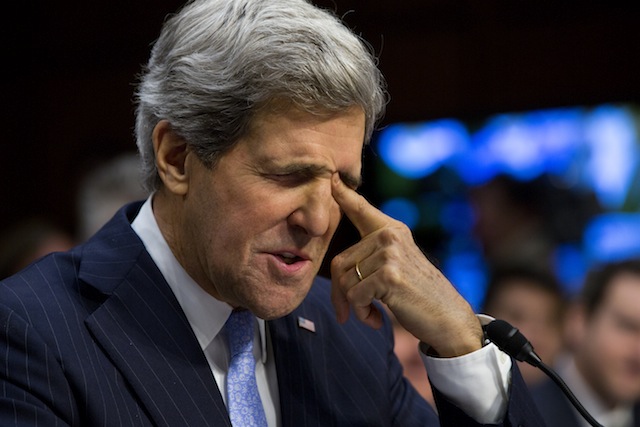
John Kerry Comes Clean About US Spying

In an extraordinary turn of events, US Secretary of State John Kerry has agreed to answer all allegations about the US government bugging the offices of the European Union and other democratically-elected governments. This is a live transcript from the press conference…

KERRY: With respect to the question of the err… of the ummm… of the possible overhearing of the err… let me just tell you that… (He fiddles with the microphone.) Is this thing working? (He fiddles with microphone some more.)

GERMAN JOURNALIST: The microphone is working! Please proceed with your answer.

KERRY: Well, you can never be sure… (fiddles with microphone.) Sometimes these things are switched on, sometimes they’re off. You know what I mean? (He winks.) I’m just saying, you can never be sure. (Long pause.)

GERMAN JOURNALIST: Well?

KERRY: Well what?

GERMAN JOURNALIST: You were telling us about bugging the EU.

KERRY: Oh yes, the bugging thing. Well, let me tell you that I’ve got off a long flight, and before that I was dealing with that whole Middle East peace thing. That’s going great, by the way. I mean, President Obama really fixed that whole Middle East peace thing back in 2009, for which he deservedly won the Nobel Peace Prize. Apart from the Benghazi thing, of course. (He pauses.) But that really couldn’t be foreseen. It was an unforeseeable blip in our intelligence, that Benghazi (coughs)… that Benghazi blip. But overall President Obama has pretty much won the war on terror… not that there ever was a war on terror, not really. That was just something Bush and Cheney cooked up, so they could hold on to power. But hey, if the American public are going to elect those guys, what can you do? I tried to tell them, but they didn’t listen to me. It was ‘swift boat’ this and ‘swift boat’ that, and before you knew it, everyone had stopped listening to me. So what was I saying? Oh yes, I’ve been in the Middle East, crossing the t’s and dotting the i’s, so to speak. Crossing t’s and dotting i’s is all that’s needed, following all the success that President Obama had in his first term, especially with all the hard work done by my predecessor, Secretary of State Clinton. I expect there will be nothing left for her to do, by the time she’s President again. Apart from fixing the US economy, that is. Though that’s going great too.

FRENCH JOURNALIST: Please, Monsieur Secretary of State, will you stick to the point?

KERRY: I will. So that’s what I’ve been doing. T’s and I’s… which has kept me incredibly busy. There’s a lot of t’s and i’s out there, in the Middle East. I mean, there’s only one ‘I’, and one ‘T’, in ‘Middle East’, but you know, they’ve got a whole bunch of other words with t’s and i’s that also need crossing and dotting. Yup, a lot of t’s and i’s… not so much ‘T and A’, if you know what I mean. You hardly ever see that kind of thing out there in the Middle East, though my security guards know a few places. (He winks.) But there’s a whole lot of t’s and i’s. So that’s what I’ve been doing. And that’s why I don’t know anything about any bugging.

GERMAN JOURNALIST: Do you seriously expect us to believe that? You were a senator for 28 years. You spent the last 4 years as head of the Senate’s Foreign Relations Committee. The Obama administration said that all senators have been briefed about the US’ spying program. So how can it be that you know nothing?

KERRY: Well, yes. There’s knowing nothing, and then there’s knowing nothing, if you know what I mean. Not that you would, because you’re not in the US government, like I am. (He winks.) Erm… no, that didn’t come out right. Disregard that wink I just gave you. I mean what I say, when I say I know nothing. I honestly hadn’t heard about it, hadn’t seen about it, hadn’t read any reports, don’t have any advisors to tell me these things. Erm… we had an internet blackout – somebody said the server was made in China, I think – and then there was some screw-up with paying our cable TV bill so that was cut off temporarily, and literally every newsagent was sold out, when we went to get the papers. And, as you know, and I’m sure you do know, I’ve been having lots of late nights and early, early mornings on this Middle East thing… (He fiddles with the microphone…) Is this still working? (He fiddles again.)

FRENCH JOURNALIST: Pardon, Monsieur Secretary of State, but I have to sympathize with my German colleague, and ask, why it is you are not answering the question he has asked? We would all like to know about the bugging.

KERRY: Yes, as I was trying to say, before you interrupted, I have been so so so deeply immersed in the Middle East. Let me tell you, it was like being buried in sand up to my neck, not that that literally happened, mind you. I mean, there was a private beach at the hotel where I was staying, but nobody buried me in sand or anything like that. I just walked on it. But not in my bare feet – it was too hot for that. I was wearing sandals.

GERMAN JOURNALIST: Please will you answer the question? We want to know about the bugging!

KERRY: Yes, and so would I. Though, to be clear, the President always briefs the rest of government and is way way more transparent, far less secretive and paranoid than Bush and Cheney used to be. So if there’s anything to know, I’d know, but I don’t know, so there’s probably nothing to know. (Coughs.) There’s almost certainly nothing to know. But if I did know something, not that I do, I’d know that every government – literally every government – does the same thing as whatever it is that we’re not doing. Err… And err… I want to see the allegations – that’s number 1! – before I can comment any further.

GERMAN JOURNALIST: The allegation is that the US government has bugged the EU’s offices and the government offices of other American allies.

KERRY: Well, err, that’s hearing the allegation. I said I needed to see it, to be precise. But I was going to go on to say… number 2, is that, err… (he coughs)… I need to, err (he coughs again)… I need to find out what the truth (coughs), what the situation is, and then I’ll share it with you, our allies, with whom we have a very very special relationship, with all of you.

BRITISH JOURNALIST: But we’ve heard that Baroness Ashton, the EU High Representative for Foreign Affairs and Security, has already quizzed you about the bugging?

KERRY: (Coughs.) Indeed. (Coughs.) Let me tell you what I told Lady Ashton, which is that… (coughs)… which is that she did indeed raise it with me, and I told her that (coughs) I’d get back to her on that. (Fiddles with microphone.)

BRITISH JOURNALIST: Excuse me? Is that all you said to her?

KERRY: We agreed to stay in touch. I agreed to stay in touch with her, and she agreed to stay in touch with me. I mean, we normally stay in touch anyway. It’s not like we’re out of touch with each other, but this Middle East thing has been keeping me very busy, though we greatly appreciate the help and support of our EU partners in helping and supporting that. (Coughs.) But we’ll be making a special effort to keep in touch, as befits our special relationship.

GERMAN JOURNALIST: A lot of American politicians have been on American television recently, answering allegations that the NSA spied on the internet. Their answer, and even President Obama said this, was that your spy agencies focus on spying on foreigners, and that they only spy on Americans if they have a court order. Don’t you think it’s a bit ridiculous to pretend you don’t know anything about spying on the rest of the world, when your President and your former colleagues in Congress keep reassuring American voters by promising them how very much the US government is spying on everybody outside of America?

KERRY: You saw that? Really? We, in America, we didn’t know the rest of the world could see our TV. How did you come to see that? I mean, what channels do you get – are you watching C-SPAN? I tell you, I was in the Middle East, and I couldn’t get HBO, which was a shame, as I’m really missing Game of Thrones, I can tell you.

GERMAN JOURNALIST: Please will you stop treating us like fools, and answer the question!

KERRY: (Coughs.) I will say that every country in the world that is engaged in international… err… you know… international… err… you know, international affairs of national and international security… which I suppose is most of them, though I’m not sure about the Vatican City, maybe not so much them… err… well, err, but I suppose they might worry about terrorism too, err, though we’ve pretty much won that war on terror, not that it can ever be won, so to speak… (coughs) what I will say is that all of those countries, without exception, is engaged in… err… (coughs) what I’d call the err… the undertaking of lots of protective activities to protect its national citizens from terrorism, and all kinds of information contributes to that.

FRENCH JOURNALIST: Are you saying that officials who work for democratic governments should be spied upon because they are like terrorists?

KERRY: (Coughs.) No, no, no. Or ‘non’, as you’d say. I speak a little French, you know? La plume de ma tante est… (coughs) No. You’re not terrorists. You’re nothing like those guys in Boston. For a start, we didn’t bother to spy on them. Though it had nothing to do with them being American citizens. It had nothing to do with that. Although we respect their constitutional rights as American citizens, not to be spied upon. Although, (coughs) we respect your rights, (coughs) your human rights, although that’s not in the American constitution, of course. Not that your human rights aren’t respected by the American constitution, which I’ve sworn to uphold.

GERMAN JOURNALIST: Mr. Kerry, you must be aware that many citizens in countries that are ‘allies’ to America still retain a deep-seated resentment and distrust of Americans and their government, believing them to be arrogant and totally untrustworthy. Do you agree, after this shambolic display, that you’ve just made that a hundred times worse?

KERRY: All I know is that… err… protecting people is, err… (coughs) not unusual for lots and lots of nations, as well as the United States, although I don’t know if we’re, err… protecting American citizens, or not. I mean, we might be. Then again, maybe we’re not (coughs) protecting them. I really can’t say. Because I don’t know. I’ve been busy, you know. (Kerry turns to face an aide, and speaks aside:) They’re not going to see this press conference in America, are they? No? No, I didn’t think so, they won’t be interested in what I say to some cockamamie foreign hacks, unless I make a major goof. What’s that? (He turns to face the front.) Oh yes, this microphone is on. (He fiddles with it.) Did you hear that? Not that it really matters either way. And beyond what I’ve said, I’m not going to comment on this any further, until I’ve had all the facts, and find out precisely what the situation is. And when I do, I promise to come back, and to, err… (coughs.)

GERMAN JOURNALIST: What do you promise to do?

ALL OTHER JOURNALISTS: Yes, what are you promising to do?

KERRY: I promise to err… (coughs.) I promise to be as candid with you on that day, as I’ve been here today. Thank you very much, no more questions.

(Kerry runs off stage.)