Home Blog Page 5

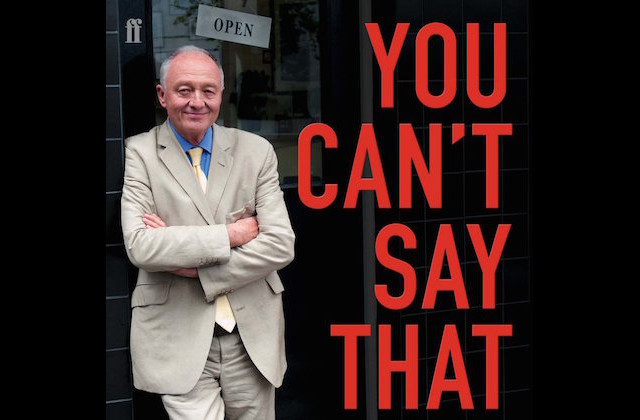
Livingstone Panders to Anti-Semites (and You Know It)

There are people on the left who think nobody on the left can be racist. It is a silly dogma; inconsistency comes easily to human beings, so what divine force could ensure that everybody who has the ‘correct’ opinion about economic growth or nuclear disarmament must also have the ‘correct’ opinions about race? Of course there will have been some passionate European Marxists who had an irrational dislike for people of Asian extraction, and some fervent idealistic Trots who maintained an inexplicable fear of anyone with African ancestry. So we should not be surprised that even if a politician is not racist themselves, they may pander to racists in order to bolster their popularity. Politicians are in the business of winning votes, after all. That is how we should understand Ken Livingstone, who recently said the following:

Let’s remember when Hitler won his election in 1932, his policy then was that Jews should be moved to Israel. He was supporting Zionism “” this before he went mad and ended up killing six million Jews.

It is impossible to ‘remember’ these things, because they are not true. Livingstone is not remembering anything at all – he is intentionally sending a signal to potential supporters. The signal is crude: if you do not like Jews, Ken Livingstone sympathizes with you. Otherwise, how do we explain how Livingstone managed to ‘remember’ things which are so obviously false?

Let us break down what Livingstone says he remembers.

“…when Hitler won his election in 1932…”

Hitler did not win an election in 1932. He never won any election. Hitler gained power in Germany in 1933 through a back-room deal with coalition partners. His coalition partners thought they were more powerful than Hitler and believed they could control him. Sadly, they were wrong.

“…his policy then was that Jews should be moved to Israel. He was supporting Zionism…”

Throughout his life Hitler wrote and said all sorts of ridiculous things, many of them contradictory. Hitler espoused rabid anti-semitic views long before 1932. It is absurd to pretend Hitler shared the goals of the Zionists.

The Zionists adopted a Jewish nationalist program motivated by the understandable desire for Jews to escape anti-semitism in Europe. In contrast, Hitler argued that Germans were oppressed by Jews. Hitler’s position was not one of supporting the intelligible goals of some Jews but of putting forward many idiotic and ultimately evil proposals that would supposedly free Germany from Jews. As early as 1919 Hitler stated the “ultimate goal must definitely be the removal of the Jews altogether.”

Wanting to create a Jewish homeland is not logically or ethically the same as wanting to expel Jews from your own nation. The creation of the state of Israel would not imply that no Jew may live in Germany. The state of Israel exists today, but Jews live in many nations. Creating a Jewish homeland was not one of Hitler’s goals, but one of the many excuses and rationalizations he proffered whilst pursing his actual anti-semitic goals.

Equating Hitler’s position with support for Zionism is like arguing Mohammed Ali supported the Ku Klux Klan’s policy on racial segregation because Ali once foolishly stated:

No intelligent white person watching this show, no intelligent white person in his or her right mind want black boys and black girls marrying their white sons and daughters and in return introducing their grandchildren as half-brown kinky-haired black people.

…this before he went mad…

There is ample evidence that Hitler was ‘mad’ before 1932. Livingstone is concocting a fictional timeline if he is trying to pretend that Hitler was a reasonable person with a coherent worldview until 1932, and that he only succumbed to despicable nihilistic racist hatred afterwards.

…and ended up killing six million Jews.

Hitler did not kill six million Jews, at least not in the sense of murdering them with his own hands. The holocaust was only possible because many other people – some German, some of other nationalities – supported, assisted, abetted or willfully ignored the crime that Hitler ordered.

It would be convenient to pin this crime on just one person, because then we could rationalize how the crime only occurred because one person ‘went mad’ and changed his policy on the so-called ‘Jewish Question’. In reality Hitler was a despicable politician who said lots of different things in order to boost his popular appeal. That does not mean he really believed what he said. He said things to please lefties. He said things to please racists. Sometimes he even said things to please foreigners and moderates. Lefties normally appreciate the unreliability of a person’s words. Hitler was a self-described ‘socialist’, but progressives rarely take that claim seriously, so why would they take his other pronouncements at face value? Hitler twisted and manipulated public opinion in order to achieve his goals. In this respect, Hitler was no different to many other politicians, like Ken Livingstone. Clever words can be used to persuade otherwise good people to rationalize repugnant behaviour.

Arguing that Hitler was a Zionist is a politician’s trick, code for justifying anti-semitic feeling by siding with the persecuted. But Ken Livingstone is not a Palestinian and he receives no votes from Palestinians. Livingstone sides with the ordinary persecuted Palestinian in a similar fashion to the way Hitler sided with the ordinary persecuted German. He does it to gain support from a certain subset of the population who are happy to adopt his rationalizations. If some of the ‘persecuted’ innocents also happen to be racists, that was no concern to either of them. Livingstone is courting racists, as did Hitler. The only difference is that Hitler was himself a racist, whilst Livingstone is unforgivably cynical.

All Lives Matter

This was not said by Ken Livingstone. It will probably never be said by him. We know why. To use the phrase ‘all lives matter’ is treated as signalling sympathy for the opponents of Black Lives Matter, a group of American political activists who believe that American blacks are put at risk because of discriminatory policing policies amongst other things. However, the words ‘all lives matter’ are not objectionable in themselves. All lives do matter. A left-leaning politician can usually be relied upon to understand context well enough not to send out signals that upset their supporters, or which needlessly court controversy. They know when somebody else plays the race card, so they must also know when they play it themselves.

If the left are normally sensitive to context, why does Livingstone seek attention in the way that he does? Zionism was born as a political response to anti-semitism. It is hence inflammatory to insist that anti-Zionism must be distinguished from anti-semitism, as if the two can be neatly separated. It is even more insulting to associate Zionism with Nazi policies. Livingstone does these things because it will win him support from some rather despicable and self-righteous individuals. Much of that support must be coming from genuine anti-semites. Other support is coming from people for whom anti-semitism has become normalized, so they are not even conscious of their prejudice against Jewish people.

Why should anyone refer to Zionism, or describe themselves as ‘anti-Zionist’? No intelligent person thinks the state of Israel is going to come to an end. No intelligent person has any humane or workable proposal that could lead to the termination of the state of Israel. Zionism is not whatever happens to be the policy of the current Israeli government; it is possible to criticize those policies without bringing up the topic of Zionism. The word Zionism is no longer useful, because the defining policy of Zionism is now a matter of inescapable fact. The Jewish nation exists. It is now so embedded in reality that we might as well talk about political opposition to the reunification of East and West Germany, or political opposition to the fall of the Soviet Union. People can be nostalgic and they may harbour resentment at changes they have experienced, but they cannot simply turn back time. Israel is here to stay.

The only reason to talk about Zionism, and opposition to Zionism, is to send a signal. That signal is intentionally misleading. The only reason to keep debating Zionism, 68 years after the founding of the state of Israel, is to signal antipathy towards real living people, not towards a policy that cannot be sensibly reversed. Progressives should know better. They identify ‘dog whistles’ and ‘coded language’ all over the place, so why are they deaf when anti-Zionism is used as a proxy for anti-semitism?

There can only be one reason for progressives to ignore the sympathetic nods towards anti-semites: they want the votes and support of people who feel an irrational prejudice against Jews. Even worse, these progressives must be consciously seeking the support of racists, or else must be so stupid and lacking in self-awareness that they are hopelessly unfit to govern. The finely-tuned linguistic sensitivities of an educated lefty allows them to split verbal atoms when most people would struggle to split hairs. Some of them treat anti-semitism as if it has been defined using a carefully marked boundary, so they walk right up to it, shout their insults but excuse themselves by insisting they never crossed into racist territory. But their intention is clear. They are speaking to people who are happy to wander over that boundary, and to the people who permanently live on the other side. They are courting anti-semites, pandering to them, and inventing linguistic games designed to disguise anti-semitism.

Livingstone is at fault, and is despicable. There should be no equivocation, though I expect there will be plenty, especially now that the grossly overhyped lawyer Shami Chakrabarti has been appointed to lead an enquiry into Labour’s antisemitism. Who needs an enquiry when we can hear the things that Ken Livingstone keeps saying, read the tweets of Labour MPs and councillors, and see the support they all receive as a result? There is no need for an enquiry because there is no good reason for a British politician to repeatedly talk about Zionism except to signal their sympathy for anti-semites. A man who courts anti-semites deserves to be tarred with the same brush as all other racists. Livingstone’s politics should be flatly rejected, and the man should be shunned.

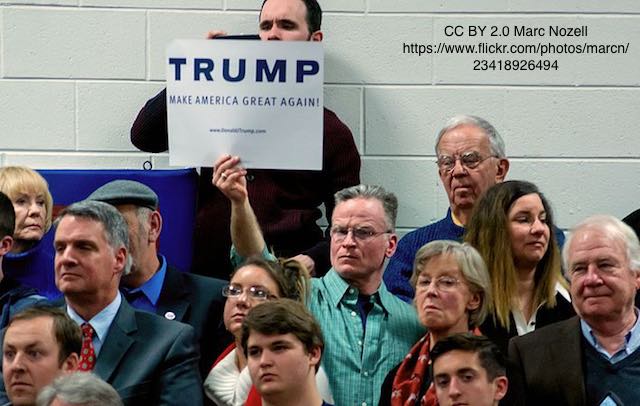
Sympathy for the Trumpians

0

Allow me to introduce myself
I’m a man, and that’s enough for anyone
I’m still hanging on, despite it all
Never stole, never cheated
Though that makes them despise me even more
I believe in Jesus Christ’s judgment
But I’ll never submit to theirs
And I’ll be damned before I do

Pleased to tell you
Our country will be proud again
But what’s puzzling you
Is that greatness is my aim

I stuck around Detroit
When all the creditors complained
Paid my debts without relief
Others cannot say the same

I rode a tank
Held a corporal’s rank
When the oil wells burned
And the Middle East sank

Pleased to tell you
Our country will rise again
But what’s troubling you
Is that greatness is my aim

I watched in anger
As elites raped and jeered
Enriching themselves
By mocking what I hold dear

I shouted out
“Who killed Ronald Reagan?”
When after all
It was the Republicans

Pleased to tell you
Our country will be great again
I’ve dug ditches and I’ve been poor
But that has never changed my aim

Just as many cops are criminals
And the broken-hearted are the saints
Our government is upside down
Just call me an American
Tired of his restraints

So if you meet me
Have some courtesy
Have some sympathy, and some taste
Don’t use your grad school politics
To belittle the lessons I learned from life
Or you’ll turn your soul to waste

Pleased to tell you
My nation will be whole again
But what’s confusing you
Is her greatness is my aim

Tell me friend, what’s my name?
I say you’re the one to blame
Just call me an American
Who is tired of his restraints

Oscar Row: Black is not the only minority

An article in the Guardian epitomizes what is wrong with so much reporting about the current row about minorities being nominated for Oscars.

Will minority viewers “” 38% of the population but responsible for 46% of movie tickets sold in the US in 2014 “” tune out when it comes to awards and speeches by a parade of white nominees?

The statistics are correct, but what is not mentioned is that Blacks are only 12 percent of the US population, per the 2010 census. There is no way you would infer that by reading the article, which refers to a stream of black actors, but not a single individual of Hispanic or Asian origin. Here is a list of every person referred to in the article, however obliquely, in the exact order in which their names appear, including duplicates. I also add an admittedly crude note about their race, adopting the categories used in the US census:

  • Chris Rock (black)
  • Chris Rock (black)
  • ‘the’ Kardashians (mostly white)
  • Chris Rock (black)
  • Will Smith (black)
  • Jada Pinkett Smith (black)
  • Dr. Darnell Hunt (black)
  • Ralph J Bunche (black)
  • Chris Rock (black)
  • Dr. Darnell Hunt (black)
  • Dr. Darnell Hunt (black)
  • Morgan Freeman (black)
  • Dr. Darnell Hunt (black)
  • Dr. Darnell Hunt (black)
  • Allison Hope Weiner (white)
  • ‘Mr. and Mrs. Smith’ (black)
  • Jamie Foxx (black)
  • ‘the’ Smiths (black)
  • Allison Hope Weiner (white)
  • Steven Spielberg (white*)
  • Idris Elba (black)
  • Lupita Nyong’o (black)
  • Allison Hope Weiner (white)
  • Allison Hope Weiner (white)
  • Idris Elba (black)
  • Daniel Craig (white)

*The US census treats being Jewish as a matter of religion, not race.

Given that the row and the article are both about statistics and representing ethnic groups proportionately to how often they appear in the population, I find the skew to be staggering. Blacks are a minority amongst minorities in the USA. After Whites, Hispanics and Latinos represent the second largest race, comprising 16 percent of the population per the last census. Although Hispanics and Latinos outnumber Blacks by roughly 4 to 3, this article seems to suggest they have nothing to say about the race row. Furthermore, no individual Hispanic or Latino is considered worthy of a separate mention, even though the piece lists several black actors who presumably are thought to be award-winning calibre.

This is a row where the numbers of Hispanics and Latinos are being appropriated to make a point, but no individual amongst that group is considered worth mentioning. That seems hypocritical to me, and I doubt it is because the author is ignorant of the statistics. After all, the article is replete with stats:

…the Academy of Motion Picture Arts and Sciences failed to nominate a single minority actor for the second year in a row.

“Minorities are making little or no progress yet Latinos go to more movies than any other group, and African Americans watch more TV. Yet most movies and TV shows are less than 10% diverse,” says [diversity expert Dr. Darnell] Hunt.

… films do better at the box office if two or three of the top eight billed actors are non-white “” yet minorities are under-represented by a factor of nearly three to one among lead roles.

There is a repeated tendency to conflate being black with being a minority. But in this context, black is not the binary alternative to white. The statistics are all couched in terms of minorities, whilst only black actors and celebrities are held up as examples of what it means to be a minority.

A Black academic, Dr. Darnell Hunt, is quoted at several points. Whilst I do not doubt Dr. Hunt’s competence, it is telling that the piece relies on a black man to speak on behalf of not only minorities, but also for women. Why is every aspect of this debate being condensed into a mushy, ill-defined discussion about ‘diversity’, when the Academy of Motion Picture Arts and Sciences already runs a gender-discriminating award system, which ensures female actors receive the same number of awards and nominations as male actors?

Pictures paint a thousand words, and the photographs which accompanied the article also tell the same story. This image was used by the Guardian to front their piece.

guardian-oscar-row-image

There are four faces, all Black. A good argument can be made for showing Rock and the Smiths, but was it necessary to super-impose Idris Elba too? If it is such a disgrace that neither Elba nor Will Smith were nominated for the best actor, then why no outrage over the lack of other minority nominees, in either the male or female categories? Why is there not a single non-Black face in any of the photos that accompany this piece about diversity? And why is the only woman who is photographed the spouse of somebody supposedly deserving a nomination?

I dislike categorization per race, as it tends to be over-simplistic, and almost always used to skew arguments. Take this egregious example from the article:

Even if this is “” as some have argued “” an accident of bad timing, the tradition-bound institution has sleep-walked into the diversity issue in the midst of a neurotic, election-year referendum on the nation’s first black president.

President Obama had a white parent and a black parent. However, he is routinely labelled black for the convenience of those making a cheap, but inaccurate, point about racial diversity. More importantly, this argument of a ‘referendum’ on the ‘black’ president neither stands up to scrutiny, nor fits the topic supposedly being discussed by the article. If voting ‘for’ the outgoing Democrat President – an absurd notion in itself – is also a vote for diversity, then why are three of the remaining contenders for the Republican nomination from minorities? Every Democrat who entered this year’s nomination race was white, including the ones that have already dropped out. The author’s imagined referendum on diversity may feature a Republican from a minority versus a white Democrat. Furthermore, two of the Republican contenders, Ted Cruz and Marco Rubio, are Hispanic and Latino. So why does the author lazily imply that the pro-Obama vote is the pro-diversity vote, whilst Hispanics and Latinos should vote as a uniform bloc with Blacks?

Despite the author’s feigned concerned for diversity, it is clear who is most guilty of sleep-walking through clichéd arguments about race.

The article closes with one of those clever-clever final sentences that poor writers adore:

The awards show is a lens on the industry: and that, in large ways or small, is a reflection on America.

What a shame this piece was so badly out of focus!

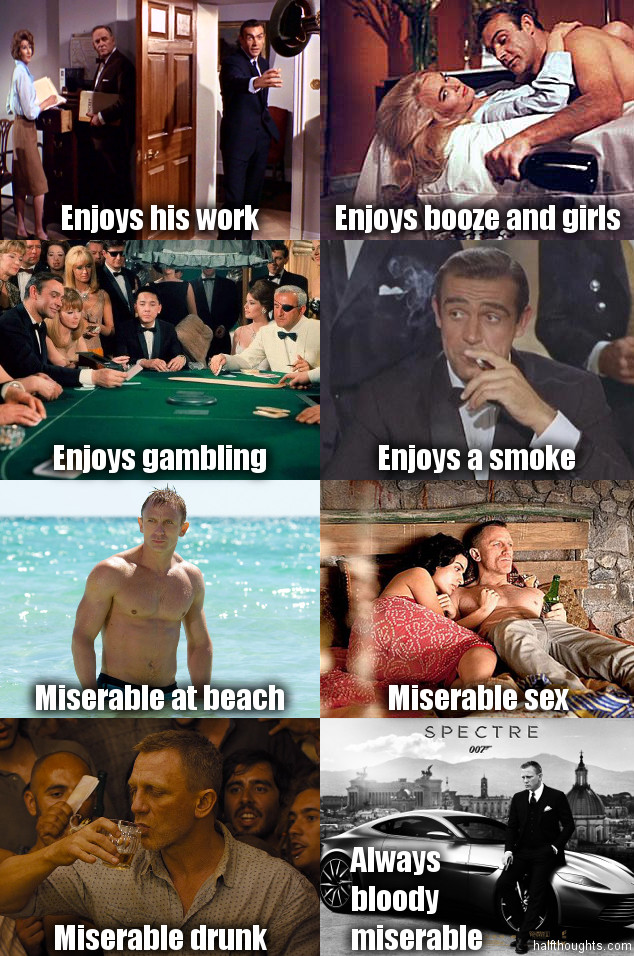
Connery vs. Craig: The infographic

Sean Connery was rugged and handsome. So is Daniel Craig. However, the character of James Bond changes to suit fashion, and so the two actors played very different parts. Whilst one Bond was a jaunty, confident pleasure-seeker, the other is a gloomy, oppressive bore. This infographic will help you to remember which Bond was more entertaining!

Happy Connery versus Miserable Craig

In the Bright Midwinter

0

A poem inspired by Christina Rossetti’s In the Bleak Midwinter, and by a sunny day in late December.

In the bright midwinter, solitary I roamed,
Earth unfurled before me, skies above me shone,
Heart was pounding, though tired to the bone,
In the bright midwinter, I was not alone.

Treasures I had gathered, wealth beyond compare,
They had lost their value, meaning thin as air,
Set them aside, the prizes turned to dust,
Follow the path to you, every day I must.

Love propels me onward, wherever I go,
Bonds felt though unseen, ties through which I flow,
Soul drawn upward, raising me to heaven,
Reborn in the family of all fellow men.

Unwilling to settle, continue to seek,
That idyllic union of valley and peak,
Terrain tests me, I walk on to my end,
Kinship that was scattered, made whole once again.

What can I give to you, meagre as I am?
If I was a shepherd, I would guide you home,
If a wise man, mine would be good counsel,
I will give what I can: welcome eternal.

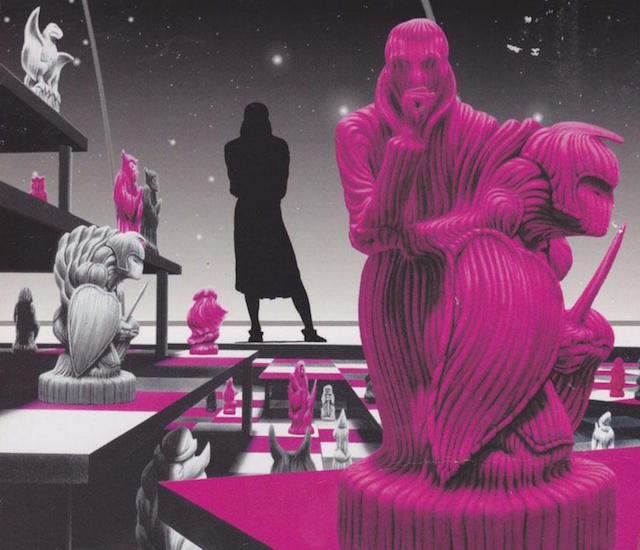
The Tao of Iain M. Banks’ Culture

When it came to religion and politics, the beliefs of British SF writer Iain M. Banks were never subject to doubt. Whilst dystopian futures feature in some of the best SF, and are also found in much of the worst of the genre, comparatively few writers set their stories in a triumphant, confident utopia which they unashamedly adore. Even fewer attempt to repeatedly wring dramatic stories from such an unpromising setting. Perfection does not lend itself to tension. Hence Banks tends to construct scenarios where his beloved Culture, a galactic post-scarcity civilization, has to lower itself to dealing with barbarians at its borders. The clash of civilizations gives Banks ample opportunity to express his views on religion and politics, by comparing the examples which he favors with those he deplores. With that in mind, I want to consider a particular question: might we say that Iain Banks’s Culture manifests a certain spirituality, or a ‘tao’ which goes beyond crude materialism? And if so, is this tao uplifting?

Banks’ disdain for any alternatives to his utopia are made plain. Barbarians might have religion; the Culture has long abandoned superstition. Different genders of barbarian species may adopt differing roles within society; citizens of the Culture do not experience gender except as another aspect of physical pleasure, and they change their gender at will. Barbarian societies might have governments, hierarchies, even businesses, whilst the Culture has no need for them… though close inspection suggests this conclusion is false. In short, the Culture is an atheist communist interstellar paradise, the kind of society that Marx might have dreamed about, if he dared to imagine the workers had achieved class consciousness, then invented benevolent machines that made them all redundant. Banks’ Culture is pristine, unsoiled by any of the messy internal compromises that real communist societies have felt necessary to accept, irrespective of the pressures created by external rivals. However, the behavior of real communists has sometimes been compared to that of religious zealots; as Karl Popper observed, Marxism tends toward a pseudoscientific worldview, demanding a degree of faith not supported by empirical observation. Because we can analyze the values of a political dogma as if it were a religion, we can make sense of the question I posed above.

To begin with, let us characterize what the Culture is, distinguishing what is described in the novels from some of the labels that Banks and others have wanted to apply to it. It is a civilization whose technology has conquered scarcity and has no higher purpose than gifting its citizens long, indolent and indulgent lives, whilst assimilating other civilizations as rapidly as it can. There is no capital, no money of any description, and no private enterprise, except in the sense that private individuals may do as they please. The society is hence communist, though perhaps communism does not really apply as there are no longer any workers to own the means of production. Private property seems to persist – for instance, people appear to treat their homes and clothes and pets as if they are belongings – but everybody can have what they want simply by asking for it. Strangely, nobody ever wants a unique possession that is already owned by another, such as an historic relic, or somebody else’s goldfish, or the product of a foreign economy. Furthermore, nobody has appetites so great that they would test the limits of what the Culture could supply. As such, the limits of the Culture’s liberal anti-capitalism remain conveniently untested.

At the same time as giving every citizen so much material freedom that they never desire more, the economy of the Culture is subject to centralized planning. The planners of this society are Minds, artificial intelligences of such scale and subtlety that human beings would be unable to determine if they were manipulated by them. Fortunately, what the Minds want coincides with what everyone else wants, although Minds are seemingly capable of disagreeing with each other. So whilst Banks and others have a desperate desire to label the Culture as anarchist, its citizens are free in the same sense that animals in a nature reserve are free; they lack both the mental capacity and desire to explore the limits of their freedom, though at some level they are governed by intelligences beyond their comprehension. In short, Banks and others make the mistake of confusing the wildness of the animals with whether the reserve is governed.

In another paradoxical twist, all ‘work’ is done by non-sentient machines, but both humans and intelligent drones choose to occupy roles that we would describe as jobs… although none of them demand payment in return. Admittedly, these jobs always seem to be inherently desirable, not least because of the status they confer. The Culture has plenty of architects, poets, diplomats and spies, but has no plumbers or waitresses, and it is unclear if anybody thinks childcare is vocation. A disproportionate number of the Culture’s citizens work in academia, being professors of almost any subject except the ones where the vastly intelligent Minds would clearly know all the answers already. Nobody needs to clean the toilet or process garbage, because dumb machines do all that. Even more oddly, there are intelligent drones which supposedly possess all the same freedoms as any human being, but who want to perform the tasks they have been designed to do. In other words, the Culture is an anarchy only in the perverse sense of the word that communists often employ: everything important is planned and ordered from the top down, but its subjects have been educated and improved to such an extent that the vestiges of their selfish desires always fit harmoniously within the designs of the elite who make all the decisions.

I could keep picking away at Banks’ description of the Culture, but that would be niggardly. Weaving a world on such a scale will always result in some loose strands and frayed edges. It is enough to say the Culture is a kind of communist atheist society that a modern Western social liberal might applaud. Its citizens are free to do the kinds of things that many of us dream of doing, enjoying plenty of casual sex and aimless recreation, whilst never suffering pain or hardship. On the other hand, the Culture’s citizens have evolved to the point where they never choose to do any of the other things that people currently enjoy doing, but which are anathema to modern Western social liberals. This includes: praying, raping, farting, stealing, being faithful to a partner or jealous of their infidelities, telling a rude joke to somebody who does not want to hear it, or asking for your bit of economy to be exempt from somebody else’s ‘planning’. Banks presents a society whose perfect values leads every citizen to be similarly perfect… or at least free of the vices and flaws that human beings have exhibited throughout recorded history.

As a consequence of being so perfect, there is a division of the Culture called Contact, which sequesters huge amounts of resources in a rather secretive and corporatist manner, and uses them to civilize every other society it encounters. This being a socially liberal utopia, any comparisons to empire-builders or missionaries are deeply unwelcome, even if they seem apt. I treat this as a crucial hint of the quasi-religious faith that underpins the Culture. The Culture’s mission includes expansion, but questioning the need to expand is somewhat taboo. Though it has the technological and material superiority to defend itself from aggressors, the Culture does not merely seek to preserve its borders, and to serve those who already lie within. The Culture also seeks to spread and assimilate, sharing the benefits of its wisdom even with societies that are deeply hostile to it. This extravagant self-confidence is not enough to demonstrate a tao that goes beyond the base cause-and-effect of materialism, but it might be evidence of a tao.

Like some philosophical arguments for the existence of God, Banks might think the Culture cannot be perfect without also seeking to maximize the reach of its perfection. And so, if there is a perfecting force within the universe, it necessitates both the existence of the Culture, and that the Culture spreads until it is ubiquitous. The Culture expands its borders because it is vital; the extension of its range may be the consequence of its tao.

With so many Culture novels to choose from, I fear an exhaustive examination of them all would leave the Culture’s tao as ineffable and superficially paradoxical as the Tao described by this planet’s Taoists. For that reason, let me look for more evidence of the Culture’s tao within the confines of a single novel. The Player of Games was the second Culture novel to be published, and it was reworked from a draft that Banks had written many years before. As such, there is a good argument for saying this novel should represent the spirit of the Culture as Banks envisaged it.
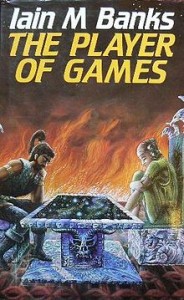
The Player Of Games by Iain M. Banks

The story was written early enough to capture Banks’ original thinking on the Culture, but being the second published novel it can explore concepts that are essential to the Culture without needing to be so hesitant about the audience’s sympathies. The story is about an interaction between the Culture and another civilization with contrary values, focusing on a single citizen of the Culture, the game-player Gurgeh. He visits the barbarian civilization of Azad, which takes its name from the extraordinarily complicated game that is used to select its ruler. Gurgeh enters the tournament whose winner is appointed Emperor, ostensibly playing as an honorary guest-cum-diplomat, though the underlying goal is to destabilize the Azad government.

The heart of this story is about communication. Whilst the game-players are competing for victory, their moves are also a form of expression. The complexity of the game means this expression may be as sophisticated, comprehensive and nuanced as that which may be conveyed through language or art. In an important and fundamental sense, the game can be a vehicle for different cultures to talk to each other. This leads to a telling question which will help us examine the Culture’s tao: what does the game-playing style of Gurgeh say about the Culture?

Before answering that question, it is necessary to assess if Gurgeh is speaking for the Culture, or merely for himself. Gurgeh is not a philosophical man, having spent his entire life perfecting his skill at playing many different kinds of game, most of which concern the movement of pieces upon boards, or the shuffling of decks of cards. Outwardly this superficial life is perfectly suited to the endless recreation of the Culture, and Gurgeh enjoys the adulation that comes with his many victories, but he may not be truly representative of the Culture. In fact, the story begins with Gurgeh feeling a sense of ennui; as comfortable as his life his, he is not happy unless he wins games, and whilst he is a peerless game-player, even the joy of victory seems to be wearing off. On the second page of the novel, Gurgeh asks himself: “what am I doing here?” having been drawn into a recreational activity which is typical of the Culture but which Gurgeh finds silly and pointless. He challenges his love interest, Yay, who persuaded him to take part:

It’s infantile, Yay. Why fritter your time away with this nonsense?

This is a confrontational question, given that every inhabitant of the Culture spends their whole life fritting away time on activities which mean nothing. However, Gurgeh also admits that he bores easily. As such, the reader knows that Gurgeh is not fully at ease with himself or others. When questioned why he lives alone, Gurgeh tells his friend Chamlis:

“Nobody can stand to live with me for long.”

“He means,” Chamlis said, “that [Gurgeh] couldn’t stand to live for long with anybody.”

Gurgeh’s lifestyle is depicted as idyllic, with a beautiful home, many admirers, and easy access to sexual partners. However, he admits:

“Everything seems… grey at the moment, Chamlis. Sometimes I start to think I’m repeating myself, that even new games are just old ones in disguise, and that nothing’s worth playing for anyway.”

If Banks intends Gurgeh to be the ‘voice’ of the Culture, as selected by the Minds that govern it, he also allows Gurgeh to question the superficiality of its ideals. Part of the problem with the Culture is an absence of meaning that can only be the result of taking risks:

“I used to think that context didn’t matter; a good game was a good game and there was a purity about manipulating the rules that translated perfectly from society to society… but now I wonder.”

He nodded at the board in front of him. “This is foreign. Some backwater planet discovered just a few decades ago. They play this there and they bet on it; they make it important. But what do we have to bet with?”

Gurgeh’s friend Chamlis agrees that Gurgeh is not perfectly adjusted to the Culture:

“You are a throwback,” Chamlis told him. “The game’s the thing. That’s the conventional wisdom, isn’t it? The fun is what matters, not the victory. To glory in the defeat of another, to need that purchased pride, is to show you are incomplete and inadequate to start with.”

Gurgeh then pinpoints why he feels ill at ease:

“This is not a heroic age… The individual is obsolete. That’s why life is so comfortable for us all. We don’t matter, so we’re safe. No one person can have any real effect any more.”

At this point, I think it worth noting how Banks has invested so much creative energy into describing a utopia which he clearly agrees with, but Banks is still willing to beautifully articulate the feelings of a character who is dissatisfied with life in that utopia. Banks deserves credit for this. It also suggests Banks would not be satisfied with a utopia that is completely inert. Gurgeh’s call for heroism gives us a hint that the Culture should be a moral force, capable of exerting a dynamic influence as well as coddling its inhabitants.

Chamlis responds to Gurgeh by mentioning Contact, the division of the Culture which does take risks and engage dynamically with forces it cannot perfectly control.

“Contact uses individuals,” Chamlis pointed out. “It puts people into younger societies who have a dramatic and decisive effect on the fates of entire meta-civilisations.

However, Gurgeh is dismissive of Contact, saying the people who work for Contact are “selected and used,” and comparing them to “game-pieces”. As he such, he illustrates how the ‘anarchism’ of the Culture culminates with a hard-headed elite who seek not just to govern within the Culture, but also to govern those outside it. When pressed on the subject of whether Contact could help him tackle his ennui, Gurgeh says:

“I have no intention of applying to join Contact… Being cooped up in a GCU [a very large spacecraft] with a bunch of gung-ho do-gooders searching for barbarians to teach is not my idea of either enjoyment or fulfilment.”

Gurgeh’s failure to fully embrace the Culture’s values is also emphasized in other ways:

“I feel you want to… take me,” Yay said, “like a piece, like an area. To be had, to be… possessed.” Suddenly she looked very puzzled. “There’s something very… I don’t know; primitive, perhaps, about you, Gurgeh. You’ve never changed sex, have you?” He shook his head. “Or slept with a man?” Another shake. “I thought so,” Yay said. “You’re strange, Gurgeh.”

Being a little unsettled and anti-social compared to others, Gurgeh is unusually sympathetic to Mawhrin-Skel, an intelligent drone which is a dangerous misfit by the Culture’s standards.

The little drone annoyed and amused him in almost equal parts. It was rude, insulting and frequently infuriating, but it made such a refreshing change from the awful politeness of most people.

Mawhrin-Skel’s discontent with the Culture is more noxious than Gurgeh’s:

“Oh, it’s all so wonderful in the Culture, isn’t it, Gurgeh; nobody starves and nobody dies of disease or natural disasters and nobody and nothing’s exploited, but there’s still luck and heartache and joy, and there’s still chance and advantage and disadvantage.”

Mawhrin-Skel has been ostracized from Contact, ostensibly for being too aggressive, even though the drone was designed to engage in combat. As a consequence, its talons have been removed, with the extraction of much of the military hardware it previously incorporated. In describing the original purpose of its life, Mawhrin-Skel chooses words which have biblical overtones:

“… imagine what I feel, all set up to be the good soldier fighting for all we hold dear, to seek out and smite the barbarians around us! Gone, Jernau Gurgeh; razed; gone.”

Gurgeh’s boredom leads him to cheat at a game with the encouragement and assistance of Mawhrin-Skel. However, the duplicitous and belligerent drone had manipulated Gurgeh with the intention of blackmailing him. It knows Contact wants Gurgeh to volunteer for a particular mission, so pressures Gurgeh to take the mission and use his influence to have Mawhrin-Skel reinstated. When Gurgeh learns the mission will involve traveling to Azad, a civilization outside of the Culture, he rationalizes:

…Gurgeh never ceased to be fascinated by the way a society’s games revealed so much about its ethos, its philosophy, its very soul. Besides, barbarian societies had always intrigued him, even before their games had.

And when Gurgeh contemplates what it would be like to travel outside the Culture for the first time ever, he looks at what life is like inside the Culture:

Something about the square, the whole village, disgusted and angered him. Yay was right; it was all too safe and twee and ordinary.

Gurgeh is briefed about his mission. The briefing further confirms how the Culture views other societies, as well as explaining why Contact needs Gurgeh’s assistance.

“Every now and again, however, Contact disturbs some particular ball of rock and discovers something nasty underneath. On every occasion, there is a specific and singular reason, some special circumstance which allows the general rule to go by the board. In the case of the conglomerate you see before you – apart from the obvious factors, such as the fact that we didn’t get out there until fairly recently, and the lack of another powerful influence in the Lesser Cloud – that special circumstance is a game.”

The society of Azad is described, with great emphasis on its faults compared to the utopian nature of the Culture.

“Empires are synonymous with centralised – if occasionally schismatised – hierarchical power structures in which influence is restricted to an economically privileged class retaining its advantages through – usually – a judicious use of oppression and skilled manipulation of both the society’s information dissemination systems and its lesser – as a rule nominally independent – power systems. In short, it’s all about dominance. The intermediate – or apex – sex you see standing in the middle there controls the society and the empire. Generally, the males are used as soldiers and the females as possessions. Of course, it’s a little more complicated than that, but you get the idea?”

Per the geniuses that run the Culture, a society like this would normally have crumbled long before it reached its current range and technological sophistication. However, the ruling game of Azad is the factor that has held it together.

“… Azad is so complex, so subtle, so flexible and so demanding that it is as precise and comprehensive a model of life as it is possible to construct. Whoever succeeds at the game succeeds in life; the same qualities are required in each to ensure dominance.”

However, the astute reader will have noticed that the hierarchical Azadian society is being described dismissively by an agent of the Culture’s hierarchical Contact division. Though Contact has not been elected by the public to influence or control other societies, that is how they see their purpose. Mawhrin-Skel perceived its role as essentially defensive, but Contact is actively engaged in coercing societies which pose no serious military threat. And when considering how the Azadian hierarchy controls information, there is another comparison that Banks seems blind to:

“If we let everybody know about Azad we may be pressured into making a decision just by the weight of public opinion… what may not sound like a bad thing, but might prove disastrous.”

“For whom?” Gurgeh said sceptically.

“The people of the empire, and the Culture. We might be forced into a high-profile intervention against the Empire; it would hardly be a war as such because we’re way ahead of them technologically, but we’d have to become an occupying force to control them, and that would mean a huge drain on our resources as well as morale; in the end such an adventure would almost certainly be seen as a mistake, no matter the popular enthusiasm for it at the time. The people of the empire would lose by uniting against us instead of the corrupt regime which controls them, so putting the clock back a century or two, and the Culture would lose by emulating those we despise; invaders, occupiers, hegemonists.”

This passage is dripping with irony, though Banks appears not to be conscious of it. The only reason this peace-loving ultra-transparent anarchy has not already invaded Azad is because an unelected elite has withheld information from the public! Instead of entering into direct confrontation, Contact intends to promote change in Azad by destabilizing its government. Does it not occur to anyone in the Culture that there is another option: to leave the Azadians alone? Whilst I feel this passage illustrates a flaw in Banks’ crushingly utopian morality, it also serves as an unflinching statement of its moral purpose. To be of the Culture, and to think like the Culture, means seeing yourself as anarchist liberators of oppressed people, willing to compromise every anarchist principle in order to achieve that goal. And the goal of liberation overrides the wishes expressed by the people being liberated; they must be liberated by the Culture, even if they neither seek nor want the Culture’s interference. This is not my tao, but it is a tao.

Fortunately, Banks saves himself from all the liberal paradoxes of his position by doing what communists often do: justifying the need to save the people by demonizing those same people.

“They have done things the average Culture person would find… unspeakable. A programme of eugenic manipulation has lowered the average male and female intelligence; selective birth-control sterilisation, area starvation, mass deportation and racially-based taxation system produced the equivalent of genocide, with the result that almost everybody on the planet is the same colour and build. Their treatment of alien captives, their societies and works is equally…”

There is no need to keep on quoting. In fact, the middle third of the book is devoted to one long laundry list of how utterly despicable Azad is. Poverty, theft, prostitution, sexual perversion, drugs, torture, corruption, hypocrisy, murder, inequality, deceit, sexism, cruelty to animals, jaywalking and nose-picking… Azad suffers from every vice imaginable. Azad’s prevailing ideology is Nazism on steroids.

Banks’ garish depiction of Azadian society serves as a wonderful distraction from the essential question that liberals should ask themselves: “as horrific as we find their society, why is it an obligation to overturn their way of life and impose our own?” Though not answered, this question is vital to understanding the tao of the Culture. The driving logic of the Culture, as epitomized by the behavior of its Contact division, is that of a false dichotomy that always leads to the same conclusion. If they encounter a society that is like the Culture, they will not disrupt it, and assimilation is inevitable. On the other hand, if they encounter a society unlike the Culture, then it is morally necessary to disrupt/educate/civilize (delete according to taste) that society until it is ready to join the Culture. In terms of the progressive march of history, this worldview could almost have been copied straight from a Marxist-Leninist revolutionary manual.

Whether intentionally or not, Banks shows that petty policing of language is used to disguise the arrogance of the Culture.

“They do,” Gurgeh said, “sound fairly…” – he’d been going to say ‘barbaric’, but that didn’t seem strong enough – “… animalistic.”

“…Be careful, now; that is how they term the species they subjugate; animals. Of course they are animals, just as you are, just as I am a machine. But they are fully conscious, and they have a society at least as complicated as our own; more so, in some ways. It is pure chance that we’ve met them when their civilisation looks primitive to us; one less ice age on [their homeworld] and it could conceivably have been the other way round.”

It is necessary that the Culture destroys/reforms/saves the horrible horrible Azadians whilst avoiding the use of pejorative language to describe them! And why are they in the position to do this? By virtue of ‘pure chance’! This passage implies an absence of morality: might is right, and the Culture just happens to be much mightier than the Azadians. However, the subsequent development of the story contradicts the bleakness of this especially amoral quote.

Gurgeh is persuaded of the need to compete in the Azadian tournament, and so undermine its government. I do not like the moral logic that Banks deploys, which relies on cheap stunts (genocide, racial extermination!) to gloss over the fact that the Culture has a central plan that involves assimilating every society, no matter how similar or dissimilar it is to theirs. But there is a moral logic here, and the conclusion is always: they must assimilate other societies for the good of the people living in them. Is this sufficient to demonstrate that the Culture has a tao? Probably not. The argument for the Culture’s tao comes at the end of the story, when game-player Gurgeh has reached the peak of his abilities at a game that is “so complex, so subtle, so flexible and so demanding that it is as precise and comprehensive a model of life as it is possible to construct.”

The journey to Azad takes years, and during that time Gurgeh studies the rules of the incomprehensibly complicated game he has been sent to play. Banks had set up his central character to feel vaguely dissatisfied with the Culture, so when Gurgeh finally arrives in Azad, Banks slaps him hard in the face. The author presents both Gurgeh and his readers with all the shocking reasons they should be grateful to live a ‘twee’ life that is the product of benevolent central planning. Gurgeh’s adventures all confirm the monotonously awful nature of Azad’s society. Meanwhile, the game-player improves his skills whilst winning match after match, despite the strenuous efforts of the corrupt Azadian hierarchy to intimidate, bribe or kill him. At one crucial juncture, Gurgeh is on the verge of losing a game and being ejected from the tournament, so his AI drone escort decides to take him on a journey to new parts of Azad that Gurgeh has not already seen. This reveals that Azad is even more rotten and unjust than we previously thought, and stiffens Gurgeh’s resolve. He makes a tremendous comeback, and progresses to the final rounds of the tournament.

Whilst Banks uses vivid language when condemning Azad’s immorality, he has a light touch when describing the AI drone that brazenly manipulates Gurgeh. The implication is that psychological engineering is fine, when done by a clever machine to promote an outcome we should all agree with.

The reigning Emperor of Azad is Gurgeh’s opponent for the final match of the tournament, though the naughty cheating lying Azadian elite has already told the public that Gurgeh has lost. Hence the final game is merely an exhibition match, played to appease the Emperor’s vanity. In short, Gurgeh is doing a brilliant job of upsetting the Azadians by beating them at their own game, and the Azadians do a terrible job of just killing and/or throwing him out of a tournament which he is not eligible to win anyway. For all their ruthlessness, it is almost as if the Azadians want to be humiliated by this infidel! Banks can be a clever writer, but even a villain in a James Bond movie would roll his eyes at the conceit of the Azadians. Real tyrants persist by ruthlessly disposing of threats to their existence, not by welcoming them into their home and encouraging them to participate in lengthy pageants that also provide plenty of opportunity for intrigue.

Gurgeh’s progress in the tournament is not just representative of his personal accomplishments. Like Bobby Fischer defeating Russian grandmasters, or the sequence of victories by Russian grandmasters beforehand, Gurgeh supposedly wins because he is a product of his society, and demonstrates why that society is superior. Gurgeh did not merely choose to play in the tournament; the Minds that govern the Culture identified him as the Culture’s best player. His whole life has been dedicated to playing games because the Culture makes that lifestyle possible, and his abilities have been enhanced by the genetic modifications and educational riches bestowed on every citizen. And when Gurgeh temporarily loses his motivation, the AIs which run the Culture know which buttons to press in order to restore his will to win. Everything builds to one conclusion: the Culture is better than all others, and that is why it wins, whatever game is being played. This is psychological torture for the Azadians, and its ruler in particular.

For Banks, the tao of the Culture is psychologically dominant: others may pretend their society is better, but deep down they know the Culture would win any fair competition. This tao is arrogant, but not without precedent. Whilst religions often exhort their adherents to be humble, zealots may adopt the opposite attitude. Within the Culture, those who work for Contact are most likely to be zealots. Perhaps we should not be surprised if Banks identifies with Contact most of all.

Like other people of faith, Banks must struggle through his doubts before he enjoys his supreme vision. This is evident when describing the game between Gurgeh and the Emperor Nicosar, which begins badly for Gurgeh.

Gurgeh was immediately impressed Nicosar’s play. The Emperor didn’t stop rising in Gurgeh’s estimation; the more he studied [his] play the more he realised just how powerful and complete an opponent he was facing. He would need to be more than lucky to beat Nicosar; he would need to be somebody else. From the beginning he tried to concentrate on not being trounced rather than actually defeating the Emperor.

Gurgeh falls behind, and struggles to reconcile his performance with his self-belief.

He was missing something; some facet of the way Nicosar was playing was escaping him. He knew it, he was certain, but he couldn’t work out what that facet was. He had a nagging suspicion it was something very simple, however complex its articulation on the boards might be… An aspect of his play seemed to have disappeared…

But then, Gurgeh is manipulated by his drone companion again. Gurgeh had taken to speaking and thinking in the Azadian tongue. The drone forces him to use the Culture’s language instead. The superiority of the Culture’s tao is manifest even in the words it uses – which is also an important belief for many progressives. Forcing Gurgeh to speak the correct language is the key to his reaching his full potential…

After initially finding it rather needlessly complex, Gurgeh enjoyed hearing the language again, and discovered some pleasure in speaking it…

He had his best night’s sleep since the day of the hunt, and woke feeling, for no good reason he could think of, that there might yet be a chance of turning the game around.

Choosing the right words means thinking the right thoughts, and that leads to enlightenment.

It took Gurgeh most of the morning’s play to gradually work out what Nicosar was up to. When, eventually, he did, it took his breath away.

The Emperor had set out to beat not just Gurgeh, but the whole Culture. There was no way to describe his use of pieces, territory and cards; he had set up his whole side of the game as an Empire, the very image of Azad.

Another revelation struck Gurgeh with a force almost as great; one reading – perhaps the best – of the way he’d always played was that he played as the Culture. He’d habitually set up something like the society itself when he constructed his positions and deployed his pieces; a net, a grid of forces and relationships, without any obvious hierarchy or entrenched leadership, and initially quite profoundly peaceful.

The absurdity of Banks’ metaphor should be obvious to anyone who does not share Banks’ beliefs. Gurgeh is the game-player, the single decision-maker in his ‘society’. In the same way that Banks is the sole author of this work, it is nonsense to suggest that Gurgeh’s forces have no hierarchy or leadership. Banks merely plays the same trick that he always plays: focusing on the supposed ‘freedom’ of the individual pieces so we ignore the elite authority that moves them around.

However, if we ignore this serious fault with Banks’ thinking, we can see how the Culture possesses a ‘tao’. The Culture’s freedom leads to a way of playing every game, approaching every problem, solving every puzzle, though this may only become evident with a game and a player as sophisticated as Azad and Gurgeh. And the Culture’s way is inherently superior to all other ways.

Every other player he’d competed against had unwittingly tried to adjust to this novel style in its own terms, and comprehensively failed. Nicosar was trying no such thing. He’d gone the other way, and made the board his Empire, complete and exact in every structural detail to the limits of definition the game’s scale imposed.

Note that Azadian society is competitive, whilst the Culture is not. But Banks does not entertain the possibility that a competitive society is more likely to evolve varied and winning strategies than one where there is little incentive to compete. For Banks, the Culture just is better, and there is no need to explain how it came to be better, or why no better alternatives will ever arise. In that sense, the way Banks describes the inevitable victory of the Culture is just like the way Marx described the inevitable victory of communism. Again, I dislike this tao, but I have to accept that Banks has an unshakeable belief in the ‘way’ of the Culture.

Because Gurgeh has rediscovered the tao of the Culture, he starts to make a comeback.

He gradually remodelled his whole game-plan to reflect the ethos of the Culture militant, trashing and abandoning whole areas of the board where the switch would not work, pulling back and regrouping and restructuring where it would; sacrificing where necessary, razing and scorching the ground where he had to. He didn’t try to mimic Nicosar’s crude but devastating attack-escape, return-invade strategy, but made his positions and his pieces in the image of a power that could eventually cope with such bludgeoning, if not now, then later, when it was ready.

And so, even the playing of a game becomes subject to destiny. The Culture may appear to be losing, but so long as it remains true to its tao, it will prevail!

Having reached enlightenment, Gurgeh loses his identity and becomes an avatar for natural and divine forces.

Gurgeh was overcome by the sensation that he was like a wire with some terrible energy streaming through him; he was a great cloud poised to strike lightning over the board, a colossal wave tearing across the ocean towards the sleeping shore, a great pulse of molten energy from a planetary heart; a god with the power to destroy and create at will.

The breaks and the times when he slept were irrelevant; just the intervals between the real life of the board and the game. He functioned, talking to the drone or the ship or other people, eating and sleeping and walking around… but it was all nothing; irrelevant. Everything outside was just a setting and a background for the game.

Banks becomes explicit about the game being a form of communication, between the tao of the Azadian Empire and the tao of the Culture, or perhaps within the dualism of a universal tao.

He watched the rival forces surge and tide across the great board, and they spoke a strange language, sang a strange song that was at once a perfect set of harmonies and a battle to control the writing of the themes. What he saw in front of him was like a single huge organism; the pieces seemed to move as though with a will that was neither his nor the Emperor’s, but something dictated finally by the game itself, an ultimate expression of its essence.

Gurgeh is in rapture, partly as a result of continuously using intelligence-enhancing drugs that help him to play. The game-player becomes so divorced from his physical body that his drone escort has to monitor his bladder and tell him when to pee. The drone is concerned about Gurgeh’s wellbeing; if it had the choice, “it would have stopped the man playing there and then.” But the drone which has repeatedly manipulated Gurgeh is not free to do that, because “it had its orders.” Once again, Banks allows the facade of anarchy to slip, revealing the tao of the Culture depends on a hierarchy, even if discussing that hierarchy is taboo. Whilst the drone continues to keep Gurgeh functional, the game-player has been absorbed by the game, losing all sense of himself.

Breaks, days, evenings, conversations, meals; they came and went in another dimension; a monochrome thing, a flat, grainy image. He was somewhere else entirely. Another dimension, another image. His skull was a blister with a board inside it, his outside self just another piece to be shuffled here and there.

But as fulfilling as it is, the rapture must end, and the game must have a victor. As he has been sublimated into the tao, Gurgeh sees the inevitable outcome before anyone else.

Over over over. His – their – beautiful game over; dead. What had he done? He put his clenched hands over his mouth. Nicosar, you fool! The Emperor had fallen for it, taken the bait, entered the run and followed it to be torn apart near the high stand, storms of splinters before the fire.

Empires had fallen to barbarians before, and no doubt would again. Gurgeh knew all this from his childhood. Culture children were taught such things. The barbarians invade, and are taken over. Not always; some empires dissolve and cease, but many absorb; many take the barbarians in and end up conquering them. They make them live like the people they set out to take over. The architecture of the system channels them, beguiles them, seduces and transforms them, demanding from them what they could not before have given but slowly grow to offer. The empire survives, the barbarians survive, but the empire is no more and the barbarians are nowhere to be found.

The Culture had become the Empire, the Empire the barbarians. Nicosar looked triumphant, pieces everywhere, adapting and taking and changing and moving in for the kill. But it would be their own death-charge; they could not survive as they were; wasn’t that obvious? They would become Gurgeh’s or neutrals, their rebirth his to deliver. Over.

As the game proceeds towards the victory of Gurgeh and the Culture, the game-player feels empathy for Emperor Nicosar. However, Banks has little pity for those who are vanquished, and he restates the supremacy of the Culture whilst portraying its opponent as a cartoonish villain. On the eve of Gurgeh’s victory, Nicosar meets his opponent privately:

The Emperor was silent for a few moments. “You must be very proud of your Culture.”

He pronounced the last word with a distaste Gurgeh might have found comical if it hadn’t been so obviously sincere.

“Pride?” he said. “I don’t know. I didn’t make it; I just happened to be born into it, I-”

“Don’t be simple, Gurgeh. I mean the pride of being part of something. The pride of representing your people. Are you going to tell me you don’t feel that?”

“I… some, perhaps yes… but I’m not here as a champion, Nicosar. I’m not representing anything except myself. I’m here to play the game, that’s all.”

At this point, I wonder if Banks is being willfully obtuse when he puts these words into Gurgeh’s mouth. A man who spends his whole life perfecting his skill at playing games, who craves the pleasure of victory and says he would like to play for higher stakes, who consciously meditates on the tao of his Culture and plays in a way that represents its ethos, claims that the victory represents nothing. This sounds to me like the self-deception of an ideologue who refuses to acknowledge his own ideology. Meanwhile, Nicosar is reduced to playing the role of comic-book villain, with religious overtones.

“You disgust me… Your blind, insipid morality can’t even account for your own success here, and you treat this battle-game like some filthy dance. It is there to be fought and struggled against, and you’ve attempted to seduce it. You’ve perverted it; replaced our holy witnessing with your own foul pornography…”

Emperor Nicosar is right: the game is not just a game played by two players. The Emperor is devastated because the Culture’s tao is about to prevail. His belief-system has been fatally undermined, and so has the faith of every member of Azad’s ruling elite who has watched this final game. Even if Gurgeh vacillates, Nicosar acknowledges the tao of the Culture. For me, this is enough confirmation that the Culture has a tao; it is akin to a moment of religious conversion. Though Nicosar rejects the values of the Culture, he can no longer dismiss their potency.

Gurgeh will win because he has followed the Culture’s tao, but the uplifting nature of the Culture’s tao has always been implicit. Its citizens are well-fed and safe, its rivals are demons, but nobody so far has explicitly argued for the moral superiority of the Culture’s tao. So Banks finally uses Gurgeh as a mouthpiece for why the Culture’s tao is stronger. As communists often do, Banks constructs an argument for the Culture that relies heavily on criticism of the alternative offered.

Gurgeh… felt dizzy, head swimming. “That may be how you see it, Nicosar… I don’t think you’re being entirely fair to-”

Fair?” the Emperor shouted, coming to stand over Gurgeh… “Why does anything have to be fair? Is life fair?” He reached down and took Gurgeh by the hair, shaking his head. “Is it? Is it?”

… Gurgeh cleared his throat. “No, life is not fair. Not intrinsically… It’s something we can try to make it, though,” Gurgeh continued. “A goal we can aim for. You can choose to do so, or not. We have. I’m sorry you find us so repulsive for that.”

At last Banks shows the cards he has been holding all along; being rather weak, he was wise not to play them sooner. The tao of the Culture is best expressed by the vague concept of fairness. Like many arguments for fairness, it is best not to examine what this entails, in case the unanimity of support for fairness is fractured by thousands of disagreements about what is fair in actual practice. However, though fairness is a vague concept, it is essentially uplifting. All other things equal, nobody prefers an unfair outcome to a fair one.

And for a man who writes a lot of words, Banks offers an ingenious excuse for why he will not examine the concept of fairness more closely:

Were they to argue metaphysics, here, now, with the imperfect tool of language, when they’d spent the last ten days devising the most perfect image of their competing philosophies they were capable of expressing, probably in any form?

But though he has wriggled out of the need to express why the Culture’s tao is superior, Banks cannot resist one brief (and seemingly reluctant) victory speech.

What, anyway, was he to say? That intelligence could surpass and excel the blind force of evolution, with its emphasis on mutation, struggle and death? That conscious cooperation was more efficient than feral competition?

And so we have the tao of the Culture, which unsurprisingly reflects Banks’ belief that central, common, benevolent, rational planning will always yield better results than the diversity promoted by competition. It even yields better results when playing competitive games!

A more sensible Emperor might have simply told Gurgeh and the Culture to leave, and then returned to ruling his Empire. However, the acknowledgement of the Culture’s tao is too much for the Emperor to bear, so he goes bonkers and kills everybody, thus hastening the demise of the Azadian Empire. The only survivors are Gurgeh and the drone that escorts him, thanks to their superior technology. At this point, it is revealed how much the drone and other AIs were manipulating Gurgeh and the Azadian elite, with the goal of encouraging the self-decapitation of the Azadian Empire.

“You’ve been used, Jernau Gurgeh,” the drone said matter-of-factly. “The truth is, you were playing for the Culture, and Nicosar was playing for the Empire. I personally told the Emperor the night before the start of the last match that you really were our champion; if you won, we were coming in; we’d smash the Empire and impose our own order. If he won, we’d keep out for as long as he was Emperor… That’s why Nicosar did all he did. He wasn’t just a sore loser; he’d lost his Empire. He had nothing else to live for, so why not go in a blaze of glory?”

“Was all that true?” Gurgeh asked. “Would we really have taken over?”

“I have no idea. Not in my brief; no need to know. It doesn’t matter; he believed it was true.”

… “You really thought I’d win?” he asked the drone. “Against Nicosar? You thought that, even before I got here?”

… “As soon as you showed any interest in leaving. [We’ve] been looking for somebody like you for quite a while. The Empire’s been ripe to fall for decades; it need a big push, but it could always go… Everything worked out a little more dramatically than we’d expected, I must admit, but it looks like all the analyses of your abilities and Nicosar’s weaknesses were just about right. My respect for those great Minds which use the likes of you and me like game-pieces increases all the time… All you needed was somebody to keep an eye on you and give you the occasional nudge in the right direction at the appropriate times.” The drone dipped briefly; a little bow. “Yours truly!”

And if that was not sufficient manipulation to make you question how much freedom is enjoyed by citizens of the Culture, Banks’ final revelation is that the drone which accompanied and manipulated Gurgeh is a disguised version of Mawhrin-Skel, the supposed outcast which first bullied and blackmailed Gurgeh into working for Contact.

So the Culture has a tao, but whether you consider it uplifting depends on your values. Its citizens have freedom, so long as they think and do the right things. If they are inclined to think and do otherwise, then the great intelligences who make all the important decisions will correct their thinking, by using deceit and blackmail if necessary. The Culture is transparent and honest, except to the extent that it is not, and it has no desire to conquer other territories, although they consider it a moral requirement to civilize their neighbors and absorb them into the Culture using the most efficient methods they can. Its people are cared for materially, but have no spiritual needs. The Minds who quietly govern the Culture only need extreme rationality to determine the difference between right and wrong. And if anybody offers an alternative point of view to theirs, then they will be defeated by the Culture’s superior technology and resources, which is proof that might equals right, and that being right makes you mighty.

I do not subscribe to these values, but I know some people do. Whether you consider the tao of the Culture to be uplifting depends on which direction you consider to be up. Banks loves his Culture, and is an apologist for every dirty track played in its name, but he dodges the greatest challenge to its tao. As useful as rational thought is, how could rationality ever construct a moral compass? Banks follows the lead of other atheist communists by maintaining blind faith in ‘rational’ values that cannot be derived rationally. The only way to avoid the moral ambiguities that trip up every attempt to ‘scientifically’ extrapolate from reason to morality, is to admit to a foundation of moral absolutes. Those absolute principles are like the rules of a game, not adopted by convention but because they describe the genuine Tao, and hence guide us towards a good and fulfilling life. Though I disagree with his conclusions, I admire the extent to which Iain Banks devoted his life to promulgating his beliefs. The challenge for any author wishing to depict a successful utopia with a strong moral dimension is to understand the extent of Banks’ accomplishment, and then to do more.

Blaming the Victims of Terror

There is a theory that says you should never blame the victim of a rape. I agree with the theory in so far as the victim does not need more pain and suffering. The majority of rape victims are women, and they should be able to wear what they like, get as drunk as they like, stay out as late as they like, and behave as foolishly as they like, without having to fear rape from anyone, whether a friend, husband, or stranger. And yet, I would say it is in a woman’s interest to recognize when her actions increase the risk to her, just as I would warn a newcomer about the worst neighbourhoods of my town. The word ‘blame’ is emotive, but there must be a degree of precautionary advice that can be addressed to people in general which is not misrepresented as blaming victims and potential victims. There will be a grey area between genuine advice and hateful blame, which will be hard to discern because we are unsure of the motives of the speaker, and because the meaning of their words may not align to the tone they take. Nevertheless, we can distinguish advice from blame. It is with this in mind that I want to discuss many public reactions to the terrorist atrocity that recently occurred in Paris.

It seems to me that some people are guilty of blaming the victim – which they perceive to be the nebulous construction that we call ‘the West’ – in ways they would never blame an individual, or a gender, when they fall victim to violence. Their words are presented like they are giving advice. The advice is that if you ever engage in violence, you will reap what you sow. I do not think these people really have much idea why the West engages in violence around the world. Nor do I, at times, but some people who know very little are happy to believe they know a lot, as it gives them an undeserved feeling of superiority.

There will be times when the West needs to engage in violence, in order to avoid a greater harm. All Western countries have a police force, and all have a military, because we recognize that violence can sometimes be necessary, in order to protect us from malice both domestic and foreign. It cannot be the case that violence is never the correct course of action. If you genuinely believe that, please let me know your location, and I will personally come and punch you in the face until you change your opinion. I will do that not because I want to hurt a pacifist, but because pacifism is morally wrong, and needs to be challenged instead of indulged. There are times when the best overall moral outcome requires violence, whether it is to subdue a rapist, or to forestall an invader. Of course it will also be possible to engage in an excess of violence, even when well-intentioned, and the right balance will never be a well-defined line, but will always fall within a murky field of grey. But we have to accept that inflicting violence is sometimes necessary in order to reduce violence.

Currently many are using mainstream media, social media, and every other opportunity to express their disdain for the West, and its violent ways. They treat the atrocities of ISIS as justified revenge for Western adventures in the Middle East. That is bunk, and cannot withstand scrutiny. That is blaming the victim, not giving useful advice. ISIS kill far more of the people close to them, then they kill from afar. Their goal is to realize a single conformist planet where everybody obeys the rules they would impose. These rules permit them to kill homosexuals and rape little girls. Their rules are not rules which can be tolerated by the West, and it is facile to suggest they are only motivated by revenge. Nobody in ISIS took a young Yazidi girl and raped her as a way to inflict revenge on the West. The leader of ISIS did not repeatedly rape an innocent American aid worker to punish the West for invading Iraq, or bombing Syria. The motives of these men are clearly more complicated, and yet more simple, than simply hurting and undermining the West in revenge for its perceived transgressions. They may be glad to hurt the West, to terrorize and befuddle its citizens, but rape is not a policy pursued by men whose sole goal is education and correction. They also rape for pleasure.

So when terrorists follow the orders of these rapists, and blow up a music hall, or a restaurant, we should not indulge their fantastic claims about wanting to live in a peaceful world where everybody will be safe, whilst demanding that we wade through a bloodbath to reach it. These people want to do bad deeds, and are the apologists and defenders of others who do bad deeds. They use violence to get things they otherwise could not: power, money, and women. They would always force a confrontation, on anybody who seeks to curb their bestial instincts. As such, the idea that they will let us live in peace, if only we are more peaceful to them, is a dangerous nonsense.

The story that the West deserves retribution is repeated so often, that we lose sight of how contradictory it can be. The French government bitterly opposed war in Iraq. The majority of British people have often opposed the policy of its government. American aid workers do not travel to the Middle East because they want to make it easier for Islamists to torture and murder them. If violence only begets violence, then criticism of violence should begin with those who resort to violence without hesitation, not to those who live in democracies where we must go through prolonged debate before violence can be officially sanctioned.

If we only focused on those who instigate violence, then nobody would have apologized for the murderers of Charlie Hebdo’s cartoonists. A cartoon is not even a slap in the face, never mind a bullet from an AK-47. However, many Westerners were apologists for the terrorists who attacked Charlie Hebdo. Did the cartoonists draw pictures that upset some people? They did. But insult and offense never justifies violence. Short skirts upset other people. Some people say it is provocative for a woman to show her body, or her hair, in public. However, in the West, we do not believe we should blame the victim of rape, no matter what she wore. So why did some rush to blame the cartoonists for the physical violence that was done to them? The only answer I can think of is that the Western apologists for terror are morally weak and simplistic, prone to seeing conflict in terms of generalizations about which ‘side’ somebody is on, and so unable or unwilling to focus on where blame really belongs.

The West has received a lot of advice recently, mostly from people who live in the West. But when the advice is to be docile, to agree to vapid justifications for terrorism, to demand that their violence never be challenged by our violence, it sounds like blaming the victim. In the West, we aspire to a society where women can walk, talk and dress freely. That is just one of many reasons why the radical Islamist vision of peace is not compatible with our own. They will fight ferociously to realize their vision; we must sometimes fight to realize ours.

In one respect, it was natural that so much of the formal and informal media commentary was directed at the West. It is the West that has most television stations, most newspapers, most computers connected to the internet. Most of those commenting cannot speak the preferred language of the terrorists. So these commentators want to give advice, to people like them. And the advice is to be better than our enemies, by avoiding a fight. But that is bad advice. We are in a fight now. History is irrelevant, because it cannot be undone. The only freedom we possess is to make choices as we move forward in life. However the fight started, we are in a fight, and we must fight it.

It is natural that Western pacifists and apologists prefer to direct their advice to Westerners, and not to the terrorists. There are many Westerners, and few violent jihadis. Some of us will listen; most of them will not. We speak the same language; they may not. But if the pacifists and apologists really want to give good advice, they should concentrate on talking to the terrorists, because terrorists also live in West. Every Western town will possess at least one wannabe terrorist, whether it is somebody who has actually received training in Syria, or a fantasist who spends too much time on the internet. Those individuals need good advice more than the rest of us do. They need to hear that God does not support them, and their violence will not be rewarded in heaven. Instead of trying to correct the supposed faults of the victim, it would be better to change the minds of those who really deserve blame.

The Rebel Alliance Won… Didn’t They?

Once bitten, twice shy. Near the end of the 20th century, I caught a transatlantic flight just to see a film on the first day of release. It was called The Phantom Menace, and it was not a good film. Some years later I was coincidentally in Cannes on the day they premiered Revenge of the Sith. I arrived too late to see Natalie Portman going in, but afterwards I did catch Hayden Christensen and George Lucas hanging around outside. The crowd swooned, cheered and waved desperately at handsome young Hayden. George waved back. Revenge of the Sith was a better film, but the bubble had burst by then. There was no urgency when I eventually sauntered to the local cinema to watch it.

Darth Maul and Boss Nass action figures
I also convinced myself that plastic toys were a good investment. When I bought these, Apple shares were trading at $1.86.

For weeks after The Phantom Menace, I wandered around New York wearing a variety of suitably themed t-shirts, engaging in conversation with total strangers about how excellent the movie was. I really believed it was a good film, and so did they. The disproof only came after I had bought the DVD, played it, put it on the shelf, and stared at the box many times, trying to will myself to watch it again. I doubt I ever will. Ever since that time, I felt a sadness about the saga. A great story had been diminished because the storyteller had continued to tell it, after he should have stopped.

Though it is anathema to the business of science fiction and fantasy, the best stories end when their creator has the courage to admit that continuing them would be a disservice to the audience. Stories should end with a bang, or a pie in the face, or a kiss on the lips, or a wild crescendo, or a door slammed shut. Like a passionate love affair, you may fondly remember the good times, but those emotions are heightened because your lover walked out on you, never to return. When a great story ends, you should feel its absence, whilst knowing it cannot return. A great story should not be allowed to fade to dust, strung out and slowly abandoned by a once-admiring audience that loses their interest.

And yet, people seem very excited by the prospect of a new Star Wars film. As Disney is behind it, I expect the movie will give audiences what they want. There will be familiar old faces, and bright young things, cool robots, and natty costumes and stunning special effects. Being the marketing geniuses they are, Disney will find a way to hook people and ensure they come back for me. But the problem with giving people what they want, is that people do not really want what they want. As the artists Vitaly Komar and Alex Melamid have shown, if you paint the paintings that market research tells you to paint, the results are terrible. On the other hand, if you think you really want something, you can probably persuade yourself it was good, even after you should have realized how awful it was. In that sense, art confuses infatuation with love in the same way we all do.

The more I learn about the new Star Wars film, the more I wonder why its story needs to be told, except for the obvious fact that Disney and everyone else involved intends to make huge profits from the venture. Do they have a story to tell? Or are they telling the same story again?

The film title, The Force Awakens, demonstrates the moviemakers have studied what audiences like. So many movie titles include words like ‘rising’ or ‘dawn’ that if an extraterrestrial race is watching us from afar, they must assume we humans love our daybreak rituals. I associate mornings with alarm clocks, wanting more sleep, and being late for work. Heck knows what kind of bright-eyed people get surveyed about the choice of movie titles. Do they leap from their beds, burst into a Doris Day song, and skip to the cinema to watch films about war in outer space, all whilst still wearing their pajamas?

So far we know the film features a new bunch of baddies, who are much like the old baddies, and live on a planet-sized planet with a big gun inside it, much like some moon-sized space stations from previous films. Some of the planets are icy, whilst others are sandy, because the filmmakers find it impossible to imagine a weird new kind of planet which has ice somewhere on its surface, and sand somewhere else.

A plucky ‘resistance’ movement is going to stop the firing of the baddies’ gun, or something equally horrific, much like their forebears, the ‘rebels’. One of the baddies wears a black helmet, wields a sword, and feels empathy for an earlier helmet-wearing sword-wielder. As he carries a sword, a goodie will also carry a sword and fight the baddie in a duel. The goodie is happy to fight a duel like this, even though it indicates a poor grasp of the essentials of combat, which is to defeat the enemy without risking your life in the process. The goodie would consider it terribly unsporting to kill the baddie by shooting him with a ray gun, or firing a missile at him, or dropping an atom bomb or an anvil on his head (only cowards kill their enemies like that). Presumably the baddie carries his sword because he shares that aspect of the goodie’s moral code, even though he is a baddie.

At least one good person will die, to demonstrate how serious the story is. Mostly this universe revolves around pretty humans. However, aliens, robots, dogs, dog-aliens, and robot dogs will briefly appear as comic stooges and/or mysterious others. Somehow, I am left with the feeling of déjà vu.

The trouble with making a sequel to Star Wars is that the original was not a very original story to begin with. Basically it was a rehash of themes from World War 2, plus some magic, and minus the part where Stalin sacrificed 20 million Soviets on the Eastern Front, then received Poland and East Germany as his reward.

Or rather, Star Wars was a rehash of themes from World War 2 movies, which usually involve a few brave soldiers parachuting (or jumping to light speed) behind enemy lines and then stealing/exploding something really important to the Nazis. The Guns of the Navarone, Saving Private Ryan, U-571, The Dirty Dozen, Inglourious Basterds… the point is to take a complicated conflict involving huge numbers of people with diverse and selfish interests and to turn it into a story where a small group committed to doing the right thing are fighting overwhelming odds and a very large group committed to doing the wrong thing. And so it was with the original Star Wars, where even the title tells us the galaxy is engaged in a desperate military struggle. However, the victory was won by a boy, a criminal, an old man, a princess, two robots, and their upright-walking semi-talking dog.

The World War 2 parallels go on and on. The Empire is described as the ‘New Order’. They are opposed by a Rebel Alliance, not by a Rebel Axis. The rebels seek to end the Emperor’s ‘ten thousand years of peace’, in comparison to overthrowing the Führer’s tausendjähriges Reich (thousand-year realm). The political leaders of the Allied forces come from aristocratic families, whilst its soldiers are backwoods farmboys from places like Arkansas or Tatooine. Officers in the Empire’s military wear the same gray as Nazi officers wore, and the stormtroopers are… well, they are stormtroopers. The dogfight above the Death Star is a replay of the Battle of Britain. The Death Star represents the technological advance of the Nazi V-weapons. (The Death Star could also represent a nuclear bomb, but it would complicate the moral analogy to observe WW2’s goodies were the ones who used WMDs.)

As with World War 2, the basic dynamic of Star Wars is that good liberal democrats will suffer a lot, but they will eventually overcome the militaristic fascist tyrants who want to oppress them. And if the good liberal democrats ever felt the need to ally themselves to a bunch of militaristic communist tyrants, then that would spoil the story, so let us avoid all mention of that.

At the end of Return of the Jedi, the audience was led to believe that the Allies had won. Fireworks were launched. Men drank and women kissed. Saddam Hussein-like statues of Emperor Palpatine were spontaneously toppled by the people. Or maybe not. Some of that may have been propaganda, stage managed for the cameras long after the war was over. Original accounts only mention Ewoks dancing to music played on a xylophone made from stormtrooper helmets. But in the end, we all knew the fascists were defeated. They had made a bit of a comeback after losing their first Death Star, but they could never survive the loss of their Führer. However, it seems we were all wrong. Hence we need a new episode in the Star Wars saga, which if it followed historical convention should have been called ‘The Continuity War’ or ‘The Thirty Years War’.

On our planet, the Cold War followed WW2. There was a realignment of power that led to relative peace for most, prosperity for a minority. However, no seeming stalemate emerges in the Star Wars universe. Instead, we are presented a picture of rebels heroically resisting the fascists for another three decades. Like Leon Trotsky’s permanent revolution, the resistance believe there can be no peace until utopia is delivered everywhere, for all. Enemies cannot be contained, nor negotiated with. There is no possibility for the equivalent of the Treaty of Brest-Litovsk, or the Nazi-Soviet Pact, which would allow enemies to co-exist without further bloodshed. They have abandoned the hope of a cessation to fighting, and do not engage in the messy compromises needed to deliver peace amongst real people with genuine differences. The resistance will keep on revolting, and will never say die until their enemies are completely wiped out – or turned to their side.

As much as I loved Star Wars, a story of perpetual war is not one I embrace. I can see why it would appeal to some people; even when real fascists fell, some still wanted to beat them over and over. When necessary, some invent new fascists to fight. This happens in both fiction and reality. Woken from his long sleep, Captain America fights the continuing Nazi program of Hydra. From the 70’s to the 90’s, the Red Army Faction also claimed to fight German Nazis, though their members were born after WW2 had ended. The Red Army Faction justified murder, robbery and kidnap by saying it was part of an ongoing struggle against imperialism.

Stories often appeal to the child inside us. Those infatuated with a cause, and disinclined to deal with messy realities, may prefer the childish story of a never-ending struggle between pure good and pure evil. In the real world, those who have peace may seek war, but those who have war mostly seek peace. Only the latter are wise. War stirs emotion, which is why it is suited to storytelling. However, war is not a solution for ennui.

Ultimately I liked Star Wars because I was kid when it came out, and that is how it should be. There was a war, it was fought, and it was won. The story had a happy ending. In contrast, a story of an endless war is not one fit for adults or children. Children have the advantage, because they will watch the new film with fresh eyes, and with little concern for the films that went before. The rest of us should consider ourselves less fortunate. Adults will see a story that has been extended, but also made more superficial. After war comes peace, or else the war must lose its meaning.

Peace is a messy business, involving compromise. After war, helmets and uniforms are removed, and people have to find a way to live next to their neighbors, and get along with their work colleagues, whoever they may be. Puritans fear the peace that comes after the cessation of hostilities, even if their enemies were thoroughly vanquished. But puritans never develop beyond the reasoning of adolescents, and so they treat every clash of wills like a teenager treats love and war. If young new fans want to discover a stirring space story where a family lineage fights a perpetual struggle for good against evil, I hope they enjoy the new Star Wars film. But as an old fan of Star Wars, I think this film is not for me. Time moves on, and so should stories. If warriors die of old age before they find peace, they probably enjoyed fighting too much.

Sunshine in the Autumn Forest

0

The leaves turn
Half way through nature’s year
Growth foreshadows decline
The sun bows lower
Dappled by barer branches
But it still shines

It is cool and moist
Standing tall as pillars of life
Grounded on our feet
Binding the foundations
Whilst the slippery mulch surface retains
Replenishing water and earth

The canopy that flourished
Thinned since Summer’s crown
Continues to shelter life
Taming chaotic elements
Reconstructing them into this domain
Readying it for new guardians to occupy

Though strength stretches beyond its prime
The forest welcomes coming shadow
Gifting time to appreciate
What was grown from half a lifetime
The remainder is no eclipse
It is settlement and preparation

At the trail’s half way mark
Glancing back is melancholic as looking forward
The ends never clear until reached
But we are not lost
Each beginning must have its middle
We are right where we are supposed to be

No Man’s Sky: First Day

NMS-first-dayNo Man’s Sky, the upcoming science fiction adventure from indie developers Hello Games, has inspired me to write a new one-off science fiction story. The game unashamedly borrows themes from classic SF, and will contain 18 quintillion explorable planets (!) thus creating an extraordinary setting that can (and will) be used for new SF narratives. Unlike my other SF stories, this was not written with publishers and editors in mind. I just wanted to write a magazine-length classic SF story that is staged within the NMS universe, and to share it freely with other fans, whilst they (im)patiently await the release of the game. I also tried to weave in some of the SF and indie themes that motivate the team at Hello Games, per the interviews they have given, whilst leaving the story open enough that it will not conflict with anything we experience when we eventually play NMS.

If anybody would like a sequel to this story, they should leave a comment and let me know. I enjoyed writing this so much, and am so excited about the game, that I can almost guarantee writing more.

===

The future’s so bright, I gotta wear shades. I woke to find myself on my back, spreadeagled and becalmed, alone in a desert expanse. That must have been some party I attended last night, not that I could remember any of it. The alcohol had drained out of my system, replaced by an epic morning-after hangover. I think it was the morning, anyway. Tilting my head to one side, I watched a blue sun climb above a lilac mountain range in the distance. As I had no recollection of which planet I lay upon, or even the name of its star system, this may have been the second or third sunrise of the day. A veil of turquoise clouds obscured most of the sky, but this was still the most vibrantly coloured planet I had ever seen, with its blood red sand and swarms of rainbow locusts overhead.

But then I realized I could not remember any of the planets I had visited before. I could not remember my home, or my name. Squinting and shaking my head like a dazed and confused old man who dramatically fell to earth, I adjusted the filter on my lifesuit visor, lowering the contrast. I was lost, suffering missing memories and a banging headache. And even worse, songs looped annoyingly around my head, and I could only recall half of their words.

You may find yourself in a beautiful house, with a beautiful wife. And you may ask yourself: well, how did I get here? Some unknown training kicked in, and I ran the suit’s internal diagnostic routine. Everything was functioning normally. Though only a basic model, the suit could sustain me for a lifetime. That might prove necessary, if I failed to find a way off this rock. I was sure I had never been here before. The suit warned that it had obtained no stellar fix, and hence could not report my location. That was unusual; normally it would track my movements from the last known fix. The clouds must have also blanketed the night, or else I had arrived during day. Perhaps I had travelled here via portal, though my physicist friends insisted that interplanetary corridors were impossible, due to the dimensional sheer.

It was odd that I could remember facts about physics, but not anyone’s face. I did not even know what I looked like. If I had not been wearing the lifesuit helmet, I would have run my fingers across my features. Whatever device had zapped me, whatever drugs had been slipped into my drink, some memories had been left intact, whilst others were scrambled. Somebody had wanted me gone, but not dead… not yet, anyway. Or maybe I had done this to myself. I felt a lot less anxious than I probably should. Perhaps I had a hunger for adventure. Judging from my mental soundtrack, I also had an infatuation with music.

Here we are now; entertain us. I surveyed myself. Two arms, two legs… my limbs were still connected, though stiff as concrete. Still lying on my back, I checked the lifesuit’s many pockets. In them I found a pack of distress flares, a multi-tool, an I/O port for upgrades to the suit’s operating system, and an energy coupling for recharging the suit or powering external devices. A pistol was holstered on my hip, but no radio transceiver was connected to the suit’s comms port. Help would not come to me; I would have to go looking for it. I rolled on my side, clambered to one knee, and finally hauled myself erect. The suit helped me, but I was painfully conscious of weight. My muscles ached. Clearly I was not used to such high gravity. I adjusted the suit’s exoskeleton to carry more of the load.

I gazed hard, scrutinizing the environment. It looked much the same, whichever way I turned. Rippling dunes stretched to the horizon in every direction but the South East. There the spindly mountains, as steep and sharp as stalagmites, reached high enough to puncture the underbelly of the clouds. If it rained, it would be over those peaks, and though they were too far away to be sure, I fancied they wore thin white caps of snow. The terrain would be difficult, but rain meant water and the possibility of vegetation, and hence a better chance of finding civilized beings like me. Not that I was civilized, according to my mother… whoever and wherever she was.

Step on it, electronic, the troops are on fire. As I turned about, I found the coarse sand to be treacherous underfoot. At each step, my boot sank into the crimson mire, disappearing almost to the knee. Walking upright would test both strength and balance. However, there was no need for walking; the lifesuit came fitted with a slimline jetpack. Though modestly powered, it would carry me to the mountains within a few hours. The flight would be tedious, but infinitely preferable to wading through the dunes.

With no georeference data for the autopilot, I decided to set the controls to manual. First I would climb to a safe height just above the level of the tallest dunes, then zip forward in straight and level flight. The jetpack fired. Up I went, rising comfortably. Very soon I ran into a descending legion of shiny locusts. Some of the flying critters were sucked into the jet’s combustion chamber, where – sput, phut, splurt, blurt! – they proved to be unexpectedly flammable. Their carcasses were expelled as burning shards, starting a chain reaction that – BOOM! – consumed the swarm in a fireball half a mile wide. Though I was startled, my lifesuit’s insulation protected me from the inferno. Less pleasingly, the explosion blew out the jetpack.

Hup, hup, heads up. Ground floor, coming up. Thankfully, I had only reached an altitude of twenty feet before my collision with the locusts; the suit absorbed most of the impact with the desert beneath. Even so, I found myself buried up to my chest. A journey of a thousand miles begins with a single step, but I was going nowhere fast. With the jetpack busted, I would have to dig myself out of this hole. I maximized the mechanical assistance provided by the suit’s exoskeleton, and began scooping sand with my hands, scraping and hurling it behind me. It was slow toil, but I attacked my task, releasing some latent anger and frustration. Though the suit did most of the work, my biceps were begging for rest by the time my hips were clear. I then tried to lift myself up, but my legs remained firmly wedged. I paused for breath, and sipped from my helmet’s feed tube. The recycled water was pleasantly chilled. I wished I could remove my helmet, and wash my face with it.

Something moved in my peripheral vision. I turned my head, scanning for anything out of the ordinary. There was nothing unexpected – just the usual array of humps and troughs in the sand. I felt I was imagining things, so returned to digging. Then I froze, because I saw it move again. A hump of sand had inched closer, then halted. I stared at it for a while. It did nothing, so I dug again. As I did, it sidled closer. I stopped. It stopped. Whatever alien lifeform this was, I had no desire to meet it. I unholstered the weapon strapped to my side, which was now just clear of the sand. Clasping the gun in both hands, I took careful aim… but shooting at a hillock of sand might be foolish. The sand would absorb the blast, whilst the creature below could be angered, and burrow deeper before attacking me. It was time to accelerate my self-excavation. I held the gun in my right hand, and pointed it downward, at my side, aiming as close to my body as I dared. I closed my eyes, and pulled the trigger. Several feet of sand were successfully vaporised. I switched hands, and repeated on my left side. The hump-creature, alarmed by the weapon fire, started to back away. I shot directly in front of me, and then behind my back. A combination of dragging myself forward whilst franticly wriggling my legs was sufficient to escape the loosened trap. The hump-creature, still hidden from view, circled toward my rear. I fired at the space between it and me. The creature got the message, and retreated. I decided to make good progress before its courage returned.

Walk without rhythm, and it won’t attract the worm. It is amazing what you can learn from popular music. But it is difficult to hum a song whilst trying to walk with an erratic tempo. Long stride – big leap – quick step, quick step – pause… long stride – quick step, pause. I was breaking up the pattern of my movement, hoping not to attract the attention of any more hump-creatures. Progress was slow, and I felt dispirited. The suit was expending more energy than me, but the strain on its cooling systems left me feeling hot and bothered. There was plenty of time for thinking, but no answers for my questions. However hard I concentrated, my name escaped me. Perhaps that was because the language centres of my brain were thoroughly jumbled. I considered writing the word ‘help’ in the sand, so it might be seen by anyone flying above. However, I was unsure of the correct spelling. (It was only later that I realized I could still spell ‘S.O.S.’)

Hours were spent carving my path through the desert, and the mountains seemed no closer. They may have been taller, and further away, than I first estimated. It could take weeks to reach them, but at least the suit would supply me with water and sustenance in the meantime. There was no alternative; I had to forge on. But I deviated from the straight path to scale an abnormally high dune, to see what I might see. At its peak, I regretted the wasted effort. There was nothing to see but sand and more clouds of locusts. Then, looking back and evaluating the distance I had travelled, I recognized a familiar pattern of movement coming toward me. A dozen hump-creatures were now in my wake. Their mounds of sand would squirrel forward, then freeze for a while, before another spurt of movement. Were they hunting me? Or were they benign and brainless creatures, drawn to the sound of my steps like a moth is attracted to the flame? My mind was filled with the image of a portly old man, saying: ‘the better part of valour is discretion’. Was he my father? Or my boss? Whoever he was, I decided to heed his advice. My suit’s exoskeleton was further cranked up, beyond its design parameters, and I abandoned my previous plan, by galloping from the hump-creatures as fast as I could.

We run for first, off the road and off the record. I felt safe now that I was racing forward in overdrive, and the pace also encouraged a quickening of my internal episode of Desert Planet Discs. More songs flashed through my memory. If I could just remember what I was doing when I listened to them, who I was with, and who they made me think of, then maybe I could recall important details from my life, like where I came from, and who were my friends and family, assuming I had some. But all that came to mind was something called ‘jogging’, which I did around something called a ‘park’, whilst wearing something else called an ‘iPod’. Is ‘jogging’ an actual thing, or did I make it up? And the technology called ‘iPods’ seemed comically antiquated. I mean, did anyone think that putting an ‘i’ before a name made it sound more interactive? Or intelligent? Or… whatever? There was also something called a ‘treadmill’, which on rainy days was found inside something called a ‘gymnasium’, or ‘gym’ for short. But I was sure these must be the fruits of a dislocated imagination. I was inside a fusion-powered lifesuit that hurtled me across an alien landscape, evading subsurface creatures that I had never seen before, or yet. In a universe as extraordinary, varied and exciting as that, who would waste time doing repetitive physical exercises down a ‘gym’?

The suit periodically complained about excess strains and power drains. Confident that I had outrun my subterranean stalkers, I eased into a brisk walk, and checked over my shoulder, at the trail I had left behind me. I had to look twice, because I could barely believe what I saw first time. Though the hump-creatures were distant, it seemed that half the desert now pursued me. Wave after wave rolled in my direction, like the desert was a sea, and the tide was coming in. I felt no desire to play the part of King Canute (whoever he was). In a panic, I decided to further boost the power supplied to the exoskeleton. However, the suit decided it had done too much already, and cut output drastically. I began to run again, relying on my unaided muscles, carrying the weight of my suit, instead of it carrying me. When I looked over my shoulder again, I saw the humps were steadily closing on me. And I cursed myself for not visiting the gym more often.

Sometimes it seems that the going is just too rough, and things go wrong no matter what I do. As I desperately searched the horizon for a way to save myself from the hump-creatures, I was thrilled to glimpse an outcrop of rusty brown rock. A long thin ridge arched upwards, poking through the surface of a dune. If I climbed to its pinnacle, I would be safe from the hidden hunters. From that vantage point I could shoot and destroy any creature that rose from the sand to chase me. Overjoyed, I sprinted to the base of the rock, and leapt upon its jagged crest, bounding to its summit. Ha! At the top, I danced a little jig of victory, and fired a series of warning shots. That would show the blighters that I meant business!

Three hours later, and still surrounded by hundreds of hump-creatures, I felt less enthusiastic about my refuge. Mounds of sand twitched nervously all around. Without a jetpack, I could imagine no way of escaping them all. My suit was fully recharged by the daylight, but these animals were tenacious. I reckoned the suit would be depleted long before these animals gave up the chase, ruling out the prospect of a race to the mountains. Though my memory was still obscured, aspects of my former personality returned like ghostly shadows, including an admiration of wildlife. Perhaps I was some kind of zoologist, or biologist. Perhaps I had come to this planet to study these creatures, but had suffered amnesia following an accident. Slaughtering animals held no appeal. But they were giving me little choice. I grew tired, though dared not sleep for fear of being ambushed. I raised my pistol, holding the grip with my right hand, and cupping its base with my left, as I knew I had been trained to do. I stood steady, and exhaled. And then I fired.

Well your mama kept you but your daddy left you, and I should’ve done you just the same. My first shot was aimed just in front of the nearest living hump, which had dared to twitch right up to the base of the ridge. It backed away. I fired again, and again. Each shot was controlled, and measured. I did not want the weapon to overheat and malfunction; it was on a low setting, enough to kill an animal at short range, but not enough to disintegrate its body. I continued to fire. More hump-creatures backed away. Fire, fire, fire; over and over. Some fled. Others stood their ground. The most aggressive one, at the base, crept closer again. So I took careful aim, and fired directly at it. The sand was blown away, and I finally saw the scaly brown armoured sand demon that lay beneath. It was five feet long, with an articulated torso like a centipede, and six squat legs on either side. It slithered on its belly, trying to dive back under cover by ramming its tapered crocodile snout into the sand. Twin tails followed as it disappeared from view. Each briefly arched in a pose reminiscent of a scorpion; I hypothesised that the dagger-like blades at their end could slash, impale and poison their prey. Though it plunged from view, it was not finished with me. Angered, the beast was worming its way around the rock, toward the side where there was least gap between the sand and me. I fired again, missing the creature. The brute accelerated, then broke through and rushed up the rock face, its legs scrabbling for purchase as it darted toward me. I fired three times. The first missed, hitting rock as the creature squirmed aside. The second sliced off one of its legs, causing the beast to open its mouth and screech, revealing double rows of needle teeth. Enraged, it lunged for me. Both tails were curled forward, ready to deal me a deathly blow, but my third shot struck between the demon’s eye slits, and it instantly slumped dead.

My heart pounded. I feared these were my final moments, and waited for more of my persecutors to attack. But to my delight, the hump-creatures fled en masse, rippling away in every direction. I was saved! And then I was thrown to my knees by a tremor, almost falling on the animal I had just killed. I clung to the rock as more tremors shook it. Though physically convulsed, I felt calm; the seismic activity may have caused the sand-beasts’ retreat. However, I soon learned my mistake. With my pistol in one hand, and the other clutching a dent in the rock, I learned it was not made of rock at all. The creatures that had run away were merely the tadpoles of this desert. Two tails reared up in front of me, each as tall as a lamppost, and tipped with blades that could decapitate me with one swipe. I looked the other way, and a mighty reptilian head rose from the sands, with jaws that could swallow me whole, like a kraken from the sea. The creature I had killed was just a child. This was the mamma, and I stood on her back. At this moment, a message flashed across my visor screen. Apparently, I had discovered a new species. Would I like to name it? I later called it the giant desert scorpogator. However, in the present moment, I had more urgent priorities.

Though shalt not judge a book by its cover. Though shalt not judge Lethal Weapon by Danny Glover. I slid my thumb across my pistol, setting it to maximum. My plan was to hold on to the monster’s back for dear life, riding it like a nightmarish rodeo. If I fell into the sand, the scorpogator would surely crush me underneath. I dived flat on my front as one tail swooshed overhead, then I rolled to escape the second tail, which jabbed downward, stabbing the beast in its own back. A putrid green juice spewed from the wound, coating the scorpogator’s armour and making it slippery as ice. Meanwhile, the kraken’s head reared around, almost bending its neck double to snap at me, first from one direction, then the other. The many segments of the beast’s torso writhed and bucked, seeking to throw me clear. Fearing I would lose my grip, I thrust my forearm into the monster’s gushing wound, and anchored myself in place. A tail swung towards me again, and I fired at it, scoring a direct hit and severing its dagger tip. One of the scorpogator’s legs reached up, scratching towards me with a fearsome claw that would cut me in two as easily as it dug the mammoth’s burrow. A glancing shot scorched the claw, prompting its temporary withdrawal, but I could not take breath because down came the uninjured tail, with me turning to see it at only the last moment. The tail’s spike crashed straight into my visor. That was extreme fortune for me; the diamond composition of the visor made it the toughest material in my suit. The blow snapped my head backwards against the monster’s back, knocking me dizzy and leaving me seeing stars, though my suit was not punctured, and suffered no damage beyond a diagonal scratch across the faceplate.

With one arm still deep in the scorpogator’s wound, I rammed my second arm inside too, and proceeded to fire repeatedly, bursting into the monster’s soft insides. I grabbed a handful of charred flesh and dragged myself within, just soon enough to avoid another hammer blow from the tail. The beast’s own armour now protected me from its thrashing appendages, but a message flashed across my visor, warning that the lifesuit was being dissolved by the scorpogator’s corrosive innards. Inside that oozing cavern of purple muscle, I oriented myself towards the animal’s head, and fired repeatedly, tunnelling through a soft grey network of tissue that I assumed was a lung. Crawling and shooting, I squirmed through the body, segment by segment, whilst the monster pounded its own back, sometimes smashing through its skin in a desperate bid to extract me. But I was too deep now, and the animal struggled in vain. Again and again I fired, disintegrating the beast from within, until I reached a narrowing which I took to be its neck. There I located a train of bones, each so tall and wide than no man could reach around them, and which ran both forward and backward along the creature’s length. This was the monster’s spine. I held my gun on continuous fire, and began to slice through the bone. After what seemed an age of red-hot burning, my pistol’s beam reached the cord of nerves that I assume is common to all vertebrates. The white thread was instantly severed, and from that point backward, the scorpogator suddenly fell limp. Only its head seemed capable of continued motion.

I retraced my route back to the outside world, and found the results were as I had supposed: the scorpogator was paralysed from the neck down. Its jaws continued to snap furiously, but so long as I walked the long way around, they would never trouble me again. I had a mind to kill this magnificent and terrifying animal, to put it out of its misery. But I was also conscious of expending a lot of energy during our struggle, and could not guess what other battles awaited me. To my surprise, a small hovering robotic drone appeared, seemingly from nowhere, and killed the giant scorpogator with a steady blast between its eyes, firing at the same point that I had when killing the infant version. The drone then flew slowly toward me, giving me hope of rescue, and affording me the opportunity to study its antennae and laser aperture, from which it blasted me too.

Dancing to electro-pop like a robot from 1984. Ow! I was having a very bad day, and was in no mood to accept a spanking from a fascist police automaton. My pistol was drawn again in less time than it took to read that last sentence, and two accurate shots soon converted the drone into scrap metal. What had prompted it to fire upon me? Was this planet a nature reserve, with robots as wardens? I could only imagine the drone shot me as punishment for hurting the scorpogator. If its purpose was to protect the wildlife from the tourists, then I wondered what, if anything, was meant to protect the tourists from the wildlife.

Unzipping a pocket, I extracted the handy multi-tool – the equivalent of a Swiss Army knife, not that I could remember who the Swiss were. A few sharp twists were enough to unscrew the drone, and examine how it worked. My guess was that it was likely fitted with a radio. This proved correct, though my impetuous shots had melted the transceiver. Poking around, my attention was drawn to the drone’s levitor, a field generator which counteracts gravity, causing the droid to hover. It was much smaller than I had previously thought possible, and it appeared undamaged. I snipped its wires, and ripped the levitor out. Then I unzipped the pocket that led to my suit’s power coupling and I/O port. After wiring both to the levitor, the suit presented me with a warning message: FOREIGN SYSTEM ATTACHED; INTERFACE YES/NO? Hell yes – I was confident the drone’s components had not been embedded with malware or anything that might subvert my suit. On the contrary, I was sure my suit’s operating system would take control of the levitor. My visor readouts confirmed the levitor was powered up, so I slowly squat down, and then leapt straight into the air. Despite the planet’s heavy gravity, I rose nearly as high and as rapidly as when I had fired my jetpack. Then I gently descended to ground. The levitor could not cancel out my weight completely, but the load was greatly reduced. Combined with the lifesuit’s exoskeleton, I could now bound over the tallest sand dune, speeding my journey whilst consuming much less power. So with no reason to delay, I headed for the mountains again.

Take a look at the lawman, beating up the wrong guy. First the hovering warden drones came singly. Then they came in pairs, then in groups of four. Whilst their numbers kept doubling, the intervals between each attack were halved, until I was continuously fighting them off. They moved as quickly as me, and could not be reasoned with. Destroying one only provoked two more to surge over the horizon. Ignorance of the law may be no defence, but where was the trial by a jury of my peers!? On this planet, the drones appeared to be judge, jury and executioner, and I was sentenced to death. I would not last much longer, firing as fast as I could, but assailed from every direction. Desperate for some relief, I copied the tactics of the scorpogator, and lunged head first into sand, digging for all I was worth, hoping to bury myself and hence fool the machines. But they continued to shoot until the sand around me dissipated. My pistol was nearly depleted, so I ran again, firing an occasional low-energy shot to hinder their pursuit.

The drones swarmed around me, and I was prepared to say goodbye to a life I could barely remember. The polymer of my lifesuit was nearly burned through on my chest and on one leg. Darkness fell unexpectedly, but I realized it was another kind of swarm – a second squadron of locusts buzzed overhead. Ignoring the blaze of weapons, the locusts were attracted to something nearby. A drone blasted me in my back, so I turned and shot it down. Locusts instantly set upon the incapacitated robot. These critters hungered for metal! My singular insurrection had assembled a banquet for the iridescent insects. After rapidly consuming their first dish, the locusts went into a feeding frenzy, gorging on every robot within range. Luckily for me, the plastics in my lifesuit were not to the locusts’ taste. In an ironic twist, the animal cavalry had come to my aid, and the wardens were now subject to the laws of nature! However, it was too early to gloat, because the pernicious and persistent drones continued to shoot at me. Though weighed down with the insect gourmands, the robots were too resilient to be quickly disabled. I pulled my trigger again… only to find my pistol had run out of juice. My rescuers had arrived too late; I could bob and weave but soon the merciless drones would finish me, whilst ignoring the locusts that devoured them. My fate would have been so different, if only I had the means to signal for help… and then I realized my mistake. With drones and locusts circling all around, I reached into a pocket, and cracked open a flaming red hand flare. It whooshed into brilliant life, and I hurled it into the melee above me. The fireball erupted a second later, flinging me from my feet, and rendering me unconscious.

One fine day in my odd past, I picked me up a transmission. I turned the fission ignition, went looking for the broadcaster. When I woke, the same blue sun was creeping over the lilac mountain range, like it had the morning before. My head was banging again, just like before. I checked myself for injuries, and found my lifesuit burned and battered, but not compromised. Then I lay back in the sand, and laughed hard. I may have lost my memory, but not my sense of humour. Headache aside, being alive felt good. What did it matter who I was? What mattered was that I lived another day. And I was enjoying the songs that revolved around my mind, even if my recollection of the lyrics was patchy. So I hummed, and set myself to work.

The desert around me was a cemetery of robotic parts, blown to pieces by the locust inferno. I picked through them. One functioning radio would be my ticket off this planet. At the edge of the debris field I found a droid that was still powered up, though damaged and resting on the ground. I carefully picked it up, holding its laser aperture away from me. That was a good decision, because the malevolent contraption continued to fire! I quickly unscrewed the case, and disconnected the drone’s spherical power generator, placing it in my pocket for safekeeping. The drone’s radio was working, and I soon wired it into the comms port of my suit. “Mayday, mayday. This is…” but I still could not remember my name. “I’m marooned alone on this planet’s surface, specific location unknown. If anyone is receiving this, I need a pick-up. Please respond.” The message was repeated three times, but there was no reply. And then a new message appeared on my suit’s visor.

LOCATION: ALTREIDIS 12. LONGITUDE 51.7434. LATITUDE -0.7819.

How had the suit determined this? It had not obtained a star fix overnight. Then the explanation became clear, as the readouts continued.

AUTOMATED DISTRESS BEACON DETECTED. LONGITUDE 51.8175. LATITUDE -0.8217.

The radio had captured the distress signal, and the suit had extrapolated my whereabouts from the information given by the beacon. I was in no position to help anyone else. However, somebody needed assistance, and they were only an hour’s walk away, so I made haste.

As I neared the beacon, I climbed a dune to see if I could get a better view of who, or what, was responsible for it. I had suffered enough nasty surprises, and was keen to avoid another. Only a dusty grey tarpaulin was visible, covering an object the size of a hut. My radio scanned for traffic; there was none but the beacon. Nevertheless, I broadcast a message over a range of frequencies: “if you can hear me, I’m coming to your assistance right now.” Still wary, I stealthily paced toward the tarpaulin, and what lay underneath. In one hand I held my pistol, which was recharged by the generator I had cannibalised from the fallen drone. With the other hand I reached for the tarpaulin, which draped right down to the sand. I tugged sharply. The tarpaulin fell away to reveal… a boxy-looking one-man spaceship. Was this my ship? I could not remember it, but it seemed familiar. If it belonged to someone else, they would regret leaving it unlocked. Within seconds I had climbed inside the canopy, and repressurised its snug cabin.

At last I could remove my helmet, and wipe the sweat from my brow. Upon my forehead, my fingers discovered something unexpected. It felt like an I/O port, similar to that incorporated into the lifesuit. The port sat snugly below my hairline, presumably so I could comb my hair across and conceal the disfiguring cybernetic implant. Of course I had no memory of why I had been surgically altered, though maybe the port had something to do with my amnesia. However, I was tired of asking myself questions that I could not answer. I removed my hands from my face, and placed them on the ship’s control panel. My fingers glided across the switches and dials. If this was not my ship, I had an uncanny instinct for piloting it. With no more ado, I was off the ground, and accelerating into space.

Show me the world, as I’d love to see it. What should I choose as my heading? I called up the warp map, and scrutinized the options. But I still did not know who I was, where I was from, or where I was going. No… that was wrong. I knew where I belonged, and where I was going. This was my ship. I was sure of it. Perhaps it had been left here for me. Perhaps I had stolen it. But it was mine now, and felt like it always had been. This was my home, in a ship, in space, traversing the endless stars. Rising above Altreidis 12, I witnessed a new dawn as I passed through the planet’s shadow and back into the light of its sun. This was a new day in my life, and I was going to live it. With nothing to tie me to any place, every day would be spent in exploration, both of the universe, and myself. I had returned to a sky that belonged to me as much as anyone; no man could tell me otherwise. And so I entered a course, and my new journey began.