If you are like me, you get mildly annoyed when people wander through a museum and feel the need to run their hands all over some ancient sculpture. Chances are they will be ignoring a number of prominent signs saying to keep their grubby hands off. They may also be ignoring the security guards, who will be looking the other way or simply too lazy to intervene. In contrast, if an artist produces a sculpture today, it is as likely as not that touching is not only permitted, but encouraged. Which leads to a quandary: without reading instructions every time we enter a gallery, how can we know the rules for engaging art?
Of course, the really annoying thing about people who put their hands over sculptures is not that they break the rules. The annoying thing is that you respect the rules. You would like to put your own filthy sticky mitts over every great work you see, but you know you are not supposed to. Instead, you allow an invisible convention to erect a force field between your natural inclinations and the object of desire. So whilst you stand there, rendered impotent by your own superego, you are forced to observe others who gleefully take their orders straight from the id.
Some of the problems with the rules for engaging art comes down to inconsistent enforcement. I was in Japan last year, and I was lucky enough to watch a musical performance at a Shinto shrine. There were prominent signs in multiple languages, warning people not to take photos. There was also a guard, presumably paid to wrestle cameras from the meagre throng who would assemble to see the hourly routine. An Italian woman stood boldly at the front of the throng, holding her camera to her chest, with the lens pointed straight ahead. Only a moron would fail to notice her click-de-clicking at regular intervals. The guard did nothing. So, I took it upon myself to do something. My plan was to gently sidle forwards and sideways through the crowd, until I had obstructed her view of the stage. Having accomplished my goal quite easily, I felt satisfied, but only for a moment. The Italian woman reacted in the only selfishly rational way, by moving to a new position further forward, where I could no longer obstruct her view. From there, she resumed her even more obvious and incessant photo taking. At this juncture, the guard waved a finger, vaguely aimed at me, and remarking “no photo”. To which the Italian woman responded by waiting a minute and then resuming her photo taking as if nothing had happened. For the remaining half hour of the performance, the guard had to perform the difficult task of pretending not to notice what the Italian woman was doing. He achieved this by somehow finding the right balance of vague but earnest gazing into the audience whilst never seeing the big woman at the front clearly breaking the rules. Contrast this guard’s approach with that of a fellow I encountered at the Parthenon. Now, perhaps we are not comparing like with like. A fiery Mediterranean defending his country’s history may well be expected to do more than a placid Japanese guy just looking for an easy life. However, you have not heard what I did yet. As a young man, I had some daft and romantic notions. Being at the Parthenon, and away from my then beloved, who was too busy with studies to take a week’s holiday to Greece, it entered my head to take a souvenir to represent my love for her. Now, we are not talking about a Lord Elgin smash and grab here. I was walking along the rubble, and I picked up two small pebbles, one reddish and one bluish. Not whitish marble bits that had once fallen off the Parthenon during the many calamities that had befallen, just common stones that happened to be lying on the same ground as this historic building. I had the idea that my love would have one, and I would keep the other. Yeah, it was a stupid idea all round, but I was lovestruck – an affliction known to impair the capacity to reason. As I was bending down to pick up said pebbles, there was a loud whistle. Then a shouted instruction: “Halt!” Naturally, I froze. An athletic and muscular fellow sprinted at full pelt towards me. For a moment I wondered if he intended to rugby tackle me to the ground, but thankfully he applied the brakes and came to a skidding stop directly in front of me. He loudly demanded that I show him what I had picked up. Seeing the modest pebbles that I meekly held out in my hand, the guard shrugged his shoulders, nodded, and said “fine”. And that was that. Fair play to the Greek guard – rules is rules, and if he had been around a century earlier, Elgin would have left Athens empty-handed.
Why is this in my mind? Well, yesterday my good friend Paul took me to the Psycho Buildings exhibition at the Hayward Gallery. He might as well have been taking me to an interactive workshop designed to explore the rules of what you are allowed to do in a gallery. For example, there was a sculpture by Atelier Bow-Wow called Life Tunnel which the audience were expected to walk through. It was, in short, a metal corridor from one floor of the gallery to another. Prohibitions about touching this would have been silly. Contrast that with the work called Show Room by Los Carpinteros. This depicted a frozen moment in time, during the blowing asunder of a conventional house. The rooms had been hit by some imaginary unseen projectile that had come through one of the walls. All of the objects were hence hung from the ceiling by threads. Some sides of the exhibit were fenced off, indicating that intrusion was not allowed, but others were not fenced off. To what extent was the audience allowed, or even encouraged, to step inside the imaginary walls and see the devastation close up? Touching was presumably not allowed, but only a modest amount of wriggling was necessary to put yourself in a place where you were literally surrounded by the shrapnel of this domestic scene. The more persistent could have relived scenes from Entrapment, Ocean’s Twelve, Ali G Indahouse or Tenacious D and countless other movies where the jewel thief gracefully contorts themselves around the laser beam sensors. Or they could simply have crawled on their bellies and ended up right in the middle of the devastated room, without ever disturbing anything. Either way, you could, in theory, stand well inside the exhibit without ever coming into contact with it, and without having transgressed against any explicit prohibitions. I only took modest steps within the exhibit, not wanting to relive any memories of whistle-blowing guards, but someone more determined – or an eager young child – would probably see it quite differently. And the artists seem to be teasing us too. If you followed the link to Los Carpinteros’ website, you will have seen that they photographed Show Room from the inside, not the outside. All of which rather begs the question of exactly how you are supposed to look at it.
Moving up a floor, we found ourselves in Mike Nelson’s recreation of his To the Memory of H.P. Lovecraft. By this, I mean we walked through a door that said “do not touch anything” and entered two large rooms that looked like someone had smashed the walls with a sledgehammer. Given that rubble was strewn across the floor, and inevitably would be stepped upon by many people, it was hard to conceive how the prohibition against touching anything was meant to be interpreted. Perhaps Nelson had intended to procure a zero-g antigravity device so we could float around. Of course, we ignored the stupidly-stated rule, else we would have found myself unable to open the door and ever leave again. Quickly leaving this brazen example of why modern art is rubbish, Paul and I found ourselves immediately re-entering the reality of normal life, stuck at the back of a long queue whilst standing in the rain. However, this particular queue led to Tomas Saraceno’s Observatory. Air-Port City. We queued, and then were asked to participate in a lottery to go either to the top level (and hence enjoy the exhibit as it is really intended) or get the consolation of being allowed inside to the bottom level. Paul and I both lost, and went through the airlock to the ground level of this inflated dome. Our role was to join the crowd sat around and peering up at the lucky three people who were rolling about the transparent membrane suspended ten feet above our heads. They looked down, we looked up. The structure itself, though interesting, was a sideshow. The people inside were the centre of attention. Rolling around on a plastic sheet, in plain view of everyone, was evidently the purpose of this artwork, so a ‘hands off’ rule would have made no sense at all. Indeed, if you lie on your back and stare up at a buxom woman lying face down, arms and legs splayed, and staring right back down at you, you appreciate that this work of art permits an unusually high degree of contact with the surface area of the audience. It also encourages an unusual degree of immodesty. The closest analogy would be those porno films where bikini-clad lovelies manage a carwash and insist on cleaning every windscreen with their D-cups.
Prior to entering Saraceno’s dome, we had been instructed to take our shoes off. With hindsight, this made no sense. Once inside, I put my shoes on the floor like everyone else, meaning the degree of shoe-to-ground contact would have been no different if they had remained on my feet. On leaving the dome, with queueing crowds pressing to get in, nowhere to sit, and the rain still pouring, I decided to get inside first and put on my lace-ups second. What a terrible error. Back in To the Memory of H.P. Lovecraft, I rested my bag against a big concrete stool so I could bend over and put my shoes on. There was no whistle, but the officious guard was on me like a shot. A long lecture followed about how the concrete stool was part of the exhibit, and hence not to be touched by hand, bag, and certainly not my bum. The fact that the stool looked like an ugly lump of concrete that had been carelessly tossed to one side was irrelevant. That was all part of the artist’s illusion. This illusion would be spoiled and diminished by the merest human contact, never mind – heaven forbid – that a mere amateur like me might actually slightly move anything. One can barely imagine the intricate precision with which Nelson must have bashed those dirty great holes in the plasterboard wall. To an untrained eye, it looked completely random, and the kind of thing any genuine psycho could achieve in just ten minutes of effort, but doubtless Nelson spent many painstaking hours getting the size and shape of each hole just so. So I made my exit, skulking down the similarly concrete stairs and putting my shoes on there. The first step of the stairs represented some kind of imaginary boundary between the artwork and the rest of the world. The artificiality of this dividing line was all too apparent when Paul commented that the concrete stools in the artwork looked exactly like, and probably were, the concrete stools placed around the gallery for people to sit on. It seems a lump of concrete originally intended to be sat upon can becomes an artist’s untouchable creation, so long as you take it from outside the gallery and put it somewhere inside.
The uneven exhibition was saved, at the end, by Rachel Whiteread’s Place. Whiteread is one of those few conceptual artists that actually deserve the description. Her works make the audience think, as well as take wonder. Some of her contemporaries just make you think how they get away with being so talentless. Her village of doll’s houses, each gently lit from inside, presented an eerie and emotional scene. And there was no doubt about the nature of audience interaction. You stood there, and walked around, and looked, and there was no need or confusion about whether to touch. The displays were mounted, making it clear where the thoroughfare of the gallery stopped and the artist’s work began. And it still told you something about the world and how we look at it, irrespective of the traditional nature of the interaction with this compositions – one enjoyed purely by the eye. The artist’s genius had been in collecting and presenting these second-hand playthings. I was lost in Whiteread’s miniature settlement, and could have happily stayed there all night. But then again, I can be a sentimental sort, what with still having that pebble somewhere. Mine was the reddish one. Knowing where art starts can be tricky. But there is no doubt where good art ends. With good art, the end is not found by touching it with our hands. What really matters is that we reach out with hearts and minds.
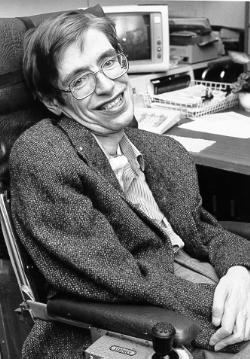
Stephen Hawking makes for an improbable celebrity. He hardly moves at all, and he tends not to make any noise. If you painted him silver, wheeled him to Covent Garden, and left an upturned hat in front of him, he would steal all the business from those people who pretend to be statues. Everybody associates Hawking with the machines that do the moving and talking for him. He controls the machines, but without them Hawking would be about as entertaining as a log of wood. In fact, without the machines Hawking would be significantly less entertaining than a log of wood, if you decided to stick the log on top of a splendid roaring fire. But that has not stopped Hawking from amassing an impressive list of film and television credits.
Why is Hawking a celebrity? His fame rests on two things. First, he wrote a very successful book designed to explain scientific ideas to a popular audience. Second, he has done some very smart maths about black holes. Nobody can dispute the number of books he has sold. But I can wonder if his cosmological maths is really any better than the cosmological maths being done by other brainy people. I do not not know about you, but my university maths education leaves me underpowered to form my own conclusions about Hawking’s abilities. I have to rely on the say-so of other bods as to whether he really is that clever. Take a look at this revelation that Hawking presented at a conference in 2004, and decide for yourself whether this makes Hawking smarter than the average cosmology professor…
The Euclidean path integral over all topologically trivial metrics can be done by time slicing and so is unitary when analytically continued to the Lorentzian. On the other hand, the path integral over all topologically non-trivial metrics is asymptotically independent of the initial state. Thus the total path integral is unitary and information is not lost in the formation and evaporation of black holes. The way the information gets out seems to be that a true event horizon never forms, just an apparent horizon.
I just about know enough maths to be familiar with the terminology in that statement, but I could not tell you what it means, whether it is true or not, or whether the conclusion could only be reached by a once-in-a-generation genius, or by any diligent Master’s student. I can, however, confidently state one thing about it. It has absolutely no practical use to anyone. Science or not, nobody is better off as a result of knowing this. To categorize it with trivia would be to do trivia a disservice. Knowing the answers to Trivial Pursuits questions like “which whale has a face like a dolphin?” (the beaked whale) and “which is the largest human artery? (aorta) might conceivably come in handy from time to time, and not just for the sake of winning Trivial Pursuits. But knowing that black holes do not form a true event horizon is of no use whatsoever (other than for the sake of winning Trivial Pursuits, if its makers ever include a relevant question).
Hawking has made many appearances as himself in shows that range from the most serious science fact to the very silliest science fiction. Despite that, as actors or narrators go, Hawking is not very good. The factors that make Hawking an ideal competitor at musical statues rather limits his abilities as a performer. This scene from Star Trek allowed Hawking to exhibit his full acting range.
Hawking has also done plenty of comedy over the years, and has even been prepared to do celebrity endorsements. Take a look at this advert.
Hawking the hawker – it is not a part he plays well. The mind boggles at the idea of Stephen Hawking zooming around in outer space in some futuristic spaceship, staring out of the window whilst flogging the centuries-old technology of spectacles. Perhaps Hawking also needs reminding that most of the galactic phenomena which are of interest to the mind also happen to be completely invisible to the eye. They were not kidding when they came up with the name black hole.
Apparently Richard Branson is determined to turn the Specsavers add into reality, by offering to launch Hawking into space. Obviously the deal is a perfect win-win for a celebrity scientist obsessed by space and a ceaseless salesman, who this time is trying to promote his fledgling space tourism business. It is currently unknown if smarty pants Hawking will point out the inconsistency between Branson’s plans to pack the super-rich into tiny tin cans sitting atop huge tanks of rocket fuel and some of his other headline-grabbing initiatives to protect the environment and conserve precious resources for future generations. Probably he will just take his seat on the spaceflight, stare out of the window, and keep schtum.
Hawking’s acting skills cannot win him new admirers. His maths equations are too complicated to understand and too irrelevant to our lives for anyone to care about them. That means Hawking’s major ongoing impact on society comes in the form of his musings on the nature of the universe. For this, he seems to be revered by many. My university education in mathematics may not have been enough to check his sums, but my university philosophy education is more than enough to tell me that when Hawking talks a lot of philosophical codswallop. Take a look at this clip, where he talks around a few ideas from various thinkers.
There are lots of shortcomings in Hawking’s worldview. One of those is that he assumes a positivist framework. Without getting into the detail, positivism ultimately seeks to base all knowledge on sensory experience. Yet Hawking, by virtue of the work he does, must rely on extreme extrapolations from the minute amounts of indirect evidence he has to work with. Theory gets built on theory, built on more theory, built on more theory… and only after a lot more theory do you finally arrive at something that you and I can see or hear. When Hawking talks about event horizons, it is not like he double-checked his results by jumping into a spaceship and going to look at a black hole up close. So what makes Hawking popular – giving answers to questions that have a deep emotional significance for many people – can only be justified on a very tenuous and contingent basis. If Branson ever tried to sign a contract with Hawking, with a view to placing commercial reliance upon Hawking’s theories, the caveats would stretch from this end of the universe to this end of the universe, having completed an orbit of the universe in the meantime.
Hawking also takes liberties with other thinkers, when trying to popularize his ideas and compress other ideas to fit his way of thinking. For example, in the above clip, what Hawking says about Immanuel Kant is wrong. I cannot go into the detail now (it would probably take a 10,000 word thesis to do the topic justice, and I doubt any of you would read to the end) but Kant’s understanding of time was far more subtle than the gross oversimplification presented by Hawking. Kant was a bone fide genius, who changed the intellectual universe in his lifetime and for centuries afterwards. Without Kant, the world would be a very different place. To give a couple of examples, both Marxism and German jurisprudence have an intellectual lineage which can be traced back to Kant. In contrast, it seems unlikely that Hawking’s research will have a lasting impact on the lives of many people. Contrary to what Hawking states, what Kant wrote about time was not just some superficial analysis based on then dominant and mistaken assumptions of physics, but a deep and sophisticated reflection on how we, as humans, comprehend the universe and hence are actively engaged in determining it. Kant’s ideas about time, like his ideas on many other topics, were fresh and revolutionary. In contrast, Hawking’s dismal dismissal of Kant is nothing less than a pop philosophy travesty. But then, you can hardly expect Hawking or anyone else to sum up some of the most intricate and imaginative reasoning of a genius in a couple of slides – just like two Powerpoint slides would not be enough to explain Hawking’s work on black holes.
Maybe Stephen Hawking is a brilliant mathematician, but not that smart or deep a thinker. That does not make him a bad person. Popularizing science is a very good thing for which he deserves a lot of credit. But some of Hawking’s output has turned the noblest of man’s intellectual adventures into lazy popcorn entertainment – to be digested passively without really encouraging thoughtful engagement with the ideas presented. It may leave the audience feeling inspired, but does not challenge them to think. And that should be a damning thing to say about a man of science.
The following clip gives us a lovely insight into Stephen Hawking, and some unexpected evidence about his nature. If comedian Jimmy Carr is telling the truth, it rather suggests Hawking is a very very nice man, but not very smart at all…
The fame of Stephen Hawking appears to be one of those self-perpetuating cycles of celebrity that emerge from time to time, like Jade Goody or Carol Vorderman. A door is opened to new opportunities, and each opportunity leads to another, like a chain reaction. Once the cycle is instigated, there is no proportionate connection between fame and merit. The most recognizable thing about Stephen Hawking is his voice, but it is not his voice at all. It defines Hawking in the imagination, and his pop culture appearances all draw heavily on the distinct tones of his voice simulator, which turns out to be NeoSpeech’s VoiceText product. Quite often we only hear Hawking, and do not see him. He may be narrating, or lending his voice to an animated caricature of himself. After all, unlike actors that run, Hawking is unlikely to do things that are visually stimulating. So when Hawking gets the credit for his voice, why is the credit not going to NeoSpeech instead? They are the ones who really made the sounds, and there will be many times where Hawking is just working from a script written by someone else. Think of the scenario: you give Hawking his lines, and get him to laboriously blink and blink again until he has programmed his machine to recite the words. I presume you record him from his home location, by setting up the microphone where he is, rather than flying him to some recording studio in Hollywood. But given the obsession with CGI simulation in so much modern entertainment, why take the trouble to be authentic and make Hawking do all that blinking and winking that he does to run his computer, when the makers of a show could just as well get their own version of the software and cut out the middle man. In fact, they could save themselves the trouble of paying Hawking too, though they would need to replicate Hawking’s customization of the speed and pitch of the voice.
If there was an innovation, and there was a way to give Hawking back his voice, and make him sound just like Anthony Hopkins or Richard Burton, would Hawking lose some of his fame? Perhaps. We live in a topsy-turvy world where people seek knowledge and inspiration from someone who does obscure mathematics about objects that are incomprehensibly far away. We live in a world constantly changing and expanding because of new ideas, from medical discoveries to computing breakthroughs, yet the poster boy of science is a man who draws the false conclusion that insight into the mathematics of cosmology is the same as insight into the world we experience. It befits Hawking that an enabling technology is both part of his fame, and a reminder that even science has limits.
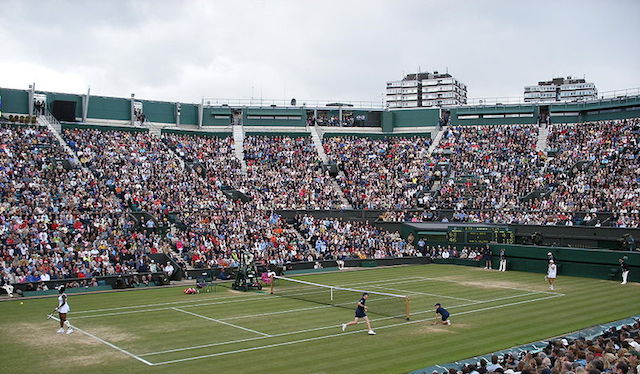
Wimbledon must rank as the most eccentric of sporting events. Strawberries and cream, Pimms and Lemonade, sporting outfits designed to look like evening wear, part-time champions, Henman Hill being rechristened Murray Mound, Cliff Richard, players moaning about appearing on court no.2, royals handing out prizes, guards of honour made up of ballboys and ballgirls, ten officials for a match made up of two players, the strange way of scoring and umpires talking of love and deuces. It is all a little odd. But the oddest thing is that anyone thinks it can serve as a rallying point in the fight for equality.
A couple of years back, there was a never-ending stream of stories about how unfair it was that Wimbledon gave bigger prizes to men than to women. Even Tony Blair jumped on to Wimbledon equal-pay bandwagon. That Blair had time to speak up for the rights of multimillionaires belies all the recent nonsense from his wife about how he was forced to backstab Brown and hold on to power in order to fight for the things he believed in. In the end, the row was about a difference of UK£30,000 in first prizes worth more than half-a-million pounds. UK£30,000 may be plenty of money to you and me, but I doubt I would lose sleep over it at the end of a day where I had already made twenty times that amount. In the end, The All-England club finally relented, and, as a consequence, the Williams’ sisters will now be slightly richer as a result. But nobody else is better off.
The thing with any business is that, in a free society, we generally seem to like the idea of a meritocracy. That means rewarding people for what they do. Wimbledon is a business, but it is not a meritocracy, at least not when it comes to equal pay for men and women. However much some people love the women’s game, it does not make as much money. Lots of people will argue that women train as hard as men. That may seem an odd argument as the Williams sisters are currently taking time off from their interior design consultancies and fashion houses in order to squeeze in a couple of weeks of bashing the full-time professionals. But how hard women train is irrelevant. Demand determines the price of entertainment, not the effort put in by the entertainers. If training determined how much sports people should make, Paula Radcliffe should earn more than Venus Williams, and Brian Jacks should be as rich as Bill Gates, instead of being someone you may vaguely remember doing lots of squat thrusts on Superstars. Another argument for so-called equal pay is that the women’s game is just as entertaining as the men’s. Well, beauty is in the eye of the beholder. I may think chess is more entertaining than tennis, but that would hardly justify taking the money spent on tickets at Wimbledon and giving it as prize money for a chess championship. By the same logic, if the men’s tournament earns more money than the women’s, because more people want to see it, then there is no good reason to take some of those earnings and use it to subsidize the women’s tournament. In the final reckoning, the women’s matches will be watched by fewer people on television, will provide entertainment of shorter total duration, and will generate lower revenues from corporate boxes. Yet the women get paid just as much as the men. Does that seem fair?
Part of the problem with this debate is the way it is framed. If you make an argument about men versus women, then naturally most decent people will say they should be treated equally and leave it at that. The problem is, what is equal treatment? In a normal workplace, women are largely expected to do the same things as men, work the same hours as men, and get measured on the same scale of performance as men. So if they get paid the same, that would seem to be equal. But if women worked shorter hours than men, or their performance was only judged relative to that of other women, and not to all their co-workers, equal payment is unfair. It would be just as unfair as paying a man the same wage as a woman but expecting him to work less.
One sport that has a different, but arguably very fair way of paying its protagonists is boxing. Boxing, unlike tennis, is a sport full of divisions to ensure fairness. Big guys beating up little guys would be boring, silly and dangerous by equal measures, so there are lots of weight divisions in boxing. But irrespective of the divisions, pay is determined by popularity. Popular boxers draw bigger crowds and more television viewers than less popular boxers, so they get more money. Winning is one way to be popular, but nobody tries to turn the equation on its head and argue that winning is the same as being popular. So why not do the same with tennis? Why not pay more to popular tennis players and less to the less popular tennis players? That would be fair – and would make no distinction based on gender. Part of the problem is that, during a tournament, there would be insufficient lead time to promote individual match-ups, thus making it hard to determine who was really drawing in the crowds. But with the rise of pay-television, maybe we will have the solution in a few years’ time. Because if people pay to watch individual matches, you will soon be able to tell who generates the money, and who does not. And you could also start to price the matches accordingly. People who like the idea of rewards based on merit may feel that such a system is inherently unfair, as it gives all the money based on popularity rather than skill and talent. But doing anything else is a form of market distortion – moving money from who generates it to somebody else who does not generate it. If women generate more money than men, they deserve more. As it happens, they generally do not generate as much money as men, which is why the arguments about equality between men and women in terms of prize money are misguided and miss the point. Affirmative action makes sense if a group is repressed and cannot get the same opportunities. Affirmative action for millionaire tennis players is just daft. Linking the money squabbles of spoilt tennis stars to the struggle to guarantee fair treatment for women in the wider work force is not just wrong-headed, it should be considered offensive.
Of course, the female players know perfectly well how money works in the real world. For the top players, prize money comprises only a small share of their incomes. The Williams’ sisters may talk big about fairness, but you will not hear them complaining how being American gives them access to more lucrative sponsorship and marketing deals than could be realized by players from poorer countries. By the same token, few women players seem to complain about the extraordinary amounts they are paid for wearing fashionable clothing, both on and off court. You can guarantee that many men, women and children spend long days in sweatshops, earning a pittance whilst serving the same business empires that ultimately will lavish riches on these tennis clothes-horses (or should that be clothes-whores?) Very occasionally you may find that a less pretty player will have a moan about how the Anna Kournikovas of the world are paid based on looks, not tennis talent. However, they do not moan for long, because everyone knows that, unlike complaining about prize money, there is no point arguing for equal treatment in the face of unequal beauty. Players get paid to sell, and that makes beauty a valuable asset. So the Williams sisters will also wear their off-the-shoulder outfits and grace the covers of magazines (take a look at Serena Williams’ official website) in order to make some easy money, without any sense of guilt. Whilst the outspoken sisters talk about being smarter, better, more balanced than every other tennis player on the circuit, and are very keen to insist on equal treatment whenever they feel disadvantaged, they say nothing about the real disparities in this world. They have no intention of hurting their wallets on a matter of principle. For all their talk, the sisters will not be giving lectures about how their glamourous photo-shoots have nothing to do with talent, help to push unrealistic expectations for average women, or how they promote a sexist ideal of feminine virtues. They have even more reason to stay mute when you remember this insidious form of sexism – that a woman’s value is determined by how attractive she looks – not only exploits women but is promulgated by women for the purpose of profiting from other women.
Equality makes for nice headlines, so long as you keep the arguments simple. Make the argument about men versus women, and the rabble-rousing is bound to be successful. But what about equal prize money for short people, or for older players? If Indians hardly ever win Wimbledon, should there be a separate competition for players from that sub-continent, with equal prize money, just to avoid any prejudice against them? How about a tournament just for people who were born into poor families and had to make more sacrifices in order to play tennis? And what about equal treatment for disabled players? Wimbledon also plays host to a small doubles contest for players in wheelchairs. By the logic of equality used to justify equal pay for women, there should be equal contests and equal pay for every category of player and contest. That would mean proper singles contests for wheelchair players, that those matches should get equal exposure, that they will be played on the same show courts, and that the winners should take an equally large prize. Of course, in the real world, fewer people would want to watch those matches, which is why they the wheelchair players do not get the same size of prize. If you imposed equality, by taking the current pot of prize money, and splitting it so the wheelchair players got an equal share, you would soon see how many top players really care about equality.
There is one very straightforward way to ensure absolute equality for all players, based purely on merit whilst eliminating any prejudices based on sex. That would be by removing any divisions within the sporting contest, and having everyone competing for the same prize. Men would play women on an equal basis, whether over five sets or three. We are nearly there already. Unlike boxing, with its many divisions, all that would be needed at Wimbledon would be for the unification of the men’s and women’s contests. That would be true equality of treatment, in every possible sense. Gender would be rendered irrelevant, and we could appreciate people purely based on how well they play, and not for their sex. Of course, women may find themselves losing to men more often than not. Not surprisingly, that is the kind of equality that the current crop of super-rich stars of the women’s game are happy to do without.
Actors can act lots of different things. They can act happy, sad, horny, drunk, even Irish. On queue, they will laugh, cry, dance, shout, smoke cigarettes (can they sue if they later get cancer?) and even take their clothes off (if you pay them enough). They pretend to play pianos by moving their hands up and down in time to the music. Actors can adopt limps, and stammers, and will even change their weight if the part demands it. They act at being great doctors and lovers and sharpshooters and even politicians (the last of which is essentially the same as acting). Many actors claim to do their own stunts. But no matter how talented an actor is, there is one commonplace activity that they often have to perform on screen that cannot be acted. They just have to do it as best as they can, the same way they always do it. And if they are no good at it, they cannot disguise the fact. In the heat of the action, many an actor needs to stop pulling faces and get on with some basic plot-driven footwork – by doing some old-fashioned running.
There must be many a thespian who, tired of taunts and jeers at their limp-wristed flouncing during Physical Education class, turned to the sanctuary of Drama for love and respect. Imagine their horror, as, years later, they land that big movie part, only to find it involves lots of running about. Instead of just humiliating themselves in front of their classmates, actors allow the whole world to see their awkward attempts at athleticism. With some artful use of editing and camera angles, even the flattest of foot might appear gazelle-like. But not all editing is artful enough. And in the competitive world of big screen acting, an actor that can really run is going to justify one or two extra exciting action shots – and maybe some more money in the process. So here, in no particular order, is my personal roll call of some of the great, the good, the mediocre and the downright ludicrous running performances of actors over the years.
Sylvester Stallone in Rocky: 8 out of 10. The big guy never had the right frame to be a good runner, but he still impresses because of how truly fit he was, with a decent sprint and those famous bounds up the steps in Philadelphia. This Italian Stallion can really gallop.
Harrison Ford in Star Wars: 8 out of 10. Ford shows himself a decent runner, despite adopting a silly head-down style which would only improve speed if you were running into a gale-force headwind. But as this video makes abundantly clear, anyone looks fast compared to a guy stuck in a stormtrooper outfit.
Dustin Hoffman in Marathon Man: 6 out of 10. Apocryphal stories abound over how Laurence Olivier would tell the method actor Hoffman to ditch his attempts at being authentic, and just to act instead. Hoffman may have worked hard on his running method, but the end product is as ragged as it is energetic. It is exhausting just watching Hoffman run ten yards, never mind a marathon.
Matthew Broderick in Wargames: 7 out of 10. A fine effort by Broderick, but we never see his full running potential. Had this early film about a computer nerd involved more running, Broderick may have saved many a code jockey from teasing about their lack of physical prowess. In the pivotal running scene, Broderick effortlessly keeps pace with his colleagues as they run before the nuclear bunker door snaps shut. Hmmm… possible nuclear war… big door to the shelter is closing… only seconds left… got to run for your life… Would you hold back and be polite, keeping company with the goofy-running girl and the old guy with the strange staccato stride pattern? Not me! They would be eating my dust!
Tom Cruise in… everything he has been in: 10 out of 10. Cruise control? Tom is supersonic. Cruise has done a lot of top (gun) running during his career, and he showed he still has the fastest pair of sneakers in the West of Hollywood with some excellent long sprinting shots in MI:3. Here is a montage that shows no matter what the film, Cruise is a proven running talent who has consistently delivered over the decades.
Michael York in Logan’s Run: 2 out of 10. In this 70’s science fiction classic, York plays Logan, a ‘sandman’ who chases ‘runners’. What a terrible piece of casting. I doubt York’s toes-pointed-outward style would enable him to catch a bus, even if it waited at the stop for him. Maybe he should shake the sand out of his shoes before he starts. If I was running after Jenny Agutter in her prime, I think I would move a darn sight faster.
John Cusack in Con Air: 1 out of 10. He is a talented actor, but Cusack runs like a total dork in this movie. If this is how fast Cusack moves in a life-or-death situation, I would hate to be stuck behind him in the queue at the Post Office.
Simon Pegg in Run Fatboy Run: 4 out of 10. It may be a comedy, but I doubt Pegg had to make an effort to look funny whilst running. As far as this movie was concerned, it is just a shame there were not more laughs in the script.
Robert Patrick in Terminator 2: 7 out of 10. Patrick has an upright running style, but it works well for the part and made for a memorably disconcerting image of a determined robot assassin from the future. If this guy was running in my direction, I would not be waiting to find out what he wants…
Orson Welles in The Third Man: 3 out of 10. Even before Orson got fat, he was obviously no speedster. This is one of the all-time great movies and the chase scene through Vienna’s sewers is a classic, but artful editing cannot hide just how slow Orson was. Running across rubble, over cobbles and through water is far from ideal, but all those quick edits are designed to mask how slow Welles is. As Welles points out in the film, it took 500 years for the Swiss to invent the cuckoo clock. Given that he is being chased by the police, Orson’s character must have been wishing they had spent that time devising faster running shoes…
Leslie Neilsen in And Millions Die!: 8 out of 10. A truly awful TV movie, I recommend you watch it if you ever get the chance. Sadly, I have no video to show here. Imagine Leslie Neilsen when he was still playing straight roles in B-movies, before he made Police Squad. Then imagine a 20-minute chase scene, all on foot, through the streets, the slums and even over the junks of Hong Kong. It has to be seen to be believed. Includes such classic ‘Wacky Races’ clichés as stopping to knock over obstacles in the way of the people chasing you, and, when it looks like you finally give them the slip, leaping out from your hiding place and whacking them over the head before doing yet more running and chasing. A great example of unintentional so-bad-it-is-good, and arguably a template for Neilsen’s later spoof-oriented career. But to be fair to Neilsen, he did a lot of running, and all of it was fast and convincing. In fact, it was the only believable thing in the film.
Kirsten Dunst in Wimbledon: 0 out of 10. Whatever Dunst’s talents, running is not one of them. Instead of running, she does that bouncy up-and-down thing that may look cute but basically gets you no further then jogging on the spot. Dunst’s character is supposed to be a top tennis player – it is no wonder you hardly see any scenes of her playing tennis and in the few there are the ball is hit straight to her. Pity her co-star Paul Bettany, who was very convincing in his extended tennis scenes, and looks like he might have a decent top speed with those long legs of his, but who clearly had to hold back when running with Dunst.
Sigourney Weaver in the Alien films: 5 out of 10. Weaver by name, weaver by nature, as Sigourney runs up and down the twisty turny corridors you always find in deep outer space (it is called ‘space’ – so why is everything so narrow?). She kicks alien butt and handles both action and acting with equal ease. But if you watch closely, Weaver has an awkward elbows-out running style. My guess is she would be banging them each time she turned a corner…
Lee Majors in The Six Million Dollar Man: 3 out of 10. Majors is a beefy guy and hence not an elegant runner, and does not adequately compensate through a Stallone-like commitment to physical fitness. Speed up the film, slow down the film, but you cannot hide the fact that the only thing less convincing than Major’s wobbly running is his acting. Remember this was the man who tried to keep Farrah Fawcett at home to do his cooking… no wonder this leaden-footed and leaden-acting star ended up losing the girl and playing The Fall Guy. Fact followed fiction when several years ago, the bionic man had his knee replaced in real life.
Michelle Ryan in The Bionic Woman: 7 out of 10. As a tall woman, ex-Eastender Ryan looks slow off the mark, but when she gets going, she can really shift. In this reprisal of the 70’s show, she puts the star of the original series, Lindsay Wagner, to shame. Three cheers for an unexpected British acting and running success…
Keanu Reeves in… everything he has been in: 5 out of 10. Reeves looks like he should be a jock, and he has done plenty of running in plenty of action movies. But has there ever been anyone who runs so much with his shoulders? And his arms flail all over the place. If you see him running through a crowd, give him a wide berth, as he needs it. Take a look at what I mean with this montage:
Tom Hanks in Forrest Gump: 6 out of 10. Upright, and using a high action for both hands and knees, this style looks slow and tiring. But in a movie about a man who spends most of his life running, Hanks wins us over with persistence and stamina – much like his character.
Honourable mentions:
Hugh Grant running for Wedding #1 in Four Weddings and a Funeral. The hair is floppy but the gait is straight.
Christian Bale zipping up steps and racing down corridors like a bat out of hell in Equilibrium. Bale is my tip to take over Cruise’s crown as running action hero heartthrob.
Will Smith did some lanky but highly impressive alien chasing during the opening scenes of Men In Black.
Daniel Craig deserves a mention for his running in Casino Royale. Bulky Craig does not look fast, but his running is direct and purposeful – and hence it is totally believable when he runs through a plasterboard wall.
Harrison Ford (again) for several decades of running from boulders and natives as Indiana Jones. The last Indie flick may have been dire, but Ford is still fleet of foot in his mid-60’s.
I could go on. Like actors in action movies, this topic will run and run, with more outings as new actors show their strides on screen. It would also be great to hear your reviews of how actors move in motion pictures. When it comes to measuring the quality of acting legwork, there is only one rule. To paraphrase Yoda: run or run not, there is no act.
This post is about Shami Chakrabarti. If you are interested in current affairs, and live in the UK, and are not just pretending to be interested in current affairs to impress people at parties, and have not been in a coma for the last few years, and know what the words current affairs mean (hint: it has nothing to do with who got evicted from Big Brother) then you know who Shami Chakrabarti is already. For everybody else, you only need to know two things. First, she is the head of a British pressure group, called Liberty, that, according to its constitution,
shall advance measures and take such steps as it shall deem necessary for the defence and extension of civil liberties and human rights in the United Kingdom and the rights and freedoms recognised by international law.
Second, you do not want to know any more. So stop reading immediately!
Okay, so you either already knew who Shami Chakrabarti was, or could not stop yourself from reading on anyhow. Well, if you are going to read on, let me make one thing clear right now. I am not going to personally attack Shami Chakrabarti as a way of attacking her stance on defending habeas corpus, opposing extraordinary rendition, fighting against ID cards or any of that. I agree with her point of view on all of that. I really like civil liberties. They allow me to say what I think and do what I like (up to a point). So, just to repeat, I am not going to personally attack Shami Chakrabarti because I disagree the points of view she regularly expresses. No, I am going to personally attack Shami Chakrabarti because she really gets on my nerves. She annoys me. I want less Shami on the telly, less Chakrabarti on the radio, and fewer stories about her home and children in the press. I want to be liberated from the oppressively omnipresent Shami Chakrabarti.
How unfair of me, especially as I am now allowing Shami Chakrabarti to invade my own tiny plot of the blogosphere. Perhaps I am being unfair. I have never met Shami Chakrabarti in person, so maybe she is a lovely human being. Maybe one day I will meet her and be won over by her charm. If that day comes, I will probably regret what I am about to write. But feeling your life is overrun by people you have never met, and never chosen to have enter your life, is rather the problem with our modern cult of celebrity. Nothing has any substance greater than personality. For some reason, talk about our freedoms, liberties, and rights has escaped the common man, who did so much to establish them. It now belongs to the specialists, with Shami Chakrabarti serving as media personality specialist #1. To soften the blow, and popularize the idea of liberty amongst the dullards, we also get to hear about how Shami plays with her kid and what she thinks about some book. She is there to defend us, in a language we can understand, and whether we like it or not. She is there to protect us, because we are dolts who cannot protect our freedoms without her inspiring leadership. She is the face of freedom. Heaven forbid we ever live in a world without Shami Chakrabarti. This was how she put it when she was appointed a Commander of the British Empire:
I hope it will send a timely signal that democratic dissent is not disloyalty, it is a positive civic duty.
There you have it. Democratic dissent = what Shami Chakrabarti does. Forgive me for thinking democracy should have something to do with the people and not an elite that speak on behalf of themselves and their supporters, however noble their cause may be.
Cult of personality. That is why I dislike Shami Chakrabarti. She sits on panels for book awards. She has just been appointed chancellor of a university. She attempts to joke around on Have I Got News For You. She gives poor answers to questions about taxation when she is on Question Time. She is everywhere, and always with the same flimsy justification – that she defends our rights. From what exactly? From the British lawmakers that were elected by… the British people. I have literally no idea how she does it. It seems to involve her not being very witty on comedy shows, not being very incisive on panel shows and during interviews, and having her photo taken an awful lot whilst wearing too much eye make-up. Other than that, I have no idea what she does. Maybe it will influence us to vote better at the next general election… if only we thought voting would make a difference and if only we were less preoccupied with petrol prices going up and house prices going down. Somehow the rationale must be that we need Shami Chakrabarti to personify the issues we otherwise would not care about or try to understand. Just check out her flippant and unfunny answer to a perfectly reasonable question asked by a reader of The Independent:
Paddy Fletcher, Vauxhall: Do you ever worry that you’ve become overexposed?
Shami Chakrabarti: Whoops. Many thanks. Zips can be so unreliable.
The problem with the cult of personality is that it has nothing to do with democracy. The good thing about democracy is that we can chuck out rubbish rulers. We may well replace them with even more rubbish rulers, but we can chuck them out too. But nobody can chuck out Shami Chakrabarti. She exists in the gulf between nobodies like you and me (the people) and the lawmakers we vote for (who are hence accountable to voters and can be chucked out). Her vote counts no more than yours or mine. She is not in any kind of office. Yet somehow, by some mysterious process, she is supposedly important, at least to journalists desperate for someone to fill all those precious column inches, television pixels, and radio frequencies.
Once upon a time, Harriet Harman and Patricia Hewitt were important in the same way Shami Chakrabarti now is. Harman and Hewitt were also the kind of people who defended our liberties, working for the National Council of Civil Liberties (NCCL). H&H were crusading in the NCCL long before Shami Chakrabarti became a lawyer (apparently we had some liberties back then) and before the NCCL decided to rebrand itself with the media-friendly moniker of Liberty. So, in short, H&H used to do the same kind of thing as Shami Chakrabarti does now. Since then, Hewitt and Harman started entering and winning elections. H&H ended up being the kind of people who get into power and use it to introduce ID cards and threaten habeas corpus. Hewitt has returned to the back benches, and become a little more outspoken on our liberties as a result, but Harman is still right there at the middle, serving as Lord Privy Seal, Leader of the House of Commons, Minister for Women and Equality, Deputy Leader of the Labour Party and Party Chair. So you could say she is right in the middle of the current government. The current government that Shami Chakrabarti is endlessly campaiging against. Ironic, huh? Not really. We should not be surprised that self-important people use single-issue groups like Liberty as vehicles to promote themselves. By doing so, they get more power, and become more pragmatic (by which I mean they are compromise on some things to get their way on other things) and end up being exactly the kind of people they were supposed to be vehemently opposed to. And even then they refuse to see the truth of it. Power corrupts. Even the meagre, listless prominence that comes with fronting a pressure group can offer a taste of power that would seduce the weak amongst us. Now, of course, I may be horribly unfair to Shami Chakrabarti, but if the previous representatives of her pressure group are anything to go by, there is good reason to be sceptical about whether Chakrabarti really is motivated by a deep-seated concern for our liberties and not by the wonderful opportunity to put herself in the spotlight. Looking at Liberty’s website, you get the impression that a Stalinist airbrush has already been applied to eliminate the inconvenient truths about its recent history. You can find no trace of the close personal connections between the pressure group and the government which it is so critical of.
Now, irritating though I find Shami Chakrabarti, my being irritated is not enough reason to blog about her. If I blogged about everybody who irritated me, my hands would be crippled from RSI. However, like Chakrabarti, I feel recent events compel me to take a stand. Despite her appearances on comedy shows, it seems Chakrabarti has a poorer sense of humour than an Abu Ghraib prison guard. She combines this with a skin so thin that, in comparison, an extra sensitive condom would feel like a coconut husk. And/or (take your pick) she is even more desperate for public attention than… I thought she was already. Which is a lot. Bystanders are at risk of being caught in the political cross-fire between the Labour government and David Davies, former front-bencher for the Tories, as Davies tries to generate publicity through fighting a by-election. In an interview with the Blairite Progress Magazine, a journal primarily written by Labour party members for other Labour party members, Andy Burnham, Labour cabinet member, said the following:
To people who get seduced by Tory talk of how liberal they are, I find something very curious in the man who was, and still is I believe, an exponent of capital punishment having late-night, hand-wringing, heart-melting phone calls with Shami Chakrabarti
And that was it – the only mention of Shami Chakrabarti in an article that hardly anyone would ever have read. If it was meant as an insult, it is a pretty tame one. It is also hard to work out whether the insult is intended more for Davies or Chakrabarti, though I assume it is aimed at Davies, as Chakrabarti has not stated an ambition for high office (yet). Heart-melting is a pretty strange choice of words, but this is hardly the most vicious verbal assault one could imagine. I have no affection for the talentless New Labour drone Burnham, but the way I read this, he was trying to conjure up the idea that Chakrabarti and Davies make strange bedfellows, without meaning to imply they are literal bedfellows. The language is crass and ham-fisted. If he had just said they were strange bedfellows he would have achieved the same allusion without anyone questioning the metaphorical nature of what was said. Given this is the knock-about world of politics, you might expect Davies would be the one who might react to slap down Burnham. Yet Chakrabarti was the one who flew into rage, and penned this missive:
Rt Hon Andy Burnham MP
Secretary of State for Culture, Media and Sport
Department for Culture Media & Sport
2-4 Cockspur Street
London
SW1Y 5DH
19th June 2008
Secretary of State
I am writing in relation to your recent article in the ironically titled “Progress” magazine. In that article you set out to smear my dealings with the former Shadow Home Secretary. I must say that I find this behaviour curious, coming as it does from a Cabinet Minister; let alone someone with a partner and family of his own.
By your comments you debase not only a great office of State but the vital debate about fundamental rights and freedoms in this country. Indeed you seem reluctant to engage in that debate except in this tawdry fashion.
I look forward to your written apology as I’m sure does Mrs Davis. If on the other hand you choose to continue down the path of innuendo and attempted character assassination, you will find that the privileged legal protection of the parliament chamber does not extend to slurs made in the wider public domain. The fruits of any legal action will of course go to Liberty (the National Council for Civil Liberties).
Sincerely,
Shami Chakrabarti
Director
Liberty
21 Tabard Street
London SE1 4LA
cc:
The Prime Minister
The Attorney General
[Before I pull the letter apart, an interesting sidenote for all those people who still refuse to believe that cynical political careerists use nice middle-class pressure groups as CV-building exercises: The Chair of Progress is Stephen Twigg, the man who slayed Michael Portillo in 1997, and who suffered his own surprise election defeat in 2005 due to the backlash over Iraq. Before he entered Parliament, Twigg was employed as a lobbyist for another human rights organization – Amnesty International.]
Hmmm. Where to begin with analyzing Chakrabarti’s letter? Well, for a start, it is poorly written. I know my writing here is hardly perfect, but this is a blog, and I hope you never catch me making a mistake about where to use a semicolon; let alone using a contraction that treats the written word like it’s spoken. Next, to accuse Burnham of a smear is an exaggeration. Calling John Prescott a fat stupid Northerner with two Jags is a smear, but that never stopped anyone. Then we get the strange idea that this kind of behaviour might be considered curious. Who still thinks that a personal attack by one politician on another politician, especially one using humour, sarcasm or innuendo, might be curious? I mean, what did Shami Chakrabarti think was happening when she appeared on Have I Got News For You? The perceived wrong – that Burnham might be hinting there really is a romantic connection between Davies and Chakrabarti – is simultaneously so oblique and absurd that to read the comment that way borders on paranoia. Nobody would have noticed if she had not drawn attention to it. Perhaps Chakrabarti really should steer clear of real politics in her later life. Imagine how she would react if she faced some real mudslinging! If you think about the nonsense that early pioneers like Barbara Castle or Margaret Thatcher probably had to put up with in order to reach high office, this trifling slight would barely register. Or perhaps Chakrabarti is the perfect modern politician, able to turn any piffle into positive publicity.
In the second paragraph we find out Burnham has debased a great office of State. Come again? He is Secretary of State for Culture, Media and Sport. Since when was that a great office of State? Then we get a bit of not-too-subtle innuendo from Chakrabarti herself, implying that Burnham is afraid of debate. She might as well have written that Burnham is a great big scaredy cat with a yellow streak down his back… and started making buk-buk noises and flapping her arms like chicken wings. Is she talking about the same Andy Burnham that appeared alongside her on Question Time on February 7? How much debating does the poor man need to do with Chakrabarti? It must be hard to compete with Chakrabarti, who is employed to debate full-time, and hence is spared the responsibility to do anything else in life. In the end, the Secretary of State for Culture, Media and Sport does not need to debate human rights with some self-appointed champion. We have a Parliament to sort that out. It is imperfect, but nobody said otherwise.
Final paragraph: apologize… or else! Perhaps Burnham hit a raw nerve, because Chakrabarti writes like a jilted lover. And then comes the big threat if Burnham continues “down the path” (he never reached the front door, never mind the garden gate.) Chakrabarti will use the law to… shut him up. So what should I be more angry/bemused about? Is it:
This is not so much making a mountain out of a molehill, but rather making Everest out of an atom;
The likeliest reason for all this hyperbolic posturing seems to be to create yet more press coverage for Chakrabarti – this story has been repeated everywhere from the Daily Mail to the BBC – and not to promote any meaningful debate about our liberties or anything else; or
The flippant attitude it shows towards our freedom of speech?
I think I am going to settle on that last answer.
Note that Chakrabarti has not sued yet. She has threatened to sue, if Burnham continues to do what he has done so far. So far he has spouted 45 words that might be construed as a mild rebuke of Chakrabarti. If he even dares to write a nasty postcard about her, his allowance will be all used up and Chakrabarti will be compelled to unleash the dogs of law. Threats serve only one purpose in life. They serve to intimidate. Intimidation is not the natural tool of the libertarian. This episode shows an unpleasant flexibility and asymmetry in Chakrabarti’s attitude to our fundamental liberties. She will happily discourage people from speaking freely by using the threat of legal punishment, if they dare to copy her tactics of personalizing an abstract argument. Meanwhile, Chakrabarti revels in the freedom to criticize and chide from her unelected platform through one media outlet after another. And remember, it is not just the government she is qualified to criticize. Chakrabarti is equally quick to find fault with the writings of J.K. Rowling or the commonsense suggestions of “well-meaning liberals”. Here is a quick mental note for any would-be Salman Rushdies and Danish cartoonists out there – better not turn to Chakrabarti for help in a fight about your right for free expression. Chakrabarti obviously does not subscribe to the libertarian principles of Voltaire:
The problem with the Director of Liberty is that she has lost her sense of perspective. She fails to properly distinguish the difference between principles and personalities, which is understandable, as she is a product of the syndrome that blurs the two. Chakrabarti may espouse freedom, but she does not embody it. Public criticism of Chakrabarti is not an attack on our liberty, it is the enjoyment of our liberty. In a democracy, people in the public eye must be subject to criticism. There is a happy union between criticism and comedy, which has a rich history within Britain. Chakrabarti is in many ways the ideal spokesperson for our era. In a world obsessed with delivering equality through quotas, a young, female poster child of Asian parentage must be an ideal complement to all those horrid old white men. Never mind that she is a lawyer nevertheless, and still part of an elite and privileged class in our society. And never mind that J.S. Mill was no less right because he was a white man who wrote On Liberty when he was in his 50’s. But if Chakrabarti turns into a po-faced and litigious harridan every time somebody rebukes her, we are better off without such an advocate of our liberties. Let us have a quick look again at the constitution of Liberty, the pressure group that Chakrabarti represents and is the source of her fame:
2.1 …In particular Liberty shall strive to ensure and safeguard the right to…
(f) freedom of thought, conscience and belief;
(g) freedom of speech and publication…
So that would include the freedom to think that Shami Chakrabarti may be behaving in a contradictory or confused manner, and to say so out aloud. But then I am not a lawyer or CBE like Shami Chakrabarti, and hence lack the brilliant legal mind which would doubtless explain why she is not really vain and selfish, but only seems to be. I only have the naïve instincts for liberty shared by democratic masses, which doubtless explains why Chakrabarti must work so tirelessly – interview after interview, panel show after panel show – to protect us from ourselves.
Humour is a necessary and vital weapon in democratic society. It punctures the egos of the pompous and cuts down the would-be leaders that seek to rise too high above the rest of us. It is essential to the execution of the British sense of fair play. They say the pen is mightier than the sword. If that is so, then the pen used in humour is a rapier, that dazzles as it slices through opponents with finesse and ease. We must use humour to remorselessly prick at anyone who, like Chakrabarti, would don a lawyerly suit of armour to evade the barbs of democratic wit and ridicule. We must use sarcasm and satire to expose the faults of anyone and everyone in public life. Comedy, even the clowning of Andy Burnham, is an essential tool for bringing the would-be elite back down to the level of the common man. We must all learn to tolerate jokes and japes without regular recourse to legal threats. In that spirit, I present my own modest contribution to the British legacy for lampooning our would-be betters, a variation on this traditional theme…
Oh dear, what can the matter be,
Dear Sha-mi Chak-ra-ba-r-ti?
You’re too used to the flattery
Don’t go into such a sulk.
They promised to let you on Have I Got News For You?
Interviews on Today; slots on Question Time too,
But no-one said that they’d ever poke fun at you,
Better learn to take a joke.
[repeat until liberties and spirits are restored…]
I was at the Reading Festival (a music festival in Reading, Berkshire, England – not a festival about reading books) a few years ago, and, like you do, I struck up a conversation with a complete stranger. Conversations in such circumstances usually relate to musical tastes, and my interlocutor announced:
“I can’t stand emo”
I replied by paraphrasing something Guy Picciotto once said (do not worry if you have no idea who he is, you will soon enough). What Guy Picciotto actually said was:
“I’ve never recognized ‘emo’ as a genre of music. I always thought it was the most retarded term ever. I know there is this generic commonplace that every band that gets labeled with that term hates it. They feel scandalized by it. But honestly, I just thought that all the bands I played in were punk rock bands. The reason I think it’s so stupid is that – what, like the Bad Brains weren’t emotional? What – they were robots or something? It just doesn’t make any sense to me.”
The conversation meandered on for a bit longer and then we both stopped and started listening to whatever band was playing on the main stage at that time. I am pretty sure they were not an emo band… if there is such a thing. And then, my friend Christian, who had been stood beside me and listening to this whole conversation with this stranger, asked me
“what’s emo?”
which made me feel moderately cool and with it. Knowing about emo somehow validated that I was still in touch with the kids, which is rather satisfying when you are a 30-something that is well on the way to being a 40-something. So I explained to Christian what emo is, or is not, depending on whether you believe it exists in the first place. The explanation went something like the following….
There was a band called Hüsker Dü that formed in 1979. Although they were never very successful, they were ahead of their time. They did something new and unique but which started a trend that has influenced a lot of other bands since. In the beginning they were a typical hardcore punk band, but after a while they learned how to play melodies too. They did both AT THE SAME TIME. The Hüsker Dü equation is hence: hardcore punk + melody = three-minute injections of melodic energy. Here is an example:
About the time that Hüsker Dü split up, the Washington D.C. hardcore scene was blossoming. In 1987, a new band, Fugazi came together. It was made up of members of earlier bands that had been important in that scene. They wanted to deviate from the standard hardcore formula, and introduce ideas and sounds drawn from other genres like funk, raggae and even hip-hop. Here is a live version of one their earliest and best known songs:
Neither Hüsker Dü nor Fugazi were emo, or “emotive hardcore” to give emo its full title. At least, there were not emo at the time, because nobody was emo at that time. In fact, it is debatable if emo really is a musical genre even now, because the bands have so little in common musically. However, language is determined by what people actually say, and these days some people certainly talk like there is a musical genre called emo. If you think like Guy Picciotto, of Fugazi, then there is no such thing as emo, because the term makes no sense. On the other hand, lots of people think Hüsker Dü and Fugazi, amongst others, established the basis for emo music. Of course, they were not trying to create the mould for a new genre of music, they were trying to break – or at least bend – the mould of an existing genre. Emo is what you get when you start out with hardcore punk, then learn to play a bit of melody, then experiment and combine it with some other musical influences, then slow it down a bit because you are getting old, then retire, then some kids listen to your old records and start copying them. That is emo. Emo is teenage punk anger and vitality morphed by broadening tastes and old age then morphed again when rediscovered by a new era of angsty teenagers. Which is why people brand Guy Piccotto’s old band, Fugazi, as emo, whether he likes it not (for proof, browse through the comments on this site.)
So emo had a bad start in life. Emo is unloved by its musical parentage, who refuse to understand it or condone it. But being willful youngsters, emo fans persist in their love of the music anyhow. As befits their mixed up parentage, emos wear lots of black, but they end up looking more like goths than punks. If you wanted a perfect stereotype for the modern, sensitive, thoughtful teenager that is the antithesis of the chav and desires music suitable for both listening to in darkened bedrooms and for jumping around to in the open air, you would probably settle on the emo. Despite being disowned by their musical forebears, the emos persist in their devotions regardless. But now a worse fate has befallen them. Sensitive thoughtful young people who want to listen to different music, to dress differently and to be different run the risk of attracting unwanted attention. They make an appealing target for bullies. And now the emos have been targeted by perhaps the biggest bully of all: the 15th most popular newspaper in the world, and the self-appointed mouthpiece of the British middle classes, the Daily Mail.
If you had never heard of Hüsker Dü or Fugazi or Guy Picciotto or any of that, I can assure you that nobody writing for the Daily Mail has heard of them either. In fact, they know rather less about emo than my friend Christian now does. Or perhaps they know a lot more. A LOT more. Because, it seems, the explanation I gave Christian may have been totally wrong. I, like the stranger I was talking to at Reading Festival, naïvely thought emo had something to do with music. How wrong we were. Thankfully, we have the well-informed research performed by the journalists at the Daily Mail to clear up our ignorance. It turns out, according to the Daily Mail, that emo is in fact a ritual death cult.
Perhaps I should do a little research about emo through the internet. You know, the kind of research even the laziest and stupidest journalist might want to consider doing. Here is a summary of the results I obtained when trying to find an answer to the rather silly question as to what emo is…
There you have it. A true case of pioneering, trail-blazing investigative journalism. Everybody interested in emo thinks it is a kind of music, or a sort of music, or not really a sort of music but something to do with music. In contrast, the Daily Mail’s research has shown emo to be a death cult. Let us have a closer look at the foundations of the Daily Mail’s death cult claims, to see how solid they are. Back in 2006, the Daily Mail was warning middle class parents (presumably their middle class kids have moved on to read better quality newspapers and so cannot be influenced by the Daily Mail) about the cult of emo. In a depressingly random article, which cited Byron, Lily Allen and everything in between, we found out that bad taste references to death in the fringes of music, art and cartoons (cartoons??) provided enough justification for the author to worry about the irresponsible way that music and fashion ‘cultures’ (suitably vague to ensure the Daily Mail could not be sued by anyone in particular) were encouraging a cult of suicide. You can read it here. What a lot of obnoxious rot. No actual evidence was cited to justify the preposterous claim that emo was a death cult, but it seems guilt by association was enough for this lazy journalist. What exactly do we learn from this masterpiece of insight?
Byron had gothic tastes.
An unnamed governor of an unnamed school said self-harm is as serious a problem as binge drinking.
Apparently emos share tips on self-harm via the internet [but we are not told where on the internet, presumably out of a self-righteous desire not to encourage that kind of thing].
Nigella Lawson is alluring and has a touch of goth about her.
Horror films are now more popular than romances amongst young women.
Emo is a death cult.
Hmmm. Forgive me if I fail to see the logical sequitur in the argument. Perhaps it has something to do with Byron dying from a bad cold or this journalist living next door to a school governor. Strangely, the journalist lists every possible source to justify the concern that a death cult is on the rise, but can find only one cause – emo music. For some inexplicable reason, the poetry of Byron, the content of horror films and the recipes of Nigella Lawson are not held accountable for the actions of today’s black-wearing youth, but emo music is.
On the same basis, I too have done some research, and found out some shocking facts about a music and fashion culture popular not just with today’s youth, but with people of all ages and walks of life. It transpires that there is this music called rock and roll (sometimes abbreviated to rock ‘n’ roll) which is responsible for all of the following:
Obesity. A guy called Elvis Presley reportedly ate too many hamburgers.
Drugs. Keith Moon of the The Who and Brian Jones of The Rolling Stones both lost their lives because of their rock ‘n’ roll lifestyle.
Paedophilia. Someone called Jerry Lee Lewis married his 13-year old cousin. That story is tame compared to what Gary Glitter did.
Plane Crashes. Victims include Buddy Holly, Ritchie Valens, The Big Bopper, and several members of Lynyrd Skynyrd.
AIDS. However, some argue that Freddie Mercury died because of a crazy little thing called love.
Death Cults. Bradford band The Cult have previously been responsible for the Southern Death Cult and then Death Cult. Clearly these are more than just silly and pompous names. Although nobody has been known to have committed suicide as a result of their music, severe irritation can be caused to any unwilling listeners.
The Daily Mail’s claim in 2006 that emo musical acts had encouraged fans to commit suicide was based on the flimsiest of associations. Encouraging your fans to die is hardly a good way to secure long-term popularity, and it is not as if the Daily Mail was able to pinpoint anyone specifically. However, the Daily Mail’s dreams of forging a link between a minor musical fashion and teenage suicide were to be realized two years later. In 2008, a depressed 13 year old from Kent called Hannah Bond killed herself. How did the Daily Mail respond? In a calm and balanced way, pointing out that of the lamentable teenage suicides that had taken place, this was the first one they could link to emo music? No. Instead, their headline read: “Why no child is safe from the sinister cult of emo”. You would think a single death hardly justifies the conclusion that there is a dangerous trend – one which no child is apparently safe from. Other teenagers will sadly have taken their lives since the Daily Mail started its witless campaign; presumably none fit the skewed viewpoint espoused by the Daily Mail. The Daily Mail, undaunted by the absence of facts, resorted to lies, damned lies and statistics. Its article stated the following:
“New figures show that the number of children admitted to hospital due to injuries inflicted on themselves has risen by a third in five years.
In 2002/03 there were 11,891 such admissions; in 2006/07 this had risen to 15,955.
In both periods, there were more than three times as many admissions of girls as of boys.
Crucially, those who self-harm are more likely to go on to attempt suicide. While there is a multitude of reasons for this epidemic (exam-related stress and bullying to name but two), it is hardly surprising that the emergence of a sub-culture that appears to glamorise self-harm and even suicide is being regarded with alarm.”
Did you notice the ham-fisted logical plunge into the abyss? The Daily Mail threw some meaningless stats in the reader’s face, admitted there a multitude of reasons for the epidemic of suicides, then slipped in an irrelevant non-fact: that alarm has been caused (by journalists) seeking to make a tenuous link between fashion trends in youths and suicide. In other words, the only substantiation for this link is the suicide of a single unfortunate young girl. Any reader might have the impression that “because those who self-harm are more likely to go on to attempt suicide” that there are rising numbers of suicides in the UK, and that girls are particularly vulnerable. However, the official statistics tell us the opposite story. Suicide rates in the UK are falling according to national statistics. Looking at the detailed numbers on UK suicides shows that, for more than a decade, and across all age groups, males are three times more likely to commit suicide than females. The official data on suicides, rather than showing a link between the musical tastes of teenage girls and suicide, shows the people most likely to commit suicide are least likely to correspond to the description of 13 year old Hannah Bond. It rather tells us we should consider poor Hannah a one-off, or that we should look for the explanations for her suicide elsewhere.
The reason to be so dismissive of the Daily Mail is that, if they wanted, they could have trawled through emo lyrics to find examples of the glamorization of self-harm and suicide. But they do not. Is this out of a heart-felt concern not to further draw attention to them? I doubt it. More likely, the Daily Mail looked hard, but could not find a single example to back their claims. No serious examination of the content of emo music justifies such an outrageous slur. The Daily Mail had to shamelessly focus on the title of an album by one of the best-known emo bands, My Chemical Romance. That album is The Black Parade. It is a concept album, and it tells the story of a life, from beginning to end. The black parade is a metaphor for the end of life. Does that mean it glamorizes death? Hardly. Take a look at some of the lyrics from one song on the album, called Welcome To The Black Parade:
We’ll carry on
We’ll carry on
And though you’re dead and gone believe me
Your memory will carry on
We’ll carry on
And though you’re broken and defeated
Your weary widow marches on
Do or die, you’ll never make me
Because the world will never take my heart
Go and try, you’ll never break me
We want it all, we wanna play this part (We’ll carry on)
Sounds like pretty life-affirming stuff to me – carrying on and not being defeated in the face of death. I would love to see a lazy Daily Mail journalist try to twist the interpretation of those lines into a message encouraging suicide. Suicide is about giving up, not carrying on. Now if you want a song about giving up, you should try this one:
So you think you can stone me and spit in my eye-
So you think you can love me and leave me to die-
Oh baby- cant do this to me baby-
Just gotta get out- just gotta get right outta here-
Nothing really matters,
Anyone can see,
Nothing really matters-, nothing really matters to me,
Any way the wind blows….
Those of course are lines from Queen’s Bohemian Rhapsody. Did that song start a death cult too? Or how about There Is A Light by The Smiths:
And if a double-decker bus
Crashes into us
To die by your side
Is such a heavenly way to die
And if a ten-ton truck
Kills the both of us
To die by your side
Well, the pleasure – the privilege is mine
Did teenage road deaths go up as a result?
Fortunately, the educated middle-class kids showed the Daily Mail that they too intend to carry on, in the best way imaginable for educated middle-class kids… by holding a march and demo outside of the Daily Mail offices. Of course, it was all orchestrated by My Chemical Romance as a neat bit of publicity for them. But then, if I were in My Chemical Romance, and the Daily Mail was having a go at me, I too would make sure I made the most of the opportunity to build my fan base by fighting back against one of the most reviled institutions in Britain. I half hope that the Daily Mail will attack this blog, just for the inevitably tide of sympathy that would flow my way afterwards. Of course, it must have been very annoying for the Daily Mail to have its silly stories about suicide-obsessed youth unwilling to leave their bedrooms undermined by gangs of black-clad teenagers gleefully singing protest songs in the bright light of day whilst sat outside their offices. There is even talk of releasing a documentary about the demo. As might be expected, some internet pranksters gave a clue as to where most of the scare stories linking suicide to emo really come from. They changed a single letter in the URL for the demo’s website, and put up a near-identical copy, except that it included several spoof videos asking the demonstrators to show their contempt for the Daily Mail by committing mass suicide. Hmmm – not very funny. But even that showed more humour than the self-righteous press release issued by the Daily Mail following the emo protest:
“Mrs Bond told the court: In Emo it is a very glamorous death to hang yourself. The band she was into, the music she was into-the whole thing is based on the black parade which is all about dying. She called Emo a fashion and I thought it was normal. I didn’t know about the cuts.
Her father said he had seen cuts on her wrists and his daughter had told him they were an Emo initiation…
…We note it has been pointed out by others that all this provides wonderful publicity for Warners and their impending release of My Chemical Romance’s latest album.
The Daily Mail is a broad church and is always ready to listen to the views of readers. We do, however, suggest those who want to protest or comment read everything we have published and act on fact not rumour.”
Talk about the pot calling the emo black! In a few short paragraphs, we are lead to believe that Hannah’s Bond mother is some kind of expert on emo lyrics (which she obviously is not), that My Chemical Romance are cynical for using the suicide of a young girl for publicity purposes (and presumably are supposed to believe the Daily Mail is only motivated by the public interest) and that people should act on fact, not rumour, when the Daily Mail printed a lot of words, but very few facts! Perhaps the Daily Mail would have done a better job if they asked some hard questions of Hannah Bond’s parents instead of exploiting their grief. Their opinions were printed as if they were facts. These opinions were then backed by a biased trawl for any information that might back the Daily Mail’s existing claim that emo is a threat to all kids. A simple glance at the stats on suicides shows the Daily Mail turned a convenient blind eye to any information that did not suit their story. Given that the Daily Mail had to wait two years for an emo kid to commit suicide, and so give credibility to their silly claims about death cults, it should not be surprising they were less than objective when it eventually happened. A tiny bit of objectivity would have helped tell the story of this suicide. The astute reader may have noticed some very disturbing revelations about Hannah’s parents in those few paragraphs of justification released by the Daily Mail. Whilst Mrs. Bond professes to know about the content of the music her daughter listened to, she said she was unaware of the cuts on her daughter’s wrists. Her father, on the other hand, had seen those cuts. What does this tell us about the state of communication in that family? Did the parents spend so much time worrying about lyrics, that they never thought to talk to each other about the scars on their daughter’s body?
We live in a world that can be intolerant of anyone who wants to be different. Depressed people will find various ways to express themselves; limiting freedom of expression deals with the symptoms, not the cause of depression. I am not worried about young people dressing up and feeling a little sorry for themselves. I am worried about them being punished and persecuted for doing so. In recent times, we have had stories from all over the world about cruelty to young people who express a different taste in music or fashion. In Mexico and Chile, emo kids have been physically attacked. In the UK, a young Goth couple were attacked without provocation by a drunken gang of teenagers. As a consequence, 20 year old Sophie Lancaster lost her life. The hectoring, bullying style of the Daily Mail, designed to deliberately whip up misunderstanding, fear and suspicion, should be seen in light of that intolerance. Thankfully, a good number of people have had the courage to speak out against the Daily Mail and name it for what it is: bigotry. Bigotry fuels the fear on our streets. If the parents of emo kids want what is best for them, they should not punish them for being different. They should punish the Daily Mail for spreading irrational fear about anything and anyone different to the norm.
In recent days, another 13 year old emo fan, Sam Leeson, has sadly chosen to take his own life. However, the press, including the Mail, has so far taken a more reasoned tone in presenting the story. Instead of blaming the emo music and culture, the explanation cited in this case is bullying. Bebo, the social networking site, is blamed for being the conduit of this bullying. That too seems an absurd inversion of logic. The blame squarely rests with the bullies, and not the mode of communication they use. We do not blame BT if a bully makes a phone call to abuse a victim, and the same should be true of Bebo or any internet site. The Mail’s reporting of the story interestingly makes no mention of Hannah Bonds or the hysterical way that emo was blamed as the cause of her death, despite the earlier claim that to do so was in the public interest. They do not even refer to My Chemical Romance or The Black Parade although other papers report that Sam was a fan of My Chemical Romance and had adorned his Bebo page was their pictures and lyrics. Perhaps there are a couple of factors at play here. For a start, it sounds like Sam Leeson, though an emo fan, did not fit the absurd but carefully crafted rationalization constructed by the Daily Mail to explain the Hannah Bonds suicide. The Daily Mail had emphasized self harm amongst girls, and Sam was a boy, with no mention being made of him ever harming himself. Sam is described as also liking other bands that sit outside of the emo scene. Most importantly, there is no quote from a parent citing emo as the cause. The other factor here is that even the Daily Mail must be wary of pushing their luck too far. Prissy claptrap may help sell newspapers, but not if it leads to a backlash. This can happen if it becomes too obvious when human misfortunes are both milked and twisted to suit sales targets and editorial stances. Linking emo with death cults is a rather unsubtle form of bullying, designed to encourage people to think of emo fans as miserable suicidal loners. That kind of bullying leads to a self-fulfilling prophesy. Depression can follow from bullying, and bullying is a likely result of ill-considered attempts to marginalize the tastes and fashions of minorities amongst young people. It is a terrible shame that another young person has to lose their life for some self-regarding journalists to show they can act with a modicum of responsibility. However, we should not expect better until readers start responding to these reckless scribblers in the only way that will make a difference – by not buying their papers, and so punishing their wallets.
Truth be told, like the stranger I met at Reading Festival, I do not like emo music. I loved some bands that are cited as the originators of emo, but I have no love for most of the bands branded emo today. To my ears, their hardcore origins have been watered-down too far. But my not liking emo is not a reason to stop other people from liking it. One of the Daily Mail journalists argued that kids should listen to Ian Dury instead of emo. That is what happens when you give the average moron an opportunity to write what they think in a newspaper. They write that the world would be a better place if everyone was more like them, and less like you. I hate the music of Ian Dury, not that he ever did any harm to me, or to anyone else, as far as I know. If I was marooned alone on a desert island with only an album of Ian Dury’s greatest hits for company, I would gleefully hit it with my rhythm stick until it was unplayable. Then hit it a little more to make sure. Then burn the remnants. Then tie it to a rock and throw it into the sea. If I was bored I might go diving for it and if I found it I would hit it a bit more. So you might say I am more of a fan of emo than I am of Ian Dury. Listing what people should like, and should not like, what they should do, and should not do, is what the Daily Mail does best. The only thing is, they never risk having an opinion that might seriously jar with a large number of its readers. Which is why it is the 15th most popular in the newspaper in the world. Middle class parents did a poor job of dealing with depression in the family? Better not print that. Blaming some minor trend in music is far easier and far less challenging. The Daily Mail only attacks people if they sit outside of its readership, belying its authority to be a moral guardian. Of course, the easiest people to pick on are the ones on the margins, such as kids who like to dress up in black. The Daily Mail is the exemplar of the modern, democratic, self-appointed thought police. Think the way we do, or there is something wrong with you. Dress like us, talk like us, mouth the same opinions as us, listen to the same music as us, or there is something wrong with you. The journalists at the Daily Mail are little more than rabble rousers for bullies. Like any bully, the only way to beat them is to stand up to them. If you want to live in a happy world, then I have two suggestions. Save the emo; give succour to emos and anyone else who takes a healthy pleasure from being different (which includes Ian Dury too, I have to admit). Starve the Daily Mail; render it, and any other trumped-up bullies impotent, by turning your back to them. To feed our freedoms, we need facts, not fear-mongering.
A few thousand years ago, God and the Devil were winding down after a day of hard negotiation on the Heaven and Hell Entrance Criteria Steering and Coordination Committee….
Devil: You really need to tell St. Peter to loosen up. He keeps turning away people and sending them to me for the pettiest little wrongs they have committed. I mean, coveting your neighbour’s ox? Or your neighbour’s wife, or your neighbour’s slave? Who has not coveted one of those three at some point in time? Everybody is going to do a little coveting here and there. You should be a bit more forgiving of the coveting. I do well enough with murder and avarice and fornication – another record year for fornication, by the way – so I have no need for all these borderline sinners Peter keeps sending my way. Hey, don’t get me wrong, business is booming and I love the way my annual figures keep coming in way ahead of forecast, but finding an apartment in downtown Hell is really getting beyond a joke. Things are getting so bad one that my zoning commission has decided to thaw all the ice in zone 4 to make room for new people. We are going to move all the traitors we froze there into a new out-of-town cryogenic storage plant. Projections are that it will cost half as much to administer, and allow us to inflict 30% more pain and suffering on its incumbents. But we got some tough deadlines to meet if we are going to make room for all the newcomers. I told those demons I got managing the project that if they don’t deliver on time I will bring them back to Earth and make them work on a really miserable job, like digging the Suez Canal or opening Terminal 5 at Heathrow Airport.
God: Don’t tell anyone I said this, but you are right. The heavenly property market is stagnant, and it does trouble me that everybody who gets my name wrong is sent down to you automatically. That hardly gives me a fighting chance, does it? Last time I looked you were a clear billion ahead of me in the soul count and the gap keeps widening. But don’t worry, I have some radical plans to turn things around. Coveting slaves is going to be fixed for sure, because I got this guy called Lincoln and he is going to free them all in a little while, so there’ll be no more coveting of them. Coveting wives will be a bit trickier, but we are thinking that maybe we can cook up a women’s lib movement and encourage the wives to covet other husbands, thus realizing some kind of equality before the law and reducing the need for our intervention. Finally, we got a real great plan for what to do with the coveting of the oxen…
Devil: Tell me, tell me…
God: You’re gonna love this. Instead of having people pulling carts and ploughs and what not with the oxen, I have just last week put some real energy-intensive black stuff in the ground. In a while they will dig it up, and starting burning it as a fuel source for all sorts of uses like power generation and motor vehicles.
Devil: But doesn’t that just mean that people will stop coveting cattle, and will instead covet their neighbour’s new Mercedes instead?
God: Sure! But it doesn’t say anything about coveting automobiles in the Bible, does it? And everyone knows the Bible is meant to be read literally, so we’ll be off the hook.
Devil: Heh, heh… and they call me a cheater who cannot be trusted! heh, heh.
God: And the best part is that they are going to call it fossil fuel because some damn idiot scientists are going to make out that it was made from decomposing organic matter. Only the true believers will suspect it was really a last-minute change of plans by me!
Devil: But, hey, if you do that, what is gonna happen when this black stuff…
God: …we’re gonna call it oil…
Devil: …. when this oil runs out? Won’t they all get really dependent on it and then start coveting it and fighting for it, and complaining when it gets more expensive as it reaches the end? Sounds like more business for me in the long run!
God: Sure, I got that covered. I am all-knowing, after all.
Devil: I forgot.
God: That’s because you’re not all knowing [chuckles at his own joke]. But seriously, take a look at this story about rising oil prices from the year 2008 A.D.
Devil: A.D.? What’s that?
God: …erm… don’t worry about that now… it’s basically gonna be like a big birthday for some carpenter guy… erm…
Devil: Okay, that sounds dull. Get back to the story about the misery caused by these rising oil prices…
God: Well, like the horns on your head, here’s the point. A lot of people are going to burn a lot of oil, and then it will start running out and when it does, more and more people will be wanting more and more of it. So the price is going to go up and up. So a lot of fat and lazy people in one part of the world are going to have to change their ways sooner or later, plus they will be messing up the atmosphere and the climate, so they had better change their ways before it is too late.
Devil: Sounds like a recipe for disaster to me. Wars, greed, environmental disaster… all the stuff I like, heh, heh.
God: Yup, they’ll be some of that. But on the other hand, rising oil prices are going to do some things that nobody – no politician, no environmentalist, no celebrity – in short none of all those happy-clappy self-righteous back-patting self-congratulating would-be self-appointed so-called leaders have the balls to do.
Devil: What’s that, oh omnipotent one?
God: Rationing. The price will go up, and some people will not afford the oil, and then they will have to put some time and money and effort into solving their problems another way. Like walking from one place to another. Or making the kids walk to school. Or staying at home because their journey is pointless anyway. Or staying at home instead of spending the day in a traffic jam. Or working from home. Or having a holiday in their own country instead of going half way round the world in order to destroy the local culture and step all over some ancient ruins until they have been turned into dust. Or switch off the lights after themselves. Or eating seasonal food grown locally instead of flying it from the other side of the world.
Devil: Heck, that sounds like a risky plan. Are you sure you know everything? Won’t they just fight and squabble and complain and ask for tax breaks and ignore the inevitability of it all and leave it too late and change the world’s climate anyhow and fight wars to get oil from other countries when the oil in their country is all used and find even more dangerous and deadly ways to ruin the earth like creating power stations that make radioactive waste and would kill thousands of people if ever there was an accident and there will be an accident ‘cos they are arrogant about these kinds of things thus making it inevitable?
God: Maybe so. But at least it will not matter any more if politicians do silly things like reducing road-building and reducing parking spaces but not curbing population growth, and not reducing the need for people to travel, and not really doing very much to ensure houses are near where people work or that public transport is adequate to really meet the needs of the growing economy because they are all too scared to do anything that will make them less popular. Even when they do something, they do the wrong thing, like arguing that road-building is pointless because as soon as you build a new road it gets filled up with cars. That is the same as arguing that roads are the cause of why people drive cars. They might as well argue that building a reservoir causes rain or building a prison causes crime. In the end, the politicians will make such a mess of things that you’ll have a lot of people stuck on too few roads, burning oil and going nowhere – what a waste! But the simple – and unpopular – answer is that much more expensive oil will make it too costly for people to sit in traffic jams, which means the fewer people left on the roads will actually be able to use them, meaning less waste all round. The truth is that this bounty of oil will first help a lot of rich people have a good life, and then later on the rich people will not want to give up that good life as a lot of poorer people start getting rich and want the good life also. As these poorer people get richer, the price of oil will have to go up because demand will grow whilst supply will reach a limit and then start to fall. How unchristian of the rich people to want all the oil for themselves! Too many cars and too few roads just means that people want to drive their cars no matter what, and they like to drive their cars and can afford to drive their cars and will even sit in traffic jams for hours rather than give up driving their cars. So the only way to stop them will be to make it so blasted expensive to buy the oil that some of them will have to change the way they live. And then the people will only use the oil if they can afford it and have a really good reason to drive their cars (I’m thinking here about people who need to drive for work or need to get to the hospital and not people who drive their kids to tennis lessons or people going to buy fancy shoes from an outlet store on the outside of town). And they will have much less traffic in the way. Which also means they will use less oil and cause less pollution as they do so.
Devil: Are you trying to say that the free market is a good thing, and rising prices caused by demand outstripping supply just means that people will stop doing bad things, start doing good things, stop taking the oil for granted and starting being more careful about the impact they have on the world you made for them? That sounds like rather a laissez-faire, non-interventionist attitude to being the Supreme Being.
God: Exactly. It’s all part of the big plan. Market economics will achieve something that none of those loud-mouthed big-shots worried about their popularity ratings will be able to do – make a tough decision about who gets to use a valuable and irreplaceable resource.
Devil: But that will only fix the mess you made by putting the oil there in the first place. So why not just stick with the oxen pulling the carts and leave it at that?
God: Erm…. I can’t tell you all the answers, now can I???
Art and immortality go hand in hand. Artists aspire to escape their own inevitable end by creating something that will live on. As William Faulkner put it:
Since man is mortal, the only immortality possible for him is to leave something behind him that is immortal… This is the artist’s way of scribbling “Kilroy was here” on the wall of the final and irrevocable oblivion through which he must someday pass.
The problem with immortality is that it has been reserved for the few, and even then it is uncertain. We know the epic poetry of Homer and the confessions of Saint Augustine because of the care and trouble expended on making copies by hand. In fact, Homer quite probably extends back to an oral tradition, so we owe a debt to the people who retold and memorized the verse. Paintings and, better still, sculptures may last, but only if properly taken care of. The Greeks would like the return of the Parthenon marbles and feel they would take better care of them than the Brits how sawed them off. However, Lord Elgin might never have had the chance to remove them if the Parthenon had not already been ruined and looted when, in 1687, the Venetians blew up the gunpowder stored there by the Ottomans. Even in the modern day, great works can be lost. Many historic treasures were stolen in the aftermath of the war in Iraq. In Feburary, a Cézanne, a Degas, a van Gogh and a Monet with an estimated collective worth of US$163 million were stolen from Zurich Museum. It is easiest to preserve film and audio recordings, because they are the easiest artworks to copy. But as recently as the 1970’s the BBC would wipe and reuse their tapes to keep costs down. Famous television shows like Not Only… But Also, starring Dudley Moore and Peter Cook, were lost. The lack of foresight in that case is even more astounding when you discover that Peter Cook had offered to pay for the tapes out of his own wallet. Perhaps there is nothing truly immortal in art, and that might encourage us to take the same attitude as Woody Allen:
I don’t want to achieve immortality through my work. I want to achieve it through not dying.
The good news is that technology not only opens up art to an ever increasing number of people, it also gives us a long tail where a creative work will remain available and accessible to all of us, even if only a very few us want it. By virtue of the internet, the greatest distribution mechanism ever devised, work can live on indefinitely. In fact, the only threat to the lifespan of art is that it will be owned and wasted by modern-day corporations that are as blinkered by the bottom-line as the BBC was when wiping their own recordings. An unhealthy obsession with property rights might lead some works to become extinct that would otherwise have been cared for and curated by somebody in the public. Nevertheless, art inspires, and there will be people inspired to reserve a little corner of the internet for their own favourite works. We can assume that a lot of modern work is immediately adapted for, promoted by, and sold over the internet. However, it is heartening to see that people are making efforts to preserve anything and everything they value. I recently found an odd little webpage devoted to a minor character of The Hitch-Hiker’s Guide To The Galaxy by Douglas Adams. See here for a page inspired by Rob McKenna, trucker and god of rain. This prompted me to look for other extreme URL oddities that could only exist with the intention to preserve obscure instances of creativity. I decided to search by using a kind of free association – typing whatever references came to mind directly into my browser and adding the obligatory .com to the end. It did not take long to get lucky. Most of these sites still have some work to do, but hats off to the creators for establishing footholds and foothills amongst the internet’s mountainous collective archive. This is what I found…
Bananasplits.com announces that the Banana Splits are coming soon, and nothing else. Given the Banana Splits with a kids television show shown in the late 60’s, one wonders if this webpage fell through a timewarp.
Butch Patrick, who played little Eddie Munster in The Munsters probably wishes he did fall through a timewarp. There is a page dedicated to him at eddiemunster.com. Given that is appears to have been scraped from another site, I guess Butch can afford the domain name but not much else…
Lawrence of Arabia was a splendid movie directed by David Lean and starring Peter O’Toole (who arguably should have got the Academy Award for his performance). At the moment they have a photo from the film, and the site exhorts you to contact them, but says nothing else. One can only guess what the response would be like if you did send them an email.
666.com turns out to be far less sinister than would think given the URL. The rather creepy unsmiling photo on the home page might also make you wonder. But it turns out it is just the repository for paintings and writings by hopeful artist Benjamin P. Wing. Good for him for believing in himself, and having some creative hobbies to go alongside his doctoral studies in computational linguistics. He should probably swap to a less macabre domain name, though.
Shinymetalass.com has a URL that is the catchphrase of Bender Bending Rodríguez from animated series Futurama, recently revived by its creator, Matt Groening of Simpsons fame. However, the URL maps to the same page as AKFlyfishing.com, and consists of quotes from artists. So far I have seen a quote from Swiss writer Henri-Frédéric Amiel and one from American artist Russell Chatham about fishing. You tell me if this will end up being about the cartoon series, quotes, art, angling, or a mixture of them all.
My favourite find was jrhartley.com. The page consists solely of the name J.R. Hartley imposed in large letters over a background of what looks like tall grasses. Heck knows what you would make of it, or why you would look for it, unless you remember the legendary British advert for Yellow Pages where an old man searches for a book called Fly Fishing by J.R. Hartley. At least, I assume that was the inspiration for this webpage. To remind or acquaint yourself with this classic ad, click below.
Looking at these sites, there is obviously a lot more work to do, but it is a start. If the internet provides an everlasting home for Rob McKenna, Eddie Munster, Lawrence of Arabia and J.R. Hartley, that is a good thing. Perhaps we can all live there forever…
Inheritance tax is the tax that seemingly everyone hates. Wherever you look, you cannot find a politician who argues for it. They all seem to be outdoing each other with promises to cut it or scrap it altogether. Perhaps they are just trying to please voters. The e-petition to scrap inheritance tax was the fourth most popular petition since the UK government introduced e-petitions. A total of 128,622 people clicked their mouse button to have their say. With the whole world seemingly against inheritance tax, apart from a few notable exceptions that I will come to later, I guess it is up to people like me to make the argument for increasing it.
The economic arguments behind cutting taxes are pretty straightforward. If you cut taxes, you give people more incentive to work. They then work harder, are more productive, earn more, and generate more total tax anyhow. Hence you can get a virtuous circle and still be able to pay for welfare and wars and all those other things you need the state for. Generally, cutting taxes is seen as a way to stimulate economies. Now, if there is one tax cut that will not stimulate the economy, it has to be an inheritance tax cut. When it comes to money and death, you cannot take it with you. The incentive to work hard and make money is generally going to be higher if you are intending to spend that money on yourself, rather than on hoarding it and distributing it in your will. People, of course, want to leave their worldly possessions to their offspring. Nothing wrong with that, but then there is nothing wrong with giving your offspring gifts whilst you are alive. If people opt to hold on to their wealth until their dying day, that rather clarifies who is their number one priority, no matter how much sentimental humbug we might have for the deceased. If you are thinking ahead to the day you die, there is no harm in spreading your possessions well before that day, in which case inheritance tax should make no impact on your attitude to work and to making money. If you are not thinking ahead to the day you die, then you are not thinking about inheritance tax either, so the rate of inheritance tax would be irrelevant when it comes to motivating you to work. Whatever logic we apply to taxes on the living, we should reverse for the dead. Taxing inheritances does not disincentivize the dead, but not taxing inheritances can disincentivize the living. Why work, if you can just live off the accumulated wealth of your forebears? Or, if you still have to work, an inheritance at least means you do not have to work as hard as you might to get the standard of living you enjoy. If you decrease inheritance tax, and increase taxes on the living to compensate, you just encourage the people waiting for a payout to do just that – they will wait, instead of working hard and making their own way in life. In contrast, higher employment taxes will discourage the people who start with nothing and have to work their way up.
One current debating point is that, because of house price rises, inheritance tax is immoral. The basis of this argument is that people will have to sell the family home to pay for the inheritance tax when the owner dies. Excuse me if my heart does not bleed profusely at the thought. So someone inherits a big valuable asset, the value of which has grown greatly in the last few decades because of economic factors and not because of hard work. They then sell it off, pay a tax bill, and get to keep the rest. What is so immoral about that? Compare that fate to those of people who cannot afford to buy a house, as a result of the disproportionate growth in house prices, because they have no inheritance, and because the supply of houses is limited by profiteering builders and endless nimby planning restrictions. Then tell me which is the more immoral. Put simply, the trend is for fewer and fewer people to live in each house. Houses that could accommodate families are increasingly being owned and lived in by old people, often alone. Where does it say that it is morally necessary that these houses be gifted, free of tax, in their wills? Presumably then the benefactors can choose either to live in the house, or put it on the market to make the most money they can. Hmmm. None of this helps liquidity in the housing market. First-time buyers would be much better off if more houses were on the market, and sellers were keen because they had to settle a big tax bill. Instead of reducing inheritance tax, and assisting the better-off in keeping an economic advantage created by the uneven distribution of housing wealth, increasing inheritance tax would help first-time buyers – people who are working hard and want a home to raise a family – by putting more housing stock on the market at more realistic prices.
Another argument is that inheritance tax is a double tax, and hence wrong. Hmmm. Governments say they do not tax you twice, but they do all the time. Why inheritance tax should be an exception I do not know. For example, you make money, get taxed, spend money, get taxed. That looks like double taxation to me. You make money, get taxed, buy a valuable asset and give it to your kids. Guess what? There is capital gains tax on the gift. If anything, inheritance tax is the only tax that is definitely not double taxation. You make some money and get taxed, then you die and your kids get taxed. That makes it the only tax where you can be sure the same person is not being stung twice.
If you ask you a silly question, you generally get a silly answer. The funny thing is that people cannot tell which questions are silly, unless you make it obvious. Here are some examples. If you ask people whether taxes should be lowered, they will agree. If you ask people if governments should spend more on services, they will agree. And if you ask people if governments should balance budgets and not rely on borrowing, they will agree. Hmmm. We do not know how the aforementioned petitioners intended to offset the loss in tax income caused by scrapping inheritance tax. Rather unhelpfully, they were silent on that topic. Let us assume that they would make up the shortfall by increasing taxes elsewhere. So let us be clear on this – reducing inheritance tax is the same as making it harder for poor people to earn more and get on in life. If you start poor, inheritance tax is irrelevant. What is relevant is the taxes you pay on the work that you do. So scrapping inheritance tax, if balanced by an increase in other taxes, would reduce social mobility. It would help to keep the wealthier wealthier and the poorer poorer. It shifts the tax burden away from people who inherit wealth they did not work for, and on to people who do not inherit wealth and pay taxes on their earnings and consumption. So I can understand why the economic conservatives like the idea, but I am confused why so many lefties favour a reduction in inheritance tax. The only possible explanation is that they think it will win votes and they can just borrow some money to make up the shortfall in government finances. That way everybody wins… apart from the great-grandchildren who will still have to service the debt. Presumably the great-grandchildren who did not inherit from their parents who did not inherit from their parents who did not inherit from their parents will still be the ones bearing a higher share of the tax burden. But then, today’s politicians will be dead by then, and hence long past caring about their political inheritance…
Ah yes, think of the children. That is what the argument about inheritance tax is about, is it not? Think of your children. Your right to give them your belongings, without the horrid state interfering… Well, think about that for a moment. Which is better, that your inheritance get taxed, or their earnings get taxed? If the total taxation take by government is the same, I say tax the inheritance. At least then children will grow up with a better chance of understanding that rewards should come from hard work, and not from accidents of birth. They might well have the motivation to do more in life. Most importantly, the hard workers will be better off. If your children work hard, and earn a lot, they would be better off with a smaller inheritance and keeping more of their earnings. On the other hand, if your children are lazy, they would be better off keeping a larger share of the inheritance and paying more tax on their earnings. So those petitioners who want to scrap inheritance tax are saying, in a roundabout way, that they think their children are lazy and would be better off with higher taxes on their earnings than on their unearned inheritance. How about that for a vote of no confidence in their own parenting skills!
Truth is, no matter how you cut the tax pie, if the total size of the pie is to stay the same, then the only decision is who will be better off and who worse off. Reducing inheritance tax ultimately helps the richer and not the poorer. If you then have income tax rules aimed at not squeezing people at the bottom, guess who gets squeezed? The people in the middle. A lot of middle earners are swallowing, and talking, a lot of bull about inheritance tax hurting them. Hmmm. So how does a modest one-off reduction to the middle earners, and a large reduction to the top tax payers make the world a better place for middle earners? It does not. In fact, it makes it worse. Consider where the money is going to come from to make up the tax shortfall. Probably not from the very poorest, who will suffer a smaller burden anyhow. Not the richest – any clever argument that the rich benefit from tax planning to avoid inheritance tax can just as well be applied to each and every tax. Nope, the people who will pay more are the ones in the middle. Cutting inheritance tax may make the rich better off, but the middle will only end up coughing up more cash in other taxes to more than make up for any benefit they gain. The irony here is that a vote-pleaser with the middle income bracket will probably hurt them most in the long run, as they will receive much smaller benefits than the rich, and they will carry a greater burden of the income taxes that would have to go up to compensate.
One last thought about children and inheritance tax. It seems governments are increasingly falling over themselves to be seen as the providers for families and children. Flexible work hours, family tax credits, parental leave from work, better investment in schools as well as healthcare for children … all great for people who receive the benefits. Also increasingly irritating for the childless singletons who find themselves having to subsidize it all. Family-friendly political policies may ultimately be the surest way of undermining the family as the cornerstone of our society. Subsidies make it easier for the reckless to fund and manage a family. In contrast, an increased burden on those without children penalizes those people who take a responsible attitude and want to be financially secure before bringing children into this world. In the end, the responsible people will be paying more tax whilst they are saving for their own families, in order to subsidize the irresponsible families that will be at greatest danger, and hence will be loudest in demanding more assistance, if there is a severe economic downturn. The risks of making the most responsible people work ever harder in order to save for a house and family seems not to have dawned on most politicians. My point here is about who benefits from lower inheritance tax must be seen in the context of overall changes that help to shape our society. The immediate beneficiaries of reduced inheritance tax would be the children of those who already have wealth. Combined with other factors, it will help accelerate the trend towards a two-speed society and two-speed economy. On one side, we will have a hard working, high taxed, joyless economy for singletons, especially if they start poor, have no inheritance, and intend to save to get on the housing ladder and have children of their own. On the other side, we will have families that enjoy quality time, low tax, and a family-friendly economy. They will have children. They will be subsidized, even if they start wealthy and inherit a house suitable to raise a family (maybe used to raise their own, or maybe just rented out to make money from somebody else). The poor will be subsidized even more if they have a family, but the subsidy will not be enough to close the gap to the better off. However, the subsidy may be enough to make them better off than their peers who decided to work and save before having a family. This looks to me like the construction of a sophisticated but damning poverty trap, where the poor are better off with families and part-time work than without families and in full-time work. The only people who really lose out are the ones who start poor and work hard to better themselves – they will bear the brunt of having to subsidize others. They will be working the long hours whilst others leave early or have career breaks to raise kids. They will generate the tax income to pay for health and education services. They will pay a disproportionate level of tax relative to their earnings, and not receive benefits. And because they started out with no inheritance, reducing or scrapping inheritance tax is of no benefit to them. In fact, it penalizes them even further, as they end up paying more tax on their earnings to compensate for the loss in tax revenues.
Just as tax cannot be divorced from spending or borrowing, so the impact of a change in inheritance tax should not be considered separately from the impact of other policies towards taxation and spending. They all help to determine the nature of our society. At present, the forces all seem to pushing the same way, and when that happens you may have one section of society of happier, but only by punishing the losers. Hopefully even the most arrogant of tinkering politicians can now see what happens if you constantly rob Peter to pay Paul. What irks me is that so many are agreed on who the winners should be, and hence who will be the losers by default, that nobody seems to have noticed that the losers may very well be the people who most deserve to be helped and rewarded if society wants to encourage family values and economic productivity.
Can 128,622 people who sign a petition be wrong? Of course! For every 128,622 who sees no contradiction in wanting lower taxes, higher spending, and a balanced government budget, you can probably find one person who talks some sense. Warren Buffett is by any measure a very wealthy man. From time to time, on some lists, he is stated to be the wealthiest man. For example, Forbes says he is worth US$62bn. Yet Buffett believes in taxing the rich Americans more, and the poor Americans less, and that death taxes are a key vehicle for achieving that goal. Buffett spoke with wit and venom on the topic when he attended the Senate hearings considering the reduction or removal of the American estate tax. You can see the video and read the transcript of what Buffett said to the Senate hearing here. For context, you can see the full video of the hearing here. Back in 1986, Buffett gave an interview to Fortune Magazine where he stated his attitude to the inheritance he would give his children.
Enough money so that they would feel they could do anything, but not so much that they could do nothing.
Twenty years hence, Buffett is still going strong, but is a man of his word; he has made plans to leave the vast bulk of his wealth to charity, mostly through the charitable foundation set up by Bill and Melinda Gates. His children profess they have been happy that their father has set them such a good example. Nobody can be quite sure what he has left them. However, all the indications from their lifestyle are that it is in line, allowing for inflation, with what he said in 1986. Back then he suggested that an inheritance of a few hundred thousand dollars would be sufficient, including the cost of a college education. That puts our petitioners into perspective. The inheritance tax rules in the UK were changed in 2007 to give an effective threshold of UK£300,000 for singletons, and UK£600,000 for couples. Per my rough calculations for inflations and exchange rates, Buffett’s few hundred thousand dollars in 1986 would be approximately equal to a few hundred thousand pounds today. So by Buffett’s standards, it looks like the British tax code is now lenient enough to result in no tax penalties for the kind of inheritance that Buffett will leave for his children. If that is enough for the children of the richest man on the planet, I struggle to sympathize with the arguments of the petitioners who want to scrap the tax completely, but do not offer any explanation for who will make up the shortfall. For me, the equation is simple. Tax the dead, and not the living, if you want people to work for the future, and not live off the past.
The Bible is a popular book, no doubt about it. It may well be the most popular book of all time. Which I guess it should be, if it was written by God, by way of a little help from his friends. Popular though it is, when people say they read the Bible, they usually mean they read passages from the Bible, not the whole thing cover to cover. I may be no Christian, but when I was a teenager, I read the Bible – from cover to cover. Do not ask why. I was an odd kid. I read it, in sequence, over the course of 2 weeks, starting with Genesis and “In the beginning…” and ending with Revelation and “The grace of our Lord Jesus Christ be with you all. Amen.”. Apologies to any Jews who think I should have stopped at the end of the Old Testament.
Since reading the Bible, I have been surprised just how useful the experience was. It is not that I believe every word of the Bible is true. I have a lot of sympathy for guidance like turning the other cheek, but there are plenty of other passages that I would not trust. That said, the Bible is important. It is a bedrock that motivates and guides many people, and underpins conventional morality and behaviour in much of the world. However, reading the Bible has also taught me that a lot of people make a lot of really ridiculous claims about it. Presumably most people do not argue with these claims because they are ignorant of what the Bible says, they rationalize and agree with the claim no matter how absurd it is, or they are simply too polite. I am none of those. Take a look at this extract from an online ministry:
Even though it is really sixty-six individual books, written on three continents, in three different languages, over a period of approximately 1500 years, by more that 40 authors (who came from many walks of life), the Bible remains one unified book from beginning to end without contradiction. This unity is unique from all other books and is evidence of the divine origin of the words as God moved men in such a way that they recorded His very words.
Excuse me? The Bible does contain contradictions. Arguing that the Bible does not contain any contradictions is like suggesting that the agreements reached by a group of politicians or diplomats will always be interpreted and implemented in the same way. Clearly that is not true. In many walks of life we can find different groups of people who agree to accept the same formulation of words, such as a contract, or a law, or even a statement made in a debate, at one point in time, but later insist on taking contradictory interpretations of what the words mean. Not every nuance of meaning can be tested at the time when words are written down. Some possible meanings will only be deliberated over in response to unforeseen later challenges. In fact, sometimes the challenges are foreseen, but for pragmatic reasons we get on with writing the words and leave any ambiguities to be dealt with later on. The Bible magnifies this problem many-fold by saying so many things in so many different ways. The Christian Bible comes in two sections. In the New Testament, there is a sequence of stories where Jesus keeps telling people they misunderstood the Old Testament. Jesus was quite the diplomat. He never finds fault with the words themselves, but merely suggests people need to read them differently. In other words, the most straightforward and literal interpretation often turns out to be wrong, according to Jesus. For example, when Jesus talks about turning the other cheek, he does so in reference to the eye for an eye rule found in Exodus and elsewhere. You would have to be a pretty unreasonable person not to see how people might be confused. They read their Bible, and follow some rule about an eye for an eye, a tooth for a tooth and all that. You think it means that if somebody kicks you in the shin, then the just punishment is that they get a kick in the shin too. Then some new beardy weirdy guy shows up and says you misunderstood. He says that the rule means if somebody slaps you on the cheek you should meekly offer the other cheek for a slap, or in the case of the kicking of shins, you should roll up the other trouser leg. No wonder the Jews and Christians went their separate ways.
I am most baffled and bemused when I hear people say the Bible is the literal truth and that we should follow it word for word. Well, great, I guess that might work. At least then we would all know which rulebook to use. Sadly, there is only one flaw with that approach. We already have thousands of people in this world, all saying they follow the Bible literally, and yet all doing things that are inconsistent with one other. No amount of faith and Bible study will be enough to teach some people the difference between good and bad. Take the Westboro Baptist Church as an example. They seem to be utterly sincere and very dedicated to the literal interpretation they have taken from the Bible. This literal interpretation of the Bible, the very same Bible that everybody else has been reading, has lead them to the following conclusions:
God hates fags.
God hates America.
God hates Sweden.
God hates Canada, Ireland, Mexico and pretty much any country you can name plus all the ones you cannot.
We should thank God for the soldiers killed in Iraq.
We should thank God for cyclones, earthquakes, whirlwinds and pretty much any other disaster that kills people.
It is a good idea to picket the funerals of American soldiers, to share with grieving families the news that their loved ones deserve to die.
It is a good idea to go to Beijing and picket the Olympic games, for reasons pretty similar to all of the above.
It is a good idea to picket pretty much anything so long as you make it clear that God is angry with us for our sins and is punishing us and we deserve it.
Here is the website of the Westboro Baptist Church. Just in case anybody is confused, I am telling you what they say, and pointing you at their site so you can double-check it for yourself. I do not agree with it. That also means I do not agree with the actions of a group of people who sincerely believe they are following the instructions of God as literally communicated in the Bible. Which also explains why I find it problematic when people insist that we should all rely on a literal interpretation of the Bible. In practice, many people reach entirely different interpretations of right and wrong, even when reading the Bible literally.
Thankfully, most people do not follow the instructions in the Bible literally. If we did, the world would be an even more miserable place. Even people who say they are Christian do not follow most of the instructions in the Bible. Even the fundamentalists who insist on a literal reading do not follow all of the literal instructions. Now, at this point in arguments about the bible, it is common to bring up all passages that cause most upset and get emotions running high. In a slight deviation from that theme, let me list a few passages that either upset people, or should upset people, if they did not choose to ignore them.
Despite all the emotion sparked by Bible passages like this, or more correctly because they provoke so much emotion, I do not believe these passages are good counter-examples to treating the Bible as literal truth. Having read the Bible, cover to cover, I can assure you that a lot of it is very mundane. Mundane, and, for the modern world we live in, silly. Just silly. There are plenty of rules that may have made sense at the time and place they were written, but which would just be daft if followed now. Here are a few:
My favourite passages in the Bible describe the rules for treating mildew. Seriously. They really stuck in my memory. I guess I like them because they really are very literal, very straightforward, and very silly by modern standards. I also like them because they are pretty close to that passage about God hating male homosexuality, which rather puts things into context. People get the wrong attitude about the Bible, if they only read, or are told, some key passages and remain unaware of the rest. Let me summarize the rules that God gave Moses and Aaron about mildew in your abode. if you notice mildew in your house, take all the furniture outside and get a priest to come over and check it out. If the priest notices some green or red spots on the walls, he will come back in seven days. If the spots are still there when he gets back, then you have to tear down all the plaster from every wall, plus tear down the parts of the walls that had mildew. Once you have rebuilt, the priest will come back again in a while. If there is mildew again, the house is buggered and you have to knock the whole thing down.
There you have it: proof, as good as I can get it, that nobody follows all of the rules stated in the Bible. Some may say they follow the Bible literally, and try to make some clever points about the difference between being literal and using figures of speech. However, the rules about mildew are no figure of speech. They are as literal as can be. However, I am also extremely confident that there is not a single person alive today who would follow those rules literally. For a start, what kind of crazy priest would want to come over your house and look at mildew? And even if there was a willing priest, who would remove all their possessions from the house first? Consider also the not very ingenious solutions offered: you get to knock down part of your house if you are lucky. If the mildew persists, you knock down the whole house. I guess that means modern advice on the treatment of mildew is blasphemy. Methinks that even the most ardent fundamentalists must be conveniently ignoring some parts of the Bible.
Yup, you cannot have your cake and eat it. You cannot insist that the Bible is 100% the word of God, totally consistent, correct without exception, and to be followed literally, and then opt to ignore certain parts. People usually focus on the bits about love, or hate. Apply a broader perspective, and it is easy for a modern reader to find fault with the Bible. The Bible is full of down to earth instructions on how to deal with mundane practical problems. Guess what? The rules that were relevant to people with ancient technology, science and knowledge are no longer relevant today. Nobody would follow them any more, whether they are a good Christian or not. Breaking the rule about mildew does not make you a bad person in my eyes, and God must be a silly bugger if he plans to send you to hell for something like that. However, anyone who says they follow the whole literal truth of the Bible should be examined against their own self-imposed standards. By those standards, their credibility takes a beating for every passage in the Bible that states a mundane, but archaic, rule for practical life.
Oh well, I guess even the most god-fearing folk will err from time to time. By the looks of this picture of Westboro Baptist Church, somebody forgot to put those railings on the roof…