Home Blog Page 36

Do You Realize?? – Never Mix Politics with Rock and Roll

Do you realize how much trouble can be caused when politicians get messed up with music? I am not talking about asking your local council leader to DJ your party, though that might be disastrous too. Politics showed its most foolish side in the US state of Oklahoma, with a brouhaha about selecting the official State Rock and Roll Song (their capital letters, not mine). Oklahomans are not short of official songs to represent their state, so you might think they must be pretty slick when it comes to approving a new one. They already have an official State Folk Song (“Oklahoma Hills”, Jack and Woody Guthrie, adopted 2001), and an official State Country and Western Song (“Faded Love”, Bob Wills, adopted 1988). Of course, they have long recognized the most pro-Oklahoma song any of us are ever likely to hear. Way back in 1953 they proclaimed the official State [Open Category] Song should be “Oklahoma”, the theme from the musical “Oklahoma” by Rodgers and Hammerstein. If you are not familiar with the song, it begins by bellowing the name “Oklahoma!” as loud as possible, and then rapidly listing a lot of reasons why Oklahoma is great, including the immortal lines:

And when we say Ay yippy yi ki yea,
We’re only saying:
You’re doin’ fine Oklahoma
Oklahoma you’re okay.

I doubt there was much controversy on the day in ’53 when they picked that song. Returning to the present day, I imagine most people were surprised at the political ructions caused when the state’s citizens were asked to vote on what should be their official state rock and roll song (sorry, I meant official State Rock and Roll Song). The overwhelming winner was a mellow ditty called “Do You Realize??” by Oklahoma’s best known veteran oddball rockers, The Flaming Lips. Official confirmation seemed assured when the Oklahoman Senate unanimously endorsed the choice. But when the decision was sent to the Oklahoman House of Representatives to ratify, it failed to garner the 51 backers needed to pass the motion, with 39 Representatives deciding to vote against the song. What angered them so much? It was not the anodyne lyrics, which include such lines as:

Do You Realize – that you have the most beautiful face
Do You Realize – we’re floating in space

Apparently, some of the Oklahoman Representatives got upset with the bass player’s choice of apparel when observing the Senate’s vote. He wore a t-shirt with a hammer and sickle emblem, which some took to imply the band has communist sympathies. Others did not like that the lead singer apparently swore at a previous public event. That puts the important work of politicians into perspective, does it not? Are politicians there to sort out the big things, like crime, or healthcare or even keeping the streets clean? Or are they there to vote for or against an official state song (sorry, I meant official State Song) which was picked by the public, because they do not like what the band members wear and one naughty word they said?

I imagine most people outside of the US know pretty much nothing about Oklahoma. In addition to trivia about state songs (or should that be State Songs?) and The Flaming Lips, I only know three things about Oklahoma (and I have been there):

1. They have a big cattle market.

2. It is flat.

3. One of their public buildings was blown up by a terrorist. He killed 168 public workers because he had a grudge against government. The terrorist was of the white, Christian, American variety.

I was only in Oklahoma one night, but I did conclude that some Oklahomans must be as knowledgeable about the rest of the world as I am about Oklahoma. Whilst waiting for my car to be retrieved from the hotel garage, I engaged in a conversation with the hotel’s porter. He told me, without prompting, that he was intending to join a mission to bring God to the sinful continent of Europe. I will not dispute that Europe is full of sinners, but you think he might have found some sinners closer to home. Hopefully American evangelicals are now more aware of global warming and will soon restrict their missions to locations within the range of an electric car. When I told the porter that European sinners might not be susceptible to the persuasive skills of an Oklahoman teenager on his first journey outside his home state, he refused to be discouraged. The porter was still not discouraged even when I suggested Europeans who spoke English might consider themselves superior to him, and that the others would not comprehend his brand of monoglot oratory. He said he did not understand the last bit of that sentence, to which I replied: “hence inadvertently demonstrating my point on both counts”. He did not understand that either. Practicing what I myself was preaching, I gave up on discouraging him and instead asked him what he was doing about bad people in the USA. He agreed there were plenty, but told me all the evidence pointed towards there being a lot more bad people in Europe. I decided there was little value in asking about where he got his evidence from. Needless to say, I did not give him a tip.

It would be unfair to judge Oklahomans based on one conversation with a teenage hotel porter, just as it would be unfair to judge the worthiness of a song based on one errant fashion decision or a single slip of the tongue. The Gospel according to Matthew says that Jesus taught the following:

Judge not, that you be not judged. For with the judgment you pronounce you will be judged, and with the measure you use it will be measured to you. Why do you see the speck that is in your brother’s eye, but do not notice the log that is in your own eye? Or how can you say to your brother, ‘Let me take the speck out of your eye’, when there is the log in your own eye? You hypocrite, first take the log out of your own eye, and then you will see clearly to take the speck out of your brother’s eye.

Those are wise words, whatever your religion. If I understand them correctly, then I should not judge Oklahomans in general or the particular Oklahomans who sit in their House of Representatives. However, the words of Jesus are wise simply because people often are quick to judge one another. Some Oklahoman Representatives made some foolish judgments about a rather innocuous rock band. Did they realize how the story would be reproduced all around the world, and the negative publicity it would create for Oklahoma? Did they realize that, outside of the USA, more people are familiar with the back catalogue of three-time Grammy winners The Flaming Lips than they ever will be with any of the good work done by the people sitting in Oklahoma’s House of Representatives? Did they realize that, outside of the USA, and probably by most people in the USA, and probably even by most Oklahomans, their behaviour would be judged to be rather silly and backward? What should have been a minor attempt to garner good publicity for Oklahoma has turned into a bigger story about the foolishness of Oklahoman politicians. Luckily for the people who voted in the state poll, The Flaming Lips, and for lovers of music and democracy in general, the good news is that common sense will prevail. The Governor of Oklahoma has intervened to set things right. Governor Brad Henry has announced he will sign an executive order to make “Do You Realize??” the official State Rock and Roll Song. He said of The Flaming Lips:

A truly iconic rock’n’roll band, they are proud ambassadors of their home state. They were clearly the people’s choice, and I intend to honour that vote.

Perhaps once he has done that, he can get back to more important business. If you live nearby, you can show your support by heading down to the Oklahoma History Center on Tuesday at 2pm, when the Governor will be making it official. For everybody else, you can enjoy Oklahoma’s official State Rock and Roll Song by taking a look below. Enjoy.

The 140 Rubaiyat: Poems for Twitter

The ruba’i is a poetic form of olden times,
Lines 1, 2 & 4 must rhyme,
Popular in Persia in the 11th Century,
Most famously by Omar Khayyam.

Choosing to twitter or to tweet,
Is a thoroughly modern conceit,
You tell your friends what you are doing,
In only 140 characters, complete.

The ruba’i was liberating –
Poets excused from conventions so grating.
Before, every single line had to rhyme,
Which proved very irritating.

Twittering is freedom of a sort,
Sharing knowledge of no import.
You follow what twitterers are up to,
Without giving it a second’s thought.

How about twitter and ruba’i combined?
Poetic trivia you might find.
Writing them with exactly 140 characters,
May prove to be quite a bind.

With ruba’i 140 characters long,
It is easy to get the numbers wrong.
A carriage return after every line,
Except, that is, for the last one.

The plural of ruba’i is rubaiyat.
You should also know that,
I wrote a series just for twitter,
They are as much use as the rest of the tat.

The 140 rubiyat I named my composition,
But twittering is not my decision.
Tweets will be made by my blogs,
Which does mean some repetition.

My twitter username is web2wit,
Though I doubt I will ever get into it.
Very much like my chosen label,
Twitter might be fun or just stupid.

No more 140 character ruba’i for a while;
A charming but difficult style.
Lyrical ditties with strict limits;
My goal is to provoke a smile.

True Views of the News

It is amazing what insomniacs can buy at 4am in the morning, thanks to teleshopping. Kitchen knives that never need sharpening. Chess sets with figures from The Lord of the Rings. Devices that giver you a flatter tummy by pumping electricity through your muscles whist you watch television (hence sparing more time for teleshopping). Collections of self-help books and CDs that guarantee to make you a millionaire by the end of the year – apparently all you need to do is launch your own line of self-help books and CDs. Of course, all of it is overpriced tat that does not biodegrade and which will be cluttering up your garage for decades to come. So imagine my surprise when I found a real gem at 4.13am on the Thursday before last: the Wonk-tel News Spectacles. At just £39.99 including postage and packing, this marvelous wonder of modern science, as demonstrated by a serious-looking person wearing a white coat, promised to help you read the news the way it really should be written. I can tell a good deal when I see one, so I ordered mine straight away. After all, the first thousand customers also received the Wonk-tel News Magnifying Glass and a special travel case for free!

This week, I’ve been reading the news with my new Wonk-tel spectacles, and I have to say they really have given me a new perspective on the news. Take this story, which reads as follows without the glasses:

No.10 apology over ‘slur’ e-mails

Downing Street has apologised for e-mails sent by one of Gordon Brown’s senior officials which reportedly discussed smearing top Conservatives.

Put the Wonk-tels on, and it says the following…

“A civil servant apologized to his bosses in 10 Downing Street (not to the taxpayers who pay his wages) because he was caught doing his job, which involved orchestrating smear campaigns against political opponents by fabricating sexual innuendos. Apparently, the PR cretin circulated his disgusting fantasies about opposition leaders using his official email address. In future, he promises to be more careful and will only be sharing scurrilous, vile made-up gossip when briefing friendly hacks down the pub or using his personal email. During the day, he promises he will just be staring out of the office window, killing time before his real work begins. He will also be careful not to repeat his mistake of forwarding offending material to such a wide distribution list that it was eventually forwarded to his arch-enemy with a well-known political blog. 10 Downing Street is keen to be seen taking action, because if it smells bad now, it will obviously smell a whole lot worse when the emails, which have not been published yet, are finally made public. As a consequence they will be firing the goon but quietly arranging to get him another job doing the same stuff elsewhere, except they will try to make it seem honourable-yet-proactive by making it look like he resigned.”

Did you see the difference? I could not believe my eyes! I re-read the story, using the magnifying glass, and it had the same impact. What a revelation. Better still, the prediction about the resignation turned out to be spot on. Here is some more of this week’s news.

Tony Blair tells Belief radio programme he thinks about Iraq every day

The Wonk-tel glasses helpfully add…

“and every night he goes to bed sure that going to war was the right thing to do and that there really was a serious threat of weapons of mass destruction being launched at the West in less time than it takes to make a cup of tea. Yes, he really is that bad at making decisions and he really is that good at spinning them so they sound like they were the right ones after all.”

Wow! Move over Jeremy Paxman, these Wonk-tel glasses really do cut through the bull. Here is another story…

Ian Tomlinson assault video ‘raises obvious concerns’, says Met police chief

Sir Paul Stephenson says video of police striking Ian Tomlinson during G20 protests should be investigated fully

The Wonk-tel magnifying glass explained the story thus…

“Sir Paul Stephenson, the Metropolitan police commissioner, was left scratching his head and wondering whether his force is composed of brainless gorillas after video footage made using a mobile phone plainly shows a police thug in riot gear needlessly shoving a man in the back, causing him to fall heavily. The victim of the unprovoked attack, Ian Tomlinson, was a paper seller trying to make his way home from work, and had unfortunately been caught up in the protests about the G20 summit in London. Stephenson wondered about his bad luck. The police not only assaulted an innocent man, from behind, as he walked down the street with his hands in his pockets. Far worse, the victim selfishly had a heart attack, maximizing the publicity for this instance of casual needless police brutality that would otherwise have gone unreported. There was seemingly no CCTV footage of the assault, which happened in the City of London, a small portion of the planet subject to extraordinary levels of constant surveillance. Despite this, an honest citizen still managed to capture the events and decided them to share them with the Guardian newspaper and the rest of the world. Police efforts to limit the damage caused to their reputation will involve distracting attention from this disturbing incident. This will involve three steps:

1. The police’s anti-terror chief will show himself to be a nincompoop by carrying top secret documents in plain view instead of inside a folder or briefcase;

2. A careless and overzealous PC will drive a car at 90mph on a 30mph road, without using his siren or flashing his lights, causing him to hit and kill a teenage pedestrian; and

3. A former police inspector will be jailed for an extensive fraud involving illegal dumping of 175,000 used tyres.

If that fails, the police will just resort to the usual tactics of releasing positive video footage for shows like “Stop, Police, Camera, Action!” and “Greatest Police Car Chases” and “The Police Doing a Great Job and This Camera Proves It!”. All such footage will be carefully screened and any incidents involving beating up innocent people or knocking down pedestrians will be carefully lost. In addition, the police will be calling for more anti-terror laws to stop pesky photographers compromising the security of the nation by taking photos that reveal their incompetence and stupidity.”

Strong stuff! I really looked forward to re-reading the final story…

Jade Goody ‘represented wretched Britain’, says Sir Michael Parkinson

Jade Goody represented “all that is wretched about Britain today”, Sir Michael Parkinson has said days after the reality television star’s funeral.

For those of you who missed it, the news was that television interviewer and personality Michael Parkinson directed his “say what I like and like what I say” Yorkshireman routine at Jade Goody, the reality TV star who recently died from cervical cancer. He said that Jade Goody had been a media chattel, as well as being “barely educated, ignorant and puerile”. Apparently, some people think that Goody deserves more reverential treatment because she made a lot of money and that must count for something. Oddly, this is all Wonk-tel had to say about Parkinson’s polemic:

“Of course she was ignorant and puerile. The only people unsure of that must be either (1) lucky enough to have totally missed the Goody media barrage when it was at its peak, or (2) have similar educational deficits meaning they do not know what the words ‘ignorant’ and ‘puerile’ mean. Parkinson, like most people in the media, diplomatically forgot to mention that Goody gave a shameful impression of modern British intolerance and rudeness when she repeatedly bullied Bollywood film star Shilpa Shetty during her last major television ‘reality’ show appearance on Celebrity Big Brother. Goody’s inexcusable screaming, ranting and hectoring was interpreted by many to be racism. As a result, the show generated by far the greatest number of complaints in British television history. It is derisory that some are trying to recast her as a positive role model, simply because she unluckily got cancer and died. Whatever next? Hitler not so bad after all – the poor chap only had one ball?”

Powerful stuff. These Wonk-tel news specs really do work. But I had better be careful when I use them. Best not wear them when updating the CV or re-reading this blog. Heck knows what they would say about me…

Would You Buy Insurance From These People?

Readers, I wrote this letter not for myself, nor for its recipient but for you. If you have ever been frustrated by the goons who run the businesses who make your life a misery, add this to the list of rants that nobody notices much. It probably will not change the world, and it almost certainly will not improve the service offered by Isobel McKendry or her sales team at the Intelligent Finance branch of the newly nationalized Lloyds-Halifax-Bank of Scotland-plus any other struggling bank they merged with recently. It did, however, make me feel a tiny bit better in the face of their raving absurdity.

Isobel McKendry
Head of Service
“Intelligent” Finance
Lloyds Halifax Bank of Scotland Uncle Tom Cobbly and All
PO Box 17316
Edinburgh
EH12 1AY

2nd April 2009

Your Ref: MK/Securities

Dear Ms. McKendry,

Re: Insurance; how I have it and will not be buying it from your business

I refer to your recent letter of 27th March 2009. Please see the enclosed photocopy of my home insurance policy. Per my conversation with a customer services representative at date of writing, this should satisfy my obligations per terms and conditions F.13.1.8, which reads: “You must show us details of the insurance and proof that it is still in force, if we ask you.”

Of course, the thought that comes to mind is, why exactly are you asking me to provide proof of my insurance now, after years of being a good customer? Is it a random request, asked of a sample chosen by computer? No. Is it because you have some good reason to believe I do not have insurance? No. Is it because of a recent telephone conversation where I got extremely bored of telling a member of your sales team that I do not want to buy insurance from your business? Yes. Is it because you run your business like draconian maniacs who have shut the door long after the horse bolted? Possibly.

You may not have understood the most important part of that last paragraph, so please let me reiterate. I do not want to buy insurance. Just to reiterate, I do not want to buy insurance. Just to reiterate, I do not want to buy insurance. Apologies if this letter is becoming repetitive, but I can assure you, it is a lot less repetitive than talking to one of your sales team. And just let me reiterate, I do not want to buy insurance.

As you can see from the attached schedule, I have the insurance I need per the terms and conditions of my mortgage. I do not need any other insurance. I do not need to tell you why I do not want any other insurance. I do not need to justify my decision not to buy insurance. I especially do not wish to pay for a telephone call and find my time is spent talking to a member of your sales team who keeps asking me to buy insurance. And just let me reiterate, I do not want to buy insurance.

There are all sorts of insurance, of course. There is insurance in case you die, insurance in case you fall ill, insurance in case you crash your car, insurance in case you fall off your skis, and insurance in case your house gets swallowed by a gigantic lizard beast from another planet. I have to admit I am not sure if my buildings insurance covers me for that last eventuality. Will that be a problem? I do hope not. But just let me reiterate, I do not want to buy insurance.

Good for you that you double-checked that I have buildings insurance. You cannot be too careful with money. I know I am. As a qualified chartered accountant, and company director of my own small business, I am glad to see that you are now being careful with the taxpayer’s money that was poured into your business after it failed so spectacularly. If only your business could have bought some insurance to protect it from the consequences of the utter incompetence of its management team. At last reckoning, their mismanagement has resulted in a £10.8bn loss and about £200bn of what is euphemistically called ‘toxic’ debt. Your business took such awfully misjudged risks that it not only needed to be rescued by Lloyds Bank, but the massive black hole in its numbers then forced Lloyds to be rescued by the taxpayer. Of course, you cannot buy insurance for such eventualities. All you can do is sit back and wait for the taxpayer to cover your losses, and try to be more careful in future. I can see you hard at work on that last point. And just let me reiterate, I do not want to buy insurance.

As part of your new risk-averse approach to customer service, will you be asking me to provide proof of my building insurance on a regular basis from now on? Will this be based on the vindictive whims of your sales staff, or is there a more fundamental pattern in how you intend to annoy your customers? I notice your letter asked me “to provide details of the insurance company who are providing you with the buildings cover along with the proof that the cover is still in place.” If you want me to send you a photocopy of the policy statement, why not just say that? It would save everybody time and money if you made your requirements plain, instead of sending a vaguely-worded letter which forces me to call your contact centre and be kept on hold whilst someone finds out exactly what it is you wanted from me. And just let me reiterate, I do not want to buy insurance.

Following the nationalization of your bank, you may have taken a misguided view of life in the public sector, and be engaged in a vain bid to make work and increase job security by aimlessly multiplying unnecessary calls and paperwork. However, I understand your ultimate goal is to eventually return to profitability, and wasting my time, along with your own, will not help you do that. And just let me reiterate, I do not want to buy insurance.

You letter refers to the recent telephone conversation with your sales team. Let me tell you a little more about how that went. If you do not believe me, just listen to the obligatory recording ‘for security and training purposes’. I wish I had recorded it too. I certainly received a thorough training experience: I was trained never to speak to a member of your sales team ever again, if I can possibly avoid it. The conversation began with me asking if I could rearrange my mortgage. As the entire premise of the “Intelligent Finance” product is that credit and debit balances net off, I wanted to go through an artificial exercise of increasing the total value of the mortgage (a liability for me) and the value of the money held in the netting savings account (an asset for me) with a consequent net exchange of value of exactly zero. Rearranging the mortgage would hence have no impact on the amount owed or the interest paid. It would not increase the risk to your business, or the burden on me. In exchange, you would have charged me a fee for this service, which I would have paid. Amazingly, I was refused. However, that is your choice, and I have no complaint about that. You are now being careful with money and it is your right to refuse. It is also my choice not to buy insurance. I was, however, very perplexed by the attitude of your sales representative. The conversation went something as follows:

“Do you have life insurance?”
“No.”
“Why not?”

Forgive me if I misunderstood the relationship between a customer and your business, but I was not aware that I needed to explain and satisfy your sales staff about why I do not have or want to buy insurance. I gave an explanation why I did not want insurance, which would have satisfied most sane people. Any normal person would have concluded from my answer that I was not going to be buying any insurance under any circumstances. However, your sales representative persisted:

“But what about your dependents?”
“I don’t have any.”
“But who will get the house?”
“You can have it.”

Have you noticed a pattern yet? I did. I noticed I was talking a lot about insurance when I phoned to talk about a mortgage. The conversation went on (and on)…

“Do you have critical illness cover?”
“No.”
“But what if you fall ill?”

Good question. What if I fall ill? Here was my answer:

“You can have the house.”
“But how will you live?”
“I’ll live like everyone else who does not have a job and cannot afford a house.”

I would have thought that would be a satisfactory answer for a business like yours. What if everything went disastrously and unpredictably wrong? Then I will do nothing and let the taxpayer bail me out. That should sound familiar, as it is precisely the business strategy followed by your executive team. Still, this was not good enough for your sales representative, who said:

“I had a company director on the telephone yesterday and we paid out under his critical illness cover…”

There you have it: a statement that belongs in the hall of fame for bad financial advice. I should buy insurance because somebody else had insurance and it paid out for him. Insurance, as I understand it, is about risk. I perceive the risk of what adverse events might happen, I look at the cost of the premiums, and I judge how much would be paid out, and by considering all three I make a reasoned evaluation about whether insurance represents good value. Apparently, though, this is misguided. I should just find out if one of your call centre staff ever spoke to anybody who ever received a payout from an insurance policy and, if they did, I should get a policy too. Is this mis-selling? On balance, I would have to say no for two reasons. First, the advice is so inane that only an imbecile would be influenced by it. Even the executive management team of your bank would know better than to evaluate risk based on a gossipy story about one person they had never met. Second, and more importantly, I did not want to buy insurance, so no selling took place, whether mis-selling or otherwise. And just let me reiterate, I do not want to buy insurance.

I thought this utterly painful conversation was nearing an end when the insurance interrogation was suspended long enough to inform me that my mortgage application had been denied. The delightfully one-sided nature of information flow was underlined when I asked:

“Can you tell me why I was denied?”
“No.”

At this point, as you can imagine, I was at least thankful that this tedious dialogue had come to a seeming end. I had been asked a lot of superfluous questions about insurance and my attitude to insurance, the sole purpose of which I can only assume was to sell me insurance. My attitude to buying insurance had not changed since I first entered into a mortgage contract with your bank, so I guess you will have to learn to live with it. I had wasted my time, and the cost of the call, but seemingly that was all. However, to my surprise, there were yet more questions about insurance:

“Do you have buildings insurance”?

The question in my mind at this time was not whether I have buildings insurance, which of course I have. As you point out, it is a stipulation of the terms and conditions that I have insurance. The question in my mind was “why I am wasting my time and paying for a call to answer this stupid question when I have already been refused the product that I had phoned to ask for?” So my answer was:

“Is there a financial regulation that obliges you to ask me that?”
“Don’t know.”

Of course your sales representative does not know. She is just reading a script from a screen. She is not qualified to give good advice and if I bought a bad product there would be lots of shirking of responsibility and saying it was all my fault, whether that is a bad mortgage product or a bad insurance product. The dialogue should hence be limited to areas that are relevant to dealing with the customer’s queries, and not some ill-judged attempt to sell insurance, or, worse still, an ineptly executed attempt to manage the risk to your bank. My response was rather flippant:

“Then I don’t think I have to answer, and I’m not going to tell you.”

That was the end of the call, because I hung up. My attitude to the query is straightforward. If you want to ask me a stupid question, you could at least have the decency to pay for the call, instead of wasting my money as well as my time. I mean, asking people if they have insurance is not exactly a sophisticated approach to risk management, is it? Here is a tip for you: some people lie. The people who do not have insurance will probably lie about it and say they do. I did not lie. I just refused to answer the question. And just let me reiterate, I do not want to buy insurance.

When I spoke to another customer service representative today, she read the little notes on the screen about my earlier call with your sales team. The little notes said that I had no insurance. I think we can agree that note is in error, and suggests a woeful approach to listening to your customers’ answers whilst cross-examining them. Given that you are such poor listeners, please let me reiterate that I do not want to buy insurance.

It does not take a logician to point out that my refusal to answer a question does not justify the incorrect conclusion that I do not have insurance. That means your records are in error. I do have building insurance. I never said I do not have building insurance. You now know I have building insurance because you have the photocopied schedule (much like every other schedule for every other year I have had the house and the mortgage, would you like to see them all?). Perhaps you should also go back and listen to the recording of the conversation and explain to your sales representative the difference between a customer refusing to answer her stupid question and a customer answering her stupid question in the negative. And just let me reiterate, I do not want to buy building insurance, because I have it already.

Ironically, my main reason for trying to rearrange the mortgage was to bolster my application for a visa to escape this country, which I find to be run by utter nincompoops that have destroyed its economy and then punish the taxpayer for trying to make a living. As the ‘Head of Service’ you will also appreciate the irony relating to my call. I called in the hope of obtaining a service from your business, was hassled about a lot of services I did not want, was refused the service I did want, and subsequently made to provide you with paperwork to justify my continuing to receive the service I already had. I will now manage the risk of this recurring by never talking to one of your sales team again. This should considerably reduce the time and money wasted on not buying insurance and not sending you documentation per F.13.1.8 or any other annoying clauses in the terms and conditions. And just let me reiterate, I do not want to buy insurance.

The good news for you is that I will be retaining my mortgage with your bank. I will not be transferring it anywhere else. Now that you are government-owned, your bank will always offer a leading rate of interest to borrowers, because the government is just as desperate to help the voters who over-borrowed from your bank as they are desperate to maintain jobs for employees of a bank that was too generous in its lending. I fully intend to take advantage of that low lending rate by continuing to borrow as much as I can for as long as I can under the current mortgage agreement, and will do nothing that violates any aspect of the terms and conditions, no matter how annoying you are. I will be paying my mortgage back as slowly as possible and generally doing nothing to help you rebuild your withered capital base. With a bit of luck, the pound will keep on falling, making my liability smaller and smaller and hence easier to repay with the income I intend to make overseas. And just let me reiterate, I do not want to buy insurance.

However, there is also some bad news for your bank. The bad news is that my company definitely will be closing its business account. That asset will be transferred to another bank which was not so horribly mismanaged (though I admit the choice is poor), has not been nationalized, and which can pay a better rate of interest on deposits. I hope this gives you an opportunity to reflect on whether this obnoxious attempt to sell insurance, followed by the spiteful demand for paperwork to support my existing mortgage, has helped to increase the profitability of your business. I think you should conclude it had the opposite effect. And just let me reiterate, I do not want to buy insurance.

Yours sincerely,

Eric R. A. Priezkalns

P.S. Forgive the comical use of a postscript, but I did not want to spoil the flow of the letter. Let me assure you that it is of no consequence to me whether you read this or not. My primary goal in writing this letter was to amuse the readers of my website, and to warn them about your derisory approach to “service”, which I can see from your letter is part of your job title but will otherwise assume you have no responsibility for. In the unlikely event that you actually have some responsibility, and this letter prompts you to do something to prevent atrocious experiences like this happening to your other customers, that would be an unexpected bonus.

P.P.S. Just let me reiterate, I do not want to buy insurance.

+++ Update +++

To be fair to HBOS, I have since been called by not one but two people, both of whom had obviously listened to the recording of my rather painful conversation about-but-not-about insurance. Both took my complaints very seriously. Is this evidence of a big business that really does try to respond to its failings in handling customers? It makes a nice change to think so!

A Script About a Script

I have been wanting to tell you all something for a while, but it has been a struggle to find the way to do it…

Ezistopheles: No, No, NO! Too wimpy a start. You have to be bolder, more courageous, more confident.

Angelic Eric: Don’t listen to him, Eric. That’s a very good beginning. Humility is a virtue.

Ezistopheles: Forget false modesty. You rock! Don’t be afraid to tell them so.

I would, if you let me get on with it. Now, where was I? Oh yes, I was just saying…

Ezistopheles: Well, you’d better introduce us now, or everybody will be confused about who we are.

Okay. I suppose now you have butted in, I better had. Some of you readers may have met them previously, but for those who have not, let me introduce my two internal voices. First, there is my conscience, the ever gracious and considerate ‘Angelic Eric’…

Angelic Eric: Oh, thank you. You’re too kind.

… and then there is my inner git, ‘Ezistopheles’…

Ezistopheles: Thanks for nothing. I suppose that’s what you get for trying to do someone a favour.

They have been helping me, in their own inimitable fashion, to write today’s blog. What I wanted to tell you was…

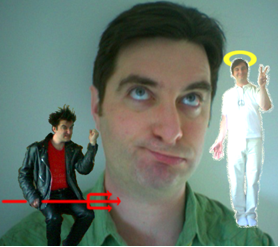
Ezistopheles: Why don’t you show them a photo of us?

Angelic Eric: That might be rather jolly. It would also demonstrate that we’re not just figments of your deranged psyche.

I only have the one photo, and I have grown a beard since then.

Ezistopheles: They want to see us, not you.

Okay then. Here is the photo of the three of us.

A photo of Eric with his internal voices

Angelic Eric: Why do always pull a face whenever someone takes a photo? You should smile more.

Ezistopheles: Never mind his ugly mug. What about telling the readers which is which in the photo. I’m the one on the left, wearing the cool leathers.

I think they could have worked that out for themselves. May we continue now?

Ezistopheles: Get on with it then.

Angelic Eric: Please proceed.

I have been working on a script…

Ezistopheles: Is it better than this one?

Angelic Eric: It’s a lot better than this one.

I beg your pardon!?!?

Angelic Eric: Erm… not that there is anything wrong with this one. Erm… I just mean that you have spent months writing Cosmic Corridors whilst you banged this out in under an hour.

Ezistopheles: Heh heh heh. You gave away the title now. Heh heh.

Angelic Eric: Darn. Sorry about that.

Maybe I should start again…

Ezistopheles: Come on, we’ve got this far. Let’s not prolong this agony any longer than we have to.

You are right. I have been working on a script for a half-hour radio comedy.

Angelic Eric: Tell them what it’s about.

It is about two thirty-something losers…

Ezistopheles: It’s based on a true story.

Angelic Eric: Don’t be so mean!

… who discover their house has doorways to other planets.

Ezistopheles: Alright, that bit isn’t drawn from real life.

Angelic Eric: I’m still a teensy weensy bit worried that it sounds like it’s only for sci-fi buffs.

Well, you should not worry about that. I was going to say it is a mixture of Seinfeld, Doctor Who and the vintage Bob Hope and Bing Crosby Road movies.

Angelic Eric: You mean like Road to Morocco? I love Dorothy Lamour in those movies.

Yes, exactly, but we are wandering off the point. The doorways lead to other planets because you cannot make comedies about going to Morocco and being chased by people trying to cut your head off any more. That would be culturally insensitive to Moroccans.

Ezistopheles: But I suppose it’s okay to make fun of Venusians, is it?

Now you are just being silly.

Angelic Eric: Will there be singing, like when Bing Crosby sings ‘Moonlight Becomes You’ to Dorothy?

Yes, there will be some singing, although it is more for laughs than anything else. We actually recorded the script ourselves, so people can listen to it and hear the dialogue, music, sound effects and everything. They can listen to it over the web or download it to their mp3 player, or even subscribe via iTunes.

Angelic Eric: Who wrote the music? You may be a wonderful writer, but you don’t know one end of a keyboard from the other.

My friend Matt wrote the music. Hence we called it Matt & Eric’s Cosmic Corridors.

Ezistopheles: I thought the characters were also called Matt and Eric. Isn’t that a bit confusing?

I do not see why it would be confusing. Most people can tell fiction from reality without too many problems.

Ezistopheles: I was more worried about you being able to tell fiction from reality. After all, this is you having a conversation with yourself.

Angelic Eric: So if it’s not just for sci-fi buffs, where does the humour come from?

Mostly the humour relates to the bickering between the characters.

Angelic Eric: You’re very good at writing bickering characters.

Ezistopheles: No he’s not.

Angelic Eric: Yes he is.

Ezistopheles: No he’s not.

We should let the audience decide whether it is funny or not.

Ezistopheles: Fair enough, but how do people listen to this so-called comedy? Sounds like it’s more of a farce, heh heh heh.

It is on the internet, at http://cosmic-corridors.com/.

Ezistopheles: Great, so what are the readers doing over here at Halfthoughts? They should be visiting Cosmic Corridors and enjoying the laugh riot of your new comedy.

Well, the website is not completely finished yet, but it seems silly to stop people from listening whilst we add a few minor final touches. So I suppose you are right, they should be over there and listening!

Ezistopheles: But you still intend to waste your time writing stuff over here at Halfthoughts, don’t you?

Yes I do, but I do not consider it a waste of time, thank you.

Angelic Eric: You forgot to mention that people should sign the guestbook at Cosmic Corridors and they should also tell all their friends to listen too.

Ezistopheles: They should tell their friends they like it even if they don’t.

Angelic Eric: That’s not very moral. They should only tell Eric they like it even if they don’t.

Excuse me?

Angelic Eric: That didn’t come out right.

Ezistopheles: Let’s hope the lines come out better in Cosmic Corridors than they did just then.

I think that is that. We did it, we told the readers. What a relief.

Ezistopheles: I don’t think they understood.

Why do you say that?

Ezistopheles: Because if they understood, they’d have gone to Cosmic Corridors already, instead of still being here reading this!

Privacy: Losing Our Virginity

If you type my postcode into Google maps, you see a lovely, flat, open field of grass. There is no house to be seen. Thankfully, Google’s modern equivalent of the Gestapo has yet to take an up to date photo of the locale. Instead of seeing my house at street view, the best you can get is a helicopter view of what the patch of ground that it was built on looked like more than five years ago. That is lucky for me, because the patch of ground is far prettier than my house. Imagine trying to sell your house if, instead of the cleverly-angled photos to give the best impression the day after you clipped the hedge, first impressions were based on Googlestapo’s street view. ‘Click’ goes the shutter, and your house is immortalized, whether you like it or not. Now anyone can see all those ugly signs that the council (always careful not to waste money, they assure us) finds necessary to erect immediately outside. For example, there is a very big sign, the purpose of which seems to be to inform the people living across the street to be careful because there is a cycle lane. There is no evidence of a cycle lane, unless the cycle lane is supposed to the strip of pavement that doubles up as being where people are supposed to walk. There was a time when the law said cyclists were supposed to cycle on the road, and leave the sidewalk so people could perambulate in peace. Nobody seems to take that law seriously any more, since cyclists were somehow elevated to saviours of the planet and hence in need of the tender loving care that only the state’s endless pot of borrowing can provide.

It is not like I have ever seen a cyclist riding along outside my house. My house is not on the way from anywhere to anywhere else, so the only people who might ride a bike outside my house are either starting or ending their journey very close by. It is beyond me how protecting their interests, by warning anyone who happens to look at the sign to be careful, is a public spending priority. For a start, any drivers may be better advised to keep their eyes on the road, instead of reading this ridiculous sign which only tells them to do what they should be doing anyway.

“How does the defendant plead?”

“Not guilty.”

“But we have video evidence and ten eyewitness accounts from bystanders, all saying your Range Rover piled into the Hatfield elderly ladies cycling club at 247 mph, killing eight and seriously injuring another thirty-seven, not to mention the substantial damage done to the bicycles, some of which were beyond repair.”

“Ah yes, but I contend that the council hadn’t erected a sign telling me not to do it.”

Then, you have to ask exactly how dangerous the road is anyway, for the few cyclists that might ever be using it. The speed limit is twenty miles per hour. It is a quiet back road, and not a rat run to anywhere in particular. A car may drive along it once every ten minutes, perhaps once every five minutes at peak time. There are speed bumps every few hundred yards. So how does the council decide to prioritize the spot outside my house as needing uglification in the cause of cycling safety?

What you would not see, if Googlestapo took an up to date photo of my house, is any evidence of a litter bin so people can throw their rubbish away. So what you would see, in just such a photo, is a lot of litter on the ground. There is an empty bottle of Lucozade lying on the ground next to the cycling safety sign, for instance. I do not know how you should measure the public need for cycle lanes and the public need for signs to protect people using cycle lanes and the public need for signs to protect people using cycle lanes even though there is no cycle lane. I also do not know how you compare these public needs with the public need to provide bins where people can throw away their rubbish. Even so, it seems to me that my community fairly obviously needs more litter bins and could have done without the cycling safety sign. Perhaps common sense is the only way to decide between spending on signs and spending on bins. Which is probably why the council struggles to measure it amongst their targets.

“We’re getting a lot of criticism that we don’t show enough common sense.”

“I can’t understand that. Nobody has shown us a report saying we’re falling short of our common sense targets. Isn’t common sense up 12% on the same quarter last year.”

“No sir. Erm, I don’t think we measure common sense. And I’m pretty sure we don’t have a target for it.”

“Well, that’s where we’re going wrong. How can we have more common sense unless we measure whether we have more common sense? We need a target for common sense. That makes sense to me.”

“Errr… how do we set a target for common sense, sir?”

“Do I have to do all the thinking for you? We set the common sense target the same way as we set all the other targets. Pay some consultants to do it for us. And then make the target 25% easier so we have some slack.”

So here I am, in a housing slump, when nobody can borrow the money or wants to buy a house, and the government has decided that what we need is another 15,000 new houses built nearby, right next to all the newly-built houses that have signs reading:


“House to let.
House is completely new and nobody can afford it.
Please take it off our hands at a greatly reduced price, even if it is just for a short while.
Yours faithfully,
The Builders.”

In the midst of this disaster which will depress my house price until 2020, by which time they will be spending public money on building houses on Mars, Googlestapo wants to show the whole world photos of my house and the neighbouring houses, and hence why they should not want to live there. Great. Just what I needed.

The thing about privacy is that it is one side of a zero-sum game with information. Somebody finds out some information they did not know before, but somebody else loses their privacy. Not all information is private, but in our legality-obsessed world, we are reducing all information to the black and white categories of public and private. There used to be more shades of grey about who could know what. Friends and family might have information that did not get shared with the world. Your neighbours might know the state of your garden, but your boss would not. The difficulty of gathering information was an effective way of filtering who got to know what. Now, as Google pursues its mission to make gathering information infinitely easier, we are left with no filters, no shades of grey – only the final defence of the ‘private’.

How far is going too far? It is a question many a young woman has had to struggle with. Where do you draw the line, and insist “no means no”? What can you say yes to, without suffering the accusation that you were “leading on” the other party? Google’s need to share pictures of our houses and streets, and of the people walking along them, is the information equivalent of heavy petting. We may enjoy it with some people, but most of us would be selective about who we share it with. It is not rape, but we know there is a danger if it gets out of hand, and we know we may be skirting closer to the line that has to be drawn. Of course, there are many information sluts. People who blog and twitter and tell you all sorts of things about themselves that you really did not want to know – like whether a public safety sign has been erected outside of their house. But even the sluts want to control what information they give away. Even the information whores might chose not to tell you everything about themselves. In the end, a prostitute might refuse to kiss a client. And even if there are information sluts, that does not mean we all choose to be so free with giving away our secrets.

Google’s mission to show the world at street level goes beyond the wholesome and dabbles with the voyeuristic. Just like a low-cut dress or a high-cut skirt is not an invitation, but it is a flirtation, people need to be realistic about the impact of what they show to the world. The effect, whether on strangers or on people they know, will not always be a good one. Doing the right thing would be easier if evil were black and white, like Google’s corporate philosophy suggests. In this case, Google are not clothing themselves in the heavy black of evil, they are dressed in the dark grey of being irresponsible. What one lady finds to be healthy attention may be deeply upsetting to another. To protect people, we must err on the side of caution. We do not lift up somebody’s skirts and wait to see if we get slapped, concluding that if no slap comes then no harm was done, and if slapped that we did wrong and will not raise the skirt of that lady again. Yet that is exactly the approach of the Googlestapo, as they catalogue and index the world at street level. If you have an objection to one of their photographs, then they will take it seriously and remove it from the internet. You might as well promise to say sorry to the girl whose skirt you lifted. It is too late then. Privacy is like virginity. Once lost, it stays lost. Once information is put in the public domain, it cannot be made private again. At best you can resurrect those greying filters, in the hope that the secret is not shared too quickly, with too many more people. But the nature of gossip tells us that the information people will least want shared is the information that people will expend most effort on sharing.

Google can hide behind public officials, who have sanctioned what they are doing. Google getting endorsement from the UK’s Information Commissioner to take photos of our houses is like Bill Clinton defining the meaning of “sex” with his lawyers. Whatever rule they come up with will be unsatisfactory for a myriad of reasons, not least because most of us will have our own personal reasons to question whether the lines were drawn in the right place. You would not rely on a public servant to protect your daughter’s chastity, so why expect them to protect your privacy? Ten years on from the UK’s Data Protection Act 1998, which set up the Commissioner’s office and which stipulated that personal information should be held securely, the UK is a country where personal information has repeatedly been lost and stolen. Nobody can measure how much has ended up in the wrong hands, or the damage that has caused. What we can measure is how successful the words of a bunch of lawyers were at stopping it: not at all. We can also measure how successful the public servants, including the Information Commissioner, were at stopping it: not at all.

Maybe within ten years time, we will be reading the story of somebody who was raped or murdered and how information about the victim was garnered by the assailant using Google’s intrusive photographs. At that time, we will also hear a lot of humbug from the Information Commissioner about how this will show the need for the Commissioner to have new powers, about how it is a very serious sign that the Commissioner needs a lot more resources, and about how nobody could have predicted what happened. Taking the last point first, of course it is predictable; I am predicting it now. It is as predictable as the countless predictions that the 1998 law to protect personal data would do nothing to reduce carelessness with people’s personal information, not least by the same government that passes these laws and employs these public servants. Government appointees get chosen not because they do the things that need to be done, but because they sound like they are doing the right things. In 1998, the government appointees were telling the country how they would be securing our data. Ten years later, they were demanding more power and more resources to do the same job. They should have said they lacked the powers and resources to do the job before it became public knowledge after people’s privacy had been violated over and over. I see the decisions about Googlestapo’s street photography as the start of a similar chain of events. A public appointee has negotiated with Google what it takes to secure someone’s privacy. The implication is that privacy can be reduced to a universal algorithm; that privacy can be delivered by code to blur a face or a number plate, thus rendering them unrecognizable. Some cars and some people will be recognizable even if blurred. People will be recognized by their clothes, people will recognize be their stature, people will be recognized by the simple fact that they live in the areas where there photographs are taken. The same will even apply to some cars; I know what Starsky’s car in the 70’s cop show Starsky & Hutch looks like, though I have no idea about the number on the plate. It is a travesty that a public official, whose role is to protect privacy, can agree that blurring makes people unrecognizable, and hence ensures their privacy is protected. At best, it protects the privacy of most, but obviously will not be fool-proof. Contrast this lackadaisical approach to securing our privacy with the advice the government gives on how we should protect our information assets. They do not tell us to share our passwords only with people we trust, because most of them can be relied upon, or not to bother shredding documents because most of the time nobody is rifling through our bins, yet they allow Google to adopt privacy-protecting measures that will work most of the time, but not all of the time.

There is no point rifling through the reasons stated for why these compromises get nodded through, as the public words tell us nothing about the real reasons. Government is weak, and Google is strong. Government is worried about popularity, and Google is confident about theirs. Government is about making compromises to stay in power a little longer, and Google just needs to keep rolling in the money forever (whilst pretending it will never do so in an “evil” way). The only time the balance will change is when something goes horribly wrong and public sympathy shifts as a result, at which time the Information Commissioner will be demanding more to do the job he was supposedly doing before. No mention will be made about the culpability of his office in allowing our privacy to be violated. The real problem here is that part of the problem is posing as part of the solution. Relying on government to regulate our privacy is like relying on government to regulate our money. The will to impose rules will only be discovered after things go terribly wrong. Even then we should be pessimistic about the competence of the individuals tasked to impose those rules, who doubtless built their reputations by being a respected part of the flawed system. Asking some to rise through a career path and then, once they reach the top, to look down and fix what is wrong with the system is like asking someone to climb to the top floor and to build the stairs from the top down. Buildings are built from the bottom up. You need solid foundations to build a solid building, yet the government appointees will have reached the top precisely because they turned a blind eye to the inadequacies they saw as they climbed upward. Expecting the products of flawed systems to fix the flaws in systems is like asking a cowboy builder to build your house, or asking the council to spend more money on bins that are needed and less on safety signs that nobody will read. If governments cannot take care of your money, whether it is the money they spend or the money in the bank, what are the chances they will take care of your right to privacy?

So far the Googlestapo is telling the world I live on an open green field, with not a house nor a person for miles around. For the sake of my privacy, that is the safest place I could be, and at least it helps to keep the cyclists away.

Reasons to Recast

In films and television, people always get cast according to how they look. Short people are angry/pushy/talkative. Slim young women are feisty. People with kindly faces are kind. Old people of colour are wise. Attractive women are the reliable, trustworthy gals you would like to shag, or the double-crossing, duplicitous vixens you would like to shag. Take note of the clever way ‘creative’ people keep you on the edge of your seat in that last example: beautiful women are either very good or very bad, but not somewhere in between. Being an overly-avid watcher of Star Trek, I have observed how Hollywood can take this to its logical and ridiculous conclusion. In Star Trek, especially the later series, there are countless alien races who look much like people, except there is something stuck to their forehead or their ears or their nose. When a new alien race is introduced, you can pretty much tell how they will behave just from the way they look. If they look very human, with a few dabs of henna to represent tiger stripes running down the side of their neck, or only have altered ears, then that race will either be good, or the type that seems good but turns out to be devious and dangerous. Foreheads that look like armour plating and pointed teeth are sure signs of aggressive tendencies. Any make-up where you have no idea what the actor underneath looks like, and you can guarantee that race will be difficult, and before long somebody will be threatening to fire torpedoes if they do not get their way.

Real life, unlike television and the movies, has no casting filter to match a person’s qualities to their looks. Bad people may look kindly, and old people may be fools. Short people may be shy, and attractive women may be dull but harmless. Of course, we may be daft enough to allow how somebody looks to influence our judgment of people, so every time a redhead gets angry, it confirms our knowledge they are a temperamental lot, but every time a redhead turns the other cheek when provoked, we fail to notice. Thanks the halo effect, good-looking people will be assumed to be intelligent, even if they are not, and ugly people will be assumed to be stupid, even if they are brainier than Einstein.

Thinking of the conjunction of Star Trek and miscasting, I started wondering what television and movies would be like, if all casting logic was outlawed, or if actors were given jobs based on a lottery. Recasting every movie since the dawn of time would take longer than I have time to do here, so instead I will focus on a genre where characters tend to be heavily stylized: science fiction. Here, in no particular order, is my list of ideal recasts, and enjoyable miscasts, of major and minor science fiction characters from through the ages (plus a few other random characters to keep you on your toes). If you know your sci-fi, it may give you a few giggles. If not, then try recasting a few of your own favourite films and shows, and imagining what the results would be like.

Imagine a universe where…

Jerry Seinfeld is Doctor Who
Thom Yorke is Wolverine
Jackie Chan is Chewbacca
Judi Dench is Laura Roslin
Daniel Craig is Buck Rogers
Oprah Winfrey is Wonder Woman
Christian Bale is Bender Bending Rodríguez
John Travolta is HAL9000
Cameron Diaz is Darth Maul
Sidney Poitier is Fox Mulder
Stephen Fry is Scruffy the Janitor
Victoria Beckham is Lady Penelope
Tom Cruise is Parker, Lady Penelope’s chauffeur
Richard Pryor is Colonel Tigh
Madonna is Arachnia, Queen of the Spider People
Gary Coleman is Mini-Me
Chuck D is Riddick
Lindsay Lohan is Number Six
Bob Hoskins is Bilbo Baggins
Humphrey Bogart is Rorschach
George W. Bush is Zapp Brannigan
Patrick Stewart is Agent Smith
Bette Davis is Buffy the Vampire Slayer
Gary Oldman is Captain Nemo
Hong Kong Phooey is the Kwisatz Haderach
Gordon Brown is ‘Crash’ Gordon
Patrick McGoohan is Gaius Baltar
Milla Jovovich is Turanga Leela
David Bowie is David Brent
Arnold Schwarzenegger is Lemmy Caution
Brangelina is a teleporter accident
David Duchovny is Commander John Koenig
Paris Hilton is Jabba the Hutt
Gérard Depardieu is Jean-Luc Picard
Diana Rigg is Lady Jessica Atreides
George Lucas is Guido
Ricky Gervais is The Blob
Tommy Lee Jones is Dixie Flatline
Ricardo Montalban is Commander William Adama
Hugh Grant is Doctor Manhattan
Natalie Portman is Servalan
Steve Martin is Ming the Merciless
Eva Green is Tank Girl
Isaac Asimov is Hari Seldon
Queen Latifah is Lieutenant Commander Uhura
Harrison Ford is Arnold Rimmer
Peter Sellars is James T. Kirk
Britney Spears is Kaylee Frye
Leonard Nimoy is Dr. Horrible
Bono is Roy Batty
Barack Obama is Harry Tuttle
Kathy Bates is Lieutenant Saavik
Richard Branson is J.F. Sebastian
Gwyneth Paltrow is Captain Mal ‘Tightpants’ Reynolds
Bill Shatner is Klaatu
Halle Berry is Dr. Susan Calvin
Timothy Olyphant is Jango Fett
Ian McKellen is Kerr Avon
Eleanor Roosevelt is Ellen Ripley
Salma Hayek is Princess Leia Organa
Burt Reynolds is Han Solo
Roseanne Barr is Barbarella
Nathan Fillion is Arthur Dent
Beyoncé Knowles is Zefram Cochrane
Elizabeth Taylor is Pris
Chris Rock is The Master
Sharon Stone is THX 1138

and…

Bill Hicks is President of the United Federation of Planets

It might take a lot of CGI, but that would be a movie I would gladly pay to see!

Whose Problem is it Anyway?

Hmmm. Work. Hmmm. Life would be very smooth if we did not have to do it. It would still be pretty smooth if work did not involve working with other people. This week, I found myself doing what I get paid to do at work, which is rewriting the same things over and over despite the best efforts of MS Word to corrupt my output as quickly as I can type. My fingers were screaming RSI, but their sacrifice had placed a nose ahead of Bill Gates word processor from Hell. Then, my race with the Microsoft gremlins was rudely interrupted by the bickering of two middle-aged managers standing right behind me. They were engaged in a prolonged and very loud debate about how much work they had to do, who was at fault for this, that and the other, who was responsible for this, that and the other, and when they were both intending to do whatever. I was tempted to turn around and suggest that if they had used their time to just do this, that, the other, and maybe also whatever, they would have finished them all long before they were likely to reach the end of their interminable debate. What really struck me, though, is what, in the heat of the battle, one of the protagonists said. Like knights of old, the modern office combatant must know the tools and tricks of his warfare. The bolder, but slightly less bald assailant verbally rushed his opponent, only to bamboozle him with a classic business side-step: the NMP. Not only did he execute the technique flawlessly, he called it by its proper name. “Not My Problem”, he bellowed about this, or that, or possibly about whatever.

NMP, as phrases go, is a metaphorical sign at a fork in the road. Equivalent signs would read “I see where you’re going with this, but I’m not going with you!” or possibly even “it’s my way or the highway, sonny Jim!” When somebody signals an NMP, you either agree to let him go down his preferred path (the path of escape), or you end up in a row. NMP is the management version of a 12 year old refusing to eat her brussels sprouts. “Eat your sprouts!” “The sprouts are NOT MY PROBLEM!” Then imagine the 12 year old pointing out that sprout eating was not an implied term in the contract with their mother, had been left out of the job spec, was not part of the SLA, had not been acceded to even informally, was not discussed in the previous steering group meeting, and, in conclusion, could not be enforced because the 12 year old had never asked to be born in the first place. What delicious irony that these two bickering managers were not long returned from day two of an all-company, all-hands, team-building, morale-building, mission-confirming, vision-stating, and generally singing-from-the-same-song-sheet jamboree.

The NMP, unlike so many other work dodges, at least has the merit of being clear, if a little confrontational. Most people, if you ask them to do something, say they will do it and then do not do it. You ask again, and they say they will do it but then do not do it. You ask again, and they say they will do it and then do not do it. Eventually, when you get to the twentieth time of asking, you will realize you have just been wasting your time and just do not bother asking again. That is how most things do not get done. HWP, or the hollow work promise, is the preferred technique for slopey-shouldered easy-lifers. HWP allows everyone to feel good about themselves whilst doing sod all of any worth. HWP is also a brilliant source of job creation. Half of the jobs in most companies go to people whose job is to elicit HWPs from other people. We all need to do this-and-that, bellows the CEO, or the board, or the executive team, or any other group of people that suddenly realizes they may be out of a job, lose their generous pension scheme, or better still end up in prison unless the company really does this-and-that (examples: train companies not killing customers by keeping their trains on the tracks, banks not defrauding their investors by actually investing the money they are given and not just using it pay off on the last round of promises). But how do you get everybody to do this-and-that, especially when they are (pretending to be) busy doing the specific things you recruited them to do, which made no mention of this-and-that? The universal answer is to employ somebody else, and to put number one on their specific list of things to do the job of chasing you to do things you should be doing. Sometimes this is known as compliance. Compliance is, after all, another word for doing what you are told to do, so it makes sense to employ someone to tell you to do it. The idea is to employ somebody to chase would-be complier and make them comply. Or rather, you get somebody to chase them and make them promise they will comply, and hence obtain a long series of HWPs from everybody in the business. At least then, when the CEO is dragged in front the SEC, or the Environmental Police or the Health & Safety Fascist Board of Repression, they can show their HWP slips and explain it was not really their fault that the staff, who were trained and warned, avoided the company’s diligent compliance procedures by not doing this-and-that during those spare minutes in the working day between 4.27am and 4.29am.

We all get steadily trained to behave the ‘right’ way at work. For example, being caught lying is bad, but always telling the truth will get you the sack even more quickly. If somebody comes at you and asks you to take health and safety seriously, then you should never, under any circumstances, NMP them. H&S is your problem by definition. HWP them instead. After all, they want to be HWP’d. If people did not HWP, and just did what they were told, then there would be no health or safety risks. That in turn would mean no need for a person to chase HWP’s about health and safety, and then they would be out of a job. I pick on H&S because it is so easy to pick on them, and because the people who work in that field so thoroughly deserve to be bullied in return for the relentless bullying they give people at work:

Do not drive tired!
Leave home five minutes earlier so you do not have to rush!
Leave work thirty minutes later so you make time for the mandatory health and safety online training module!
Keep a good work-life balance for the sake of your well being!
Kill the health and safety person for the greater good of your colleagues!
Wear a plastic sock in the showers at the gym so you do not get a verruca!

I only made up two of those Stalin-esque H&S exhortations, and the verruca-sock combo was not one of them.

For a long time, I was like some wild crazy bucking bronco at work, refusing to wear the saddle, reigns and noose that management had picked out for me. I completely misunderstood the purpose of my job spec, and of the NMP, with the consequence that I NMP’d all and sundry, not just the goon squad from H&S. Worse still, I did what it said in the job spec, including the bits that nobody expected you to do. Yes, I really was that foolish. The inverted pyramid of management, where there must be no fewer than twenty people managing every act performed by every single actual worker, was a constant source of confusion and bafflement. In my naivety, I was fond of saying how I did not like to work for more than one boss at a time! I must have been mad. Everybody has more than one boss, except perhaps God and people like Heather Mills-McCartney-as-was who ‘work’ for charity by sometimes giving small bits of their hard-earned divorce settlements. As I grew older, I realized everybody was my boss. The girlfriend, the customer, the government, the stakeholders, the landlord, the collective will of the Chinese nation, polite society, long-term benefits scroungers and adolescents who drink too much cider on a Friday night and seek to resolve their emotional issues with a spot of casual violence “” all have a reasonable claim to be my boss. If I had a dog, it too would be my boss, expressed in demands for walks, tins of rancid meat and squeaky toys. The only person who is not my boss is me. But until I realized that, I was making life very difficult for myself, especially at work, where my bosses included my line manager, his line manager, her line manager, the CFO, the CEO, the Health & Safety guy, the project manager, the deputy project manager, the contractor filling-in for the deputy project manager whilst she is on maternity leave, the consultant telling the temp how to do her job and anybody else who fancied they had something to do which might possibly be better done if it somehow involved me. Mistakenly, I would NMP large swathes of these people. It was my way of telling people I would not do what they wanted me to do. Cue long arguments of the type that between the two middle-aged managers who stood behind me.

Being a little slow-witted, it took me a long time to realize that, if I am a shirker, or just too busy, then NMP tends to backfire. Persistent people, with nothing better to do, will just bug you an awful lot in the hope they can nag you into conceding their authority to make you do whatever it is they want doing. HWP is far superior for ridding you of these people, as chances are they will be horribly disorganized and simply forget to chase you, plus an HWP will get rid of them in an instant. Boring people into submission with HWP is far more successful than goading their authority with NMP. However, HWP is not at all appropriate when dealing with someone who you consider to be your boss. Your boss is very likely to remember what you said you were going to do, and if you consistently fail to do what you promise, you will probably do your career more harm than if you simply resorted to flicking V’s at them every time they make eye contact. In contrast, NMPs are ideal when handling people who just think they are your boss. They tell you to do something, you say no, they insist, you NMP. Then they have to go get authority from somebody who really is your boss. If your boss is a wimp, and gives in, you may need to give in too, but at least you will have caused them a lot of trouble in the meantime, and proven the point they needed to go to your boss before they could get their way, which means they could not have been your boss after all.

Despite the previous paragraph, if your boss is a real big wimp, and agrees to everything to keep everyone happy, you must always HWP them, and never NMP them. If you NMP them, they will just hover over your desk until you promise to do whatever nonsense it is that they promised their boss they would do, but which they cannot begin to do because they have no idea how to do it. It makes no difference if you do not know how to do it either, because the main thing is that the boss wants to blame you for not doing it, hence getting them off the hook. So never ever NMP a boss like this. Much better that you HWP them. If you HWP them, they instantly will leave you alone, and will search out some other poor victim to do some other pointless work that does not need doing. Of course, the whole point with HWP is that you do not do it, which will eventually cause a little embarrassment for the boss, who could blame you but would still be stuck needing to do something they cannot do themselves. It is much more likely that they will be afraid of being found out as the useless nincompoop they are. When such a boss realizes you HWP’d them, they will typically attempt to cover up the whole forrago of their own incompetence and their team’s lack of respect by pestering someone more docile than you to do the dreaded task instead. If, on the other hand, you ever sort any problems for such a boss, he or she is bound to back to you with each and every other problem they are too stupid to solve for themselves. This is the fast track for guaranteeing you do all the work of your boss, barring one vital task they will inevitably keep for themselves: communication. Communication is, of course, a synonym for taking the credit. Much better that you HWP them and give them a few sleepless nights about how they will communicate their way out of that. One good solid HWP, if seen through to the bitter end, with consistent promised you will do whatever it is that you have not the slightest intention of doing, will secure your freedom for life, or at least until the next round of redundancies (and with any luck your boss will be made redundant before you do). But you have to stay solid with an HWP. Do not backslide and make a token effort. A token effort might make it seem like you genuinely intended to do it, and if it looks like you did a job badly, that might enable your boss to make it seem like you are the incompetent one. Never be caught doing a job badly. Not doing a job at all is far superior than doing a job badly, as you can always rely upon plausible deniability, like when US Presidents sell arms to terrorists then decide that is a bad idea then decide they forgot what they decided to do then decide they forgot what the question was, would you please not repeat it I am a busy man and have so many things to do like posing for this photo shoot, saluting this flag and kissing this baby here. One good solid HWP guarantees that a weak boss will just pick on somebody else from then on. With a bit of luck, the team will discover some solidarity, and everybody will successfully embargo the silly problems the boss should not have taken on, by applying a block HWP every time the boss attempts to sucker them. Over time, the boss will be trained to do one of two things. Either the boss will learn to solve the problems they agreed to solve, or the boss will learning not to agree to take insoluble problems on in the first place. Or they may just learn to NMP their own boss and be done with it. Whatever route your boss takes, once trained, they will be an inspiration for the team and help it get back to what it really should be doing, absolutely nothing else, and possibly not even that. And the best part is you will have more time to fill out those H&S forms.

NMP should, under no circumstances, be confused with the similar-sounding SEP. Like so many great ideas in my head, SEP was not first discovered in my head, but originated in the head of Douglas Adams, of Hitch-Hiker’s Guide to the Galaxy fame. In the universe of HHGTTG it was impossible to make something invisible. But stick a Somebody Else’s Problem field around it, and everybody would just pretend they could not see it. SEP is what you get when something really needs to be done, and nobody wants to do it and nobody in particular is expected to do it. Of course, you should never actually say a problem is SEP. SEP’s are implied. Better still, they are implied by everybody else – you did not hear or were out of the room and have no idea what everybody else is not talking about. If confronted about an SEP, you must not answer any questions about whether it is SEP, as this just makes you look shifty. Instead, you must explain it is NMP, without commenting on whether it is SEP. This approach works because, in the formal logic of work, that NMP is true does not imply that SEP is also true. It is perfectly possible for a problem to be nobody’s problem, in which case NMP is true, but SEP is false. The relationship is not symmetrical, as SEP does imply NMP. This is because when a problem is somebody else’s problem, you can be pretty sure there will be nobody who agrees that it is their problem. However, you should never admit a problem is SEP, as people will just assume you are saying that because it is really your problem and that you are just trying to pass the buck.

If somebody accidentally asks you about a problem which is SEP, just look around the room, talk about something else, and avoid the topic. Whoever is asking will soon take the hint and realize they were talking about SEP, or else they risk making it their own problem. If they do not take the hint, just start acting like Robert De Niro in Taxi Driver:

You talkin’ to me? You talkin’ to me? You talkin’ to me? Then who the hell else are you talking to… You talking to me? Well I’m the only one here. Who the fu*k do you think you’re talking to?

Then you should laugh and ask them if they liked Taxi Driver. Either they have seen the movie, will laugh and forget all about the SEP, or else they will not have seen the movie, will think you are a bit odd, and will forget all about the SEP. It does not matter if they think you are odd, because they never saw Taxi Driver and hence you do not care what they think. If you are under real pressure, and your Robert De Niro impersonation stinks, you might want to resort to the last-ditch tactic of saying the SEP is NAP (Not Anyone’s Problem). This implies a gap in the org chart and a need to recruit somebody new to own the SEP. However, never say this to someone who actually has the authority to recruit somebody new. Somebody with that level of authority will immediately pin the job on you and pat themselves on the back for keeping headcount down. When dealing with somebody who could recruit to solve a NAP, insinuate the problem is NMP for both you and them. If they do not get the hint, the listener’s only option is to conclude that finding out whose problem it is has effectively become their problem. Anybody who takes on the problem of finding out whose problem the problem is, is effectively setting themselves up for a fall, as they make themselves the default choice for taking ownership of the problem when it is discovered that the problem is currently NAP. When they realize this, they will quickly conclude that the problem must be SEP and that there is hence no need to establish precisely whose problem it is. Or they will recruit somebody else to do it and at least guarantee it was not their problem. It was probably that kind of thought process that inspired someone to create the job you currently do.

SEP is a powerful technique, especially when applied to problems that seem intractable and thankless. Never ever get stuck with a problem that everybody else thinks is SEP. Even if you do solve it, they will not thank you for it. Because they will all be ashamed that they pretended it was SEP, they will also pretend it was never a problem in the first place, so you still will find you get no thanks for solving it. Problems which are easy to solve and where the solution will earn a lot of credit, simply cannot be SEP’d. Everybody wants to own these problems. Make sure you do too. Speak often, and at length about the problem. Be upbeat about finding a solution. That way, when the problem is solved, some people may wrongly think you were part of the solution. If you want to enhance your credentials as owner of the problem, be sure to deride everyone else who claims to be owner, making a point of saying how they all NMP’d the problem, even if that is a blatant lie. In such cases, although people will know you are lying through your teeth, a lot of them will assume you are bitter because you did not get the credit you deserve, and will not stop and think long enough to realize you do not actually deserve any credit to begin with. Being thought of as bitter is not great, but it is a lot better than being thought of as irrelevant because somebody else is solving all the problems.

In the last resort, remember that all problems can be solved by a full-scale FTS. FTS is not a phrase invented by Douglas Adams, being rather too fruity for inclusion in a BBC Radio 4 pre-watershed comedy. FTS is an acronym invented by my friend James, who speaks several languages and has a very nice life and a gorgeous wife in San Francisco, so he must know what he is talking about. FTS is an acronym of three four-letter words, two of which are four-letter words. The other four-letter word is “that”. If somebody comes at you with a really bad problem, which simply cannot be solved, and will overwhelm you and knock all your problem management into the middle of next week, just tell them to Fu*k That Sh*t. It is your last line of defence. Really bad problems cannot be SEP’d or even NMP’d and certainly won’t be HWP’d away, as everyone will assume you have no clue to solve them (because you really do have no clue how to solve them) and will constantly be asking you about progress and insinuating you are a dunderhead for not making any progress with such an obviously important and pressing problem.

To be pedantic, it is not necessary to swear in order to tell people them you are FTS’ing the problem they brought to you. If you are worried about offending them (perhaps the problem is about rude language in the work place) then just look them straight in the eye, and say, in a commanding voice, “that’s a full-scale FTS”. Either they will know what FTS means, or they will not know. If they know, they will instantly leave you alone. If they do not know, chances are they will be slightly uncomfortable at the fact they do not know, and will hence avoid wanting to seem stupid by asking what it means. So they too will instantly leave you alone, afraid that you will continue to talk in acronyms they do not understand and hence confirm their ignorance and incompetence for their job. In the unlikely event they do ask what FTS stands for, just say “it’s not my problem to tell you what FTS stands for, but as you don’t know I don’t mind telling you that it means Fu*k That Sh*t. And you can take it from me, that’s a fact.” They will probably be so perplexed and awed at the same time that they will leave without saying another word. Many colleagues, upon hearing this instruction, will never risk talking to you again, which can only be a bonus in most jobs. And if the the full-scale FTS speech does not work, you must be at the wrong company. That nonsense works everywhere else in the world, so wherever you are now, they must be working you too hard and you can earn more and do less somewhere else, even when times are hard. Take it from me “” you can start your new career by applying for a job at the place where I am working now. Just write a covering letter which begins “you should recruit me because I believe that the company’s problems are my problem.” Anyone reading that letter is going to love you and want to give you the job of the boldly baldy NMP man who stood behind me. After all, it means they will have somebody new to give all their problems to.


What Is Wrong With The World

I am in Oman. Oman is a hot and sunny country. It is day time, and it must be thirty Celsius in the shade. But I am shivering. You see, I am inside. I am sat in an office. I am sat at a desk that looks like pretty much any other desk in any other office any where in the world. It is the top floor of this building, but because the windows are small, I, like everybody else on this floor, depends on fluorescent strip lighting, like you might find anywhere in the world, in order to see what I am working on. The fluorescent strips are a lot less bright than the sunshine outside. And I am shivering. The air conditioning is on, and for whatever reason it must be aimed at my seat, so I am shivering. I could walk over to the wall and turn the air conditioning down, but you can guarantee that within ten minutes somebody from the other side of the floor will come along and turn it up again. So I just go outside now and then to warm up. I am in a hot sunny country and I have to go outside to warm up and get some natural light. And they say the world is running out of energy. Work that one out.

By all rights, I should be the last person on this floor that feels the cold. One way you can tell this office is in Muscat, the capital of Oman, and not Brisbane or Grimsby, is by looking at what people are wearing. Omani outfits have, over hundreds of years, been perfected to keep people cool. They are long and airy. I, in contrast, am wearing the usual boring Western long-sleeved shirt and trousers combo. So my clothing should be warmer than the local outfits. Perhaps, though, they have a critical edge on me, what with wearing hats. The Omanis all wear hats or scarves, so perhaps they are saving a lot of the heat from their heads in their hats, whilst all the heat from my head does is try to defeat the air conditioning’s thermostat in a futile battle. My head, hot as it may be will never win in a straight contest with the air conditioning, unless they run out of oil in Oman, which will not be for a while yet.

I often think the world is just wrong. Not “wrong, but we can understand why”. Not “wrong, but there is a reason why we do things like that”. Not “wrong, but there are mitigating circumstances”. Just wrong. Take, as an example, when Brits go on holidays abroad. Britain is nice in summer, or at least nicer. It is awful the rest of the time. British people go to other countries at exactly the time of year when Britain is the nicest it will be. One of the disadvantages of living in Britain is that you cannot enjoy outdoor activities in Britain all that much. There is nothing better than a bit of fun with friends when the weather is nice, having a picnic or enjoying a kickabout in the park. If only your friends were not on holiday. So instead of Brits going out, enjoying the summer, and being sociable with friends, we hang out with strangers in a foreign country.

Why do we all have to work during the day? A lot of jobs are better done during the day, when you can see what you are doing. Why do all the jobs where people sit in offices, bathed in artificial light, have to happen during the day? Today, I will be going home at the same time as everybody else in this office. Taking the traffic jam home, I will see the sun set. I will have spent the whole day in artificial light, and then, in my private time, rely upon artificial light. If I enjoyed myself during the day, and worked only at night, then I could get natural light for half of the time, instead of none of it. That would save energy, as well as making me happy. It would not make any difference to my work, except that there would be nobody else around to work with (unless people start thinking like me).

If people did not go to work at the same time, there would be less traffic congestion, less time wasted, and less fuel burned whilst going nowhere. We would need fewer roads and fewer ugly car parks. If people took their holidays at different times, the airlines could make a more reliable profit all the year around, instead of needing to charge a fortune in summer in order to cover their losses during the rest of the year. Beautiful countries would not need to be scarred by so many concrete hotels, and people working in tourism would have a more consistent source of income the whole year around. When I was young, my teachers said everybody is a unique individual. It does not seem to be working out like that.

Thinking the way I do, I thought I might set up yet another website, just dedicated to observations, called ‘What Is Wrong With The World’. It would basically be a list of what is wrong with the world, but perhaps you guessed at that already. It does not matter if anyone takes notice. I am not pretending to be Martin Luther, pinning my theses somewhere everybody can read them. It would just be nice to know if there is anyone who thinks like me, or whether I really do live in a world where everyone else thinks there is no way to improve on working during the day or taking your holidays during summer.

There is a Harry Hill joke which I often think about but find hard to tell in a funny way. I was in hysterics when I heard it, but I think you had to be there when Harry told it. The joke involves Harry’s father opening up a bed shop, called ‘Beds Beds Beds’. There is a guy with a shop around the corner already called ‘Beds Beds Beds’ so Harry’s dad changes the name to ‘Beds Beds Beds Beds’ instead. The guy around the corner sees his dad’s shop, and did not like his competitor getting one up on him, so he changes the name of his shop to ‘Beds Beds Beds Beds Beds’. Harry’s dad then changes his shop to ‘Beds Beds Beds Beds Beds Beds’. That is pretty much the gag except it goes on a lot longer “” to the point where you either holding your aching sides and the tears rolling down your cheeks, or you left a half hour ago, wondering why anyone thinks Harry Hill is funny. I think I like it because it makes a point about people being the same no matter how silly the consequences are.

I thought ‘What Is Wrong With The World’ lends itself to quite a snappy URL, so I looked to see if www.www.com or www.wwww.com had been taken. They had. So has www.wwwww.com. So has www.wwwwww.com. So has www.wwwwwww.com. So has www.wwwwwwww.com. So has www.wwwwwwwww.com. By this point, I was thinking it was getting ridiculous. I mean, who wants a website where the URL is nine consecutive w’s? Like nobody is ever going to mistype it and end up at www.wwwwwwww.com instead, and you nobody is going to get confused when hearing it over the telephone…

“The phone crackled. I missed that last bit.”
“W”
“And what was before that?”
“W”
“Instead of just reading out a lot of w’s, why didn’t you just tell me it was nine w’s?”
“Because I thought you might type www.9doubleyous.com by mistake”
“That’s what I said, nine w’s”
“No, I meant 9 double yous”
“That’s what I said”
“Forget it”

Of course, nobody does want a website called www.wwwwwwwww.com or www.wwwwwwww.com or even plain www.www.com. They all got bought by people who want to make money from spam links or by selling the domain to somebody else who really wants the name. Yup, the ticket touts of the internet world, who register a domain just so they can sell it on to somebody else, had the creative juices flowing on that day…

“You know what, we should register the sequence from three w’s dot com to nine w’s dot com.”
“Why would anyone want a URL like 9doubleyous.com? Is it supposed to be some kind of gambling site?”
“I meant www.wwwwwwwww.com”
“Why didn’t you just say so?”

These internet tout parasites think the world owes them a living because they have the time and resources to mindlessly drive up the price for anyone who wants to do something useful before they die. There are so many parasites in the world today, sucking blood out of anyone they can find, that it is hard to find anyone who just does a hard and honest day’s work. It sure is not me. Remember, I am the guy who wandered around outside to warm up. Arguably I should warm up by typing faster. Wandering outside, instead of working, I was thinking of this blog, and not what I was paid to think about. But it worked out even as I inadvertently thought about work the previous evening. As I was wandering outside, enjoying the Omani sunshine (note to self: bring sunglasses to work tomorrow) I started wondering why did the domain touts stopped at nine. Why not ten w’s? Perhaps they missed a trick. Perhaps I had better buy it before someone else does. Or maybe I will get 3doubleyous.com instead.

Reimagination Machinations

The ‘reimagined’ Battlestar Galactica, a dark jazz riff on the 1970’s space opera for children, is nearing the end of its final run. By popular acclaim, and by most any other measure too, it ranks amongst the best television of this decade. But whilst the new Battlestar Galactica has been a revelation, it also carries a heavy responsibility. In the wake of its success, the idea of revamping old television shows has taken on a life of its own. The straightforward trick of taking a kitschy show and amping up the grit, grime, adult content and seriousness levels is a perfect reflection of the obsessions of our age, and a pretty good idea if you want an immediate boost to the ratings of a new show. Since Battlestar, we have seen Bionic Woman get the full makeover, and Ian McKellan is lined up tp be in the cast of the new version of The Prisoner. Like rap music – which so often samples classic tunes of the past and builds a song around them – taking themes from old TV and splicing them into a new product introduces the risk of creating ugly frankenstein works that tarnish what was good about past creations, and overlay little that is new or of value. They introduce some danger: the danger of spoiling our memories of what was once great. Nevertheless, the temptation is bound to be too great, and the fashion for reimagining will probably stay with us for at least another decade before the world of creative media goes back to coming up with good original ideas. In the interim, expect a lot of weird reinventing of the television wheel. Here are a few of my own speculations of shows that could soon get the reimagination treatment.

Scooby Ski-Doo

Scooby Doo, bitter about the endless stream of caretakers with their absurd monster-oriented plots, and tired of a life of endless and aimless wandering, splits from the rest of the Mystery Machine team. He travels to Alaska in a quest for peace and quiet, and to find himself. He settles amongst great unspoiled natural beauty in a tiny community. It appears Scooby may have finally found happiness and true love with Lady Lightning, the leader of a huskie pack. Cue many shots of magnificent snow-covered landscape, with Lady Lightning frolicking with Scooby, who has taken to riding a ski-doo. Scooby’s happy days are short-lived, however. As the winter draws in, and the days grow short, Scooby finds himself assailed by terrible foreboding nightmares. In an ironic twist, after spending his life fighting fake monsters, Scooby’s sleeptime visitations are a terrifying premonition of an attack by real vampires and werewolves on the town. Scooby and Lady Lightning fight fiercely to protect the towndwellers, but Scooby is ill-prepared to find that the leader of one of the warring monster factions is a zombie Scrappy-Doo.

El Dorado: Return to the New World

A British ex-pat community goes about their ordinary lives in a pleasant, if bland, tourist trap on the coast of Spain. Their lives rotate around tales of love and heartbreak, petty crime, and family intrigues. Bunny, at last happily settled with her fifth husband, has opened a scuba-diving training school. One afternoon, on a regular dive with her pupils, they discover a sunken Spanish galleon. Exploring the ship, they find a tremendous treasure trove, and carry some of the precious artefacts back to the town. Deciphering the ornate script on their find, they realize it had been looted by Spanish adventurers from Montezuma, and it carries an ancient Mayan curse (according to Wikipedia). The ex-pats party all night, revelling in what they suppose will be their untold wealth, but they awake the next morning to much worse than a hangover. The curse has transported their entire community back to the Mexican Yucatan Penninsula of the 16th Century. Assailed by Mayan warriors, they have to learn to fight and defend themselves, whilst desperately searching for a medicine man who can undo the curse and help them return to their own time.

The Slayer’s Daughter

Christina, raised in a strict evangelical family on a remote farm in Colorado, struggles to come to terms with the revelation that her beloved mother and father are not her biological parents. She was adopted at an early age, and has no memory of her real mother and father. A mysterious Englishman calls at her house one day, offering to tell Christina about her roots. Christina was in fact the lovechild of Buffy the Vampire Slayer and Angel. Though they loved their daughter, Buffy and Angel realized that their beloved daughter would always be in danger if her identity were known to the demons they constantly fight. They decide to place her for adoption in order to protect her. Christina, shocked by this story, which she considers to be pagan and tantamount to devil-worship, rejects it, throws the still unnamed Englishman out of her house and continues to adhere to the strict fundamentalist Christian principles she was schooled in. The plot develops with the ongoing story of Christina’s devout religious practices, her finding work as a shop assistant at the local drug store, her abstinence from sex before marriage despite the advances of willing suitors, and the day-to-day trivialities of a miserable, joyless life of hating gay people and regularly masturbating with a giant plastic cucumber interspersed with intense bouts of shame and remorse. In a twist, we discover the demons do locate Christina and plan to kill her, but seeing what a truly unpleasant and despondent person she is, they change their minds and decide to just let her be.

Quantum Leap of Solace

Scott Bakula reprises his role as time-travelling scientist Sam Beckett, with Dean Stockwell playing the holographic assistant Al, a character that only Sam can see. Still trapped in the temporal rift caused by his ill-conceived experiment, Sam has by now helped literally thousands of people to right a string of wrongs and get their lives back on track, including reversing a mistaken vasectomy and successfully saving an anoerexic by getting her hooked on greasy bacon butties. Even so, Sam seems no closer to his own escape and redemption, and starts to lose faith that he will ever return to his own life and time. Worse still, being caught in the rift means that Sam never ages, and he faces the terrifying prospect of spending eternity jumping from one corny period drama to another. Meanwhile, the elderly Al now uses a wheelchair, and faces the delicate challenge of grooming Todd, his grandson and an assistant at the military laboratory, to take on his mantle of Beckett’s only link to his original life.

Leaping into the body of J.F. Kennedy shortly before his assassination in Dallas, Sam initially decides to crouch down and cower in the back seat of the convertible limo. This elicits boos from the thronged spectators, so instead Sam leaps from the vehicle, rushing his would-be murderer on the grassy knoll and punching him out with a solid right upper cut. At the subsequent trial, Sam speaks up for the patsy, Lee Harvey Oswald, and secures his release from prison. According to calculations, this should prompt Sam to leap, but nothing happens. Further reflection shows that the person Sam was sent to help was not Oswald, but Jackie Kennedy, who has been driven to deep depression by her husband’s philandering. Confronted with the opportunity to shag Marilyn Monroe, Sam does what any man would, and merrily humps away without a second thought for poor Jackie. Opening his eyes to the opportunity to live a life of gratutitous sexual excess, Sam decides not to do the right thing and instead exploits his power, popularity and position to the maximum, not only continuing his affair with Monroe, but instigating additional affairs with many other leading Hollywood starlets of the era, including Janet Leigh and Audrey Hepburn. Meanwhile, his Presidency grows in popularity, with Sam not only winning a second term in office in the guise of JFK, but leaving office with a record popularity rating after the use of biological weapons secures victory over the Vietcong in the summer of 1968.

Moving into the early 70’s, Sam-Kennedy’s lasciviousness shows no signs of abating. To further his opportunities to meet glamourous women, loyal nationalist Sam sets up a charitable foundation which acts as a front for Sam-JFK to perform key diplomatic and mediatory roles in conflicts worldwide. This frequently intertwines with espionage intrigue and he meets and beds a string of gorgeous women of all races. Spending an increasing time apart from her husband, and distraught at his continuing infidelities, Jackie commits suicide. Sam rationalizes that after Jackie’s death leaping will be impossible, and he consoles himself by spending the rest of Kennedy’s natural life enjoying endless sport sex with many willing women of all walks of life, which is graphically portrayed at least twice per episode. Despite the extreme physical stress, Kennedy’s body lives to the age of 97, dying of a mid-coitus heart-attack whilst enjoying a three-in-a-bed session with Lindsay Lohan and Britney Spears. Sam then gets the opportunity to make amends, by leaping into the bodies of Lindsay Lohan and Britney Spears in turn. He helps them both by turning them into well-adjusted people, both of whom turn their backs on fame to settle down into happy lifelong marriages.

Found

This one-off special begins with Russian premier Vladimir Putin ordering a nuclear submarine on a special mercy mission to find the island in Lost. Through montage sequences and flashbacks, we see the lives of the crack crew of submariners aboard the submarine, and their former lives at home with their families. Their relentless search for the island lasts a supposed three years. They find it, causing jubilation as the crew realizes their mission is near its end and they will soon return to their homes and families. Ten seconds later, they nuke the island, obliterating it from the face of the planet and leaving no evidence that it ever existed. The show concludes with Putin, still sweating after an intense judo work out with an FSB colleague, explaining how sorry he felt for all the island’s inhabitants, and for any viewers that have wasted their time watching their absurd adventures. He hence felt compelled to put them all out of their collective misery with this giant act of kindness.