Home Blog Page 2

Gender Neutral Pronouns for Our Readers, Not Our Writers

This tweet from the ACLU caught my eye:

This seemed like an odd recommendation from a body that is supposed to champion free speech. That is because the Teen Vogue article being endorsed tells readers to never use the following words:

  • sister
  • husband
  • daughter
  • boy
  • nephew

By now, you will have already grasped the reasons why. All of these terms imply the person has a gender, but not everybody is male or female, so using these gender-specific terms might be considered exclusionary. I am happy to accept that argument. Many different peoples in totally different parts of the world devised languages which assign a gender not just to people, but to all sorts of things that have no need for gender. La Lune? Why would the French think a large rock orbiting the Earth is feminine? Der Löffel? Why are German spoons male, when German forks are female and German knives are neither? So we can all accept that most language is just a lot of arbitrary, irrational meaningless rules invented a long time ago by people who never justified their decisions.
And this begs the question of why we think learning many languages is evidence of a superior mind, but I digress…

What seems odd to me is that anyone would prohibit all use of these words because, pretty obviously, almost everybody does use them. Teen Vogue may have a lot of readers, but I marvel at the ambition that they will persuade the entire human race to change deeply engrained habits by publishing this lone article, even if the ACLU has also decided that free speech advocacy no longer includes tolerance for words that 99.99 percent of the human race uses on a daily basis. For myself, I am resolved to go with the flow: if Teen Vogue and the ACLU can persuade 3.5 billion people to reject all use of gender-specific pronouns then I will too. In the meantime, if more than half the human race thinks it normal to needlessly refer to gender then I will also seek to accommodate them, contrary to the advice in the article, by biting my tongue when people talk about their ‘brother’ instead of referring to their ‘sibling’. I also have no desire to correct people who refer to their ‘nieces’ and ‘nephews’ because, despite what the article says, I think it would be impolite to insist that everybody uses the word ‘nibling’ instead. After all, the word ‘nibling’ sounds like it was made up by some arbitrary idiot on a whim, and I have no reason to believe that person is better qualified to be the ultimate umpire of language than any of the other authoritarians who try to control what people think by limiting what they may say.

But none of this is of any real interest, because nobody is going to take the slightest notice of this article in Teen Vogue, or what the ACLU thinks about gender neutral pronouns. I know this because the vast majority of people working for Teen Vogue and the ACLU will keep on using all the prohibited words, even though they have just been told not to. Here are just a few examples:

I could go on, and on, and on. Obviously I could, because whilst Teen Vogue and the ACLU may tell readers and supporters what words they cannot use, neither organization has the slightest intention of correcting the language used by their binary gender obsessed staff. And that tells you something important about the mindset of the brain-dead editors who commission articles like these, and the near-robotic social media grunts who press buttons to promote them. They are so wrapped up in the joy of encouraging others to make the world a better place that they never stop to ask if they have ever made any effort to follow the advice they foist upon others.

I wish good luck to anyone who really wants to improve the state of the world by restricting the excessive usage of needlessly binary pronouns. You are going to need plenty of good fortune, because your simpering allies in the press and social media are too moronic to provide any real help.

Brexit Means Mass Starvation (or Something Like That)

Some arguments are so bad they should simply be reproduced, word for word, with pauses to reflect on how lousy they really are. This is about one of them.

To date, Britain has not succumbed to the mass unemployment, economic depression, plunging stock market, or benefits cuts that were promised as the inevitable consequences of a referendum decision to leave the EU. As a result, our expensively-educated masters will now teach us about other apocalyptic outcomes that must surely follow as soon as the UK-EU divorce is finalized. One of the strangest of these is that planes will stop flying. As aircraft fly perfectly well between the EU and every other country in the world, it is mystifying that their owners and operators would prefer them all to crash into the sea instead of choosing to land at a non-EU Heathrow after taking off from the still-EU Charles de Gaulle. But the delusional faction of British society who have now rebranded themselves as “the people” – despite being an actual minority of actual people – also realize that their transportation-led arguments are of less relevance to those of us who do not own a Tuscan villa. Hence they have identified another economic consequence which will surely make anybody rethink the dangers of leaving the EU: mass starvation.

Famine has always been a great source of political upheaval, as acknowledged by anybody who refused to eat Marie Antoinette’s cake and Irish terrorists who long remained upset about potatoes. Imagine how many people it will persuade to vote the right way, as part of the people’s new non-fear-oriented campaign of rational persuasion? Up steps Jay Rayner, the Observer’s restaurant critic, whose great skill at evaluating the efficiency of waiters and the temperature of soup naturally makes him the perfect choice to explain how the 21st century food chain works.

Brexit provides the perfect ingredients for a national food crisis

A droll punning title confirms we are dealing with a serious man who should be treated with respect.

In 1941, the refrigeration company William Douglas and Sons completed work on a brick-and-steel-frame cold store for meat and fish, on a site at Goldsborough in North Yorkshire. Although the building was demolished a couple of years ago, Theresa May and her newly appointed Brexit secretary, Dominic Raab, might still like to have a look at the site, to get a sense of what the central management of a food supply chain crisis really looks like.

Probably we should all look at the site of a demolished building in order to improve our knowledge of how the European Union works, and why its food producers would prefer to stop selling food, presumably out of spite rather than any rational self-interest. Contemplating why the EU as analogous to a derelict building would surely be of greater educational benefit than reading Jay Rayner’s article.

Because right now they don’t seem to have the first clue.

Make senior politicians look at demolished buildings until they get a clue? It is a radical theory, but I suspect most voters would prefer they do political things like negotiating the UK’s exit from the EU.

It’s vast and it sits alongside what was once a railway track.

Yes, we really are four sentences in, and already sidelined by comments about railways. It is a shame the cold store was not built next to an air strip, so we could be told how pigs (in the form of Danish bacon) will not be able to fly after Brexit (because of the principles of aviation cannot be relied upon without the approval of EU bureaucrats).

What’s more, it’s only one of 43 built that year around the country, alongside 40 grain stores. And all for a population only a little more than half that of today’s.

And no longer needed today, for a population a little less than double that of 1941.

Last week, in evidence to the Brexit select committee, Raab announced that the government would be working to secure “adequate food supplies” in the event of a no-deal Brexit, which could impede the free flow across our borders of the 30% of our food currently imported from the EU.

Raab is guilty of a classic political mistake. It is only when a government says they are trying to do something that a restaurant critic can be relied upon to show us why they are failing.

No, the government itself would not be stockpiling food. Quite right. It doesn’t have a way of doing so. Instead, it would be up to the food industry to deal with it. They are comments that have left the entire British food supply chain “” farmers, producers and retailers “” utterly baffled.

Yes, the principles of capitalism are baffling, are they not? People who sell food might be interested in an opportunity to sell more food if there was a need for food. Or else they can run their businesses as if the only thing that matters is the subsidy they receive from the EU.

“There isn’t warehousing space in this country,” Ian Wright of the Food and Drink Federation, which represents the interests of UK manufacturers, told me. “There doesn’t need to be, because companies do not hold huge inventories. It’s massively financially inefficient to do so.”

Ian Wright makes perfect sense. Businesses do not invest in infrastructure they do not need. But this focus on the middlemen – the warehousers – misses the point of how the supply chain works. It is financially ‘efficient’ to wring the necks of the actual food producers, screwing them for every penny whilst expecting them to deliver exactly what is needed, when needed. The issue is not storage, but whether the supply can be ramped up or down at short notice, in just the way the retailers already expect.

Only 49% of the food we consume is produced in Britain, he said. The rest comes from abroad, and most of that is in the form of ingredients to be turned into the foods we eventually eat. It arrives just in time to be used…

“Just in time”? Like a car manufacturing plant. That sounds like a good way to boost profits, unless it costs your business the opportunity to make more sales. That is why car manufacturers do their utmost to make production scalable to match demand. This is also the issue when supplying food. That is why we have a supply chain that can sell people bananas even though none grow in this country, and people eat strawberries even in the middle of our Winter.

But what I really want to know is whether the 49 percent of food we produce includes the 20 percent of food we waste each year? It would be more convenient if we only wasted foreign-produced food, so we could simultaneously address many problems by not burning fossil fuels to transport food from faraway countries so it can end up in a British rubbish bin.

…after which the finished goods are immediately dispatched. “I don’t think the government understands that,” he said.

Perhaps not. But did he ask them if they understood? Anybody who speaks the English language can understand what has just been articulated, begging the question of whether it is the politicians or the businessman who does not understand how the world works, or if they are both being as cynical and duplicitous as each other.

Or, as the head of one of Britain’s biggest food manufacturers put it to me, “That lot couldn’t run a fish and chip shop.”

Everyone is entitled to an opinion, but if this is the quality of the analysis then I prefer to see some evidence of the coming armageddon before entering into a panic about leaving the EU.

Helen Dickinson, chief executive of the British Retail Consortium, which represents all the major food retailers, agrees. “It’s just not a practical notion,” she said. “There’s no space to store food. Supply chains are extremely fragile.”

So, a top businesswoman has just said that top businesspeople are crap at running their businesses. Did she get her PR training from Gerald Ratner? Helen Dickinson should ask the proprietor of the local chippy for some basic advice about business, such as: “is having an extremely fragile supply chain a good thing, yes or no?”

Dickinson’s words tell us the problem is with the businesses who choose to rely on an unreliable supply chain, not the politicians seemingly being asked to coddle those businesses.

Perhaps the food industry would have a better grasp of the government’s thinking, or be able to explain its failings, if there had been any contact with ministers or civil servants, but so far there has been none.

Maybe so, but does the food industry need to speak to grown-ups to learn that an extremely fragile supply chain is a bad idea? Seemingly so. Unfortunately, Jay Rayner does not possess the intellect to provide that feedback either.

“We suggested to government months ago that we should talk about contingency planning,” says Wright, “but we haven’t yet had the conversation.”

The idea of a businessman needing to speak to a politician before they can plan for contingencies that will affect their business is as ridiculous as a homeowner refusing to buy insurance until the local fire brigade has come over to explain the risk of their house burning down.

The same applies to the big supermarkets. “As far as I know, none of the supermarkets have been approached,” says Dickinson. Ditto the farmers. “None of the elected officials or officials at the NFU has had any of those conversations,” a senior figure at the National Farmers’ Union told me.

Literally nobody can do anything until the government has told them to do it? I am pretty sure the shareholders in Tesco – already battered by management incompetence and swindling – will be glad to hear that their well remunerated executives are paralysed by the need to be told by government how to keep their shelves filled.

Should we be concerned? According to Wright, absolutely. “You need only one unexpected shock in the supply chain and you’ve got no product very quickly.”

It is obvious that Ian Wright does not considerable himself answerable to ordinary people, or else he would be concerned by the admission that the entire food industry is one surprise away from utter failure. What is surprising is that he used to work in corporate relations for major businesses like Diageo. Let us imagine what would happen to the share price of a business like Diageo if he diligently informed shareholders that the business was ‘one unexpected shock’ away from losing a ton of money.

He points to the recent acute shortage of CO2, a by-product of the fertiliser business. It led to supply problems with everything from beer to crumpets. A no-deal Brexit would make that one episode look like child’s play. “It would be disruption on a pretty epic scale, at least for a number of weeks,” he says. “If this does go wrong, we would see a very speedy erosion of choice.”

It is a struggle to see how a lack of choice for a few weeks is synonymous with an existential threat to the country, but perhaps I am not as needy as the writer of this article. The average supermarket shopper already knows about diminishing choice, without having to wait for Brexit, because anyone paying attention to the shelves (or profits) of Tesco would know they offer significantly less choice than they did before. This change was not motivated by an ‘unexpected shock’ but by the realization that Tesco could generate bigger profits by buying a smaller selection of products in larger quantities. So Ian Wright’s argument is rapidly devolving into saying Brexit could have the same impact on shoppers as decisions which executives make to increase corporate profits. Which is exactly how problematic Brexit really is.

That would be the case in any year, but over the next 12 months supply problems are going to be exacerbated by other challenges facing British agriculture. As we report today, the NFU is calling a drought summit to discuss the critical weather-related issues facing farmers across the UK. Many cattle are already being given winter feeds because grassland has been scorched. Some are being sent to slaughter early to cut losses. Milk yields are heading downwards and potato crops have been badly hit.

And 20 percent of food is wasted. Anything can sound bad if you use emotive words like “badly hit” instead of telling us how much supply will be constrained. Even the owners of a chippy know how many potatoes they need.

Raab’s solution is just to find other countries to make up the shortfall.

No, that is everyone’s solution. We know this because the food industry has just said they do not believe in stock management, which means the only way they could increase supply to cater for demand is to seek additional suppliers.

“The idea that we only get food imports into this country from one continent is not appropriate,” he said. But if that means, looking towards the United States, he is deluding himself.

So why not just ask Raab if he was expecting the USA to supply all the extra food needed? Because the writer is a restaurant critic, that is why.

Last week the Centre for Food Policy at City, University of London released a briefing paper written by, among others, Professor Tim Lang, looking at British food security post-Brexit. It pointed out that the US is currently only the tenth largest exporter of food to Britain.

That must be a strange paper, pointing out which country comes tenth in a list instead of pointing out the nine countries ahead of it.

“For the US to replace the combined food imports from the other nine of the top 10,” the report said, “would require a vast food flotilla and logistics operation exceeding that of the 1940-45 Atlantic convoys.”

So what these brilliant people are saying is that it would be a bad idea to stop all imports from the top nine sources of food, and to replace them all by solely relying on imports from one other country? Wow. My mind has been blown by the genius of this insight. Next they will be telling us it is a bad idea to try to eat your own head, because probably you cannot, but it would be bad for you if you tried.

The reference to the second world war is apposite.

No, it is not. It is hackneyed. The-people-who-are-actually-a-minority-whilst-fantasizing-about-being-a-majority think that everybody who voted to leave the EU has a morbid fascination with WW2. The truth is that only EUphiles keep comparing Brexit to a world-ending calamity.

The Atlantic convoys, like those cold stores, were created to counter an external, existential threat to national survival.

Here it comes… previously we had extremely fragile supply chains that might lead to a lack of choice. But now, without a single useful number being presented, we will make the leap to…

This peacetime threat has been created entirely by the ludicrous ideology of Brexit, its mismanagement by Theresa May’s government and infighting within the Tory party.

Hoorah! Why even pretend that this article had anything to do with contingency planning for international food businesses when the real purpose was just to repeat the same old complaints yet again?

Our currently abundant food supply may well be downgraded to merely “adequate”.

So the author thinks it is apposite to compare a war which was an existential threat to the country and which killed between 50 and 80 million people, to a political decision which may leave us relying upon an adequate supply of food? I wonder if Marie Antoinette would have been alright if there had been an adequate supply of cake.

It is a dereliction of duty and an abnegation of the basic responsibilities of good government, on a truly staggering scale. Those involved should hang their heads in shame.

The same could be said of the editorial team at the Guardian, for publishing this fact-free piffle. But if we want advice about how to run a business, perhaps it is best not to turn to the team whose greatest achievement is reducing their chronic losses. On the other hand, if they had some money to spend on journalism and research then perhaps they would not resort to having their restaurant critic cooking up theories for why Brexit will be worse than the most tragic war the world has ever seen.


#FlushLush: The Tax, Pay and Profiteering Vices of a Virtue-Signalling Cosmetics Business

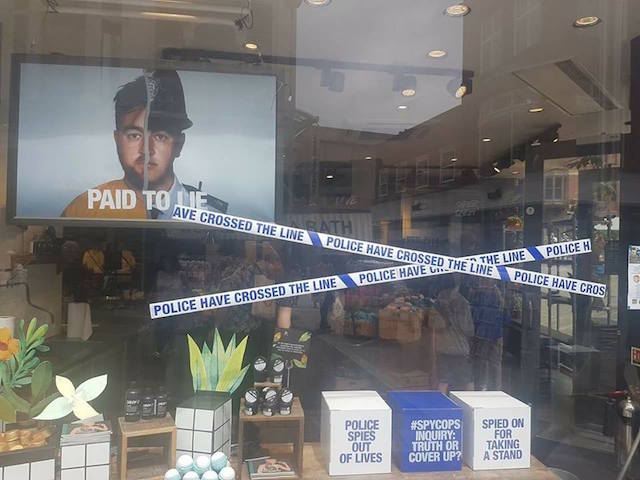
I neither buy nor believe in cosmetics because I consider all human beings to be perfectly beautiful as they are, and so I literally never heard of a business called Lush before noticing this post from UK Cop Humour. Put simply, thousands of UK police officers are understandably upset because a multi-million pound cosmetics empire thinks it wise to put dangerously divisive messages about the UK police in all their shop windows (pictured below).


As sadly typical of our increasingly self-righteous and polarized society, Lush’s management team want to raise awareness of stuff and/or increase profits through shock marketing techniques, but they lack the good sense to restrict themselves to topics where they actually have some competence. I think the behaviour of Lush’s management team is wretched and irresponsible, even though I also agree with the goals that Lush is promoting through their ‘spycops’ campaign: that allegations of abuses by undercover police should be thoroughly investigated and prevented from happening again. Being angry at Lush for creating a marketing campaign that is so corrosive to our society, and curious about the executives who think they are entitled to behave like this, I thought I would use one of the key techniques that so-called social justice warriors like to apply to big profitable corporations they loathe. It seemed appropriate to do so; I doubt that fans of social justice are so diligent at checking the affairs of big profitable corporations that pretend to be on their side. So I looked at the accounts of Lush, as publicly filed with Companies House, and open to inspection by anybody. These are some of the things I learned about Lush, and how it is managed:

  • Lush has cheated its taxes and had to pay fines as a result;
  • Lush pays ‘fat cat’ wages to its top director;
  • Lush exploits its customers by charging prices at huge mark-ups.

By now, you already get my point, or have tuned out because you do not want to hear the truth. Whether you consider yourself as belonging to the left or the right, there should be something troubling about a big rich business which tries to boost sales by telling people how much it cares about social justice, but whose way of conducting its own affairs is so clearly contrary to social justice.

Here are the key anti-social aspects of Lush’s business model in more detail, all gleaned from the 2017 accounts filed for various companies in the Lush group.

Fat Cat Wages

Lush pays £450,000 pa to its top director, not counting what that person also receives as dividends. This is more than 20 times the amount it pays to most of its staff, and 3 times the amount Theresa May receives as Primeminister. To put it another way, if Jeremy Corbyn becomes Primeminister he has promised to prohibit companies from allowing such a wide discrepancy between its highest and lowest paid staff.

Illegal Dividends

In February 2017, Lush made a big dividend payment that broke the law (Companies Act 2006). Per their explanation of why they broke the law, the Lush group includes so many legal entities in so many countries that they simply lost track of how they were moving money around from one place to another, and so announced a dividend payment from a company that had not actually generated enough profit to legally permit that scale of payment.

Tax Evasion and Tax Avoidance

Lush’s international group uses royalties as a way to move profit from high-tax countries to the UK, which is a relatively low-tax country. This lowers the amount of tax they pay in other countries where they operate. Using royalties to shift profits is a method commonly used by international businesses to avoid tax.

Lush might argue their tax practices are not wrong, because it is perfectly legal to design payments like royalties so as to lower the overall tax burden on a business; avoidance is legal, whilst evasion is not. However, at least some of their tax planning has been found illegal, resulting in fines in some cases. Sadly, Lush’s accounts do not explain the scale of the fines they have paid, nor how many times the business has been penalized by tax authorities. This is what they do say:

During the year, we have encountered some enquiries from tax authorities on the tax treatment of some inter-company transactions… in some instances this has included making payments for tax under declared… in some situations we have incurred interest and penalties…

Fat Margins

Despite these unanticipated tax penalties, and the big salary for the top director, and the hefty dividends, Lush is a very profitable business. Lush’s sales margins are 61.4%, which means a customer who buys a £1 bar of soap is paying for something that costs only 38.6p to produce.

Put into the context of their vitriolic, self-righteous and divisive political campaigns, Lush does not sound like a decent socially-conscious business to me. Anyone who really cares about justice – whether it is social justice or the traditional kind – should buy their bath oils and body lotions from another business. Or better still, they should not waste a single penny on cosmetics and should only buy products and services that they and the rest of the world really needs.

There Is No End

This poem draws upon lyrics by Jim Morrison of The Doors.

Beautiful friend,
Can you picture my eyes again?

Desperately now we see
That we became limitless and free.

Elaborate plans all waylaid,
Our safety was surprisingly remade.

Listen to this and I’ll tell you about heartache and the loss of god,
Whispered through our dreams like some soft-spoken new language.
Musing forever after can wait upon another life.
No eternal reward will forgive us for wasting the next dawn.

A face comes in from the rain,
Without need to explain.

Until I look into your eyes again,
There is no end.

Night Is Upon Us

0

Night is upon us,
So predictable, yet so unexpected.
We anticipated all would glow ever brighter until we were bathed in perpetual gold,
But now we are surrounded by absence.

We look to each other,
Seeking to pinpoint blame for who stole the light.
It was all of us.
The darkness always lay within.
Our lies displaced our memories, making us strangers to our natures.

A fiction was cast,
In place of our shadows.
Delusions became monuments to our vanity.
Narcissus wedded his self-portrait, and they gave birth to our egos.
Inbred and overfed, we look better unseen.

Never Mind They Know It All

Facebook’s gone and took the lot. Never mind.
They know all about what’s what. Never mind.
Thought you’d kept things to yourself,
Like your phone, your bank, your health,
Now they even know your wealth. So never mind.

Google’s gone and took it too. Never mind.
They know all about who’s who. Never mind.
Know your face, your home, your friends,
Which products to recommend,
Next they’ll drive you round the bend. So never mind.

Thought you’d got something for free. Never mind.
But it cost your liberty. Never mind.
Now their algorithms affirm,
Your privacy will not return,
And it’s ’cause you never read the terms. You never mind. No, you never mind.

Do the Airport Shuffle

Part One: The Check-In Desk.

There was no need to check in, having done it online. All that was needed was to drop off one bag. Just one solitary bag. Not my other bag, which would remain in the cabin with me. I can afford to lose clothes, when the airline screws up, as they so often do. But the laptop, tablet, bluetooth keyboard, electric razor, presents for the children of friends, and all those many cables to connect this-and-that would be far too difficult, too painfully time-consuming to replace. They must come with me. No matter what.

“9.1 kilos. Too heavy.”

“How much should it be,” I said, knowing the answer already.

“7 kilos.”

“You want me to repack one bag into the other?”

She nods.

I look flustered, and ask if I can go away and do it somewhere else. She nods again. So I go around the corner, and the shuffle begins.

Remove laptop bag from carry-on bag. Unzip it, and place alongside. USB cable from laptop bag into top right shirt pocket. iPhone charger cable from laptop bag to top left shirt pocket. iPhone earbuds from laptop bag to ears. Android mobile phone to be used with an overseas SIM to jacket right pocket. Spectacles case from laptop bag to trouser back pocket. Malaysian notes and coins from laptop bag to security wallet hanging from belt. Australian notes and coins from laptop bag to security wallet hanging from belt. Tablet from laptop bag to left trouser pocket (the pocket is deep, and the tablet will just fit). Macbook power cable from laptop bag to jacket right pocket. Pens from laptop bag to shirt left pocket. Universal socket adaptor from laptop bag to right jacket pocket. Sunglasses from laptop bag to top right pocket. Sunhat from carry-on bag to head. That should do it.

I lift the laptop bag and realize the strap is quite heavy. I remove the strap from the laptop bag and place it in the case to be checked-in. It is not like I will be walking far with my laptop bag.

Returning to the desk, I enquire if my two bags – I leave the laptop bag out of the case, in the hope it will increase sympathy – are now light enough.

“They’re okay.”

“How close?”

“7 kilos.”

“7 kilos exactly?”

“7 exactly.”

It was a good job I removed that strap from the laptop bag. It would have been heavy enough to make a difference.

Part Two: Security

My jacket is too warm. It needs to come off first. I hang it over the handle to my wheelie case. Then the shuffle can begin again, in preparation for the airport security checks and the mandatory displacement of objects that is associated with them everywhere.

USB cable from top right shirt pocket to laptop bag. iPhone charger cable from top left shirt pocket to laptop bag. iPhone earbuds from ears to laptop bag. Android mobile phone for the overseas SIM to laptop bag. Spectacles case from trouser back pocket to laptop bag. Macbook power cable from jacket right pocket to laptop bag. Pens from shirt left pocket to laptop bag. Universal socket from right jacket pocket to laptop bag. Sunglasses from top right pocket to laptop bag. Sunhat from head to laptop bag. Now I am ready to queue for the compulsory security check.

Laptop bag to tray for the security scanner. Security wallet from belt to tray. Belt from trousers to tray. Tablet from left trouser pocket to tray. Loose change from trouser pocket to laptop bag. Watch from wrist to laptop bag. Wallet from trouser pocket to laptop bag. Toiletries from laptop bag to tray. Laptop from laptop bag to tray. Me from normal to standing with arms aloft in a body scanner. Handkerchief from trouser pocket to the right hand of the security man and then back again. Shoes from feet to security man’s tray. Shoes from security man’s tray back to my feet.

And after all that I am deemed fit to fly. I am no smarter, no lighter, slightly older, and carrying everything I intended to bring with me, one way or another. And when I return, I will do the airport shuffle again.

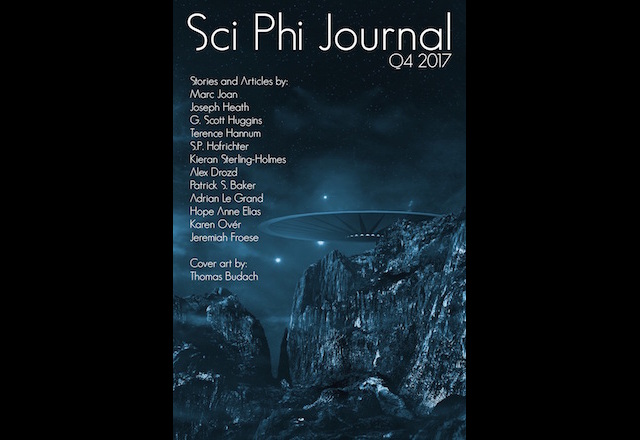
Goodbye to Sci Phi Journal et al.

Mid-way through the year I purchased a struggling publication that was about to close down. Despite my efforts to turn it around, Sci Phi Journal will still cease at the year’s end. There may come a time when it is worth ruminating on the reasons for failure, but probably not. I suspect that Sci Phi Journal will simply disappear from the collective memory; the exception will be those authors who sold their first story to SPJ. I know what I learned from the experience, but the ability to recount a story is not predicated on there being an audience willing to listen to it. So rather than analysing the reasons for SPJ’s demise, I prefer to emphasize the positives drawn from the brief time I owned and edited the magazine. And mostly those positives involve people, who I have been extraordinarily fortunate to encounter as a consequence of running SPJ, and would not have met otherwise. The following list is not complete, and will not be deliberately circulated. I will not even advise the people named that I have mentioned them here. However, there is a possibility that somebody will someday google one or two of these names whilst researching the history of a successful author or publisher. If so, I hope to pleasantly surprise that researcher.

Sarah Paige Hofrichter, whose byline is SP Hofrichter, is an excellent communicator of ideas that fizz with intellectual energy. The mind boggles at her having a baby without that causing any interruption to the delivery of her column. Her appreciation of sophisticated philosophical issues and Norse mythology means she is literally the only person who should be allowed to script the inevitable Thor vs. Doctor Who motion picture.

David Kyle Johnson writes such thoughtful and impressive examinations of the works of mainstream science fiction that anybody who has read them will have learned nothing from this sentence. Everyone else should just read his articles, or enrol on the courses he teaches.

Marc Joan writes good stories based on real science. The stories have a timeless quality but the science is cutting edge. On that basis, he epitomizes the ideal virtues of a science fiction writer.

Mary-Jean Harris is both effervescent and spiritual at the same time. I consider her to be the personification of a metaphysical cocktail.

Words fail me when I contemplate Rananda Rich. This is a shame, because words never seem to fail her.

Matthew P. Schmidt wrote the best science fiction short story that I have ever read. I would feel blessed if I was not such an unworthy publisher.

G. Scott Huggins is tremendously productive. His fertile imagination proffers great stories, and he is steadfast in his beliefs. I admire his capacity to tear into intellectual positions he disagrees with without ever being unfair. He deserves a bigger following, though if he keeps working as hard as he did for SPJ, he should be guaranteed to amass it before too long.

Alex Drozd’s only fault was that he joined SPJ too late. If his column had begun earlier then he might well have attracted many new fans to SPJ, as well as to himself.

I had an intense desire to rewrite most of the sentences by Adrian Le Grand, but he would not let me. He was probably right. It was only months after reading his stories that I realized he is a great romantic writer who has adopted science fiction as a disguise.

Terence Hannum did let me rewrite some of his sentences, but a specific choice of word is to a great story what a brushstroke is to a great artistic vision. He would undoubtedly become very rich if he went to Hollywood and expounded his ideas during the time it takes to ride an elevator.

Joseph Heath has already reached a level of success where he can gain nothing by receiving a compliment from me. So whilst I did not fully agree with his analysis of the fiction of Iain M. Banks, I was amazed that he paid me the courtesy of reading my own take on the same author. The mind boggles at how he can find time for such niceties whilst being a serious and popular thinker.

James ‘Jim’ Fitzsimmons was asked to review an awful lot, but he still improved everything he read. He worked hard, was unfailingly polite, and generous to a fault. If I knew how to clone people then I would have cloned Jim and sacked myself. Two Jims might have been able to keep SPJ going, and three would have turned it into a success. However, there are very few people like Jim Fitzsimmons, so I was lucky to have worked with one.

As for the nameless people who resisted the temptations of fame (!?) and chose to work anonymously on SPJ, you know who you are, and how much I am indebted to you. Which is not to say I am literally indebted, because I paid your invoices on time, but instead means I will always owe you gratitude.

And those of you who read Sci Phi Journal deserve an honourable mention, though I am not going to send you certificates like the Writers of the Future contest. If only there had been more like you!

Brexit and Social Mobility

It is not science, but a comparison of two maps should be leading people to do some serious research… of a type that journalists or politicians rarely do. The map on the left shows how different regions voted in Britain’s referendum on the European Union, with the blue showing those parts that wanted Brexit. The map on the right shows the results of the latest research from the Social Mobility Commission, the non-partisan bit of government that no journalist or politician wants to draw attention to because: (1) it is non-partisan, (2) arguing for the benefits of social mobility is not as straightforward as arguing about poverty or the distribution of wealth, and (3) both of Britain’s major parties have a lousy record on social mobility. The blue on the right-hand map shows areas where social mobility is below average. Whilst the two maps are not a perfect mirror, there clearly is a relationship between social mobility and attitudes to the EU.


A link between social mobility and attitudes to the EU should make perfect sense: why would you care about the notional freedom to live and work in Davos, Dublin or Dubrovnik if your reality is being stuck in a dead-end job in Doncaster? But as too few of the ruling elite want to talk about the consequences of repeatedly failing to respect the aspirations of millions of Brits – largely because the elite is composed of life’s winners, who have every reason to limit the best options to their own children – then we will not talk about it in the context of Brexit either. So let us all agree to describe Brexit voters as racists or morons instead… because that is far easier than dealing with real problems that keep getting worse, and that neither politicians nor the media want to see addressed.

A Brief Guide to Cultural Appropriation at Halloween as Written for Stupid Americans

In the United States of America, an increasing number of citizens are worried that they may choose the wrong Halloween costume for themselves, or their children. Clearly this is not evidence of people living such rich, pampered, lazy, privileged, self-indulgent lives that they can afford to obsess about trivialities. Instead, this trend demonstrates that many American individuals are reaching a new level of refined ethical sensibility that requires them to wisely devote several hours of quiet contemplation to all the ways party clothing may wrongly glorify the appropriation of other cultures. But these individuals still want to look good and signal that they know how to laugh at themselves. This can lead to an intolerable form of anxiety that psychologists now refer to as Beingupyourownahole.

In fact, such individuals will have noticed the deliberate mistake made in the opening paragraph, which refers to them as Americans (two continents, named after an Italian, total population of 1 billion people, most of whom speak Spanish) when they are only USAers (half a continent, no handy collective noun because their country is made of lots of states named after lots of different white Europeans, total population 300 million, most of whom speak a culturally superior version of English). I ask that those individuals forgive me for briefly appropriating the word ‘American’ to aid communication with the many USAers who still fail to correctly label their own nationality.

The new breed of USAers are leading the world to peace and harmony via at least thirty woke tweets per day, but this can leave them short of the time they need to address other important matters. Even the most sensitive USAer sometimes faces a tough party deadline when confronted with big decisions about whether their seven year old daughter can dress as a princess because she really likes sequins and tiaras but is unwittingly reinforcing gender stereotypes and implicitly endorsing caste-based social hierarchies. As a consequence, more and more USAers are turning to internet guides that quickly explain what they can wear on Halloween (see here, here, here, here, and here). However, it has come to my attention that most of these guides are woefully inadequate. Though they correctly assert it is wrong to put on blackface, or to dress as a Navajo brave, or to wear an Arab dishdasha, or to appear even vaguely Mexican, they fail to address many other examples of blatant and insulting cultural appropriation. So here is the complete guide to what USAers may and may not wear at Halloween.

Zombies

A belief in the reanimated dead stems from Haitian folklore, and the Vodou religion in particular. Obviously you cannot dress as a zombie without appropriating Haitian culture.

Vampires

Vampires are stereotyped as thin white people who lived in castles, dressed in cloaks and were minor members of the Transylvanian aristocracy. Even if you are descended from Count Dracula himself this would still count as a severe case of cultural misappropriation, as well as being deeply disrespectful to the folklore of 18th century Eastern Europe. You may not dress as a vampire.

Pirates

“Arrr! Shiver me timbers! Unless you batten down them hatches we’ll soon lay in Davy Jones’ Locker, me hearties!” Clearly use of the so-called ‘pirate’ dialect is cultural appropriation, unless you possess a genuine West Country accent because you are actually from Somerset. So you may dress like a pirate but you cannot talk like one.

Togas

Have you listened to a speech at the Forum Romanum? Do you even know three words of Latin? Of course not. And nobody wants to see your stained bedsheets anyway.

Frankenstein’s Monster

Just because Boris Karloff and James Whale went to Hollywood and did some cultural appropriation in the 1930’s does not give you permission to continue their desecration of Mary Shelley’s gothic novel. I bet you have never even seen a genuine pitchfork, and have never once been chased through the night by the torch-wielding anti-scientific inhabitants of a European village.

Witches

Do not even think of going there. Real people were tortured and murdered because others accused them of being in league with Satan. The misogyny should be obvious, and the glorification of witchcraft is insulting to both the Christians who sincerely believe witchcraft exists and to the atheists who think Christians are superstitious dullards for believing witchcraft exists. And about a quarter of witches were men, so the stereotypes are doubly sexist, and you risk offending everybody. Even Harry Potter is an icon of witchcraft, so you would be wise to burn all of JK Rowling’s books and any merchandise from those movies. Though the books have been read and enjoyed by half a billion people, that is no excuse for culturally appropriating the worst parts of the 16th and 17th centuries.

Golems

If you are really Jewish, and you respect the Shabbat, and can quote chunks of the Torah, then maybe you can dress as a golem. But be wary of cultural appropriation, because however orthodox you are, there is always a Jew that is more orthodox than you.

Leprechauns

Never mind the blarney about having a great-grandmother from Tipperary, because dilution means you have as much of Ireland pumping through your veins as somebody who just drank a pint of Guinness. Can you speak Gaeilge? (Repeatedly saying the word ‘craic’ does not count towards your linguistic proficiency.) Have you ever handled a bodhrán? Would you know what to do with a hurley? Have you even seen a single game of rugby? If the answer to these questions is ‘no’ then you have the same right to Irish culture as the average US President: none whatsoever. And leprechauns are the most tedious element of Irish folklore anyway.

Fat Slobs in T-Shirts, Baseball Caps and Sweatpants

Cheap loose-fitting clothes are the epitome of US culture, so you are welcome to enjoy Halloween by dressing like stereotypical USAers. Doing so will give you the confidence that you will not offend anyone from a different culture, because this is what foreigners expect from the citizens of your country. To make the most of your appearance, adopt the lumbering gait of somebody aimlessly shambling around a shopping mall whilst chewing twelve sticks of gum and carrying an extra large soda. However, be careful to avoid looking too like the zombies in Dawn of the Dead, as that would also count as appropriation of Haitian culture. Though it might seem boring that your outfit consists of the same clothes you wear every other day, the upside is that this is the most terrifying Halloween costume of all, because it accurately reflects the USA’s influence on cultures worldwide.